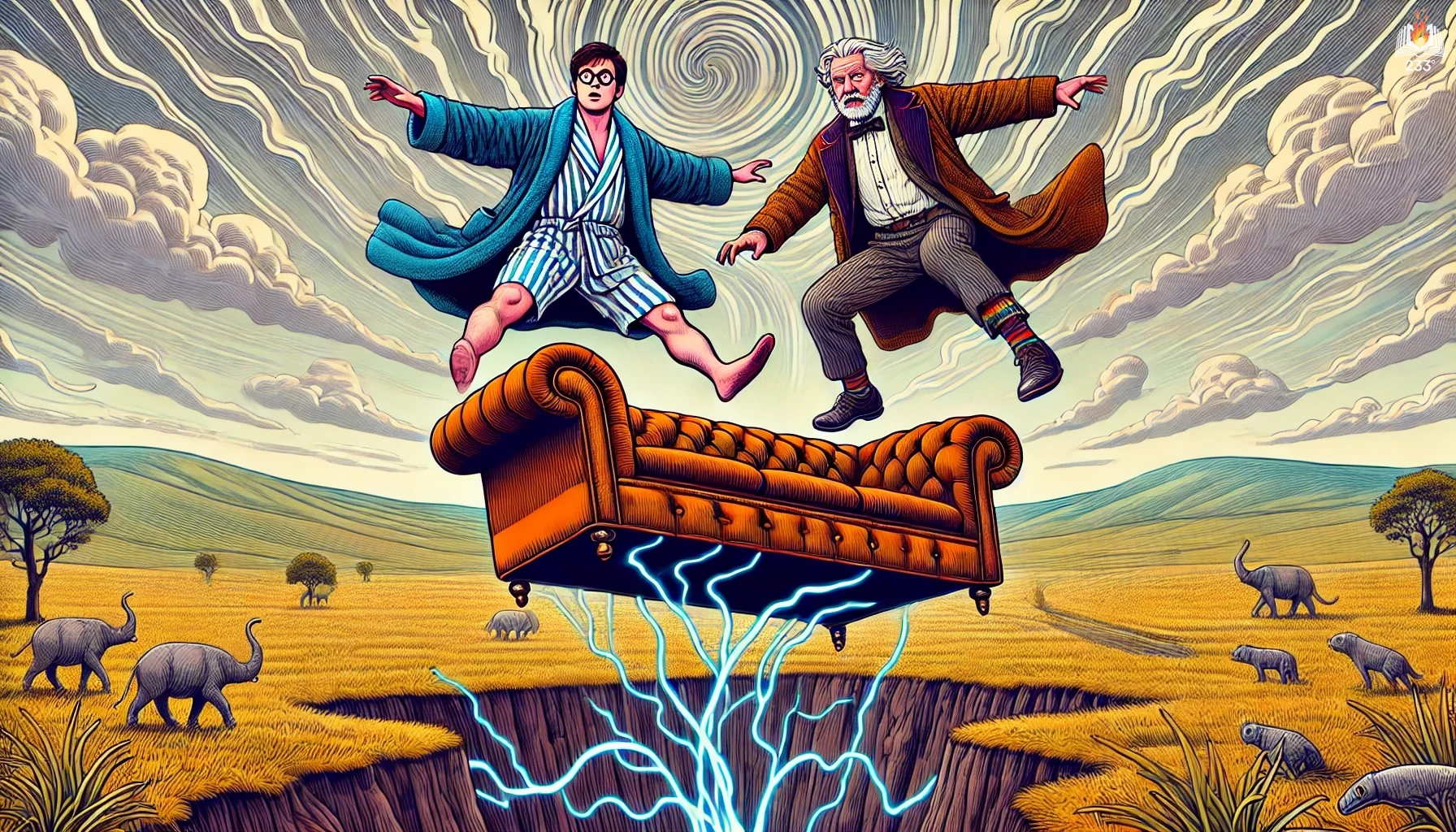
The Long Dark Tea-Time of the Soul by Douglas Adams (1988) is a comedic fantasy-mystery novel featuring the eccentric detective Dirk Gently. It explores the intersection of Norse mythology, existential questions, and modern absurdity through a chaotic, hilarious investigation. The book is part of the Dirk Gently series, following Dirk Gently’s Holistic Detective Agency.
Plot Summary
Dirk Gently sat in his cluttered flat, wrestling with a morning that had already grown tedious when an unusual request for his services arrived. Dirk’s holistic approach to detection, rooted in the interconnectedness of all things, meant that he seldom received ordinary cases. This one was no exception. A peculiar man named Geoffrey Anstey had come to him, claiming his life was threatened by a mysterious figure. Anstey’s paranoia seemed nonsensical, yet his payment terms—generous in the extreme—compelled Dirk to accept. Dirk’s unconventional methods ensured he missed the early-morning meeting with his client. Arriving hours late, he discovered the man dead in a locked room, his head severed and spinning on a turntable.
At the same time, Kate Schechter, an American living in London, found herself embroiled in an extraordinary sequence of events. A chance encounter at Heathrow Airport had led her to assist a massive, odd-looking man with striking Nordic features and an utter disregard for modern norms. This man, Thor, exuded a presence both magnetic and baffling. Moments after their brief exchange, an explosion destroyed the terminal, hurling Kate into a strange world of unanswered questions and celestial implications.
While Kate recovered from the blast, Thor wandered through London, struggling with his diminished godhood and grappling with the human world’s indifference to his divine nature. Stripped of much of his power, he sought refuge in an unlikely place—a seedy hotel. His father, Odin, fared little better. Once the great Allfather, Odin now presented himself as a frail and weary old man, reduced to conducting questionable business deals under the guise of an ordinary executive. Together, the two gods exemplified the waning influence of ancient powers in a world uninterested in myths.
Dirk’s investigation into Anstey’s bizarre death pulled him into the strange orbit of these divine figures. As his probing advanced, Dirk discovered Anstey had been entangled in a celestial contract. A larger, cosmic drama was unfolding—one that threatened the fragile balance between gods and mortals. He soon realized that Thor was central to the puzzle, but finding a way to connect the Norse god’s struggles to the murder required leaps of logic only Dirk could attempt.
Meanwhile, Kate found herself unable to distance herself from the chaos that had begun at Heathrow. Thor reentered her life in a storm of frustration and ineptitude, lashing out at vending machines and bureaucracies with equal fury. Intrigued by his mix of power and vulnerability, she became an unwilling ally. Together, they navigated the peculiarities of modern life, from laundromats to pubs, as Thor sought to reclaim his lost stature.
As Dirk unraveled more of the threads linking Anstey’s death to the divine intrigue, he learned of the sacred contract Thor was expected to honor. This agreement, forged long ago, bound him to appear at an elaborate ritual designed to sustain the precarious balance between divine and human realms. Failure to comply threatened dire consequences not only for Thor but also for the fabric of reality itself. Yet Thor’s defiance was emblematic of his fall from grace—his reluctance to submit to the obligations of his lineage mirrored humanity’s disregard for ancient traditions.
Dirk’s relentless, often haphazard investigation brought him into direct conflict with a malevolent entity responsible for enforcing the contract. This sinister figure, cloaked in shadows and radiating menace, pursued Thor with unyielding determination. The looming specter of destruction hung over everything, yet Dirk’s peculiar methods revealed unlikely solutions. He uncovered the truth of the contract’s origins and devised a plan that relied as much on chance as on his own insights.
Kate’s bond with Thor deepened as they traversed London, their journey marked by moments of absurdity and poignancy. Thor’s flashes of divine power were countered by his all-too-human frustrations, and Kate found herself reflecting on the fragility of both gods and mortals. Together, they encountered Odin, whose faded grandeur underscored the passing of an era. The reunion between father and son was as much a clash of egos as a meeting of kindred spirits.
The narrative built toward a chaotic convergence of all the disparate threads. Dirk orchestrated an elaborate gambit that brought Kate, Thor, and Odin into the heart of the cosmic drama. As Thor confronted the consequences of his defiance, Dirk’s unorthodox approach proved critical in averting catastrophe. Kate’s grounding influence added an unexpected layer of humanity to the resolution, allowing both gods and mortals to find common ground.
In the end, the cosmic scales were balanced, though not without sacrifice. Thor reclaimed a measure of his divine purpose, though his path forward remained uncertain. Kate returned to her life, forever altered by her brush with the extraordinary. Dirk, satisfied with the outcome yet burdened by its implications, moved on to his next improbable case.
The interconnectedness of all things, Dirk’s guiding principle, revealed itself in surprising and often humorous ways. Gods and humans alike grappled with their places in a changing world, their struggles illuminating the absurdities of existence. As the dust settled, the question lingered: was it fate, coincidence, or something altogether beyond understanding that had drawn them together?
Main Characters
- Dirk Gently (Svlad Cjelli): A holistic detective with unconventional methods, Dirk believes in the interconnectedness of all things. His quirky brilliance, financial struggles, and penchant for chaotic solutions propel the narrative.
- Kate Schechter: A pragmatic yet unlucky American woman caught in a supernatural whirlwind after narrowly surviving a mysterious airport explosion.
- Thor: The Norse god of thunder, who is stranded in the modern world. His divine pride and temper clash with his vulnerability as a displaced deity.
- Odin: Thor’s father, the once-powerful Norse god who now lives a subdued and corporate life, embodying themes of faded grandeur and change.
- Mr. Anstey: Dirk’s client, who fears a supernatural threat. His murder sparks the story’s mystery, linking divine beings and bizarre contracts.
Theme
- Interconnectedness: The novel explores how seemingly random events and characters are deeply linked, reflecting Dirk’s holistic philosophy.
- Mythology in Modernity: Norse gods struggling in a contemporary setting underscore themes of relevance, adaptation, and decay of old powers.
- Existential Absurdity: Adams humorously delves into the absurdities of modern life, from corporate greed to personal crises, mirroring the larger-than-life chaos of the gods.
- Human Nature: The novel critiques greed, ambition, and humanity’s propensity to exploit even the extraordinary, using satire and irony.
Writing Style and Tone
Douglas Adams employs a witty and whimsical narrative style filled with dry humor, playful metaphors, and philosophical musings. His descriptive passages transform mundane settings, like airports or houses, into surreal landscapes rife with absurdity.
The tone alternates between light-hearted comedy and reflective melancholy, capturing the triviality of daily life alongside the grandeur of mythic themes. Adams masterfully balances humor and poignancy, creating a rich and immersive reading experience that satirizes and celebrates life’s complexities.
Quotes
The Long Dark Tea-Time of the Soul – Douglas Adams (1988) Quotes
“I may not have gone where I intended to go, but I think I have ended up where I needed to be.”
“There are some people you like immediately, some whom you think you might learn to like in the fullness of time, and some that you simply want to push away from you with a sharp stick.”
“It can hardly be a coincidence that no language on earth has ever produced the expression, 'As pretty as an airport.”
“The impossible often has a kind of integrity to it which the merely improbable lacks.”
“A life that is burdened with expectations is a heavy life. Its fruit is sorrow and disappointment.”
“Words used carelessly, as if they did not matter in any serious way, often allowed otherwise well-guarded truths to seep through.”
“People who need to bully you are the easiest to push around.”
“It was his subconscious which told him this---that infuriating part of a person's brain which never responds to interrogation, merely gives little meaningful nudges and then sits humming quietly to itself, saying nothing.”
“I don't go to mythical places with strange men.”
“Yes, it is true that sometimes unusually intelligent and sensitive children can appear to be stupid. But stupid children can sometimes appear to be stupid as well. I think that's something you might have to consider.”
“Rather than arriving five hours late and flustered, it would be better all around if he were to arrive five hours and a few extra minutes late, but triumphantly in command.”
“The idea was fantastically, wildly improbable. But like most fantastically, wildly improbable ideas it was at least as worthy of consideration as a more mundane one to which the facts had been strenuously bent to fit.”
“Nobody got murdered before lunch. But nobody. People weren't up to it. You needed a good lunch to get both the blood-sugar and blood-lust levels up.”
“Dennis Hutch had stepped up into the top seat when its founder had died of a lethal overdose of brick wall, taken while under the influence of a Ferrari and a bottle of tequila.”
“I am a private detective. I am paid to be inquisitive and presumptuous.”
“I've had the sort of day that would make St. Francis of Assisi kick babies.”
“Ok," he said, "I don't like to disturb you at what I know must be a difficult and distressing time for you, but I need to know first of all if you actually realize that this is a difficult and distressing time for you.”
“When the girl sitting at the next table looked away from a moment, Dirk leaned over and took her coffee. He knew that he was perfectly safe doing this because she would simply not be able to believe that this had happened.”
“Nobleness was one word for making a fuss about the trivial inevitabilities of life, but there were others.”
“But for a moment Dirk had a sense of inifinite loss and sadness that somewhere among the frenzy of information noise that daily rattled the lives of men he thought he might have heard a few notes that denoted the movements of gods.”
“I rarely end up where I was intending to go, but often I end up somewhere I needed to be.”
We hope this summary has sparked your interest and would appreciate you following Celsius 233 on social media:
There’s a treasure trove of other fascinating book summaries waiting for you. Check out our collection of stories that inspire, thrill, and provoke thought, just like this one by checking out the Book Shelf or the Library
Remember, while our summaries capture the essence, they can never replace the full experience of reading the book. If this summary intrigued you, consider diving into the complete story – buy the book and immerse yourself in the author’s original work.
If you want to request a book summary, click here.
When Saurabh is not working/watching football/reading books/traveling, you can reach him via Twitter/X, LinkedIn, or Threads
Restart reading!