

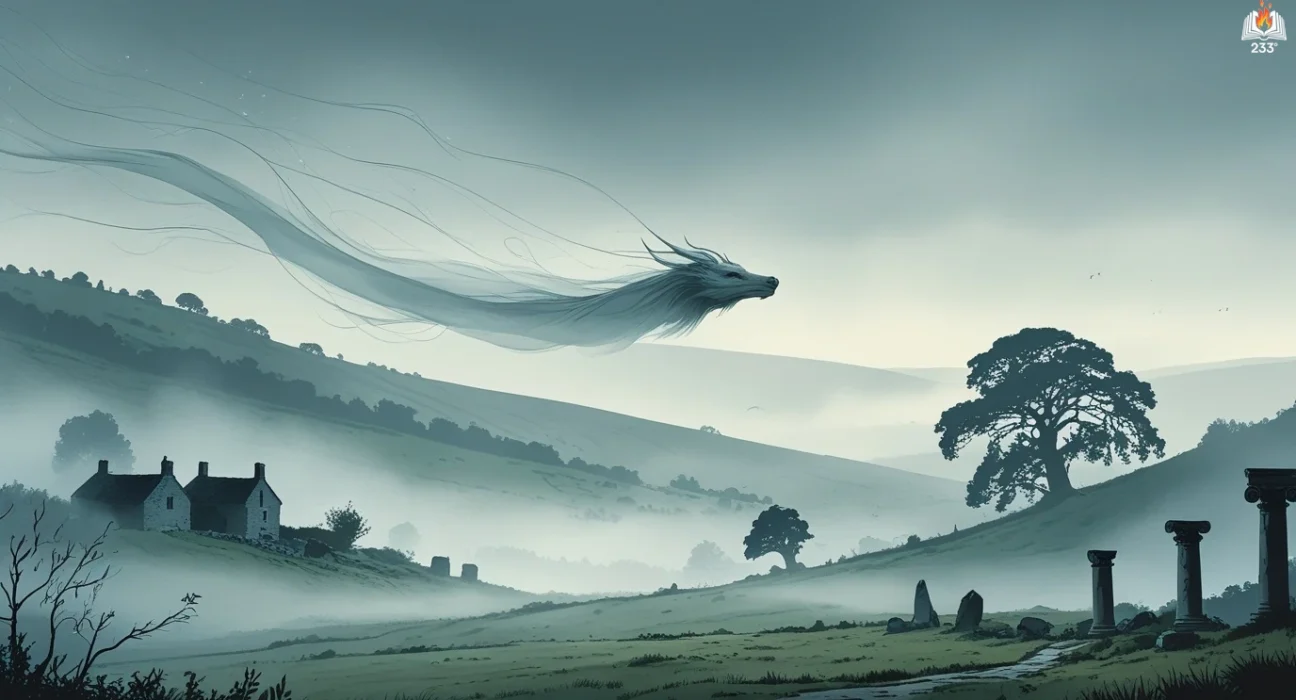
The Buried Giant by Kazuo Ishiguro, published in 2015, is a hauntingly lyrical novel set in post-Arthurian Britain, where a mysterious mist of forgetfulness blankets the land. Blending myth, memory, and medieval fantasy, Ishiguro crafts a poignant odyssey of an elderly couple—Axl and Beatrice—who journey through a crumbling countryside to find their long-lost son. Along the way, they encounter warriors, monks, and mythic creatures, each entwined with the lingering shadows of past wars and personal betrayals. A meditation on memory, trauma, and love, this novel marks a bold stylistic shift for the Nobel laureate, known for Never Let Me Go and The Remains of the Day.
Plot Summary
In a time long after the Romans had gone and King Arthur’s name was no longer sung with reverence, the land lay blanketed beneath a silent mist that dulled memory and softened the edges of history. Axl and Beatrice, two elderly Britons, lived on the edge of a warren carved into a hillside, where warmth was scarce and whispers of the past came and went like smoke. They remembered, vaguely, that they had a son, though neither could recall his face nor the reasons for his absence. But with the spring sun inching back into the sky and a restlessness stirring in Axl’s heart, they resolved to set out across the troubled countryside to find him.
Their journey began with the humblest of steps, their frail bodies burdened by time, and their memories interrupted by strange lapses. The land they crossed was dotted with traces of a forgotten war – abandoned villages, cryptic ruins, and creatures that once belonged to the realm of myth. Axl and Beatrice were soon joined by Wistan, a towering Saxon warrior sent with a quiet, deadly purpose, and by Edwin, a boy whom others feared as cursed after a strange wound appeared upon his stomach. Though the boy’s innocence had been clouded by suspicion, he clung to Wistan with wide-eyed trust, sensing in him a protector against the terrors that prowled in memory and mist.
As the small group journeyed eastward, the mists thickened, not just across the land but within their own recollections. What they remembered one day vanished the next. Villages faded behind them, and conversations they had shared slipped from mind. Beatrice often grew uncertain, and her strength faltered as she limped quietly onward. Axl, ever tender, kept to her pace, guiding her across riverbanks and thistle-choked fields, though he too was troubled by shadows stirring in the recesses of his mind – images of fire, of men in armor, of things he could not quite name.
In the ruins of an old Roman villa, they took shelter from a storm and encountered a strange boatman and a bitter old woman who accused him of cruel betrayal. Her words, her grief, settled over Axl and Beatrice like a quiet warning – that some wounds, once exposed, could not be bound again. As they continued, the countryside became more treacherous. The ruins of battles and memories long buried surfaced with each step. When they reached the monastery of a solitary order, they found no peace – only secrets. Beatrice, weak and weary, sought the help of monks who promised healing, though at a price she did not fully understand.
In the monastery’s shadow, the travelers encountered Sir Gawain, ancient and noble, once of Arthur’s court. Mounted upon his loyal steed Horace, Gawain spoke in riddled wisdom, veiling his knowledge in ceremony and reflection. But beneath his knightly bearing, the truth lingered – he had been tasked with guarding the she-dragon Querig, whose breath blanketed the land with forgetfulness. It was Arthur’s final decree, meant to silence the memories of a genocidal war between Britons and Saxons, and to secure a fragile, haunted peace.
Wistan knew this secret, too. He had come to slay the dragon, not out of vengeance, but to release the land from its enchanted slumber – to return truth to the people, even if that truth would reopen old wounds and reignite ancient hatreds. The confrontation between Gawain and Wistan was solemn and inevitable. Gawain, aged and weary, did not resist. His loyalty to Arthur had remained unbroken, but in his heart, he understood that peace built on forgetting could not endure.
The dragon lay in a cave high in the hills, her breath thin and barely audible, but still strong enough to cloud the minds of all who lingered beneath the sky. When Wistan descended into the lair, Axl and Beatrice waited with Edwin nearby. The battle was unseen but felt – a tremor in the ground, a disturbance in the wind. When Wistan returned, his blade was slick with blood, and the air had changed. The mist, almost imperceptibly, began to lift.
With the dragon’s death, the memories long suppressed began to stir. Axl and Beatrice, freed from the enchantment, faced the truths that had long lain hidden beneath their tenderness. They remembered their son, and why he had been lost to them. There had been a terrible quarrel – a betrayal – and it was not certain whether he still waited or even lived. But they pressed on, weary but resolute, toward the distant village that might still hold a part of their past.
The journey brought them to the edge of a wide, still river. There, on the shore, the same boatman who once took the old woman’s husband stood waiting with his ferry. He greeted them gently, without judgment, and listened as Beatrice spoke of their long journey and their wish to cross. But the boatman asked his questions with quiet gravity – did they know each other truly? Had their memories returned? Were they prepared for what lay ahead?
The river, it was said, could only be crossed by those whose bond was whole, who knew one another fully, without illusion or forgetting. Axl hesitated, his heart weighted with the knowledge of what he had once done, and what had been taken from them. Beatrice, tender and forgiving, looked upon him not with anger, but with sorrow and love.
The boatman led Beatrice to the ferry. She stepped aboard, her figure small beneath the gathering dusk. Axl remained on the shore, his feet rooted in silence. The boat began to drift from the bank. She looked back once, eyes searching his, not in blame but in longing. Whether he would follow or be left behind, no voice spoke aloud. The river carried her gently into the distance, and the mist once more curled low over the waters.
Main Characters
Axl – A gentle and introspective elderly Briton, Axl is haunted by the vagueness of his memories and driven by a quiet resolve to reconnect with his son. His love for Beatrice is steady and profound, but his forgetfulness also masks painful truths he has long avoided. Through the journey, Axl transforms from a passive wanderer into a man forced to confront the buried guilt and grief of a violent past.
Beatrice – Known affectionately as “princess” by Axl, Beatrice is compassionate, devout, and persistent. She suffers from a mysterious illness and becomes the emotional core of their journey. Her fragmented memory and fragile body mirror the larger national amnesia, and her relationship with Axl evolves as old memories gradually resurface, testing the strength of their bond.
Wistan – A fierce Saxon warrior with a deep sense of duty, Wistan travels with a hidden agenda—to confront and destroy the source of Britain’s collective forgetfulness. Though outwardly brutal and practical, he is driven by ethical conviction and carries the trauma of past conflicts.
Edwin – A young Saxon boy who accompanies Wistan, Edwin is perceived by others as cursed after a mysterious bite on his stomach. He clings to Wistan as a father figure and represents innocence poised between myth and reality. Edwin’s presence injects tenderness and tension into the journey.
Sir Gawain – An aged knight of Arthurian legend, Gawain is a tragic remnant of a once-noble era. He travels with his ancient steed Horace, concealing secrets of King Arthur’s legacy and his own role in maintaining the magical mist. His speeches are riddled with poetic melancholy and veiled regret, anchoring the novel’s deeper meditations on justice and truth.
Theme
Memory and Forgetfulness – The novel’s central motif is the mist that robs people of memory. Ishiguro uses it both literally and symbolically to explore how societies suppress trauma and individuals protect themselves from emotional pain. The recovery of memory becomes a double-edged sword, exposing love, betrayal, and loss.
Love and Aging – Axl and Beatrice’s marriage is a testament to enduring love, but also a delicate exploration of how love is sustained or tested when memory fades. Their tenderness coexists with unspoken wounds, and the novel asks whether love can survive the truth of the past.
War and Peace – Beneath the pastoral and mythic setting lies a landscape scarred by war. Ishiguro explores the cost of peace built on collective amnesia, suggesting that harmony may be maintained at the price of justice and remembrance. The tension between Saxons and Britons simmers as a backdrop to the journey.
Myth and History – The novel straddles the line between myth and historical allegory. Characters like Gawain evoke Arthurian romance, but their legends are recontextualized as flawed, human stories. Ishiguro challenges the reader to question the reliability of heroic narratives and the myths societies build to survive.
Writing Style and Tone
Kazuo Ishiguro adopts a starkly different narrative voice in The Buried Giant, moving away from the restrained realism of his earlier works into a dreamlike, archaic prose imbued with mythic cadence. The narration often breaks the fourth wall, gently guiding the reader through fog-laden memories and ambiguous truths. Dialogue is stylized and formal, evoking the oral traditions of old epics and fairy tales. This deliberate antiquation creates a sense of distance, allowing readers to view the narrative through the mist of time and illusion.
The tone is elegiac and contemplative, undercut by unease. Even in moments of pastoral beauty or quiet intimacy, there is always a lingering dread—the suggestion that something dark and irrevocable has been lost or repressed. Ishiguro writes with a tender ambiguity, letting the reader feel the emotional gravity of the characters’ choices without fully explaining them. The novel’s philosophical undercurrents are slow-burning, woven into the fabric of its fable-like surface, making it feel both timeless and sharply relevant.
Quotes
The Buried Giant – Kazuo Ishiguro (2015) Quotes
“When it was too late for rescue, it was still early enough for revenge.”
“Who knows what will come when quick-tongued men make ancient grievances rhyme with fresh desire for land and conquest?”
“But God will know the slow tread of an old couple’s love for each other, and understand how black shadows make part of its whole.”
“How can old wounds heal while maggots linger so richly?”
“How is it possible to hate so deeply for deeds not yet done?”
“The giant, once well buried, now stirs. When soon he rises, as surely he will, the friendly bonds between us will prove as knots young girls make with the stems of small flowers.”
“Are you still there, Axl?” “Still here, princess.”
“A couple may claim to be bonded by love, but we boatmen may see instead resentment, anger, even hatred. Or a great barrenness. Sometimes a fear of loneliness and nothing more.”
“The danger isn't the river's speed, friend, but its slowness.”
“It would be the saddest thing to me, princess. To walk separately from you, when the ground will let us go as we always did.”
“Some of you will have fine monuments by which the living may remember the evil done to you. Some of you will have only crude wooden crosses or painted rocks, while yet others of you must remain hidden in the shadows of history.”
“Foolishness, sir. How can old wounds heal while maggots linger so richly? Or a peace hold for ever built on slaughter and a magician’s trickery?”
“What kind of god is it, sir, wishes wrong to go forgotten and unpunished?”
“I was wondering, princess. Could it be our love would never have grown so strong down the years had the mist not robbed us the way it did? Perhaps it allowed old wounds to heal.”
“Perhaps God’s so deeply ashamed of us, of something we did, that he’s wishing himself to forget.”
“Then he took the sword in both hands and raised it—and Gawain’s posture took on an unmistakable grandeur.”
“Yet are you so certain, good mistress, you wish to be free of this mist? Is it not better some things remain hidden from our minds?”
“When the hour’s too late for rescue, it’s still early enough for revenge.”
“The stranger thought it might be God himself had forgotten much from our pasts, events far distant, events of the same day. And if a thing is not in God’s mind, then what chance of it remaining in those of mortal men?”
“Some of you will have fine monuments by which the living may remember the evil done to you. Some of you will have only crude wooden crosses or painted rocks, while yet others of you must remain hidden in the shadows of history.”
“Abiding love that has endured the years—that we see only rarely. When we do, we’re only too glad to ferry the couple together.”
“Be merciful and leave this place. Leave this country to rest in forgetfulness.”
We hope this summary has sparked your interest and would appreciate you following Celsius 233 on social media:
There’s a treasure trove of other fascinating book summaries waiting for you. Check out our collection of stories that inspire, thrill, and provoke thought, just like this one by checking out the Book Shelf or the Library
Remember, while our summaries capture the essence, they can never replace the full experience of reading the book. If this summary intrigued you, consider diving into the complete story – buy the book and immerse yourself in the author’s original work.
If you want to request a book summary, click here.
When Saurabh is not working/watching football/reading books/traveling, you can reach him via Twitter/X, LinkedIn, or Threads
Restart reading!