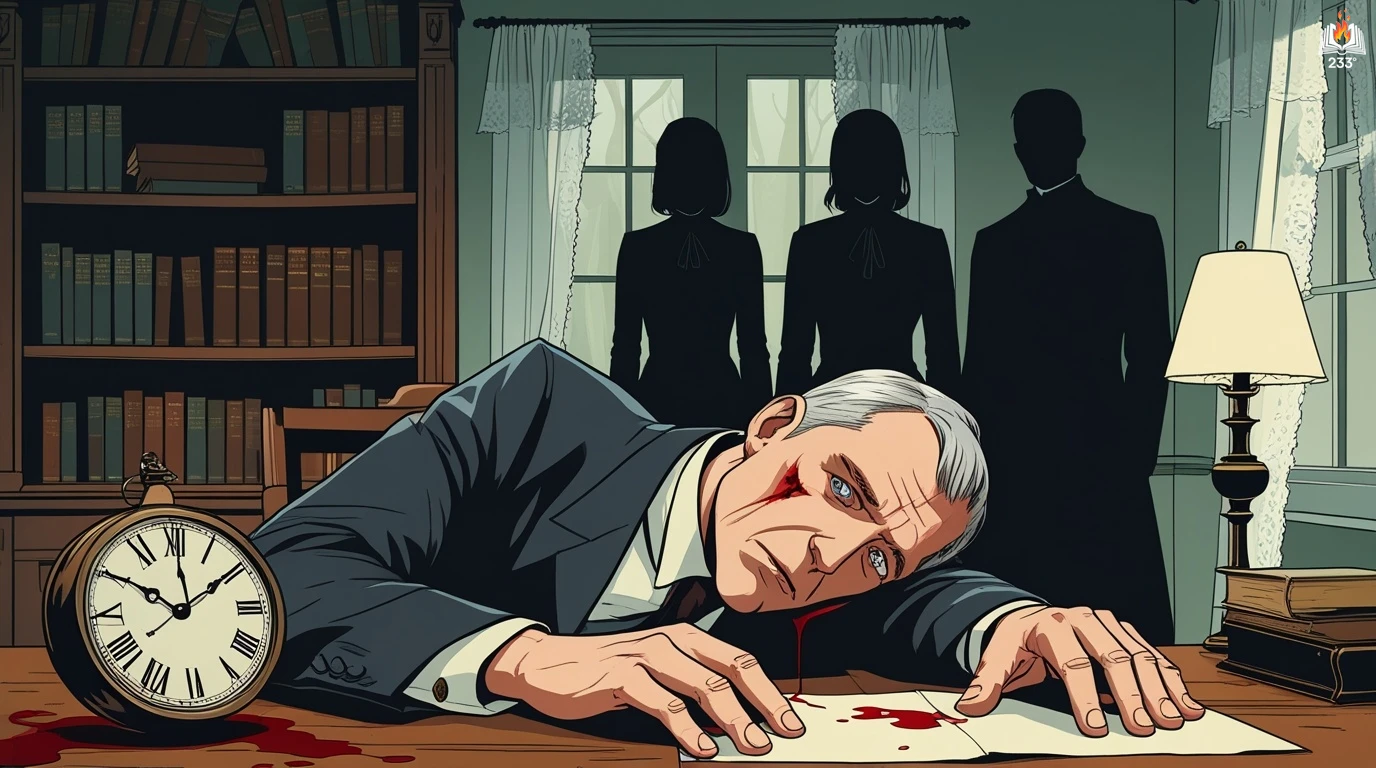


The Moving Finger by Agatha Christie, first published in 1942, is part of her celebrated Miss Marple series, though Marple herself plays only a small role near the end. Set in the seemingly quiet English village of Lymstock, the novel unravels a sinister mystery when a wave of anonymous poison pen letters leads to suspicion, scandal, and murder. Christie masterfully blends sharp observation of village life with a tense atmosphere of dread, making it one of her most psychologically astute mysteries.
Plot Summary
The small village of Lymstock lay bathed in spring sunshine, its quiet lanes and quaint cottages seemingly untouched by the world’s troubles. Into this peaceful setting arrived Jerry Burton, recovering from a flying accident, and his lively sister, Joanna. Sent by his doctor to seek rest and quiet, Jerry found instead a place brimming with curiosity and the stirrings of something darker. Lymstock, with its hedgerows, church spires, and gentle gossip, would soon reveal a far less idyllic heart.
Their arrival at Little Furze, a prim white house with a faded veranda, was met with the polite rituals of village life – visits, calling cards, and neighborly chats. Joanna, amused by the local customs, threw herself into village society, while Jerry, more reserved, watched the undercurrents stir. It was a prankish sort of peace they had entered, until the morning when a letter arrived. Typed words on cheap paper, pasted to form vile accusations: the first poison pen letter had found its mark. The letter suggested Jerry and Joanna were not siblings but lovers, a crude insult that amused them both – at first.
But Lymstock was already entangled in whispers. Dr. Owen Griffith, the town’s gentle and thoughtful doctor, confessed to Jerry that several villagers had received similar letters – accusing Mr. Symmington, the austere solicitor, of indiscretions with his dowdy clerk; accusing Griffith himself of scandalous conduct with patients. The letters spared no one and stoked a growing unease.
At the heart of the Symmington household was a fragile order. Richard Symmington, dry and methodical, his delicate wife Mrs. Symmington, two lively young sons, and Megan Hunter – Mrs. Symmington’s awkward daughter from her first marriage, a girl with a coltish manner and shy eyes. Megan roamed the village like a stray, overlooked and underestimated, her presence a quiet thread through the days.
As the letters multiplied, they began to worm into the minds of the villagers. Suspicion bloomed. The Calthrops, the kindly vicar and his sharp-eyed wife, fretted over the damage being sown. Mr. Pye, the fussy, effeminate collector of porcelain, trembled behind his treasures. Even the seemingly unshakable Miss Emily Barton, former mistress of Little Furze, murmured of trouble. Yet the village carried on – until one afternoon, Mrs. Symmington was found dead in her sitting room, an empty bottle of cyanide near her chair, and a torn letter in the fireplace. The scrap she left behind read simply that she could not go on.
Lymstock reeled. Mrs. Symmington’s death brought the weight of tragedy down like a shutter. The inquest spoke gently of a fragile mind unhinged by anonymous cruelty. But beneath the sorrow stirred questions – why had this woman, of all people, succumbed? And was the letter’s vile claim that her younger son was not Symmington’s child the truth, or only a fatal blow struck at random?
Elsie Holland, the beautiful and efficient governess, became the pillar holding the household together, tending the children and softening the edges of grief. Jerry and Joanna, hearts moved by the orphaned Megan, invited her to stay. Megan came like a shadow, raw with grief, eager to escape the house of death. Yet even under their roof, Megan remained a creature apart, watching, absorbing, waiting.
The police circled, but no arrest came. Suspicion twisted through the village lanes. Servants whispered, neighbors speculated. The daily girl, Beatrice, fled after receiving her own letter, her boyfriend convinced of betrayal. Yet as tension mounted, it was not the police but the quiet entrance of Miss Marple, an elderly lady with a keen eye and a deep understanding of human nature, that signaled a shift. Summoned by Mrs. Dane Calthrop, the vicar’s wife, Miss Marple arrived under the pretext of a visit, but her sharp mind read the village like a well-worn book.
As days passed, a second death struck – Agnes, the Symmingtons’ maid, was found murdered. She had known something, perhaps overheard a conversation or seen a letter, and her silence had been bought in blood. The poison pen letters ceased, but the sense of menace remained, curling like smoke through the village streets.
Miss Marple, listening, observing, pieced the human puzzle together. It was not the village’s black sheep or outcasts who were at the heart of the crime, but its very center. Richard Symmington, the grieving widower, was no broken man but a calculating one. The poison letters, he had realized, were a perfect cover – a way to murder his wife without suspicion. His motive was simple: love. Love for Elsie Holland, the golden governess, whom he planned to marry once freed from his delicate, burdensome wife.
To expose him, Miss Marple staged a clever trap. Megan, awkward and overlooked, transformed herself under Joanna’s guidance into a graceful young woman and confronted Symmington. In that moment, Megan revealed she knew the truth – that her stepfather had murdered her mother. Symmington, caught off guard, tried to kill Megan, only to find himself stopped, the trap sprung. The village, so eager to pity him, watched as the mask cracked and the murderer stood revealed.
In the quiet aftermath, Jerry’s affections turned not to the glittering Joanna, nor to the polished women of the village, but to Megan, whose fierce heart had drawn him close. Joanna, too, found an unexpected tenderness with Dr. Griffith, his shyness yielding to a warmth that surprised them both. Lymstock, shaken and reshaped, settled back into its rhythms, the dark chapter closed, but not forgotten.
The last of the spring sunlight touched the hedgerows, and the air stirred with gossip, laughter, and the endless small dramas of village life. Peace returned to Lymstock – a peace touched with memory, watched over by the unassuming presence of Miss Marple, whose gentle wisdom had restored order to the heart of the village.
Main Characters
Jerry Burton: The narrator, a pilot recovering from a crash, who moves to Lymstock with his sister Joanna. Jerry is observant, wry, and gradually drawn into the dark undercurrents of village life. His charm and growing engagement with the mystery drive much of the narrative.
Joanna Burton: Jerry’s fashionable, sophisticated sister. Initially an outsider amused by the village’s quaint ways, Joanna’s sensitivity deepens over the course of the novel, and she forms a surprising romantic connection.
Megan Hunter: The awkward, neglected stepdaughter of Mrs. Symmington. Megan evolves from a shy, ungainly girl into a central figure of strength and insight. Her relationship with Jerry marks one of the emotional arcs of the novel.
Mrs. Symmington: The seemingly gentle and fragile wife of the local solicitor. Her apparent suicide after receiving a poison pen letter sends shockwaves through the village and sets the real mystery into motion.
Mr. Richard Symmington: A respected solicitor, devoted to his family, whose calm demeanor hides complex emotions. His grief after his wife’s death is pivotal in the unfolding investigation.
Miss Marple: Though she appears late, Miss Marple’s keen understanding of human nature is crucial in uncovering the truth. She demonstrates how a sharp mind can pierce through appearances to grasp motives and guilt.
Elsie Holland: The beautiful, kind-hearted governess, whose radiant exterior contrasts with her limited depth. She plays a role as both a source of village fascination and an unwitting figure in the mystery.
Owen Griffith: The local doctor, intelligent and emotionally guarded, who is both a confidant and a potential romantic interest. His medical perspective shapes the community’s view of Mrs. Symmington’s death.
Theme
Deception and Hidden Truths: At its heart, the novel explores the contrast between appearance and reality. Behind Lymstock’s tidy cottages lie secrets, resentments, and old wounds, suggesting that no community is as innocent as it seems.
The Destructive Power of Words: The anonymous letters serve as both literal and symbolic agents of destruction, highlighting how words can shatter reputations, stir paranoia, and even drive people to tragedy.
Isolation and Belonging: Jerry and Joanna’s arrival as outsiders mirrors Megan’s internal sense of alienation. Over time, the narrative examines how people carve out belonging or remain adrift in their own worlds.
Justice and Moral Order: Despite its darkness, the novel ultimately reaffirms a moral order. Miss Marple’s quiet intervention ensures that the guilty are exposed and the innocent find peace or redemption.
Writing Style and Tone
Agatha Christie’s writing in The Moving Finger is marked by her signature clarity and economy of language. She masterfully captures dialogue, particularly the rhythms of village gossip, with wit and precision. Christie balances brisk plotting with sharp psychological insights, allowing the reader to observe both the surface events and the subtle emotional undercurrents. The first-person narration by Jerry Burton adds a layer of charm and humor, providing a slightly ironic outsider’s perspective on the claustrophobic world of Lymstock.
The tone shifts deftly between lighthearted observation and creeping menace. Christie creates an atmosphere where tension builds gradually, and the intrusion of violence into an idyllic setting feels both shocking and inevitable. She laces the novel with sly social commentary, poking fun at class pretensions and the intricacies of village life, while never losing sight of the human stakes at its center. Even amid tragedy, the novel ends on a note of resolution and renewal, offering both mystery and emotional catharsis.
Quotes
The Moving Finger – Agatha Christie (1942) Quotes
“Dogs are wise. They crawl away into a quiet corner and lick their wounds and do not rejoin the world until they are whole once more.”
“There is too much tendency to attribute to God the evils that man does of his own free will. I must concede you the Devil. God doesn't really need to punish us, Miss Barton. We're so busy punishing ourselves.”
“In everybody's life there are hidden chapters which they hope may never be known.”
“Where do one's fears come from? Where do they shape themselves? Where do they hide before coming out into the open?”
“There are questions that you don't ask because you're afraid of the answers to them.”
“I never can stand seeing people pleased with themselves,” said Joanna. “It arouses all my worst instincts.”
“Yes, it was dangerous, but we are not put into this world, Mr. Burton, to avoid danger when an important fellow creature's life is at stake. You understand me?”
“A man travels fastest who travels alone.”
“If suicide is your idea of escape from trouble then it doesn't very much matter what the trouble is.”
“How strange that a girl could trouble your inmost soul so long as she kept her mouth shut, and that the moment she spoke the glamour could vanish as though it had never been.”
“Only cats and witches walk in the dark.”
“From all I have heard, geniuses are people to be heartily disliked.”
“Murder is a nasty business on an empty stomach.”
“The trouble is, that this sort of things once it starts, grows.”
“Things never burn when you want them to, they got out. You'd probably have had to strike match after match.”
“... go down to the country, take a house, get interested in local politics, in local scandal, in village gossip. Take an inquisitive and violent interest in your neighbours.”
“The police, they're seemingly so frank, and they tell you nothing.”
“I think there's something heavenly about numbers, anyway.”
“The great thing in these cases is to keep an absolutely open mind. Most crimes, you see, are so absurdly simple.”
“Only mothers can’t say they don’t want their children and just go away.”
“It was a cheap school, you know, and the teachers weren't very good. They could never answer questions properly." "Very few teachers can," I{Jerry}said. "Why not? They ought to." I agreed.”
“It's full of festering poison, this place, and it looks as peaceful and as innocent as the Garden of Eden." "Even there," said Owen drily, "there was one serpent.”
“I'm afraid I always find Shakespeare terribly dreary. All those long scenes where everybody is drunk and it's supposed to be funny.”
“And anyway, a man has no business to let himself be made a fool of by a woman. It’s his own look out if he does.”
“What's wrong with Shakespeare?" I{Jerry} inquired in interest. " Twisting himself up to say things in such a difficult way that you can't get at what he means. Still, I like some Shakespeare.”
We hope this summary has sparked your interest and would appreciate you following Celsius 233 on social media:
There’s a treasure trove of other fascinating book summaries waiting for you. Check out our collection of stories that inspire, thrill, and provoke thought, just like this one by checking out the Book Shelf or the Library
Remember, while our summaries capture the essence, they can never replace the full experience of reading the book. If this summary intrigued you, consider diving into the complete story – buy the book and immerse yourself in the author’s original work.
If you want to request a book summary, click here.
When Saurabh is not working/watching football/reading books/traveling, you can reach him via Twitter/X, LinkedIn, or Threads
Restart reading!