Northanger Abbey is a satirical novel by Jane Austen, completed in 1803 but published posthumously in 1817. It parodies the gothic novels popular at the time, while simultaneously exploring themes of romance, social manners, and the development of the young female protagonist, Catherine Morland. Set partly in Bath and partly in the fictional Northanger Abbey, the story follows Catherine’s journey from innocence to self-awareness, as she learns to distinguish between the fanciful dangers of gothic fiction and the realities of life.
Plot Summary
In a quiet village in Wiltshire lived Catherine Morland, a girl who could hardly be considered a heroine in the traditional sense. The daughter of a clergyman and part of a large, ordinary family, she grew up rather plain, fond of outdoor sports, and showed little interest in accomplishments like music or drawing. Yet as she grew older, Catherine’s features softened, and at seventeen, she was “almost pretty,” full of youthful energy and eager for adventure. Despite her sheltered life, she harbored dreams fed by the gothic novels she devoured, especially tales filled with mystery and suspense.
Her opportunity for adventure came when family friends, Mr. and Mrs. Allen, invited her to accompany them to Bath, a bustling city known for its social scene. Catherine, excited by the prospect of new experiences, eagerly accepted. Upon arriving in Bath, she found herself enraptured by the excitement of balls, assemblies, and promenades, though her initial experiences were rather lonely, for she had no acquaintances.
That changed when Catherine met Isabella Thorpe, a lively and outgoing young woman who quickly became her intimate friend. Isabella, like Catherine, was an avid reader of gothic novels, and the two bonded over their shared love of these thrilling tales. Through Isabella, Catherine also became acquainted with her brother, John Thorpe, a brash and self-assured young man who took an immediate interest in her. John’s loud boasting and selfish nature, however, did little to endear him to Catherine, though she did not yet realize the depths of his insincerity.
It was not long before Catherine’s path crossed that of another young man, Henry Tilney, whose wit, charm, and intelligence made a lasting impression on her. Unlike the overbearing John, Henry engaged Catherine in light-hearted conversations, often teasing her gently about her gothic sensibilities. Catherine quickly found herself captivated by him. Soon after, she was introduced to Henry’s sister, Eleanor, a quiet, thoughtful young woman with whom Catherine formed a deep and sincere friendship.
As Catherine spent more time in Bath, her attachment to the Tilneys grew, and she was delighted when General Tilney, the father of Henry and Eleanor, invited her to stay with them at their home, Northanger Abbey. This invitation stirred Catherine’s imagination, for the name of the abbey evoked images of ancient, mysterious castles, full of hidden secrets. Influenced by the gothic novels she so loved, Catherine began to imagine all manner of dark possibilities awaiting her at the Tilney estate.
Upon arriving at Northanger Abbey, Catherine was struck by its grandeur, but her excitement only deepened when she found that parts of the house seemed eerily old and neglected. Her mind filled with gothic fantasies, she soon convinced herself that the abbey harbored dark secrets, particularly concerning the death of Mrs. Tilney, the late wife of General Tilney. Catherine suspected the General of having played a sinister role in her death, imagining hidden chambers and tragic secrets.
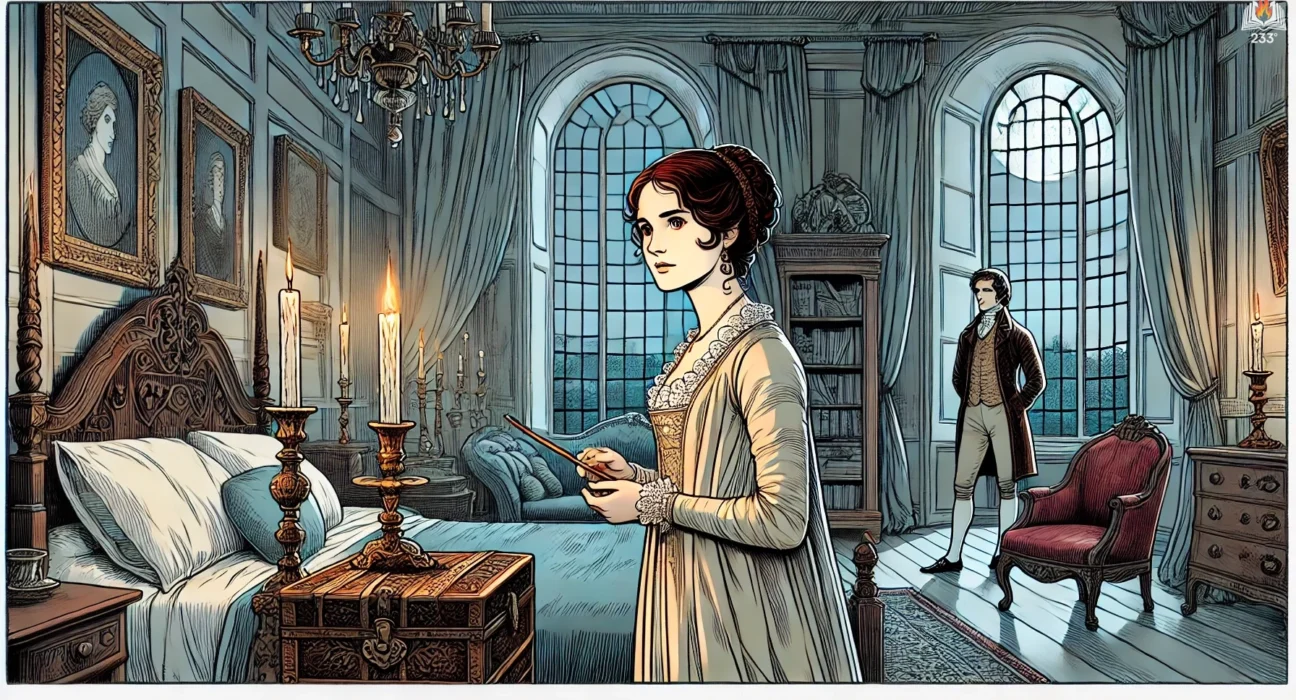
One night, unable to resist her curiosity, Catherine explored Mrs. Tilney’s former quarters, searching for evidence of foul play. However, she found nothing but mundane explanations for everything she had imagined. When Henry discovered her snooping, he was both amused and dismayed by her wild theories. With kindness but firmness, he explained that his mother had died of natural causes and that his father, while strict and materialistic, was not the villain Catherine had imagined. Mortified by her own foolishness, Catherine realized how her imagination, fueled by novels, had led her astray.
As Catherine grappled with her embarrassment, another shock awaited her. General Tilney, who had previously treated her with great hospitality, suddenly and unceremoniously ordered her to leave Northanger Abbey and return home. Confused and heartbroken, Catherine obeyed, making the long, lonely journey back to her family in Wiltshire. She could not understand why she had fallen from favor so abruptly, but later learned the cause from Henry, who visited her to explain everything.
It turned out that John Thorpe, eager to advance his own suit with Catherine, had misled General Tilney into believing that she was an heiress. The General, ever motivated by wealth and status, had welcomed her warmly, hoping she would be a suitable match for Henry. However, once John’s deception was revealed, the General, furious and disappointed, cast Catherine out, believing her to be penniless.
Henry, however, had grown genuinely fond of Catherine and did not share his father’s mercenary views. Despite his father’s disapproval, he proposed to her, confessing that he had come to love her for her kindness, honesty, and natural charm. Catherine, overjoyed, accepted his proposal, and though General Tilney initially objected, he eventually relented when it became clear that Catherine, though not an heiress, came from a respectable family.
In the end, Catherine’s fantasies of gothic adventure were replaced by the more grounded and fulfilling reality of love and friendship. She had learned to see the world for what it was, not through the lens of gothic fiction, and had found happiness in the warmth of the Tilney family. Her growth from an imaginative, naïve girl into a mature young woman was complete, and she returned to Northanger Abbey not as a heroine in a gothic tale, but as the future wife of Henry Tilney.
Main Characters
Catherine Morland: The heroine of the novel, Catherine is a naïve and imaginative 17-year-old girl. Initially obsessed with gothic novels, her vivid imagination often leads her to misinterpret events around her. Over the course of the story, she grows from a wide-eyed dreamer into a more grounded and mature individual.
Henry Tilney: A charming and witty young clergyman who becomes Catherine’s romantic interest. Henry enjoys teasing Catherine and is quick to see through her overly dramatic views of the world. He represents reason and sensibility, guiding Catherine away from her gothic fantasies.
Eleanor Tilney: Henry’s sister and Catherine’s close friend. Eleanor is kind, gentle, and shares a deep bond with Catherine. She also serves as a contrast to the more scheming female characters in the novel, such as Isabella Thorpe.
General Tilney: Henry and Eleanor’s father, a strict and overbearing figure. Catherine initially suspects him of being a villain out of one of her gothic novels, but later learns that his “villainy” is grounded in materialism and social ambition rather than gothic horror.
Isabella Thorpe: A beautiful but shallow and manipulative young woman who befriends Catherine in Bath. She is flirtatious and ambitious, particularly in securing advantageous marriages, and eventually reveals her true, self-serving nature.
John Thorpe: Isabella’s brother and a loud, boastful suitor of Catherine. He embodies arrogance and selfishness, making him a foil to the more honorable and kind-hearted Henry Tilney.
James Morland: Catherine’s brother, who becomes infatuated with Isabella Thorpe, only to be heartbroken when her true colors emerge. His subplot mirrors Catherine’s own coming-of-age and disillusionment with superficiality.
Theme
The Gothic Novel and Imagination: The novel heavily satirizes the gothic novels that were popular during Austen’s time, particularly works like Ann Radcliffe’s The Mysteries of Udolpho. Catherine’s love for gothic stories leads her to imagine dark and mysterious events at Northanger Abbey, but she eventually learns that real life is much more ordinary. This theme reflects the dangers of letting fiction warp one’s perception of reality.
Coming-of-Age: Northanger Abbey is very much a bildungsroman, with Catherine’s growth into maturity forming the crux of the story. She begins as a girl full of fantasy and misunderstanding but ends with a more grounded understanding of the world, particularly concerning love and relationships.
The Role of Women in Society: Through characters like Catherine, Isabella, and Eleanor, the novel explores the limited options available to women of Austen’s time, particularly in terms of marriage and social mobility. Isabella represents the manipulative woman who sees marriage as a financial transaction, while Catherine learns to navigate these societal expectations more wisely.
Marriage and Courtship: As in many of Austen’s works, marriage is a central theme, with courtship dynamics driving much of the plot. However, Northanger Abbey also questions the mercenary nature of some marriages (e.g., Isabella’s pursuit of James Morland) and celebrates marriages based on mutual respect and affection, like that of Catherine and Henry.
Writing Style and Tone
Austen’s writing style in Northanger Abbey is marked by her characteristic wit and irony. She frequently breaks the fourth wall to address the reader directly, a device that adds a playful, self-aware quality to the narrative. Her use of free indirect discourse allows readers insight into Catherine’s internal world, where her imagination runs wild, while also highlighting the disparity between her thoughts and reality.
The tone of the novel is light and satirical, particularly in its parody of gothic tropes. Austen gently mocks Catherine’s naiveté and her tendency to imagine herself in the role of a gothic heroine. The humor in the novel comes from this juxtaposition of Catherine’s fantastical expectations with the often mundane reality of the situations she encounters.
Quotes
Northanger Abbey – Jane Austen (1817) Quotes
“The person, be it gentleman or lady, who has not pleasure in a good novel, must be intolerably stupid.”
“There is nothing I would not do for those who are really my friends. I have no notion of loving people by halves, it is not my nature.”
“A woman, especially if she have the misfortune of knowing anything, should conceal it as well as she can.”
“If adventures will not befall a young lady in her own village, she must seek them abroad.”
“I cannot speak well enough to be unintelligible.”
“No man is offended by another man's admiration of the woman he loves; it is the woman only who can make it a torment.”
“Oh! I am delighted with the book! I should like to spend my whole life in reading it.”
“To look almost pretty is an acquisition of higher delight to a girl who has been looking plain the first fifteen years of her life than a beauty from her cradle can ever receive.”
“Beware how you give your heart.”
“I assure you. I have no notion of treating men with such respect. That is the way to spoil them.”
“If I could not be persuaded into doing what I thought wrong, I will never be tricked into it.”
“[I]t is well to have as many holds upon happiness as possible.”
“Now I must give one smirk and then we may be rational again”
“Where the heart is really attached, I know very well how little one can be pleased with the attention of any body else.”
“Miss Morland, no one can think more highly of the understanding of women than I do. In my opinion, nature has given them so much, that they never find it necessary to use more than half.”
“Where people are really attached, poverty itself is wealth.”
“She mediated, by turns, on broken promises and broken arches, phaetons and false hangings, Tilneys and trap-doors.”
“But Catherine did not know her own advantages - did not know that a good-looking girl, with an affectionate heart and a very ignorant mind, cannot fail of attracting a clever young man, unless circumstances are particularly untoward.”
“No one who had ever seen Catherine Morland in her infancy, would have supposed her born to be a heroine... But from fifteen to seventeen she was in training for a heroine...”
“To begin perfect happiness at the respective ages of 26 and 18 is to do pretty well”
“I leave it to be settled, by whomsoever it may concern, whether the tendency of this work be altogether to recommend parental tyranny, or reward filial disobedience.”
We hope this summary has sparked your interest and would appreciate you following Celsius 233 on social media:
There’s a treasure trove of other fascinating book summaries waiting for you. Check out our collection of stories that inspire, thrill, and provoke thought, just like this one by checking out the Book Shelf or the Library
Remember, while our summaries capture the essence, they can never replace the full experience of reading the book. If this summary intrigued you, consider diving into the complete story – buy the book and immerse yourself in the author’s original work.
If you want to request a book summary, click here.
When Saurabh is not working/watching football/reading books/traveling, you can reach him via Twitter/X, LinkedIn, or Threads
Restart reading!