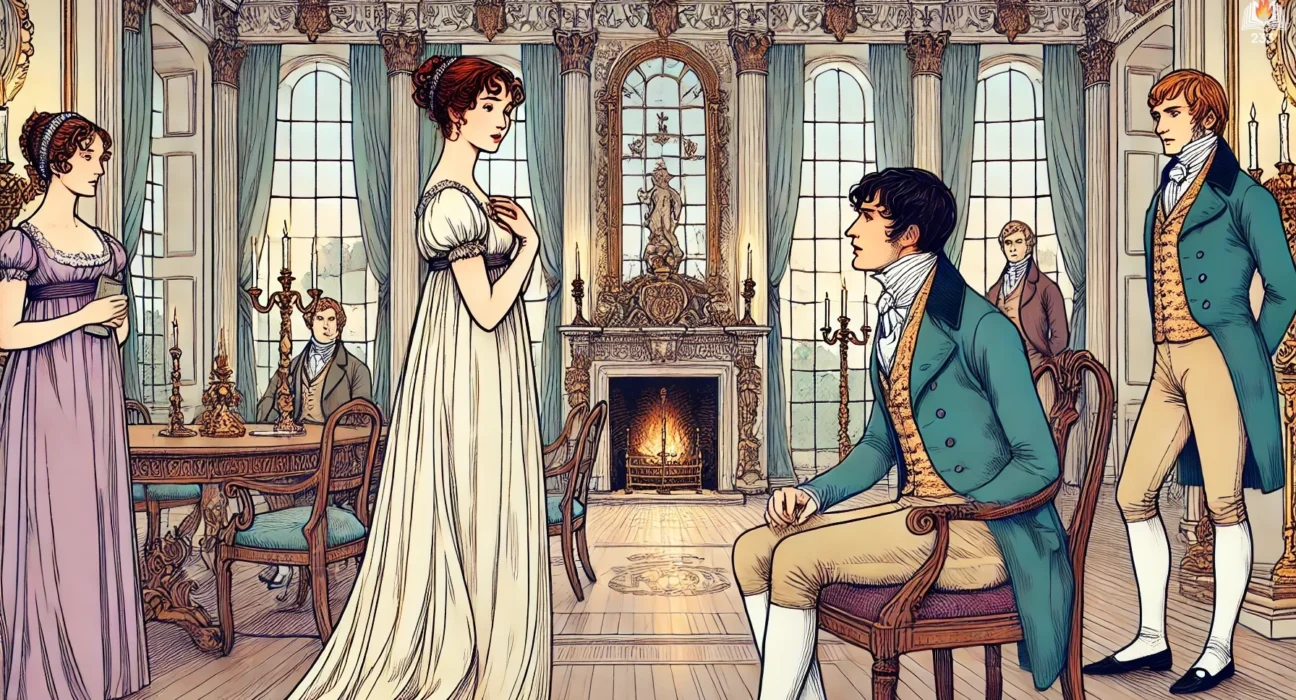
Mansfield Park by Jane Austen was first published in 1814. The novel explores the life of Fanny Price, a young girl from a poor family who is sent to live with her wealthy relatives, the Bertrams, at Mansfield Park. Austen delves into themes of class, morality, and the role of women in society, showcasing her signature wit and social commentary. Mansfield Park is known for its complex character dynamics and sharp critique of the aristocracy.
Plot Summary
Fanny Price was just a shy, ten-year-old girl when she left her impoverished family to live at Mansfield Park, the grand estate of her wealthy relatives, the Bertrams. Life at Mansfield was overwhelming. Though her uncle, Sir Thomas, and her aunt, Lady Bertram, received her kindly, her other aunt, the domineering Mrs. Norris, and her spoiled cousins Maria and Julia made her feel the weight of her lower status. Fanny found comfort only in the companionship of her cousin Edmund, who treated her with kindness and consideration.
As the years passed, Fanny grew into a quiet, observant young woman. Sir Thomas, stern and concerned with propriety, left for a long stay in Antigua to deal with his business, and with his absence came a sense of freedom at Mansfield. During this time, the lively and fashionable siblings Henry and Mary Crawford arrived in the neighborhood. Their charm and wit quickly captivated the Bertram household. Henry, with his flirtatious ways, drew both Maria and Julia into his orbit, despite Maria’s engagement to the wealthy but dull Mr. Rushworth. Mary Crawford, with her playful spirit and beauty, attracted Edmund’s attentions, much to Fanny’s quiet dismay, for she had secretly fallen in love with him.
Fanny watched as Henry played with Maria’s affections, a dangerous game given her upcoming marriage. Julia, though initially drawn to Henry, was pushed aside by her sister’s deeper connection to him. When Sir Thomas returned from Antigua, he immediately sensed the impropriety brewing under his roof. Eager to maintain appearances, he hastened Maria’s wedding to Mr. Rushworth, despite the clear lack of affection between them. After the wedding, Maria and her new husband left for their honeymoon in London, taking Julia with them, while Henry Crawford remained behind, setting his sights on a new target: Fanny Price.
To Fanny’s shock, Henry declared that he had fallen in love with her. He pursued her with an intensity that bewildered her. She, who had seen his flirtations with her cousins, could not trust his sincerity, nor could she be swayed by his wealth and status. Despite pressure from Sir Thomas, who was pleased with the match, Fanny resolutely refused Henry’s proposal, standing firm in her belief that his character was not worthy of her love.
Sir Thomas, angered by her refusal and believing her to be ungrateful, decided to send Fanny back to her humble family in Portsmouth, hoping that the contrast between her life at Mansfield and the hardships of her original home would make her reconsider Henry’s offer. Life in Portsmouth was harsh. The noisy, cramped household, her mother’s indifference, and the disorder of her surroundings were a sharp contrast to the quiet elegance of Mansfield. Yet, despite her discomfort, Fanny held fast to her principles and resisted the idea of marrying Henry.
While in Portsmouth, Fanny received news of a scandal that shook her world. Henry had resumed his flirtation with the now-married Maria, and the affair had become public. Maria left her husband and ran away with Henry, disgracing herself and her family. Julia, in a fit of impulsiveness, eloped with Mr. Yates, a frivolous acquaintance. The Bertrams were in turmoil. Sir Thomas, devastated by the collapse of his daughters’ reputations, realized that Fanny had been right about Henry all along. He sent for her to return to Mansfield, recognizing her steadfastness and moral strength in contrast to the recklessness of his own daughters.
Upon her return to Mansfield, Fanny found that Edmund had finally seen the truth about Mary Crawford. Mary’s lack of moral seriousness and her flippant attitude toward Maria’s scandal had disillusioned him. She had suggested that if the affair had been better concealed, it might not have been such a disaster. Her casual disregard for the consequences of such actions made Edmund realize that, despite his affection for her, Mary was not the woman he had once thought her to be.
Heartbroken over Mary’s true nature but free from his attachment, Edmund’s attention turned toward Fanny. He began to see her in a new light, recognizing the quiet strength, integrity, and goodness that had always been there. As Edmund’s affection for her grew, Fanny, who had long loved him in silence, dared to hope that he might come to love her as well. In time, Edmund confessed his feelings, and the two were united, bound by their shared values and mutual respect.
As the dust settled at Mansfield Park, Maria was sent away to live in seclusion with Mrs. Norris, her reputation in tatters. Julia returned with her husband, Mr. Yates, and though her actions were rash, they were not as ruinous as Maria’s. The Bertram family, humbled by the events, turned to Fanny for the grace and moral clarity they had often ignored. Sir Thomas, once distant and formal with her, came to appreciate her as the true heart of Mansfield Park.
In the end, Fanny’s patience, quiet resolve, and adherence to her principles had triumphed. She found happiness not through wealth or social status, but through love and respect. Mansfield Park, once a place where she felt out of place and overlooked, became her true home, with Edmund by her side.
Main Characters
Fanny Price – The protagonist of the story, Fanny is shy, morally grounded, and often overlooked by her relatives. Sent to live with her wealthy cousins at Mansfield Park, she struggles to find her place while maintaining her sense of right and wrong.
Edmund Bertram – Fanny’s cousin and her closest confidant. Edmund is kind and principled, aspiring to join the clergy. His deep bond with Fanny drives much of the emotional undercurrent of the novel.
Sir Thomas Bertram – The patriarch of Mansfield Park. Strict and imposing, Sir Thomas is deeply concerned with the appearance of propriety and the financial well-being of his estate.
Lady Bertram – Fanny’s aunt and the wife of Sir Thomas. She is indolent and detached, often leaving the upbringing of her children to others.
Maria and Julia Bertram – Fanny’s cousins, who embody the superficiality and vanity of the upper class. Their actions highlight the consequences of selfishness and poor moral judgment.
Mrs. Norris – Fanny’s other aunt, who lives near Mansfield Park. She is manipulative and penny-pinching, constantly asserting her influence over the family while treating Fanny poorly.
Henry Crawford – A charming and wealthy man who creates romantic complications within the Bertram family. His flirtations with both Bertram sisters and later Fanny highlight the novel’s themes of temptation and morality.
Mary Crawford – Henry’s sister, who captivates Edmund with her wit and beauty. However, her worldly outlook and moral flexibility stand in contrast to Edmund’s values.
Theme
Class and Social Mobility – The novel explores the rigid class structures of 19th-century England. Fanny, coming from a poor family, is constantly reminded of her lower status, yet her moral superiority challenges the idea that wealth equates to virtue.
Morality and Virtue – Austen frequently contrasts the moral steadfastness of Fanny and Edmund with the more dubious behaviors of other characters. The novel raises questions about the true nature of goodness and whether it is determined by birth, wealth, or personal character.
Marriage and Relationships – The novel critiques the mercenary nature of marriage in the upper classes, where alliances are often formed based on wealth and social standing rather than love or compatibility.
Education and Influence – The characters in Mansfield Park are shaped by their upbringing and education, or lack thereof. Fanny’s moral education, largely self-taught through observation, is set against the more formal but superficial education of her cousins.
Writing Style and Tone
Jane Austen’s writing in Mansfield Park is characterized by its subtle irony and sharp social commentary. She uses free indirect discourse, a narrative technique that allows readers to see the thoughts of her characters, often highlighting their flaws and contradictions. Austen’s wit is present throughout, though Mansfield Park carries a more somber and serious tone compared to her other works, reflecting the novel’s focus on morality and social criticism.
The tone shifts between lighthearted observations of social rituals and a deeper, more reflective mood as Fanny navigates her complex emotions and ethical dilemmas. The novel’s structure, which emphasizes Fanny’s growth and the consequences of the more reckless characters’ choices, creates a moral framework that is central to the narrative.
Quotes
Mansfield Park – Jane Austen (1814) Quotes
“Life seems but a quick succession of busy nothings.”
“I was quiet, but I was not blind.”
“We have all a better guide in ourselves, if we would attend to it, than any other person can be.”
“Selfishness must always be forgiven you know, because there is no hope of a cure.”
“A large income is the best recipe for happiness I ever heard of.”
“A fondness for reading, properly directed, must be an education in itself.”
“Her own thoughts and reflections were habitually her best companions.”
“Let us have the luxury of silence.”
“Every moment has its pleasures and its hope.”
“But indeed I would rather have nothing but tea.”
“There will be little rubs and disappointments everywhere, and we are all apt to expect too much; but then, if one scheme of happiness fails, human nature turns to another; if the first calculation is wrong, we make a second better: we find comfort somewhere.”
“Oh! Do not attack me with your watch. A watch is always too fast or too slow. I cannot be dictated to by a watch.”
“Fanny! You are killing me!" "No man dies of love but on the stage, Mr. Crawford.”
“Let other pens dwell on guilt and misery. I quit such odious subjects as soon as I can, impatient to restore everybody not greatly in fault themselves to tolerable comfort, and to have done with all the rest.”
“I was so anxious to do what is right that I forgot to do what is right.”
“But there certainly are not so many men of large fortune in the world as there are pretty women to deserve them.”
“I have no talent for certainty.”
“[N]obody minds having what is too good for them.”
“Of course I love her, but there are as many forms of love as there are moments in time.”
“Everybody likes to go their own way–to choose their own time and manner of devotion.”
“I am very strong. Nothing ever fatigues me, but doing what I do not like.”
“You have qualities which I had not before supposed to exist in such a degree in any human creature. You have some touches of the angel in you.”
“...but then I am unlike other people I dare say.”
“If this man had not twelve thousand a year, he would be a very stupid fellow.”
“Oh! write, write. Finish it at once. Let there be an end of this suspense. Fix, commit, condemn yourself.”
“She was feeling, thinking, trembling about everything; agitated, happy, miserable, infinitely obliged, absolutely angry.”
“To sit in the shade on a fine day and look upon verdure is the most perfect refreshment.”
“Life seems nothing more than a quick succession of busy nothings.”
We hope this summary has sparked your interest and would appreciate you following Celsius 233 on social media:
There’s a treasure trove of other fascinating book summaries waiting for you. Check out our collection of stories that inspire, thrill, and provoke thought, just like this one by checking out the Book Shelf or the Library
Remember, while our summaries capture the essence, they can never replace the full experience of reading the book. If this summary intrigued you, consider diving into the complete story – buy the book and immerse yourself in the author’s original work.
If you want to request a book summary, click here.
When Saurabh is not working/watching football/reading books/traveling, you can reach him via Twitter/X, LinkedIn, or Threads
Restart reading!