

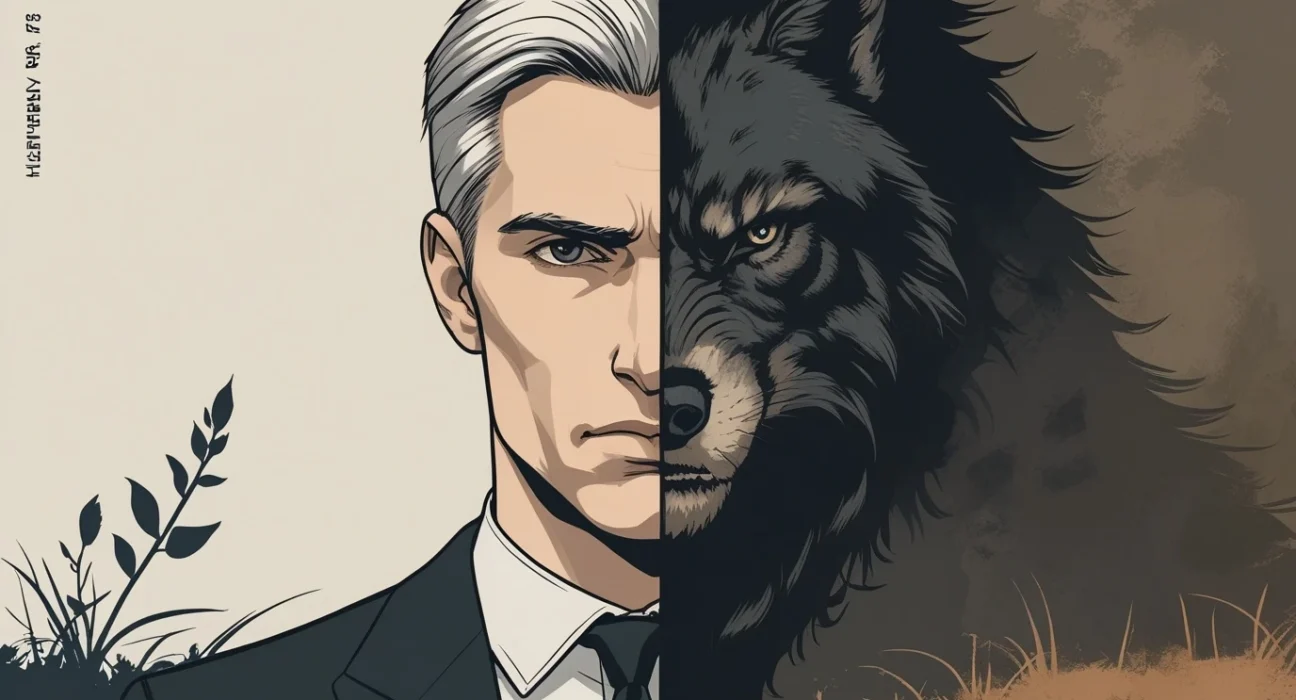
Steppenwolf by Hermann Hesse, first published in 1927, is a seminal work of modernist literature that blends philosophical introspection with psychological depth. Written during a tumultuous period in Hesse’s life and Europe’s interwar years, the novel is framed as a manuscript left behind by a mysterious lodger named Harry Haller – the eponymous “Steppenwolf.” The book explores the duality of human nature, the crisis of individuality in a conformist society, and the possibility of spiritual and artistic redemption through suffering and self-awareness.
Plot Summary
In a quiet, respectable town lived a lodger named Harry Haller, a man approaching fifty who appeared dignified and composed but bore a deep and harrowing solitude within. Those who passed him in the stairwell noted a hint of wildness in his eyes, something not quite of this world. He called himself the Steppenwolf – half-man, half-wolf – a creature torn between two instincts: the cultivated intellect of modern man and the untamed hunger of the beast.
To the outside world, Harry was a learned gentleman. He lived among books, wandered libraries, and contemplated art and music with reverence. Yet no amount of intellectual achievement brought him peace. He found no comfort in the bourgeois order that surrounded him – the clean vestibules, the manicured araucarias, the polite conversations. These symbols of middle-class serenity filled him not with envy, but with despair. He longed not for comfort, but for meaning. Each day he fought against the sickness that gnawed at him, a sickness not of the body, but of the soul. For years he had carried within him a quiet, persistent wish to end his life.
On an ordinary evening, his wandering feet brought him before an old wall in a narrow street. A doorway appeared in the darkness, framed by a faint and flickering sign: Magic Theater. Entrance not for everybody. The letters danced briefly, then vanished. Intrigued and disturbed, Harry could not open the door. Instead, he found a man in the street carrying a tray of wares and a signboard proclaiming an anarchist evening entertainment. From him, Harry obtained a small booklet – a treatise about the Steppenwolf – and took it home.
The treatise spoke with uncanny clarity of Harry’s inner torment. It named him as a creature divided in two – man and wolf – condemned to war within himself. But it went further, suggesting that this duality was itself a simplification. Man is not merely two, but a multitude. Within each soul live a thousand selves – angel and clown, child and sage, tyrant and lover. The failure of modern man, it said, was to insist on rigid identities, on illusions of unity. The Steppenwolf suffered because he believed too deeply in the split, and rejected the dance of multiplicity that life demanded.
After reading, Harry walked the streets, pulled by a longing both ancient and immediate. In a dance hall filled with the raw pulse of jazz, he met a woman who would alter the course of his path. Hermine was unlike any other. Elegant, bold, and enigmatic, she called herself a mirror to his soul. She offered him not philosophy, but a promise: to teach him how to live, how to laugh, how to dance. And when the time came, she said, he would kill her.
Hermine led him gently and cunningly into the world of sensuality. She dressed him, taught him to move to the rhythm of jazz, to dance without shame. She introduced him to Maria, a lover of warm eyes and languid grace, through whom Harry experienced physical intimacy stripped of guilt and anxiety. Each night with Maria was a lesson in joy, a celebration of touch and delight. Through these pleasures, Harry began to thaw. The wolf no longer snarled at the edge of his being. The man, too, softened.
In the smoky brilliance of Pablo’s jazz orchestra, Harry discovered a strange kind of peace. Pablo, a man of few words and many smiles, seemed at first a simple musician, but there was something behind his gaze – something ancient and knowing. He invited Harry to return to the Magic Theater, not through a door in a wall this time, but through an inner transformation.
What followed was not a dream, but not reality either. In the Magic Theater, Harry stepped beyond the boundaries of time, self, and logic. Here, the soul was not a singular flame but a kaleidoscope of characters. In room after room, Harry lived many lives. He witnessed a grotesque war game, where men slaughtered one another in the name of sport. He became a puppet in a comedic farce, mocking his own solemnity. He watched his childhood unfold, felt the sting of old wounds and the longing of unfulfilled dreams. He saw his soul divided like panes of colored glass, each fragment a forgotten self.
In one chamber, he found Mozart seated like a serene god. The composer smiled at him, full of wisdom and mischief. Harry, full of anguish, tried to explain his despair – the ugliness of modernity, the collapse of spirit. Mozart, unmoved by his lament, told him his error lay not in the world, but in his own seriousness. Laughter, Mozart said, was the only true answer. Laughter at himself, at the futility of judgment, at the tragedy of ego. Salvation was not found in retreat, but in the embrace of contradiction.
At last, in a chamber filled with mirrors and shadows, Harry found Hermine, naked and still. Her eyes pleaded with him, and he understood her earlier promise. In a trance, with a knife in hand, he fulfilled what had been foretold. The act was terrible and tender, a ritual not of violence but of sacrifice. In ending her life, he ended something within himself – the illusion of control, of reason, of singular selfhood.
But the act did not bring punishment. Instead, it brought awakening. The voice of Pablo, calm and benevolent, echoed through the void. This was only the beginning. Harry had failed, but now he had learned to laugh. He had stepped beyond the rigid forms of identity and morality, touched the hidden pulse of life’s multiplicity.
And so the Steppenwolf did not die. Not yet. He stepped out of the theater with a new resolve. He would go on living – laughing, stumbling, learning – with all his thousand souls in chaotic harmony. The road ahead was long and uncertain, filled with suffering and ecstasy alike, but he would walk it. Somewhere, Mozart waited, and the dance was not yet over.
Main Characters
Harry Haller (The Steppenwolf): A solitary intellectual approaching middle age, Haller is tormented by an existential crisis. He perceives himself as composed of two natures – human and wolf – constantly at odds. Profoundly alienated from bourgeois society, he oscillates between self-loathing and a longing for transcendence. His journey through despair, fantasy, and the surreal “Magic Theater” marks a deep internal metamorphosis.
Hermine: A mysterious and androgynous woman who befriends Harry and becomes his spiritual guide. She mirrors his internal contradictions and pushes him toward sensual experience and acceptance of life’s multiplicity. Her name, echoing Harry’s own, reinforces her role as a projection of his psyche, perhaps a feminine aspect of himself.
Pablo: A jazz musician who represents a world of instinct, pleasure, and aesthetic spontaneity. Seemingly superficial, Pablo becomes the enigmatic curator of the Magic Theater, guiding Harry through a series of metaphysical and hallucinatory experiences that challenge his rigid dualism.
Maria: A sensual and free-spirited lover introduced to Harry by Hermine. Through Maria, Harry learns to embrace physical pleasure without guilt, an essential step in his spiritual awakening.
The Narrator (The Editor): A reserved and rational young man who provides the framing introduction and commentary on Harry’s manuscript. Though minor in narrative involvement, his reflections offer a contrasting perspective on Harry’s psychological turmoil and lend credence to his spiritual significance.
Theme
Duality of Human Nature: The central conflict in Steppenwolf lies in Harry’s belief that he is composed of two distinct selves – the cultured man and the savage wolf. Hesse uses this motif to explore the illusion of a singular identity and the psychological fragmentation of the modern individual.
Alienation and Bourgeois Society: Harry’s disdain for bourgeois values – comfort, conformity, mediocrity – reflects a broader critique of modern civilization. His intellectual arrogance and emotional isolation underscore the spiritual emptiness of societal norms.
The Search for Wholeness: Much of Harry’s journey is a psychological quest to transcend binary thinking and accept the plurality within himself. The Magic Theater serves as a symbolic realm where he confronts and integrates his many inner selves, including suppressed instincts and forgotten joys.
Art and Music as Redemption: Throughout the novel, music – especially classical compositions by Mozart and jazz improvisations by Pablo – functions as a portal to transcendence. Art offers Harry fleeting moments of beauty, connection, and clarity that contrast with his spiritual despair.
Suffering and Transformation: Suffering is portrayed not as mere pain, but as a crucible for self-discovery and rebirth. Haller’s descent into madness, hallucination, and moral transgression is necessary for his ultimate transformation.
Writing Style and Tone
Hesse’s writing in Steppenwolf is introspective, poetic, and layered with metaphysical symbolism. The narrative structure is complex – beginning with a realist framing device by the editor, transitioning into Harry’s confessional manuscript, and culminating in surreal dream-like sequences within the Magic Theater. This multifaceted narrative mirrors the psychological fragmentation Hesse seeks to examine. His prose is deeply lyrical when describing emotional states or philosophical dilemmas and becomes more frenetic and experimental during hallucinatory passages, effectively capturing the instability of Harry’s inner world.
The tone of the novel is melancholic, intellectual, and at times, despairing. Hesse does not shy away from existential bleakness, portraying Harry’s spiritual suffering with brutal honesty. Yet, threaded through this despair is an undercurrent of yearning – for transcendence, unity, and grace. This dual tone mirrors the novel’s central theme: the tension between despair and hope, between death and renewal. Even as the Steppenwolf contemplates suicide, there remains a whisper of potential, a belief that art, laughter, and love may offer redemption.
Quotes
Steppenwolf – Hermann Hesse (1927) Quotes
“Solitude is independence. It had been my wish and with the years I had attained it. It was cold. Oh, cold enough! But it was also still, wonderfully still and vast like the cold stillness of space in which the stars revolve.”
“You are willing to die, you coward, but not to live.”
“There is no reality except the one contained within us. That is why so many people live such an unreal life. They take the images outside of them for reality and never allow the world within to assert itself.”
“In eternity there is no time, only an instant long enough for a joke.”
“For what I always hated and detested and cursed above all things was this contentment, this healthiness and comfort, this carefully preserved optimism of the middle classes, this fat and prosperous brood of mediocrity.”
“I am in truth the Steppenwolf that I often call myself; that beast astray that finds neither home nor joy nor nourishment in a world that is strange and incomprehensible to him.”
“A wild longing for strong emotions and sensations seethes in me, a rage against this toneless, flat, normal and sterile life. I have a mad impulse to smash something, a warehouse perhaps, or a cathedral, or myself, to committ outrages...”
“There are always a few such people who demand the utmost of life and yet cannot come to terms with its stupidity and crudeness.”
“How foolish it is to wear oneself out in vain longing for warmth! Solitude is independence.”
“But it's a poor fellow who can't take his pleasure without asking other people's permission.”
“His life oscillates, as everyone's does, not merely between two poles, such as the body and the spirit, the saint and the sinner, but between thousands and thousands.”
“I do want more. I am not content with being happy. I was not made for it. It is not my destiny. My destiny is the opposite.”
“The man of power is ruined by power, the man of money by money, the submissive man by subservience, the pleasure seeker by pleasure.”
“A wild longing for strong emotions and sensations seethes in me, a rage against this toneless, flat, normal and sterile life.”
“Now true humor begins when a man ceases to take himself seriously.”
“I would traverse not once more, but often the hell of my inner being. One day I would be a better hand at the game. One day I would learn how to laugh. Pablo was waiting for me, and Mozart too.”
“Life is always frightful. We cannot help it and we are responsible all the same. One's born and at once one is guilty.”
“In fear I hurried this way and that. I had the taste of blood and chocolate in my mouth, the one as hateful as the other.”
We hope this summary has sparked your interest and would appreciate you following Celsius 233 on social media:
There’s a treasure trove of other fascinating book summaries waiting for you. Check out our collection of stories that inspire, thrill, and provoke thought, just like this one by checking out the Book Shelf or the Library
Remember, while our summaries capture the essence, they can never replace the full experience of reading the book. If this summary intrigued you, consider diving into the complete story – buy the book and immerse yourself in the author’s original work.
If you want to request a book summary, click here.
When Saurabh is not working/watching football/reading books/traveling, you can reach him via Twitter/X, LinkedIn, or Threads
Restart reading!


