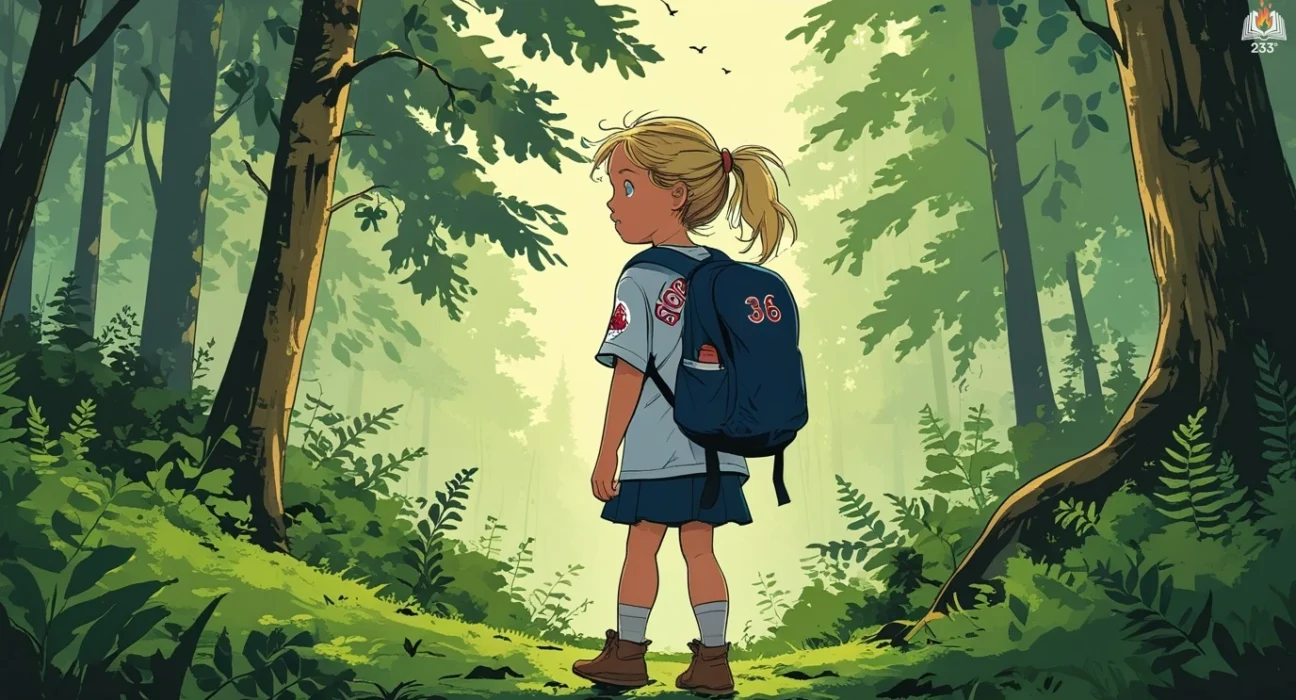
The Girl Who Loved Tom Gordon by Stephen King, published in 1999, is a psychological thriller about a young girl lost in the wilderness. Nine-year-old Trisha McFarland, separated from her family during a hike, must rely on her wits, resilience, and the imagined presence of her idol, baseball player Tom Gordon, to survive. As hunger, exhaustion, and fear consume her, she begins to believe that something sinister is stalking her through the woods.
Plot Summary
On a bright June morning, Trisha McFarland sits in the backseat of her mother’s Dodge Caravan, wearing her treasured Red Sox jersey with Tom Gordon’s name and number on the back. Her mother and older brother, Pete, argue as the car winds its way toward the Appalachian Trail in Maine. Their mother, Quilla, is determined to turn these weekend outings into family bonding experiences, but Pete resents every second of it, bitter over their parents’ divorce and the move to Maine. Trisha, caught in the middle, plays the part of the cheerful peacemaker, but beneath the surface, she feels like weak glue trying to hold together two things that are breaking apart.
The trail stretches ahead of them, a winding path through deep green trees, the air thick with the scent of pine and damp earth. Trisha walks behind her mother and brother, their voices rising and falling in tense waves. She doesn’t want to listen to them fight anymore. When the chance presents itself, she steps off the trail, intending only to relieve herself and take a brief break from the tension. But the moment she moves away from the path, the world subtly shifts. The trees seem taller, the forest denser. The arguing voices fade into the wind.
Thinking she can cut across a small clearing and meet up with the trail again, Trisha walks forward instead of backtracking. The sound of hikers ahead reassures her at first, but as minutes pass and the trees seem to stretch endlessly around her, she realizes she is no longer sure which direction leads back. The voices are gone. The path is gone. The only sounds are the rustle of leaves, the distant caw of a crow, and the soft whisper of wind moving through the high branches.
She tries to stay calm. She picks landmarks – a twisted tree, a cluster of ferns, a patch of checkerberry bushes – and moves toward them, certain that if she keeps walking, she will find the trail again. But the forest is deceptive, and the ground slopes in ways she does not expect. When she stumbles upon a fallen log and crawls under it, her hand brushes something smooth and cold beneath the leaves – a snake. Panic surges through her, and she scrambles up too fast, catching her shirt on a jagged branch. Blood wells from a small tear in her back, but the fear of the unseen, slithering thing behind her drives her forward.
She walks for what feels like hours. Hunger gnaws at her stomach, but worse is the thirst. The warm June air is heavy with moisture, and the mosquitoes and gnats swarm relentlessly around her face. She has water in her pack, a sandwich, a hardboiled egg, a few snacks. Rationing them carefully, she presses on, telling herself that her mother and Pete must have noticed by now that she is missing.
They will come looking. They have to.
She finds a stream – a thin, winding ribbon of water that snakes through the valley below. Water leads to people, she reminds herself. If she follows it, she will find a town, a road, a campsite. She begins her descent toward the valley, slipping on the loose, rain-slicked stones, tumbling forward. Her shoulder slams into the rocks, her poncho dragging behind her like useless wings. A sharp jab of pain shoots up her ankle, but she grits her teeth and keeps going.
The forest closes in around her, and with it comes something else. At first, it is nothing but a feeling – the prickling sensation of being watched. The trees are too still. The underbrush whispers with something more than wind. Trisha tells herself it is her imagination, just exhaustion twisting her thoughts. But when she comes across the remains of an animal – a deer carcass, stripped clean, bones gnawed and scattered – she knows she is not alone.
The God of the Lost.
The name comes unbidden, rising from some deep, primal part of her mind. A presence lurks in the woods, shadowing her steps, watching from just beyond the trees. She does not see it, but she feels it. It is not a bear. It is not a wolf. It is something older, something that has been waiting for a long time.
To fight the fear, she calls on the only thing that has ever made her feel safe – Tom Gordon. The Red Sox closer, the man with ice water in his veins. She imagines him walking beside her, nodding at her with quiet confidence. He believes in her. He knows she can win this game. She listens to her Walkman when the radio signal allows, catching snippets of the Red Sox broadcast, grounding herself in something familiar, something human.
Days pass. The food runs low. Her ankle throbs with every step. Her body is covered in bites, scratches, bruises. But she refuses to stop. She drinks from the stream, careful not to drink too much at once. She eats what little she has left, stretching each meal, willing herself not to panic. She does not pray, but she whispers to Tom Gordon, telling him she will not let the God of the Lost win.
The presence draws closer. One night, as she sleeps, she hears it breathing outside her makeshift shelter. Heavy. Slow. Patient. She forces herself to stay still, to not cry out, to not let it know how afraid she is.
The final confrontation comes in the clearing of a dried-up riverbed. Weakened, feverish, delirious, Trisha sees it at last – a monstrous thing, not a man, not an animal, something made of shadows and hunger. It moves toward her, its form shifting in the dim light. She raises her hands, holding an imaginary baseball, winding up for the perfect pitch. Tom Gordon’s voice is in her head, steady and sure.
She throws.
The motion is real – a rock hurled with all the strength she has left. It strikes the creature, and in that moment, something shifts. Whether it was truly real or something her mind created in its desperation, it does not matter. The thing recoils. It retreats.
And then there are voices – real voices. Searchers crash through the underbrush. She collapses as they reach her, her battered body finally surrendering.
Days later, in a hospital bed, she wakes to the sound of the Red Sox game on the radio. Her mother is there, holding her hand. Pete stands at the foot of the bed, looking at her with something like awe. Trisha listens to the announcer’s voice, calling the game, Tom Gordon on the mound.
As she drifts back to sleep, she smiles. She had faced the God of the Lost. And she had won.
Main Characters
- Trisha McFarland – A resourceful and imaginative nine-year-old girl who gets lost in the woods. Her love for baseball and admiration for Red Sox pitcher Tom Gordon help her cope with isolation and fear.
- Quilla Andersen – Trisha’s strong-willed mother, recently divorced, struggling to maintain control of her children while dealing with her son Pete’s resentment.
- Pete McFarland – Trisha’s older brother, a moody teenager who resents their mother for moving them to a new town. His constant arguing with their mother indirectly leads to Trisha getting lost.
- Tom Gordon (imaginary presence) – A Boston Red Sox pitcher whom Trisha idolizes. In her mind, he becomes a guiding and protective figure as she navigates the dangers of the wilderness.
- The God of the Lost – A shadowy, possibly supernatural entity that Trisha believes is stalking her. Whether real or a hallucination, its presence adds to the terror of her journey.
Theme
- Survival and Resilience – Trisha faces hunger, injury, and fear but fights to stay alive, learning how strong she truly is.
- Isolation and Psychological Endurance – Lost in the vast wilderness, Trisha’s loneliness drives her to rely on imagination and memory to maintain her sanity.
- The Power of Faith and Belief – Trisha’s belief in Tom Gordon as a guiding figure mirrors religious faith, offering her hope and courage.
- The Thin Line Between Reality and Imagination – As exhaustion and fear take hold, Trisha’s perception blurs, making it unclear whether the entity stalking her is real or a product of her mind.
- Nature as a Force of Indifference and Horror – The woods, vast and uncaring, serve as both a place of beauty and terror, embodying nature’s raw and unyielding power.
Writing Style and Tone
Stephen King’s writing in The Girl Who Loved Tom Gordon is immersive and deeply psychological, blending vivid descriptions of nature with the raw, internal struggle of a lost child. The prose is rich in sensory detail, making the reader feel Trisha’s exhaustion, hunger, and growing dread. King’s use of stream-of-consciousness narration enhances Trisha’s isolation, allowing readers to experience her shifting mental state firsthand.
The tone fluctuates between eerie suspense and emotional intensity. King crafts an unsettling atmosphere where the woods feel both vast and suffocating, turning an ordinary survival story into a psychological thriller. The horror elements are subtle, more psychological than supernatural, relying on fear of the unknown rather than outright terror. Throughout the novel, King maintains an undercurrent of hope, showing Trisha’s determination to survive despite overwhelming odds.
Quotes
The Girl Who Loved Tom Gordon – Stephen King (1999) Quotes
“It was like drowning, only from the inside out.”
“The world had teeth and it could bite you with them anytime it wanted.”
“The world is a worst case scenario and I'm afraid that all you sense is true”
“The world has teeth and it can bite you with them any time it wants.”
“You could get used to anything if you had to.”
“Shadows were too black, and when a breeze stirred the trees, the shadows changed in a disquieting way.”
“Let it eat her; let it beat her. It could do both. But she would not beat herself.”
“I've got icewater in my veins and I hope you freeze on the first bite. Come on, you busher! Batter-fucking-up!”
“It's God's nature to come on in the bottom of the ninth, Tom had told her.”
“You could get used to anything if you had to. She knew that now.”
“Part of her wanted to run. Never mind how flowing water was bound to take her to people eventually, all that was likely just a crock of Little House of the Prairie shit.”
“No matter what you had to do or how bad you had to do it, no matter how much yatata-yatata you had to listen to, it was better to stay on the path.”
“Let the evil of the day be sufficient thereof,”
“The thing that looked like a bear gazed down on her haughtily from its seven feet of height. Its head was in the sky and its claws held the earth.”
“It’s a special thing, Trisha—the thing that waits for the lost ones. It lets them wander until they’re good and scared—because fear makes them taste better, it sweetens the flesh—and then it comes for them.”
“It’s a special thing, Trisha—the thing that waits for the lost ones. It lets them wander until they’re good and scared—because fear makes them taste better, it sweetens the flesh”
“some day some hunter will come along and find your bones.”
“The world had teeth and it could bite you with them anytime it wanted.”
“Better to be dead than to be lost.”
“Hey, the fact that no one's used a nuclear weapon on actual living people since 1945 suggests there has to be something on our side. Sooner or later someone will, of course, but over half a century ... that's a long time.”
“what if she just said Hey Pete, fuck you, deal with it instead of trying to be either all quiet and sympathetic or all bright and cheery and let’s-change-the-subject? Just Hey Pete, that’s a big fuck you, like that?”
We hope this summary has sparked your interest and would appreciate you following Celsius 233 on social media:
There’s a treasure trove of other fascinating book summaries waiting for you. Check out our collection of stories that inspire, thrill, and provoke thought, just like this one by checking out the Book Shelf or the Library
Remember, while our summaries capture the essence, they can never replace the full experience of reading the book. If this summary intrigued you, consider diving into the complete story – buy the book and immerse yourself in the author’s original work.
If you want to request a book summary, click here.
When Saurabh is not working/watching football/reading books/traveling, you can reach him via Twitter/X, LinkedIn, or Threads
Restart reading!