Memnoch the Devil by Anne Rice, published in 1995, is the fifth installment in her renowned The Vampire Chronicles series. The novel follows the vampire Lestat de Lioncourt as he is drawn into a metaphysical and theological journey unlike any other he has experienced. In a radical departure from his usual role as a brooding antihero, Lestat finds himself confronted by the Devil—Memnoch—who invites him to serve as an agent in Heaven’s cosmic plan. What ensues is a mystic odyssey that takes Lestat across dimensions and through biblical and spiritual revelations, as he grapples with faith, damnation, and divine purpose.
Plot Summary
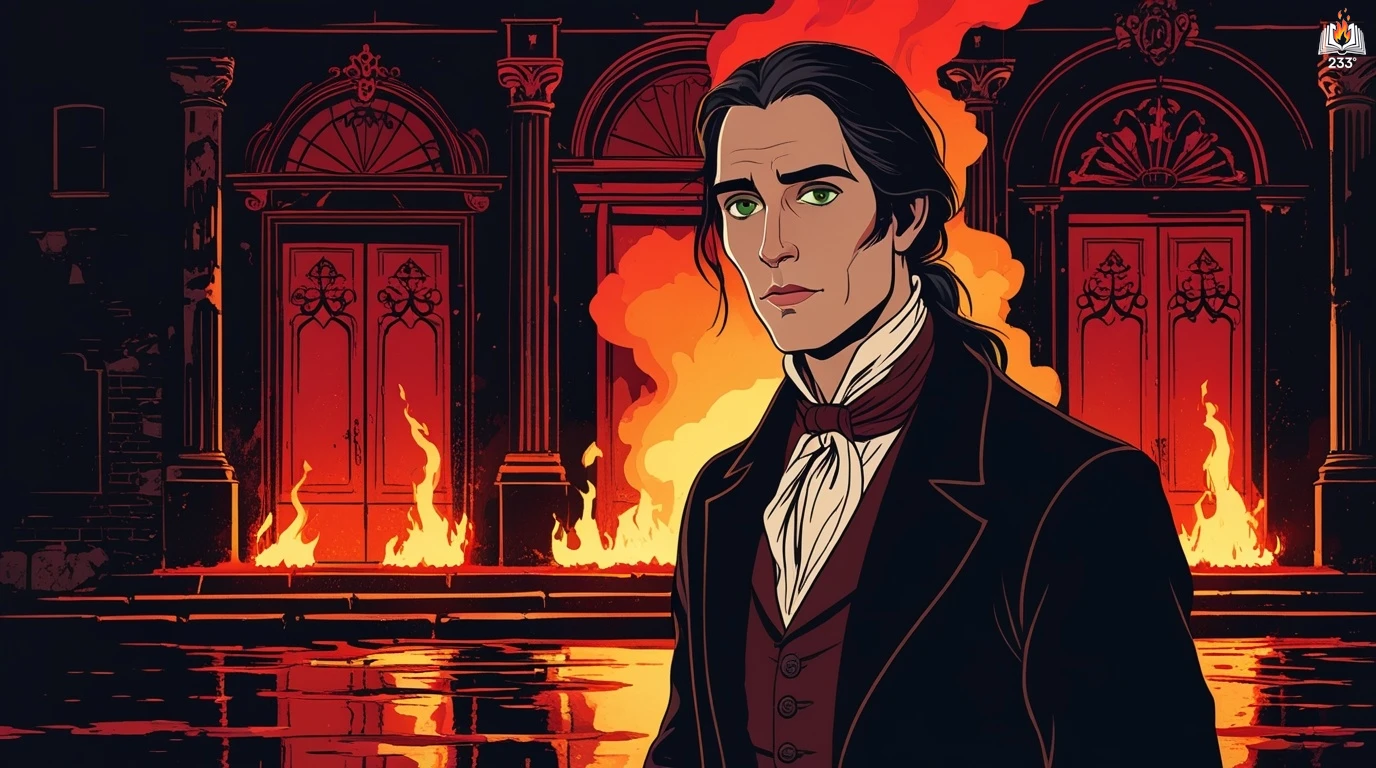
Beneath the heavy folds of winter’s shadow, in a grand hotel laced with velvet and gold, the vampire Lestat encountered his old companion David Talbot. The air was thick with snow and secrets, and though Lestat wore the charm of vanity like a silk tie, something darker clawed at him – something unseen, a presence stalking him from the edge of sound and sight. The immortal hunter, master of cities and centuries, now stood haunted. And so began a journey not through darkened alleys and shadowed cathedrals, but into the soul’s great reckoning.
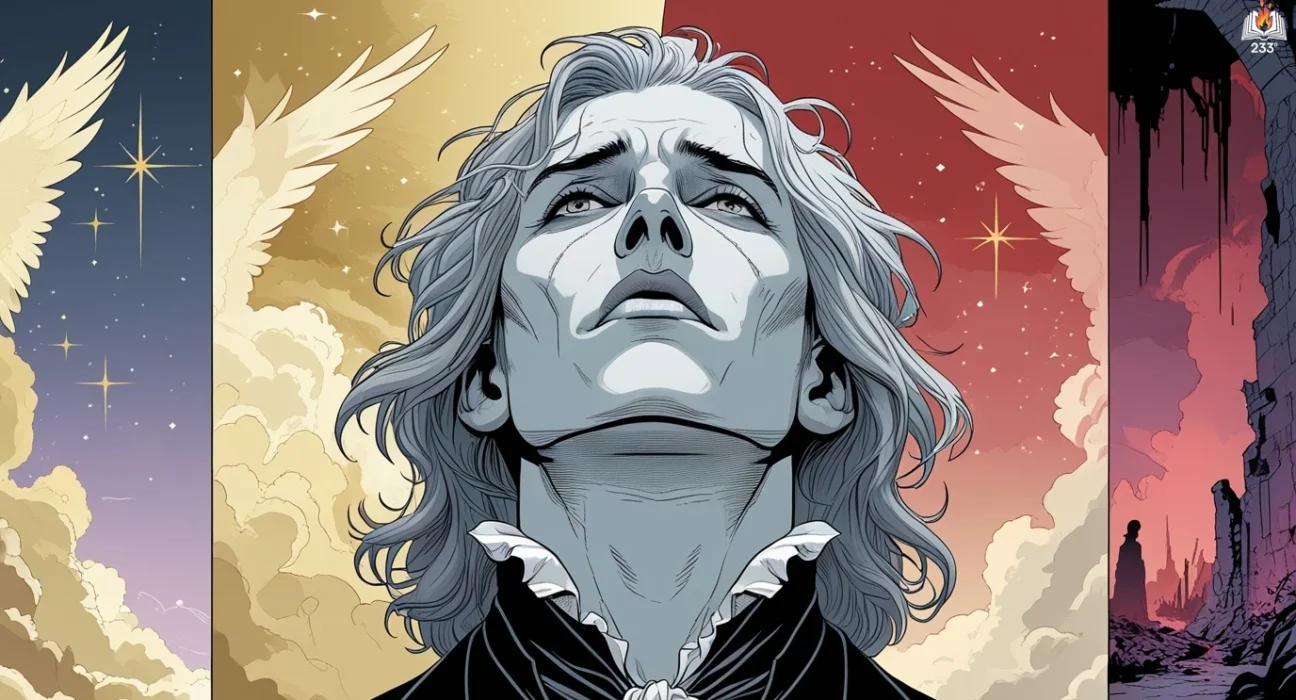
David listened as Lestat confessed the unthinkable: he was afraid. Not of enemies, not of death, but of something vast and ancient. Whispers surrounded him – pieces of conversations too surreal, too calculated, to be mortal. Something watched him from the corners of reality, and when it revealed itself, Lestat found the ground gone, the world dissolved, and a blinding light behind a towering, winged figure with a face he could not endure to look upon.
But before this terror would fully reveal its purpose, Lestat was drawn to a different soul – Roger, a man of contradiction. A drug lord who adorned himself with sacred relics, a collector of holy art steeped in sin, a father who loved his daughter with unshakable devotion. Lestat followed him not merely out of hunger but fascination. Roger was decadent and violent, but within him burned a wild, human complexity that intrigued the immortal. His daughter, Dora, glowed like a flame in a storm – a devout televangelist with a pure heart and a voice like crystal. She sang of salvation, danced with divine ecstasy, and lived alone in a crumbling convent that pulsed with quiet spirits.
Roger became the chosen victim. Lestat stalked him through the city’s underbelly, not only to drink from his veins, but to know him – to taste the twisted miracle of a soul torn between damnation and fatherly love. Lestat waited until Dora had left, then found Roger in his private shrine, a flat full of ancient crucifixes and sorrowful saints, objects stolen or bought from the bleeding hands of history. There, Lestat ended him, pulling the soul from the flesh in the savage, intimate act of vampiric feeding.
But death offered no relief from what hunted him. After the kill, the voice returned – clear, compelling, undeniable. The figure appeared again, towering, cloaked in power, wings spread like the vault of night. It did not strike. It did not chase. It spoke.
This was Memnoch.
Not a beast, not a caricature of evil, but a being of thought and agony. He claimed to be the Devil – not in opposition to God, but His servant. Once the most brilliant of angels, Memnoch said he had refused to accept God’s design that allowed humanity to suffer, to die ignorant, to worship blindly. In rebellion not of pride but of compassion, Memnoch took on the burden of Hell, shaping it not as punishment, but as a domain of enlightenment. He guided souls there to face their truth, to prepare for Heaven in full awareness.
Lestat scoffed at the tale – at first. But Memnoch beckoned him further. He showed Lestat visions beyond imagining. Together they traveled through time and space, into the very heartbeat of creation. Lestat saw the forging of Earth, the rise of humanity, the touch of God in Eden and the despair of angels watching suffering unfold. He saw Heaven – not as white clouds and harps, but as a realm of peace and order. And Hell – not flames and chains, but a place where souls wept and wandered, confronting the wounds of their mortal lives.
Memnoch revealed his argument with God – that love could not grow without knowledge, that obedience without understanding was tyranny. And so he had opposed, and for this opposition, he bore the weight of being called the Adversary.
The journey shook Lestat to his core. He met the spirit of Christ – not the sanitized idol of paintings, but a being radiant with pain and divine sorrow. Lestat witnessed the Crucifixion in grotesque intimacy, felt its despair unravel him, and held the cloth that caught the dying breath of the Nazarene. That cloth – the veil of Veronica – became the relic that would forever burn in his immortal hands.
Memnoch offered a choice. Serve him. Become the bridge between human ignorance and spiritual truth. Be the witness, the scribe, the voice that speaks of Heaven and Hell with unvarnished eyes. Lestat was torn, seduced, and terrified. In all his long life, no hunger, no power, no love had unsettled him like this proposition.
But he refused. He fled.
He awoke in blood, confused and broken, the relic of Christ clutched in his burning hands. He returned to David, a ruin of his former self, seeking solace, answers, anything to ground him. He gave Dora the veil, and in doing so ignited a storm of belief. She saw it as divine proof, a holy relic worthy of worship. Her ministry soared. She was reborn as a prophet, a saint of modern faith.
Lestat, meanwhile, descended into silence. The journey had cost him more than blood. He lay in a crypt, weakened not in body but in spirit, unable to reconcile the truths he had seen. He no longer hunted. He no longer challenged. He wept without tears, holding in his heart the image of the Devil who might not be evil, and the God who allowed suffering so that love might be chosen freely.
And through it all, Dora stood radiant before crowds, holding high the relic that now pulsed with the myth of redemption. David watched from the shadows. The vampires whispered. The veil glowed. And Lestat – the prince of night, the rebel, the monster, the seeker – lay still in darkness, dreaming of angels and demons, and the unspeakable truths that lived between them.
Main Characters
Lestat de Lioncourt: Charismatic, defiant, and introspective, Lestat is a centuries-old vampire and the narrator of the novel. Always a seeker of truth and transcendence, his arrogance is matched only by his spiritual longing. In Memnoch the Devil, Lestat is haunted by terrifying visions and pursued by a mysterious being, eventually revealed to be the Devil himself. His journey is not merely physical but existential, as he confronts the nature of good, evil, and his place in the divine order.
David Talbot: Once a mortal scholar and Talamasca elder, now a vampire made by Lestat, David serves as Lestat’s confidant and grounding force. Wise, rational, and morally steadfast, David listens with concern and empathy to Lestat’s spiraling fear and spiritual revelations. He symbolizes the voice of reason and loyalty in a tale rife with metaphysical extremes.
Memnoch (The Devil): A figure of grand contradiction, Memnoch is presented not as the archetypal embodiment of evil but as a misunderstood divine being in rebellion. He claims to be working on behalf of God, trying to elevate humanity’s spiritual awareness. Through Memnoch, Rice weaves a complex theodicy that challenges traditional religious dogma.
Dora: A mortal woman and televangelist with ethereal beauty and spiritual charisma, Dora becomes the symbol of grace and innocence in the novel. She is the daughter of Lestat’s chosen victim and stands as a pivotal figure in Lestat’s emotional and spiritual reckoning. Her purity and conviction fascinate Lestat, influencing his choices in subtle yet profound ways.
Roger: Dora’s father and Lestat’s initial “victim,” Roger is a drug lord and art collector with a deeply corrupted soul. His dichotomy—a ruthless criminal who genuinely adores his daughter—presents a moral puzzle that complicates Lestat’s feeding rituals and introduces the novel’s broader questions of redemption and damnation.
Theme
Faith and Doubt: At the heart of the novel lies a sweeping theological exploration. Lestat’s journey is a confrontation with divinity, in which he must reconcile his vampiric identity with questions of salvation, the soul, and moral consequence. Through his dialogue with Memnoch, Rice questions the justice of divine will and the role of suffering in God’s plan.
The Nature of Evil: By humanizing the Devil and presenting him as an agent of God rather than an adversary, Rice redefines traditional conceptions of evil. Memnoch’s account of history, his role in suffering, and his empathy for humanity challenge both Lestat and the reader to rethink the binary of good vs. evil.
Immortality and Isolation: As an immortal, Lestat experiences the world in deep cycles of passion and detachment. This novel accentuates the existential solitude that immortality brings, especially as Lestat contemplates eternal consequences beyond mere physical death.
Redemption and Sacrifice: The novel dwells heavily on the Christian motifs of suffering and redemption. It contemplates whether beings like Lestat can be saved, and what price must be paid to attain grace. Dora’s pure-hearted spirituality contrasts Lestat’s existential torment, serving as a symbol of unwavering faith.
Writing Style and Tone
Anne Rice’s writing in Memnoch the Devil is lush, philosophical, and densely introspective. She weaves ornate prose with theological discourse, embedding the narrative with religious imagery and metaphysical speculation. The novel is structured more like a confessional gospel than a typical vampire tale, with Lestat delivering long, passionate monologues and spiritual reflections that blur the line between divine vision and psychological breakdown.
The tone of the novel is hauntingly reflective and at times feverish, driven by Lestat’s internal anguish. Rice immerses the reader in Lestat’s turbulent psyche, conveying both awe and dread through his voice. There is a melancholic beauty to the narrative as it alternates between gothic horror and cosmic awe, constantly pushing the boundaries of genre into theological speculation. The emotional pitch remains high throughout, creating a sense of relentless questioning that mirrors Lestat’s escalating fears and revelations.
Quotes
Memnoch the Devil – Anne Rice (1995) Quotes
“Believe in angels? Then believe in vampires. Believe in me. There are worse things on earth.”
“Sometimes fear is a warning. It's like someone putting a hand on your shoulder and saying Go No Farther.”
“Heaven would be Hell in no time if every cruel, selfish, vicious soul went to Heaven.”
“Do you know what I think about crying? I think some people have to learn to do it. But once you learn, once you know how to really cry, there's nothing quite like it. I feel sorry for those who don't know the trick. It's like whistling or singing.”
“Our language needs endless synonyms for beautiful; the eyes could see what the tongue cannot possibly describe.”
“_There's no way to cheat a sensualist like me, somebody who can die laughing for hours over the pattern of the carpet in a hotel lobby.”
“Maybe this is madness. Maybe that's what Hell is. You go mad. And all your demons come and get you just as fast as you can think them up.”
“You look good to me, you damnable little devil, good to embrace and good to love.”
“How could anyone love Him? What did you just tell me yourself about the world? Don't you see, everybody hates God now. It's not that God is dead in the twentieth century. It's that everybody hates Him! At least I think so.”
“The atheism and nihilism of my earlier years now seems shallow, and even a bit cocky.”
“-You are on the verge of being truly mad. -No, not at all. Look at me. I can tie my shoelaces. See?”
“Oh, but when love is reached through suffering, it has a power it can never gain through innocence.”
“And my dark soul is happy again, because it does not know how to be anything else for very long, and because the pain is a deep dark sea in which I would drown if I did not sail my little craft steadily over the surface, towards a sun which will never rise.”
“I don't like myself, you know. I love myself, of course, I'm committed to myself till my dying day. But I don't like myself.”
“Yes, something about the fabric of life ripping for a moment so you glimpsed things you shouldn’t have seen.”
“We have souls, you and I. We want to know things; we share the same earth, rich and verdant and fraught with perils. We don't either of us know what it means to die, no matter what we might say to the contrary.”
“I crossed the street. The snow felt rather good, but then I’m a monster.”
“The waiter had set down the hot drinks, and the steam did feel glorious. The piano played Satie ever so softly. Life was almost worth living, even for a son of a bitch of a monster like myself.”
“My hands were...my strange white, slender, glittering hands.”
“He seemed even younger now, as though he were traveling backwards in time, in his mind, or merely becoming innocent, as if the dead, if they are going to stick around, have a right to remember their innocence.”
“He bent close to me, and suddenly kissed me, in a manner that seemed entirely childlike and also a bit European.”
“We are never entirely sure about each other’s powers. It’s all a game. I would no more have asked him how he got here, or in what manner, than I would ask a mortal man how precisely he made love to his wife.”
We hope this summary has sparked your interest and would appreciate you following Celsius 233 on social media:
There’s a treasure trove of other fascinating book summaries waiting for you. Check out our collection of stories that inspire, thrill, and provoke thought, just like this one by checking out the Book Shelf or the Library
Remember, while our summaries capture the essence, they can never replace the full experience of reading the book. If this summary intrigued you, consider diving into the complete story – buy the book and immerse yourself in the author’s original work.
If you want to request a book summary, click here.
When Saurabh is not working/watching football/reading books/traveling, you can reach him via Twitter/X, LinkedIn, or Threads
Restart reading!