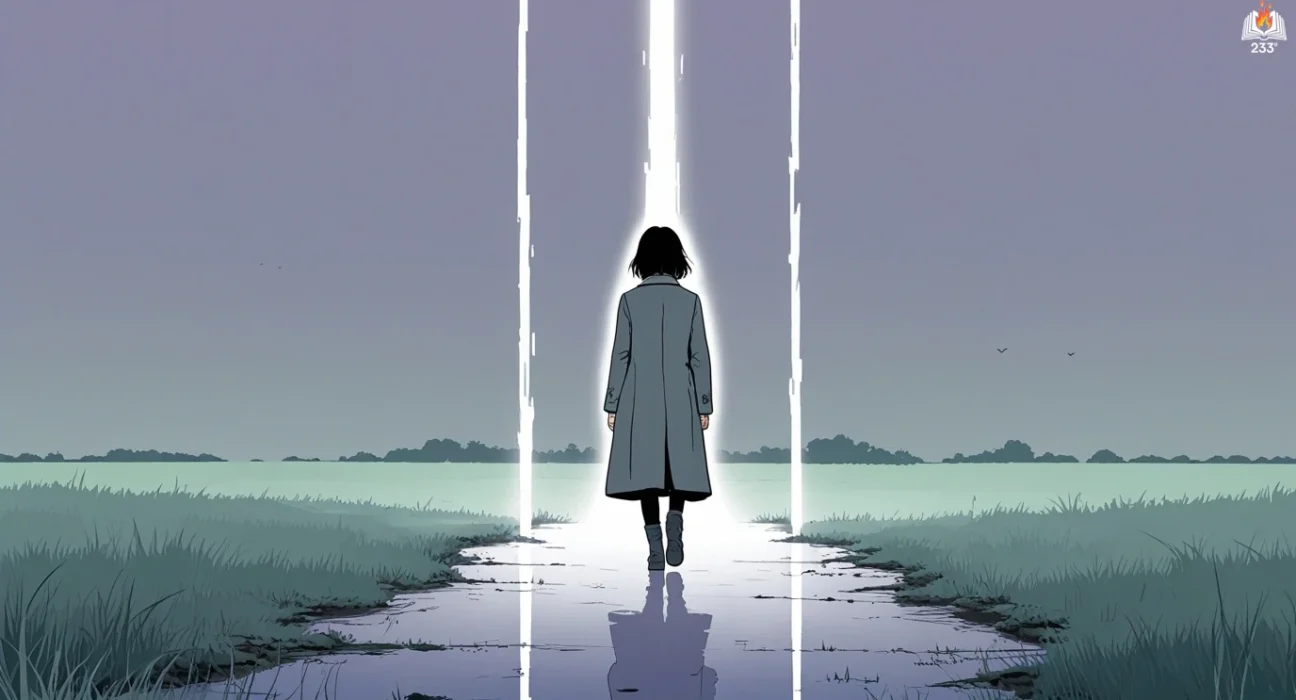
Sputnik Sweetheart by Haruki Murakami, published in 1999, is a melancholic and meditative novel that traverses the shadowy corridors of longing, loss, identity, and the ungraspable nature of love. Set across Japan and Europe, it follows an unnamed narrator as he becomes entangled in the emotional and psychological unraveling of Sumire, a quirky aspiring writer who vanishes after falling in love with a mysterious older woman named Miu. Deeply atmospheric and introspective, the novel explores not only the intricacies of human relationships but also the strange, surreal fractures that form within the self.
Plot Summary
In the spring of her twenty-second year, Sumire fell in love. The kind of love that arrives like a tornado, tearing through the familiar terrain of one’s life, scattering sense and self into the air. The woman she fell for was Miu – seventeen years her senior, refined, enigmatic, and impossibly distant. Sumire, who had never before known passion, found herself pulled into a gravitational field she couldn’t explain. She was an aspiring writer, disheveled in appearance, utterly devoted to literature and stubbornly out of step with reality. The moment Miu gently tousled her hair at a wedding reception, something inside Sumire lit up with terrifying clarity.
Drawn by a force she didn’t understand, Sumire accepted a job offer from Miu. Three days a week in an office near Harajuku – a small room with a desk, a computer, and stacks of paperwork that rarely demanded urgency. The job itself was simple, but what truly mattered was proximity. Miu existed in a realm of calm control, untouched by Sumire’s frantic inner world. To be near her was to orbit a distant star – always glowing, always unreachable.
Sumire changed. The tangle-haired Kerouac disciple began wearing tailored skirts and modest heels. She exchanged her rugged secondhand coats for neat blouses and quiet perfume. Beneath the surface, though, she remained the same – a girl whose mind spilled over with stories that refused to take shape, who lived in metaphors and long silences, who called her best friend at 4 a.m. from a phone booth to ask the difference between a sign and a symbol.
He listened. The man who loved her from a quiet distance, who taught elementary school children and accepted that his love for Sumire would remain invisible. He was the one she came to when her thoughts twisted into knots, who read her unfinished stories and cooked her dinner when she forgot to eat. He could never breach the wall between them, but he stayed near, like the moon following a ship lost at sea.
Miu invited Sumire on a business trip to a small Greek island. There, under a sky bluer than any ink she had ever spilled across a page, Sumire hoped for something unnamed – a revelation, perhaps, or a touch that might close the void between them. They shared meals, drank wine, watched the sea change colors with the hour. One night, Sumire confessed her desire, trembling and bare in her vulnerability. But Miu, frozen by a wound buried in time, could not reciprocate. Her body, her heart – something had been sealed away long ago.
Years earlier, in a foreign city, Miu had stepped into a Ferris wheel cabin and watched herself fracture. In the mirrored window, she had seen a version of herself trapped with a stranger, her body used while her mind hovered helplessly above. After that night, something vital within her had ceased to move. Her hair turned white. Her reflection no longer matched her inner self. Since then, she had lived with half a soul, untouched and untouching.
Sumire listened to this story and understood. She didn’t speak of it again. But a few days later, she vanished.
She left behind only her belongings in the hotel room – passport, clothes, even her notebooks. Miu, frantic and disoriented, called the one person she believed could find her – the man Sumire trusted most. He flew to Greece and walked through the quiet streets of the island, trying to retrace her last steps. Locals remembered seeing her. She had wandered the harbor at dawn, lost in thought. Then, nothing.
In Sumire’s computer, he found the fragments she left behind. A long, raw letter written to Miu – unsent, unfinished. In it, she detailed everything – her obsession, her loneliness, her bewilderment. And a strange dream, or vision, where she saw herself split into two – one part watching from above, the other lost in a foreign city, unable to return. The tone was calm, almost serene, like someone preparing to walk through a doorway they could not come back from.
He stayed on the island, waiting, hoping. But no one found her. Not alive, not dead. It was as if she had stepped through a hidden seam in the world and disappeared into the folds of a different reality.
He returned to Tokyo, carrying the weight of her absence like a second shadow. Months passed. Seasons turned. He continued his routines – school, books, walks through the city. Sumire remained a ghost in his mind, a name that echoed between subway announcements and the clatter of chalk on the blackboard.
Then, one night, the phone rang.
It was her. Her voice was distant, faint, but unmistakable. She spoke briefly, haltingly, from an unknown location. She said she was cold. She said she had crossed to the other side. She didn’t explain. He asked questions, desperate for answers, but the connection slipped away. The line went dead.
He waited by the phone, night after night. It never rang again.
And so, life continued. Like Sputnik, the lonely satellite Sumire had once described – orbiting the earth without a destination, transmitting signals into the void. People vanished. Love remained unspoken. The world, vast and indifferent, turned quietly on.
Main Characters
- Sumire: Sumire is a fiercely unconventional 22-year-old woman obsessed with literature, particularly Jack Kerouac. An aspiring writer who dropped out of college, she is passionate, eccentric, socially awkward, and wildly idealistic. Sumire lives in her own abstract world, disconnected from practical concerns. Her romantic and artistic longing defines her character arc – she falls deeply in love with Miu, a love that is both liberating and destructive. Her gradual emotional unraveling and mysterious disappearance form the emotional and narrative core of the novel.
- The Narrator: An unnamed elementary school teacher and Sumire’s closest friend, the narrator is rational, emotionally reserved, and quietly in love with Sumire. He serves as a stable, grounding presence, often acting as her confidant and emotional support. Though deeply introspective, he is limited in action, largely passive in the face of his own desires. His internal monologue provides the lens through which the reader experiences the story – filled with yearning, philosophical reflection, and subdued melancholy.
- Miu: Miu is a wealthy, elegant, and emotionally distant woman in her late thirties. She becomes the object of Sumire’s affection and hires her as a personal assistant. Miu is composed and refined, yet harbors a traumatic secret that has fractured her ability to feel romantic or sexual connection. Her past – marked by a surreal psychological event – haunts her, and her inability to reciprocate Sumire’s passion plays a central role in the emotional disintegration that follows.
Theme
- Unrequited Love and Emotional Distance: Every major relationship in the novel exists in a triangle of longing: Sumire loves Miu, who cannot love her back; the narrator loves Sumire, who sees him only as a friend. These unfulfilled connections illustrate Murakami’s recurring meditation on emotional inaccessibility – the pain of loving someone who exists just beyond reach. Love in Sputnik Sweetheart is an isolating force rather than a unifying one.
- Identity and Fragmentation: The novel repeatedly explores the notion of a fragmented self. Miu’s mysterious experience in a Ferris wheel results in a literal split of identity. Sumire feels incomplete, as if she hasn’t yet formed into a whole person. The narrator, too, feels like a passive observer in his own life. Murakami uses these fractures to symbolize the existential uncertainty and the surreal discontinuities of modern identity.
- Isolation and Loneliness: Characters are often depicted in solitude, wandering cities or musing in quiet apartments. Sumire and the narrator both experience profound alienation despite their emotional closeness. The image of Sputnik – a satellite traveling alone through the void of space – becomes a powerful metaphor for emotional isolation and human disconnection in the vastness of existence.
- The Role of Art and Literature: Sumire’s identity is deeply tied to her literary aspirations, her love for Kerouac, and her compulsion to write. Her struggle to find a narrative form that contains both beginning and end mirrors her emotional chaos. Literature in the novel is both a means of self-expression and a mirror that reveals internal fragmentation.
- Surrealism and the Supernatural: Murakami employs subtle surrealism – notably through Miu’s traumatic dissociation and Sumire’s mysterious disappearance – to blur the lines between reality and the subconscious. These dreamlike elements underscore the idea that our inner lives are just as real, if not more so, than the tangible world.
Writing Style and Tone
Haruki Murakami’s style in Sputnik Sweetheart is spare, lucid, and deeply introspective. He combines conversational narration with philosophical musings, creating an atmosphere of quiet melancholy. His prose often dips into poetic rhythms when characters reflect on love, music, or the mysteries of life. Dialogue is minimal but resonant, charged with emotional undercurrents. His use of first-person narration renders the novel deeply personal and emotionally intimate.
The tone of the novel is meditative and wistful, permeated by an ache for something lost or unreachable. There’s a quiet sadness to the way the characters move through their days – always searching for connection, meaning, or the missing pieces of themselves. At times, the novel veers into the surreal, but even these moments are grounded by Murakami’s calm, almost detached prose. This understated emotional register amplifies the haunting quality of the story, making it feel like a dream you’re only half awake in.
Quotes
Sputnik Sweetheart – Haruki Murakami (1999) Quotes
“Why do people have to be this lonely? What's the point of it all? Millions of people in this world, all of them yearning, looking to others to satisfy them, yet isolating themselves. Why? Was the earth put here just to nourish human loneliness?”
“I dream. Sometimes I think that's the only right thing to do.”
“I have this strange feeling that I'm not myself anymore. It's hard to put into words, but I guess it's like I was fast asleep, and someone came, disassembled me, and hurriedly put me back together again. That sort of feeling.”
“The answer is dreams. Dreaming on and on. Entering the world of dreams and never coming out. Living in dreams for the rest of time.”
“Sometimes I feel so- I don’t know - lonely. The kind of helpless feeling when everything you’re used to has been ripped away. Like there’s no more gravity, and I’m left to drift in outer space with no idea where I’m going’ Like a little lost Sputnik?’ I guess so.”
“We're both looking at the same moon, in the same world. We're connected to reality by the same line. All I have to do is quietly draw it towards me.”
“In dreams you don't need to make any distinctions between things. Not at all. Boundaries don't exist. So in dreams there are hardly ever collisions. Even if there are, they don't hurt. Reality is different. Reality bites. Reality, reality.”
“Don't pointless things have a place, too, in this far-from-perfect world?”
“If they invent a car that runs on stupid jokes, you could go far.”
“In the world we live in, what we know and what we don't know are like Siamese twins, inseparable, existing in a state of confusion.”
“Maybe it's just hiding somewhere. Or gone on a trip to come home. But falling in love is always a pretty crazy thing. It might appear out of the blue and just grab you. Who knows
“We each have a special something we can get only at a special time of our life. like a small flame. A careful, fortunate few cherish that flame, nurture it, hold it as a torch to light their way. But once that flame goes out, it’s gone forever.”
“There weren't any curtains in the windows, and the books that didn't fit into the bookshelf lay piled on the floor like a bunch of intellectual refugees.”
“Don't pointless things have a place, too, in this far-from-perfect world? Remove everything pointless from an imperfect life, and it'd lose even its imperfection.”
“Understanding is but the sum of misunderstandings.”
“Was the earth put here just to nourish human loneliness?”
We hope this summary has sparked your interest and would appreciate you following Celsius 233 on social media:
There’s a treasure trove of other fascinating book summaries waiting for you. Check out our collection of stories that inspire, thrill, and provoke thought, just like this one by checking out the Book Shelf or the Library
Remember, while our summaries capture the essence, they can never replace the full experience of reading the book. If this summary intrigued you, consider diving into the complete story – buy the book and immerse yourself in the author’s original work.
If you want to request a book summary, click here.
When Saurabh is not working/watching football/reading books/traveling, you can reach him via Twitter/X, LinkedIn, or Threads
Restart reading!