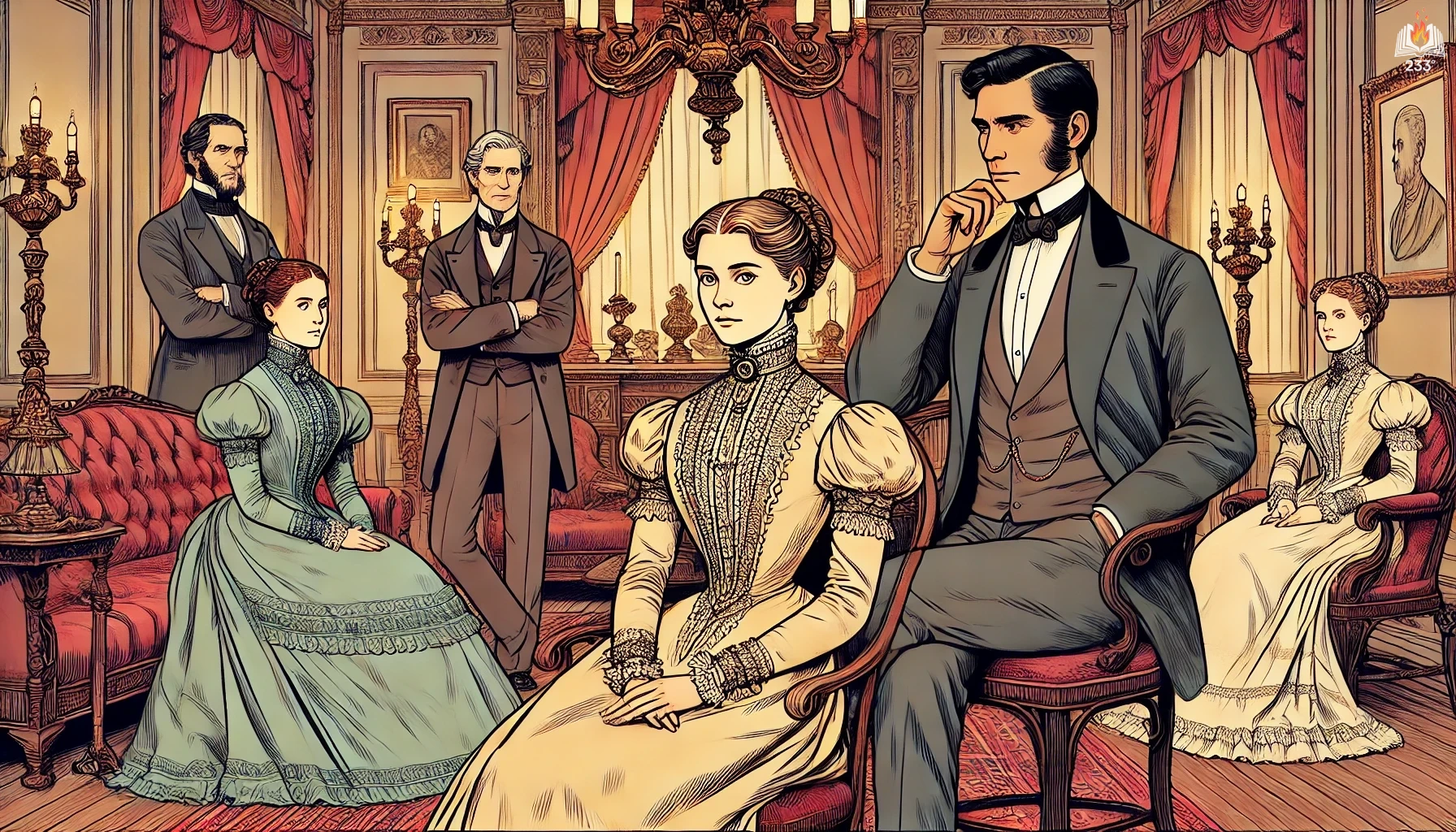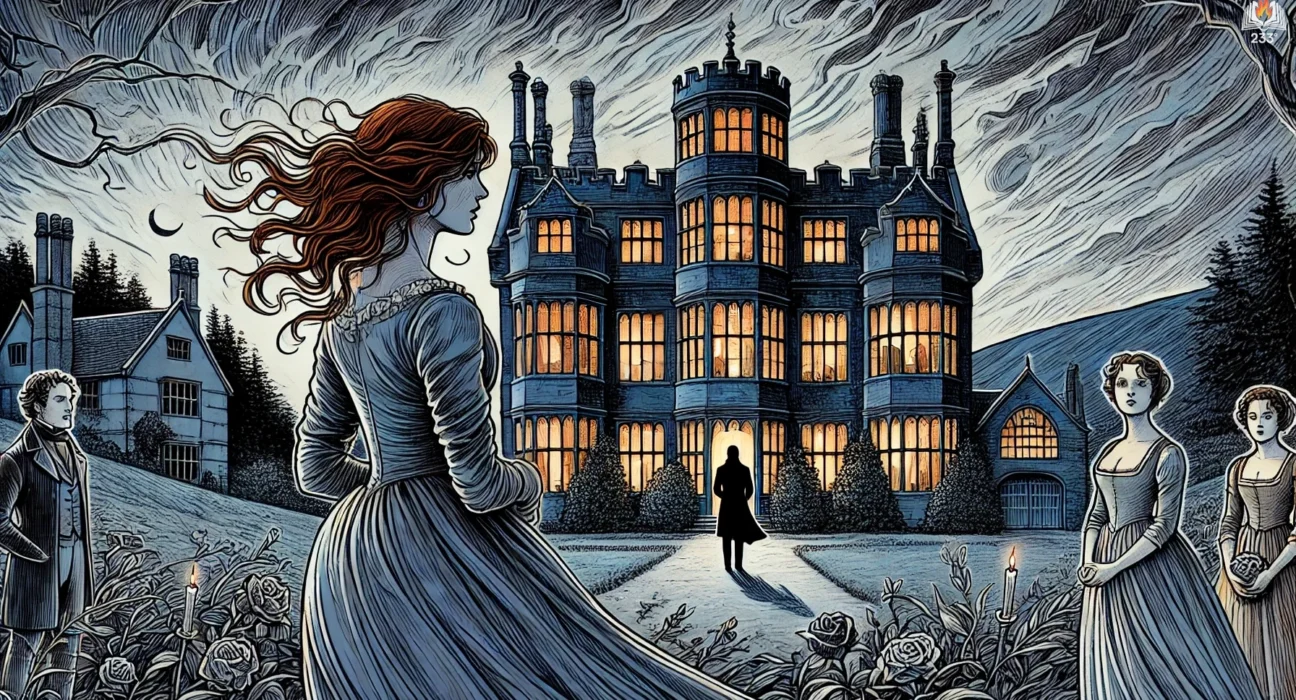
Jane Eyre, first published in 1847, is a novel by English writer Charlotte Brontë. The story follows the life of an orphaned girl named Jane Eyre as she grows into adulthood and searches for a sense of belonging, love, and purpose. The novel is widely regarded as one of the greatest works of English literature, blending elements of Gothic romance, social criticism, and a rich exploration of personal morality and independence. Through the protagonist’s emotional and psychological development, Brontë addresses complex themes such as class, gender, and spirituality.
Plot Summary
Jane Eyre, a young orphan, grows up in the care of her cruel aunt, Mrs. Reed, at Gateshead Hall. The household is cold and hostile towards her, especially her cousin John, who torments her relentlessly. Isolated and mistreated, Jane’s only comfort is her vivid imagination and the books she escapes into. However, one fateful incident of rebellion against John’s bullying leads Jane to be locked in the dreaded “red room,” where her uncle died. The room terrifies her, and the psychological toll of her mistreatment reaches a breaking point.
Mrs. Reed, eager to rid herself of Jane, sends her to Lowood School, a strict and harsh institution for orphaned girls. There, Jane faces severe conditions under the hypocritical Mr. Brocklehurst, the school’s headmaster, whose sermons on humility and piety contrast with the lavishness enjoyed by his own family. Despite the cold, hunger, and illness that plague Lowood, Jane forms a meaningful friendship with Helen Burns, a kind and devout girl whose quiet suffering leaves a deep impact on Jane. Helen’s death from consumption further strengthens Jane’s resolve to survive. Jane also finds a motherly figure in Miss Temple, the school’s superintendent, whose kindness and intelligence inspire Jane to pursue her own independence.
After six years as a student and two more as a teacher at Lowood, Jane yearns for freedom and new experiences. She advertises for a position as a governess and is soon offered employment at Thornfield Hall. When she arrives at the imposing estate, she meets her pupil, the lively and affectionate Adele Varens, and Mrs. Fairfax, the kindly housekeeper. Jane’s life at Thornfield is quiet but content until she meets the master of the house, Edward Rochester, a dark and brooding figure whose presence alters the course of her life.
Rochester is enigmatic and unpredictable, often conversing with Jane in ways that challenge and intrigue her. Despite the differences in their social standing, a bond forms between them, one that grows deeper as they spend more time together. However, strange occurrences within the halls of Thornfield disturb Jane. Eerie laughter and mysterious incidents, such as a fire in Rochester’s room, unsettle her, but Rochester dismisses her concerns, attributing them to Grace Poole, a servant with peculiar habits.
Rochester’s growing affection for Jane culminates when he declares his love for her, and they become engaged. Jane, despite her deep love for him, remains grounded in her principles, refusing to be swayed by wealth or status. The night before their wedding, Jane experiences a haunting vision of a spectral figure in her room, further amplifying the sense of foreboding. The next day, during the wedding ceremony, a shocking revelation comes to light—Rochester is already married.
Jane learns that Rochester’s wife, Bertha Mason, whom he had wed years ago in Jamaica, is living in the attic of Thornfield. Bertha, who suffers from violent madness, has been hidden away for years under the care of Grace Poole. Rochester admits he was deceived into the marriage by Bertha’s family, who concealed her mental illness. Though he begs Jane to stay with him, promising her a life of love despite the scandal, Jane’s moral compass refuses to allow her to live as his mistress. Heartbroken but resolute, she leaves Thornfield, choosing her integrity over her passion.
Jane’s flight from Thornfield leads her into hardship. Penniless and alone, she wanders the moors until she is taken in by the Rivers family—St. John, a stern clergyman, and his sisters, Diana and Mary. Jane recovers her strength and takes a position as a village schoolteacher. Over time, she forms a close bond with the Rivers siblings, especially with St. John, though his cold demeanor leaves Jane unsettled. Eventually, Jane learns that she is related to the Rivers family and that she has inherited a large fortune from her uncle, John Eyre. Overjoyed by the newfound family and wealth, she shares her inheritance with her cousins.
St. John, driven by his rigid sense of duty, asks Jane to marry him and accompany him to India as a missionary. Though she respects his convictions, Jane refuses, knowing that theirs would be a loveless marriage built on duty rather than affection. Her heart still belongs to Rochester, and a mysterious voice calling her name in the wind strengthens her resolve to return to him.
Jane makes her way back to Thornfield, only to find the grand estate in ruins. She learns that Bertha Mason set fire to the house and, in the ensuing chaos, Rochester lost his sight and one of his hands while trying to save her. Bertha perished in the flames. Jane seeks him out at Ferndean, a remote manor where he now lives, isolated and blind. When Jane and Rochester are reunited, she finds him a changed man—humbled, repentant, and deeply vulnerable.
Their love, tested by trials and separation, now flourishes in a new, equal partnership. Jane marries Rochester, and their life together is marked by mutual respect and devotion. Rochester slowly regains partial sight, allowing him to see their first child. In the end, Jane finds the belonging and love she has sought all her life, not by sacrificing her independence, but by asserting it and finding a love that complements her strength.
Main Characters
Jane Eyre: The novel’s protagonist, Jane is a passionate, intelligent, and resilient young woman. Orphaned as a child, she faces numerous hardships growing up, but she is determined to maintain her dignity and independence. Her journey from mistreated orphan to strong, self-assured woman is central to the narrative, and her character embodies themes of self-respect, morality, and emotional resilience.
Edward Rochester: Jane’s employer and eventual love interest, Rochester is a brooding, complex figure. He is portrayed as both cynical and romantic, grappling with his own dark past. His relationship with Jane is turbulent, marked by intense emotions and secrets, but he grows as a character, learning about love, redemption, and equality in relationships.
St. John Rivers: A clergyman and Jane’s cousin, St. John is a stern and deeply religious man. He represents a foil to Rochester, offering Jane a life of duty and self-denial. Though well-meaning, his rigid adherence to his faith and sense of duty makes him emotionally cold and unyielding, contrasting sharply with Jane’s passion and independence.
Mrs. Reed: Jane’s cruel aunt, who raises her at Gateshead Hall. Mrs. Reed resents Jane and treats her harshly, favoring her own children. Her treatment of Jane sets the stage for the young girl’s early hardships and quest for love and acceptance.
Bertha Mason: The mysterious wife of Mr. Rochester, Bertha is kept hidden in Thornfield Hall. Her character, often seen as a symbol of unchecked passion and madness, plays a critical role in the novel’s Gothic atmosphere and in the moral dilemmas Rochester and Jane face.
Theme
Independence and Self-Respect: Jane Eyre’s journey is one of personal growth, where her independence and sense of self-worth are tested repeatedly. From her early life as an orphan to her experiences at Thornfield and beyond, Jane maintains her integrity and refuses to compromise her values, especially when it comes to love and morality. The novel explores what it means to be self-sufficient and how personal respect is essential to a fulfilling life.
Love versus Autonomy: A central theme in the novel is the tension between love and autonomy. Jane deeply loves Mr. Rochester, but she refuses to stay with him when it compromises her moral beliefs. The novel suggests that true love does not involve submission or sacrifice of personal values but rather a partnership of equals.
Social Class and Gender Roles: Jane Eyre tackles the strict social hierarchy of 19th-century England, exploring how class and gender limit opportunities. Jane, a poor orphan, is constantly reminded of her social inferiority but refuses to be defined by it. The novel critiques the rigid class structure and the subordinate position of women, advocating for equality in relationships and society.
Religion and Morality: Religion plays a significant role in shaping the characters’ lives. Jane is influenced by Christian values, but her understanding of religion emphasizes compassion and forgiveness over strict adherence to rules. St. John Rivers represents a more austere and duty-bound form of faith, while Rochester’s journey is one of seeking redemption. Brontë contrasts these perspectives, ultimately advocating for a balanced, humane spirituality.
Gothic Elements: The novel incorporates many Gothic elements, including the eerie atmosphere of Thornfield Hall, the mysterious figure of Bertha Mason, and the supernatural overtones that underscore Jane’s emotional and moral journey. These Gothic motifs heighten the novel’s tension and symbolize the inner struggles of its characters.
Writing Style and Tone
Charlotte Brontë’s writing in Jane Eyre is marked by its first-person narrative style, which allows readers to experience the world through Jane’s intimate and reflective voice. The language is rich with emotion, capturing Jane’s internal struggles and her evolving sense of self. Brontë uses vivid descriptions, particularly of landscapes and settings, to evoke mood and reflect Jane’s emotional state. The detailed portrayal of Thornfield Hall, for instance, mirrors the mysteries and turmoil Jane faces in her relationship with Rochester.
The tone of Jane Eyre shifts throughout the novel, from bleak and oppressive during Jane’s childhood at Gateshead and Lowood to more hopeful and romantic as she arrives at Thornfield. There is a strong undercurrent of melancholy and introspection, but Jane’s resilience and determination prevent the novel from feeling overly tragic. Brontë balances moments of intense emotional drama with quieter reflections on morality, love, and freedom. The novel’s tone also carries a feminist edge, as Jane’s thoughts often challenge the societal expectations imposed on women of her time.
Quotes
Jane Eyre – Charlotte Brontë (1847) Quotes
“I am no bird; and no net ensnares me: I am a free human being with an independent will.”
“I would always rather be happy than dignified.”
“Do you think I am an automaton?
“ I care for myself. The more solitary, the more friendless, the more unsustained I am, the more I will respect myself.”
“Life appears to me too short to be spent in nursing animosity or registering wrongs.”
“I do not think, sir, you have any right to command me, merely because you are older than I, or because you have seen more of the world than I have; your claim to superiority depends on the use you have made of your time and experience.”
“If all the world hated you and believed you wicked, while your own conscience approved of you and absolved you from guilt, you would not be without friends.”
“Jane, be still; don't struggle so like a wild, frantic bird, that is rending its own plumage in its desperation." "I am no bird; and no net ensnares me; I am a free human being, with an independent will; which I now exert to leave you.”
“I am not an angel,' I asserted; 'and I will not be one till I die: I will be myself. Mr. Rochester, you must neither expect nor exact anything celestial of me - for you will not get it, any more than I shall get it of you: which I do not at all anticipate.”
“I can live alone, if self-respect, and circumstances require me so to do. I need not sell my soul to buy bliss. I have an inward treasure born with me, which can keep me alive if all extraneous delights should be withheld, or offered only at a price I cannot afford to give.”
“Reader, I married him.”
“Prejudices, it is well known, are most difficult to eradicate from the heart whose soil has never been loosened or fertilised by education: they grow there, firm as weeds among stones.”
“Every atom of your flesh is as dear to me as my own: in pain and sickness it would still be dear.”
“I had not intended to love him; the reader knows I had wrought hard to extirpate from my soul the germs of love there detected; and now, at the first renewed view of him, they spontaneously revived, great and strong! He made me love him without looking at me.”
“Flirting is a woman’s trade, one must keep in practice.”
“All my heart is yours, sir: it belongs to you; and with you it would remain, were fate to exile the rest of me from your presence forever.”
“The soul, fortunately, has an interpreter - often an unconscious but still a faithful interpreter - in the eye.”
“I ask you to pass through life at my side—to be my second self, and best earthly companion.”
“I have little left in myself -- I must have you. The world may laugh -- may call me absurd, selfish -- but it does not signify. My very soul demands you: it will be satisfied, or it will take deadly vengeance on its frame.”
“There is no happiness like that of being loved by your fellow creatures, and feeling that your presence is an addition to their comfort.”
“Even for me life had its gleams of sunshine.”
“Laws and principles are not for the times when there is no temptation: they are for such moments as this, when body and soul rise in mutiny against their rigour ... If at my convenience I might break them, what would be their worth?”
“Good-night, my-" He stopped, bit his lip, and abruptly left me.”
We hope this summary has sparked your interest and would appreciate you following Celsius 233 on social media:
There’s a treasure trove of other fascinating book summaries waiting for you. Check out our collection of stories that inspire, thrill, and provoke thought, just like this one by checking out the Book Shelf or the Library
Remember, while our summaries capture the essence, they can never replace the full experience of reading the book. If this summary intrigued you, consider diving into the complete story – buy the book and immerse yourself in the author’s original work.
If you want to request a book summary, click here.
When Saurabh is not working/watching football/reading books/traveling, you can reach him via Twitter/X, LinkedIn, or Threads
Restart reading!