The Trial by Franz Kafka, first published posthumously in 1925, follows Josef K., a seemingly ordinary man who is unexpectedly arrested by an obscure authority on unspecified charges. As he tries to navigate the bureaucratic and surreal process of defending himself, Kafka portrays a world where justice, reason, and individual agency are meaningless. The novel’s exploration of guilt, powerlessness, and alienation has made it one of the defining works of 20th-century literature, and it is often cited as a prime example of the “Kafkaesque”—an adjective used to describe absurd, oppressive, and nightmarish situations.
Plot Summary
One morning, Josef K., a chief clerk at a bank, wakes up to find himself unexpectedly arrested in his own apartment by two warders, Franz and Willem. Confused, he asks them why he’s been arrested, but they offer no explanation. They simply tell him that legal proceedings are underway, and he will be informed of the charges against him in due course. His landlady, Mrs. Grubach, is equally puzzled by the intrusion but believes that Josef is a respectable man who must have been falsely accused.
Despite the arrest, Josef is allowed to continue with his daily life, going to work as usual. His initial indignation over the absurdity of the situation fades into confusion. He becomes determined to meet with those responsible for his arrest and clear up the misunderstanding. Soon after, he receives a summons to appear at a hearing, though the details are vague.
Josef arrives at the designated location, a dilapidated building in a poor neighborhood. There, he is ushered into a room that looks nothing like a courtroom but is filled with curious onlookers, all part of the mysterious legal system. Josef meets the Examining Magistrate, a figure of authority who seems to hold power over his fate, but the hearing is chaotic, and Josef’s attempts to defend himself are met with laughter and apathy. He finds himself caught in a web of obscure rules, unable to make sense of the proceedings. The hearing concludes without any clear outcome, leaving Josef more frustrated and confused than before.
As Josef navigates this bewildering process, he consults several people for advice. One such person is a court painter named Titorelli, whom he visits at his cramped, stuffy studio. Titorelli claims to know the inner workings of the court and offers Josef dubious advice. He explains that the court’s judgments are predetermined, and even if Josef proves his innocence, the trial will continue indefinitely. Titorelli presents three options, none of which provide Josef with true freedom—an acquittal, endless postponement, or a pro forma guilt. None of these choices satisfy Josef, who leaves Titorelli’s studio more hopeless than before.
Throughout his ordeal, Josef’s personal life begins to unravel. His relationships become strained, particularly with Fräulein Bürstner, a young woman who lives in his building. Josef’s infatuation with her grows as his trial deepens, and he seeks her out, hoping for some kind of human connection. One evening, he enters her room under the pretext of apologizing for the intrusion caused by the warders on the morning of his arrest. However, the conversation takes an uncomfortable turn, and he kisses her, an act that leaves him feeling conflicted.
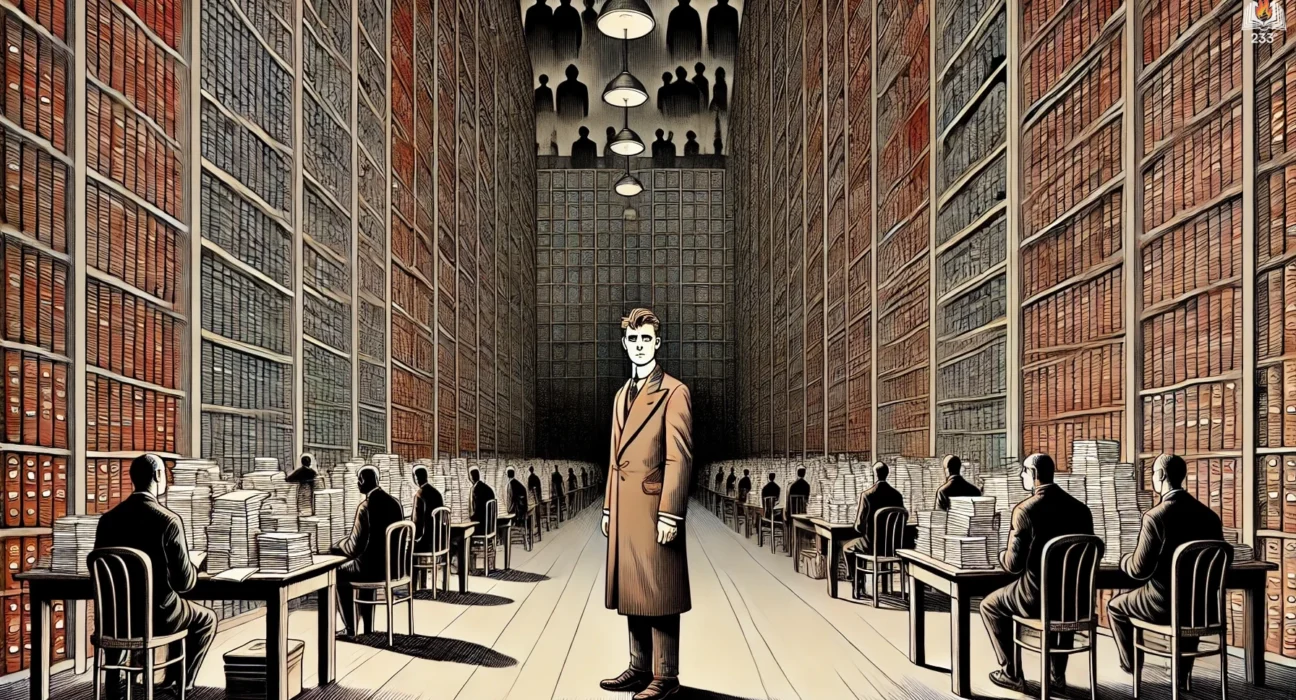
As the trial drags on, Josef’s work at the bank starts to suffer. His professional standing deteriorates, and his superiors begin to view him with suspicion. His once-confident demeanor gives way to anxiety and fear. Josef’s life spirals into disarray as he is consumed by the trial, which seems to invade every aspect of his existence. The court, shrouded in mystery, operates behind closed doors, and Josef is never given access to any official documents. The labyrinthine bureaucracy only serves to deepen his sense of helplessness.
Desperate for help, Josef turns to his uncle, who introduces him to an eccentric lawyer named Huld. The lawyer is ill, bedridden, and surrounded by a host of strange visitors, including Leni, his seductive nurse, who takes an immediate interest in Josef. Despite her flirtations, Josef feels trapped in yet another layer of this bizarre world. Huld offers little concrete assistance, and it becomes clear that he is just as much a part of the system as those who arrested Josef. Josef grows increasingly disillusioned and dismisses Huld, believing he can handle the situation on his own.
Time passes, and Josef hears little from the court. His life becomes an aimless journey as he drifts further from his old routines. He learns more about the court from various people, including a prisoner who lives in the same building and spends his days poring over court records. The knowledge Josef gains does nothing to clarify his situation; instead, it reinforces the hopelessness of his case. Everyone he speaks to seems powerless in the face of the court’s overwhelming and impenetrable authority.
As Josef approaches his thirty-first birthday, he is summoned by two men to a secluded quarry on the outskirts of the city. Though he knows what this means, Josef offers no resistance, passively following the men as they take him to his final judgment. They lead him to a desolate pit and hand him a knife. Josef, in a moment of despair, realizes that he is expected to carry out his own execution. He hesitates, hoping for some intervention, some last-minute reprieve, but none comes. One of the men takes the knife and plunges it into Josef’s heart.
His final thought is of shame, as if he has failed not only himself but everyone around him. Josef dies without ever knowing the nature of his crime, without ever understanding the system that condemned him. The trial, from beginning to end, remains an incomprehensible force, an all-consuming entity that has stripped him of his dignity, freedom, and, ultimately, his life.
Main Characters
Josef K.: The protagonist, a chief clerk at a bank, who is arrested for an unspecified crime. Over the course of the novel, Josef’s initial confidence deteriorates as he becomes entangled in the convoluted legal proceedings. His journey is marked by growing confusion, isolation, and helplessness, reflecting Kafka’s themes of alienation and existential anxiety.
Mrs. Grubach: Josef K.’s landlady, who seems to be sympathetic to his plight. Her relationship with Josef underscores his connection to the mundane world, and her perspective on his arrest brings a hint of social judgment.
Fräulein Bürstner: A neighbor of Josef K. and a typist. Josef is romantically interested in her, and she represents a form of normalcy that he clings to. Their interactions reveal his frustration with the increasing absurdity of his situation.
The Inspector and The Warders (Franz and Willem): These characters initiate Josef K.’s arrest in the opening scenes. They personify the inexplicable and oppressive nature of the authority that Josef faces. Their casual cruelty and disregard for justice emphasize the dehumanizing bureaucracy in Kafka’s world.
The Examining Magistrate: A figure of authority who presides over Josef’s first hearing. He embodies the opaque and impenetrable legal system that Josef must contend with, further complicating Josef’s attempts to understand or influence the process.
Theme
Absurdity of Justice: One of the novel’s most striking themes is the absurdity of the justice system. Josef K. is arrested and put through a trial without ever being informed of his crime. Kafka uses this to explore how individuals are powerless in the face of faceless, indifferent authorities, where logic and reason fail.
Alienation and Isolation: Josef’s detachment from others grows as he becomes more entangled in his trial. Kafka uses this alienation to explore the modern human condition, where people are estranged not only from the system but from each other and even themselves.
Guilt and Innocence: Though Josef K. maintains his innocence, his arrest and subsequent treatment make him question his own sense of guilt. Kafka blurs the lines between guilt and innocence, suggesting that societal judgment can impose guilt regardless of actual wrongdoing.
Bureaucracy as Oppression: Kafka critiques the dehumanizing effects of bureaucracy. The court system in The Trial is labyrinthine and opaque, a machine that grinds Josef down through endless, meaningless procedures, reflecting the overwhelming power of institutions over individuals.
Writing Style and Tone
Kafka’s writing in The Trial is characterized by a clear, almost clinical style that heightens the surreal, nightmarish nature of the events. His language is straightforward, but the situations he describes are bizarre and disorienting, creating a sharp contrast between the absurd content and the calm, rational tone. This juxtaposition reinforces the sense of alienation and hopelessness that permeates the novel. The narrative is often detached, which mirrors Josef K.’s growing emotional numbness as he grapples with an incomprehensible legal system.
Kafka also employs a fragmented, episodic structure that reflects Josef’s psychological disintegration. The dialogue in the novel is often circular and evasive, mirroring the endless bureaucracy Josef faces. Kafka’s use of repetition—especially in descriptions of legal proceedings and characters’ evasive responses—contributes to the oppressive atmosphere, making it feel as though Josef is caught in an inescapable loop.
The tone of The Trial is predominantly dark and oppressive, with occasional moments of absurd humor. The humor, however, is never reassuring; it instead highlights the cruel irony of Josef’s situation. Kafka’s tone evokes a sense of futility, where even moments of resistance or clarity are swallowed by the overwhelming absurdity of the world Josef inhabits.
Quotes
The Trial – Franz Kafka (1925) Quotes
“It's only because of their stupidity that they're able to be so sure of themselves.”
“It would have been so pointless to kill himself that, even if he had wanted to, the pointlessness would have made him unable.”
“From a certain point onward there is no longer any turning back. That is the point that must be reached.”
“They're talking about things of which they don't have the slightest understanding, anyway. It's only because of their stupidity that they're able to be so sure of themselves.”
“it is not necessary to accept everything as true, one must only accept it as necessary.' 'A melancholy conclusion,' said K. 'It turns lying into a universal principle.”
“Logic may indeed be unshakeable, but it cannot withstand a man who is determined to live.”
“No," said the priest, "you don't need to accept everything as true, you only have to accept it as necessary." "Depressing view," said K. "The lie made into the rule of the world.”
“The books we need are of the kind that act upon us like a misfortune, that makes us suffer like the death of someone we love more than ourselves, that make us feel as though we were on the verge of suicide, lost in a forest remote from all human habitation.”
“The right understanding of any matter and a misunderstanding of the same matter do not wholly exclude each other.”
“But I’m not guilty,” said K. “there’s been a mistake. How is it even possible for someone to be guilty? We’re all human beings here, one like the other.” “That is true” said the priest “but that is how the guilty speak”
“You must not pay too much attention to opinions. The written word is unalterable, and opinions are often only an expression of despair.”
“Someone must have slandered Josef K., for one morning, without having done anything truly wrong, he was arrested.”
“Like a dog!" he said, it was as if the shame of it should outlive him.”
“It is not necessary to accept everything as true, one must only accept it as necessary”
“I like to make use of what I know”
“I see, these books are probably law books, and it is an essential part of the justice dispensed here that you should be condemned not only in innocence but also in ignorance.”
“Next time I come here," he said to himself, "I must either bring sweets with me to make them like me or a stick to hit them with.”
“Judgement does not come suddenly; the proceedings gradually merge into the judgement.”
“It's sometimes quite astonishing that a single, average life is enough to encompass so much that it's at all possible ever to have any success in one's work here.”
“The moonlight lay everywhere with the natural peace that is granted to no other light.”
“You do not need to accept everything as true, you only have to accept it as necessary.”
“Don't concern yourself about anybody. Just do what you think is right.”
“You're not cross with me, though?" he said. She pulled her hand away and answered, "No, no, I'm never cross with anyone.”
“If he stayed at home and carried on with his normal life he would be a thousand times superior to these people and could get any of them out of his way just with a kick.”
We hope this summary has sparked your interest and would appreciate you following Celsius 233 on social media:
There’s a treasure trove of other fascinating book summaries waiting for you. Check out our collection of stories that inspire, thrill, and provoke thought, just like this one by checking out the Book Shelf or the Library
Remember, while our summaries capture the essence, they can never replace the full experience of reading the book. If this summary intrigued you, consider diving into the complete story – buy the book and immerse yourself in the author’s original work.
If you want to request a book summary, click here.
When Saurabh is not working/watching football/reading books/traveling, you can reach him via Twitter/X, LinkedIn, or Threads
Restart reading!