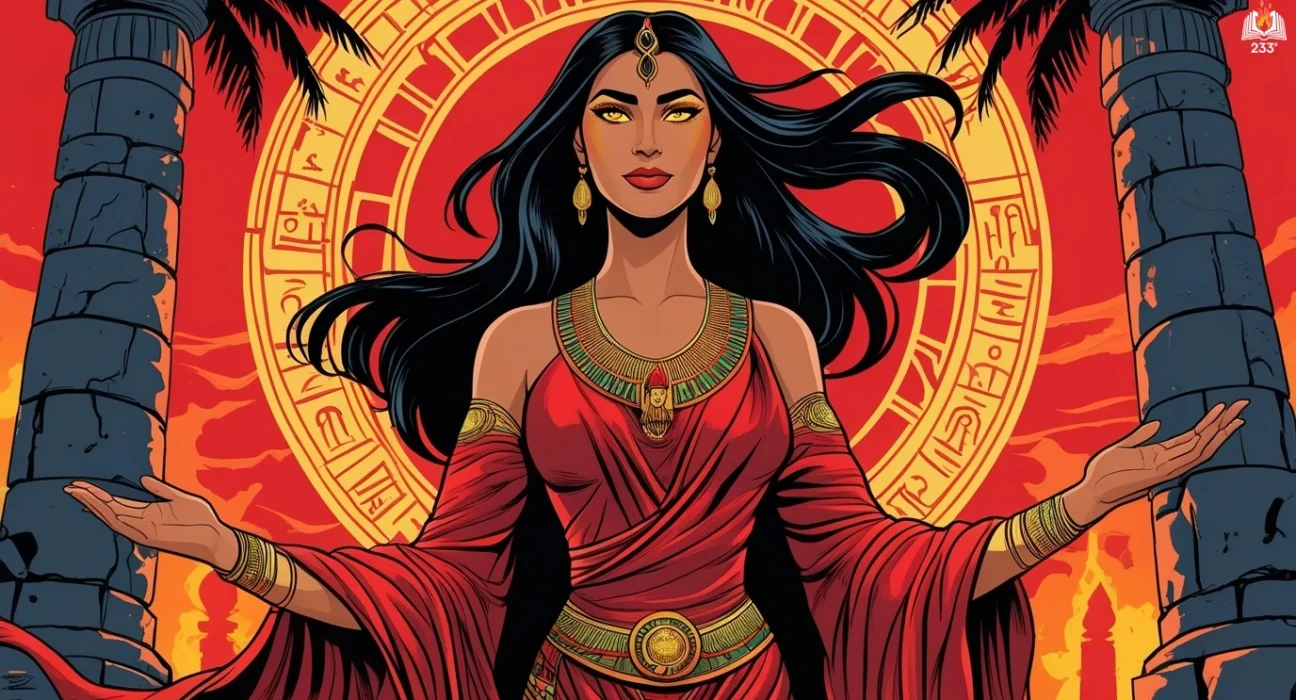
The Queen of the Damned by Anne Rice, published in 1988, is the third installment in the celebrated The Vampire Chronicles series. Continuing directly after The Vampire Lestat, this novel expands Rice’s vampire mythos with a sweeping, multilayered narrative that reaches into ancient history and stretches across continents. Told through multiple perspectives, it intertwines the rock-star exploits of Lestat with an impending supernatural cataclysm that traces back to the origins of vampirism itself. At the heart of the tale is Akasha, the eponymous queen, whose awakening sets into motion a chain of events that threatens vampirekind—and humanity at large
Plot Summary
In a world humming with ancient secrets and modern sounds, the Vampire Lestat dared to do what no immortal had done before – rise to fame among mortals, strutting beneath stage lights and howling through amplifiers, seducing the world with songs steeped in the blood of ancient truth. His concerts shook more than arenas. They woke the dead.
As his voice spiraled through speakers, something stirred deep beneath the earth. Akasha, the first vampire, the silent queen who had slept for six thousand years beside her consort Enkil, awoke. Drawn by Lestat’s music, his audacity, his invitation to join the mortal world, she rose from stillness with a purpose forged long before the birth of kingdoms. Enkil remained unmoving, a hollow shadow. Akasha drank him dry and left him as a brittle shell of forgotten royalty.
Unbeknownst to Lestat, his voice had summoned not only the Queen but others – watchers, seekers, and the ancient guardians of their kind. Across continents, vampires and scholars felt the ripples. The Talamasca’s Jesse Reeves, fascinated by Lestat’s legacy and haunted by her own connection to the immortal Maharet, followed the path of symbols and songs, stepping into darkness willingly. Maharet, the red-haired immortal who had lived in silence, tending the vast human family she traced through millennia, felt the winds shift. Her twin, Mekare, long lost to madness and separation, began her return through visions and ancient pain.
Lestat, ever the performer, basked in Akasha’s adoration. She made him her chosen one, offering him not only her blood but her twisted vision – a world without men, where women ruled, and the Queen reigned with divine authority. To Akasha, men were the architects of destruction, and vampires the instruments through which justice could be delivered. She would reduce the world to ashes and build anew with fire and blood. Lestat, horrified yet entranced, became her unwilling consort, dragged across the globe as she enacted her vengeance. Temples burned. Cities trembled. Men died in droves.
In a hidden fortress beneath frozen ice, Marius awoke to horror. He had once protected Akasha and Enkil, watched over them with reverence, believing in their stillness. Now, Akasha had shattered that belief. His sanctuary lay in ruins, his King gone, and Akasha on a path of war. He rose from the ice, wounded and furious, and joined the other elders summoned by fate – Pandora, Armand, Mael, and Khayman, the first child of the Queen, cursed to remember when none could. They convened not in fear, but in desperation. Akasha’s madness could not be allowed to consume the world.
From their fragmented histories, they pieced together the origin – Maharet and Mekare, the red-haired witches who once lived in the ancient lands before Egypt bore its name. Possessed of powerful sight and communion with spirits, the twins had drawn the wrath of Akasha and Enkil in life. Their defiance had brought punishment. Enkil ordered Mekare’s tongue torn out, and the sisters cast into separation. But before the sentence was carried out, the Queen’s court was invaded by a spirit named Amel. He slipped into Akasha as she died and birthed the first vampire. The curse began not with ceremony but with spiritual invasion – not divine but chaotic, fused with rage, blood, and the broken will of a ghost.
Mekare was silenced, but not destroyed. She wandered the centuries, a shadow, her mind twisted by pain and hunger. Maharet, who remained bound to the world through her descendants, waited for her sister’s return. Their bond stretched across oceans and time, stronger than the Queen’s dominion.
Akasha, now bold and unstoppable, summoned the ancient vampires to a ruined castle. There, she laid out her vision – to destroy ninety percent of the male population, rule the world through the obedience of the few, and silence all who defied her. Most resisted. Some begged her to reconsider. Others remained quiet, their power hidden behind eternal faces. Lestat, bound by the intimacy of her blood yet reviled by her plan, sought a way to resist without dying by her hand.
Maharet arrived, her calm defiance the only answer to Akasha’s fury. And with her came Mekare – silent, hollow-eyed, bearing the weight of centuries. In a final reckoning, Mekare struck. She overpowered Akasha not with strength alone, but with inevitability. The Queen’s body shattered, her power dissolving into the air. Mekare devoured her heart and brain – not out of vengeance but to contain the spirit of Amel that had once animated the Queen. In that dreadful union, Mekare became the new vessel of the vampire essence. Not a queen, but the silent guardian of all their fates.
With Akasha gone, the world sighed. The fire receded. The ancient ones returned to shadows, leaving Lestat stunned and adrift. His hunger for meaning remained unfulfilled. The music faded. The adoration was memory. He walked once more as an outsider, the brat prince whose name had summoned gods and woken monsters.
Jesse, now transformed into one of the undead, remained with Maharet, a new link in a chain of blood and memory. The Talamasca, wounded by betrayal and truth, retreated further into secrecy. The coven houses whispered again, uncertain whether their future lay in silence or revolt.
Beneath it all, Mekare sat upon the throne once shared by the Queen and King, her eyes unblinking, her lips forever still. She did not speak. She did not move. But within her burned the spirit of Amel, and the delicate, invisible cord that tethered all the undead to existence.
The world had changed. The silence returned. But it was no longer a silence of peace – it was one of watchfulness, of a balance restored at terrible cost. And those who survived understood that eternity was not a gift, but a sentence, and that the dead could dream even in stillness.
Main Characters
Lestat de Lioncourt: Charismatic, reckless, and ever-the-showman, Lestat is both narrator and catalyst. His rock concert awakens ancient powers, and he becomes entwined with Akasha, the Queen of the Damned. Despite his flamboyant bravado, Lestat wrestles with guilt, moral ambiguity, and a desperate desire for meaning, recognition, and love.
Akasha: The first vampire and ancient queen, Akasha is resurrected by Lestat’s music. Once a silent idol, she reawakens with a deadly vision – to cleanse the world and establish a matriarchal utopia. Her beauty belies a chilling ruthlessness, and her warped sense of justice drives the plot’s central conflict.
Maharet and Mekare: Red-haired twin witches from ancient times, their tale is pivotal to the origins of vampirism. Maharet, who has retained her soul and compassion, lives to protect her mortal descendants, while the mute and tortured Mekare reemerges as a powerful force of reckoning. Their arc brings the novel full circle to its mythic roots.
Jesse Reeves: A member of the Talamasca (a secret society studying supernatural phenomena), Jesse’s personal connection to Maharet and her vampiric transformation mark her journey from observer to participant. Intelligent and sensitive, Jesse acts as a bridge between the mortal and immortal worlds.
Marius: A wise and ancient vampire who once guarded Akasha and Enkil (the King and Queen), Marius embodies the voice of reason and historical continuity. He opposes Akasha’s plan, believing in balance and responsibility among vampires.
Louis de Pointe du Lac and Gabrielle: Lestat’s companions from previous novels, they represent his past and moral conscience. Louis’s melancholy and Gabrielle’s wild independence contrast with Lestat’s chaotic desire for fame and connection.
Theme
Power and Responsibility: The novel examines the moral weight of power—especially immortal and supernatural power. Akasha’s vision of world domination contrasts with the reluctance of elder vampires to interfere with humanity, forcing questions about justice, dominance, and balance.
Origin and Myth: Through the story of Maharet and Mekare, Rice constructs an elaborate mythology that explores how myths are born, preserved, and perverted. The novel becomes an origin story not only for vampires but for belief systems themselves.
Feminism and Matriarchy: Akasha’s plan to wipe out most of the male population and rule over a new world of women introduces a radical and terrifying interpretation of feminist ideology. The narrative critiques both the abuse of power and the dangers of dogma, regardless of intention.
Immortality and Isolation: As in other Chronicles novels, immortality is shown not as a gift but a burden. Characters like Louis, Maharet, and Marius endure centuries of emotional detachment, loss, and existential dread.
The Search for Identity: Lestat’s existential turmoil underlies the narrative – his need to be seen, loved, and understood reflects a deeper theme about self-definition in the face of eternal life, fame, and monstrous acts.
Family and Legacy: The concept of a “Great Family,” Maharet’s vast line of mortal descendants, emphasizes the idea of connectedness, heritage, and the responsibility one holds to those who come after.
Writing Style and Tone
Anne Rice’s writing in The Queen of the Damned is lush, sensual, and richly descriptive. Her prose is operatic in scope, alternating between poetic introspection and gothic grandeur. The narrative unfolds in a fragmented, prismatic fashion—each chapter often shifting viewpoints, settings, and times. This multiplicity adds layers of complexity but demands close attention, as the reader must gather threads from disparate characters to see the whole tapestry.
Rice’s tone oscillates between melancholy, mysticism, and philosophical inquiry. Her characters ruminate on morality, time, and the essence of evil with Shakespearean flair. She blends horror with beauty, violence with lyricism, resulting in a tone that is both darkly romantic and intellectually provocative. In moments of narrative climax—such as Akasha’s fiery declarations or the haunting retelling of the twins’ story—Rice’s voice crescendos into mythic intensity. Her stylistic fingerprints are unmistakable: ornate, meditative, and seductively immersive.
Quotes
The Queen of the Damned – Anne Rice (1988) Quotes
“Come on, say it again. I'm a perfect devil. Tell me how bad I am. It makes me feel so good!”
“Goddamn it, do it yourself. You’re five hundred years old and you can’t use a telephone? Read the directions. What are you, an immortal idiot?”
“I can’t help being a gorgeous fiend. It’s just the card I drew.”
“It's an awful truth that suffering can deepen us, give a greater lustre to our colours, a richer resonance to our words.”
“Keep your secrets Keep your silence It is a better gift than truth”
“I’d thought I knew what beauty was in women; but she’d surpassed all the language I had for it.”
“There are too many other inexplicable things around us--horrors, threats, mysteries that draw you in and then inevitably disenchant you. Back to the predictable and humdrum. The prince is never going to come, everybody knows that; and maybe Sleeping Beauty's dead.”
“The spirit who inhabits her animates us all. Destroy the host, you destroy the power. The young die first; the old wither slowly; the eldest perhaps would go last. But she is the Queen of the Damned, and the Damned can't live without her.”
“It was haunted; but real hauntings have nothing to do with ghosts finally; they have to do with the menace of memory.”
“You're a perfect devil, Lestat!" "That's what you are! You are the devil himself!”
“Yes, I know," "And I love to hear you say it, Louis. I need to hear you say it. I don't think anyone will ever say it quite like you do. Come on, say it again. I'm a perfect devil. Tell me how bad I am. It makes me feel so good!”
“In the flesh,” Maharet said. “In the flesh all wisdom begins. Beware the thing that has no flesh. Beware the gods, beware the idea , beware the devil.”
“And you must know we do not really change over time; we are as flowers unfolding, we merely become more nearly ourselves.”
“Amazing what the British do with language; the nuances of politeness. The world's great diplomats, surely.”
“It is not man who is the enemy of the human species. It is the irrational; it is the spiritual when it is divorced from the material; from the lesson in one beating heart or one bleeding vein.”
“I've always been my own teacher. And I must confess I've been my favorite pupil a well.”
“[...] so important to believe in a concept of goodness, even if we make it up ourselves. We don't really make it up. it's there, isn't it?" "Oh, yes, it's there," she said. "It's there because we put it there.”
“you do get wiser when you live for hundreds of years; but you also have more time to turn out as badly as your enemies always said you might.”
“To be human, that's what most of us long for. It is the human which has become myth to us.”
“But let me be a lover in the Savage Garden with you, and the light that went out of life would come back in a great burst of glory. Out of mortal flesh I would pass into eternity. I would be one of you.” - Daniel”
“He imagined his past gone, along with his future. Death was the understanding of the immediate present: that there is finally nothing else.”
“Lestat, you are the damnedest creature!' he whispered under his breath. 'You are a brat prince.”
“I had to have him, had to. Just the way I had to have everything I wanted; or had to do everything I'd ever wanted to do.”
We hope this summary has sparked your interest and would appreciate you following Celsius 233 on social media:
There’s a treasure trove of other fascinating book summaries waiting for you. Check out our collection of stories that inspire, thrill, and provoke thought, just like this one by checking out the Book Shelf or the Library
Remember, while our summaries capture the essence, they can never replace the full experience of reading the book. If this summary intrigued you, consider diving into the complete story – buy the book and immerse yourself in the author’s original work.
If you want to request a book summary, click here.
When Saurabh is not working/watching football/reading books/traveling, you can reach him via Twitter/X, LinkedIn, or Threads
Restart reading!