

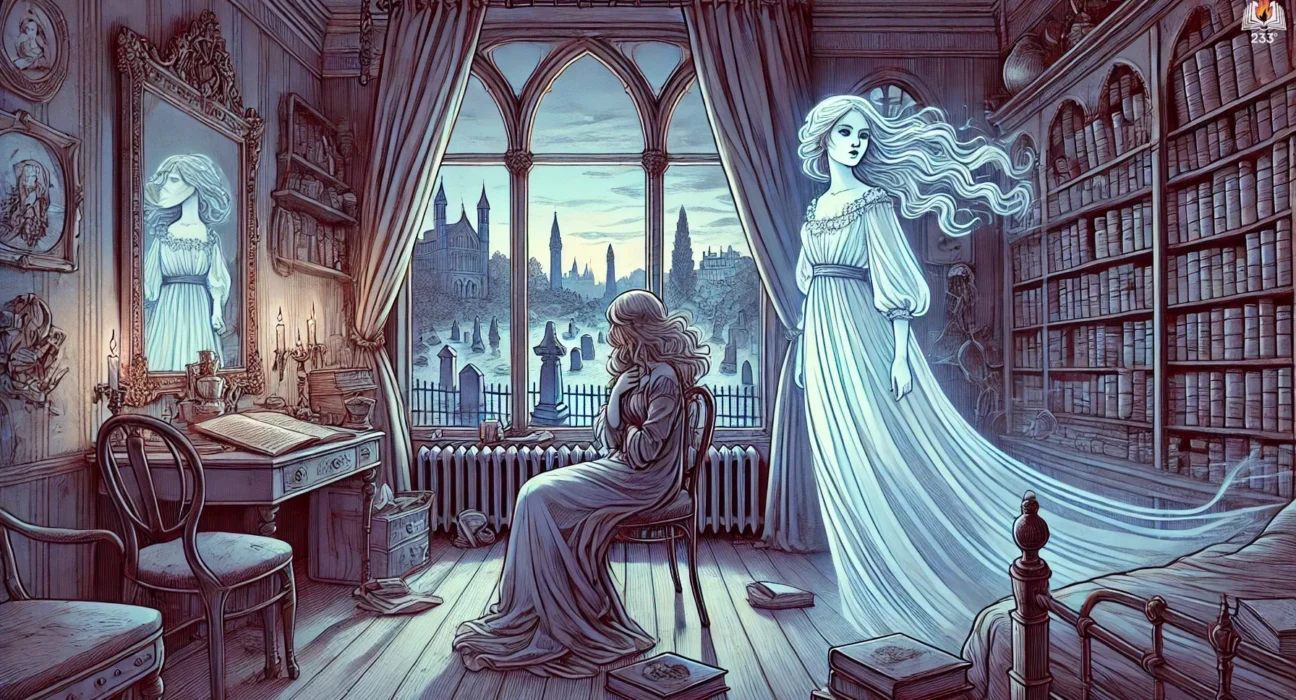
“Her Fearful Symmetry” by Audrey Niffenegger, published in 2009, is a gothic tale of love, loss, and secrets set near Highgate Cemetery in London. The story begins with the death of Elspeth Noblin, whose will leaves her apartment to her twin nieces, Julia and Valentina, under unusual conditions. What follows is a haunting exploration of familial bonds, identity, and the metaphysical.
Plot Summary
Elspeth Noblin’s life ends in a sterile hospital room, her lover Robert mourning by her side. Her death is not the end, however, but the beginning of an unsettling legacy. Elspeth, in a twist of fate, leaves her apartment in Highgate, London, to her estranged twin sister Edie’s daughters—Julia and Valentina. The will carries peculiar conditions: the twins must live in the apartment for one year, and their parents, Edie and Jack, are forbidden to enter or benefit from the inheritance. Highgate Cemetery, a sprawling, gothic resting place for the dead, looms over this tale of eerie connections and buried secrets.
Julia and Valentina, mirror-image twins, share an uncanny closeness that sets them apart from others. Julia is dominant and assertive, while Valentina is fragile and uncertain, yearning for independence but trapped in her sister’s shadow. Their arrival at Elspeth’s flat brings them into a world unlike anything they have known in suburban Chicago. The apartment, filled with books and artifacts, pulses with a spectral energy that soon reveals its source: Elspeth herself, now a restless ghost bound to the place of her death.
Elspeth observes the twins from the shadows, gradually making her presence known. Meanwhile, Robert, a historian and Elspeth’s grieving lover, becomes drawn to the twins. Living in the flat below, he is both a guide to the mysteries of Highgate Cemetery and a keeper of Elspeth’s memory. He forms an uneasy alliance with the sisters, particularly Valentina, who is drawn to his quiet, melancholy demeanor.
In the flat above the twins, Martin Wells battles his own demons. A crossword setter plagued by severe obsessive-compulsive disorder, Martin’s rituals dominate his life, driving his wife Marijke to leave him and return to Amsterdam. Martin’s story unfolds as a poignant counterpoint to the twins’ growing entanglement with Elspeth’s ghost. His solitude and meticulousness mirror the twins’ insular relationship, adding a layer of human frailty to the spectral drama unfolding below.
As the months pass, the twins uncover secrets about their family. Elspeth and Edie, it emerges, were also identical twins but estranged for over two decades. The reasons for their estrangement remain unclear, but the tension between the generations mirrors the growing discord between Julia and Valentina. Valentina, suffocated by Julia’s overbearing love, begins to rebel. Her health, weakened by a congenital heart defect, becomes a symbol of her struggle for autonomy, her body mirroring the constraints of her soul.
Elspeth seizes upon Valentina’s vulnerability, manipulating her in a bid to restore herself to life. She reveals her ability to interact with the physical world and draws Valentina into a dangerous pact. Valentina, desperate to escape Julia and define her own identity, agrees to a macabre plan: she will stage her death, allowing her spirit to leave her body temporarily, only to be revived later. Elspeth promises to guide her through this perilous process.
The plan is set into motion, but its execution spirals into tragedy. Valentina’s spirit separates from her body, but Elspeth betrays her, seizing the opportunity to inhabit Valentina’s now-empty shell. Valentina becomes a ghost, trapped like Elspeth was, tethered to the apartment. The twins’ bond, already strained, is irrevocably severed as Julia discovers the truth. She is devastated by the loss of her sister and appalled by Elspeth’s cruel manipulation.
Robert, who has grown close to Valentina, recognizes Elspeth’s deception. His grief over her actions transforms into anger, and his love for her becomes tainted with horror. He confronts Elspeth, now inhabiting Valentina’s body, but finds himself powerless to undo the damage. Elspeth, despite her successful return to the living world, cannot escape the consequences of her choices. Her presence in Valentina’s body feels unnatural, a grim reminder of her betrayal and the moral lines she has crossed.
Julia, bereft and desperate for closure, turns to Robert for support. Together, they devise a way to free Valentina’s ghost from its prison in the apartment. Meanwhile, Elspeth’s relationship with Robert deteriorates. His inability to reconcile the woman he loved with the one who betrayed them both drives a wedge between them. Elspeth’s actions, once rooted in desperation and longing, leave her increasingly isolated.
In the apartment above, Martin makes a decision that parallels the story below. Spurred by Marijke’s absence and his own desire to change, he begins to break free from the compulsions that have governed his life. His journey toward reclaiming his freedom offers a glimmer of hope amidst the darker events in the flat below.
As time passes, the balance in Highgate shifts. Valentina’s ghost finds release, her spirit dissipating into the ether. Julia, forever marked by the experience, resolves to live her life more independently, carrying with her the lessons of loss and resilience. Robert leaves Highgate, unable to remain in a place so haunted by the past. Elspeth, now trapped in the ruins of her own choices, finds herself alone, her attempt to reclaim life leaving her more ghostlike than ever.
The tale concludes in the shadow of Highgate Cemetery, where life and death remain intertwined. The stories of the living and the dead echo through its grounds, a testament to the enduring complexities of love, loss, and identity.
Main Characters
Elspeth Noblin: A complex and enigmatic woman, Elspeth is the deceased aunt who haunts her old apartment. Her actions in life and after death drive much of the story’s conflict, including her unresolved relationship with her twin sister Edie and her romance with Robert.
Julia and Valentina Poole: Twin sisters with a near-psychic connection, they inherit Elspeth’s apartment. Julia is assertive and protective, while the delicate Valentina struggles to assert her individuality, creating tension in their relationship.
Robert Fanshaw: Elspeth’s grieving lover and a historian obsessed with Highgate Cemetery. Robert becomes a reluctant ally and confidant to the twins as they uncover the apartment’s mysteries.
Edwina “Edie” Poole: Elspeth’s estranged twin sister and the mother of Julia and Valentina. She harbors a shocking secret that is central to the story’s unraveling.
Martin Wells: A reclusive upstairs neighbor suffering from severe OCD. His story provides a poignant subplot of love and isolation.
Theme
The Nature of Twinship: The novel delves into the unique dynamics of twin relationships, exploring unity, dependence, and individuality through Julia, Valentina, and the ghostly connection between Elspeth and Edie.
Life and Afterlife: A core theme examines what lingers after death. Elspeth’s ghost and her attempts to interact with the living raise questions about the boundaries between life and the afterlife.
Secrets and Betrayal: The story is driven by buried family secrets and betrayals, unraveling through Elspeth’s diaries and Edie’s past choices, creating ripples across generations.
Identity and Autonomy: Valentina’s yearning to escape Julia’s dominance and establish her independence highlights the struggle for self-definition within close relationships.
Obsessions and Constraints: Through characters like Martin and Valentina, the novel examines the mental and emotional constraints people live under, from OCD to toxic relationships.
Writing Style and Tone
Audrey Niffenegger employs a richly descriptive, atmospheric writing style that immerses the reader in the haunting beauty of Highgate Cemetery and the claustrophobic confines of Elspeth’s apartment. Her prose combines the lyrical with the macabre, balancing poetic imagery with unsettling moments of horror and melancholy.
The tone shifts between wistful and ominous, capturing the characters’ complex emotional landscapes while maintaining a sense of foreboding. Niffenegger’s penchant for exploring dark, fantastical elements is evident, as she seamlessly weaves realism with the supernatural, making the extraordinary feel eerily plausible.
Quotes
Her Fearful Symmetry – Audrey Niffenegger (2009) Quotes
“There are several ways to react to being lost. One is to panic: this was usually Valentina's first impulse. Another is to abandon yourself to lostness, to allow the fact that you've misplaced yourself to change the way you experience the world.”
“Listen, sometimes when you finally find out, you realize that you were much better off not knowing.”
“You're the oddest person I've ever met, you couldn't get rid of me if you tried.”
“Why do you have a cigarette lighter in your glove compartment?" her husband, Jack, asked her. "I'm bored with knitting. I've taken up arson”
“What is more basic than the need to be known? It is the entirety of intimacy, the elixir of love, this knowing.”
“I'm bored with knitting. I've taken up arson.”
“Is it sad to fancy David Tennant when you're dead?”
“He was not in the house. He did not come back that night. Days went by, and at last she understood that he would not return at all.”
“He thanked her and left the house in the mood of a shipwrecked man who has allowed the rescue ship to pass him by.”
“That’s the thing about living vicariously; it’s so much faster than actual living.”
“That’s the thing about living vicariously; it’s so much faster than actual living. In a few minutes we’ll be worrying about names for the children.”
“In the dim light of the computer screen he seemed otherworldly; Julia thought him beautiful, though she knew it was the beauty of damage.”
“He had never realized, while Elspeth was alive, the extent to which a thing had not completely happened until he told her about it.”
“I think play must have been invented so we wouldn't go mad thinking about certain things.”
“I don't want to boss anyone and I don't want to be bossed.”
“I guess no matter what your family is like, you're not surprised.”
“He would say her name over and over until it devolved into meaningless sounds - mah REI kuh, mah REI kuh - it became an entry in a dictionary of loneliness.”
“That is what madness is, isn't it? All the wheels fly off the bus and things don't make sense any more. Or rather, they do, but it's not a kind of sense anyone else can understand.”
“Not because they’re dead. Though unattainability is always attractive.”
“There was only the cemetery itself, spread out in the moonlight like a soft grey hallucination, a stony wilderness of Victorian melancholy.”
“Sometimes a thing is---too much---and it has to be isolated put away.”
“Each of them warmed to the sound of the other's voice. They lay in the dark together, in distant cities, each of them thinking, We were lucky this time. And they pressed their phones closer to their ears, and both of them wondered how much longer this separation could go on.”
“When we were that young we invented the world, no one could tell us a thing.”
We hope this summary has sparked your interest and would appreciate you following Celsius 233 on social media:
There’s a treasure trove of other fascinating book summaries waiting for you. Check out our collection of stories that inspire, thrill, and provoke thought, just like this one by checking out the Book Shelf or the Library
Remember, while our summaries capture the essence, they can never replace the full experience of reading the book. If this summary intrigued you, consider diving into the complete story – buy the book and immerse yourself in the author’s original work.
If you want to request a book summary, click here.
When Saurabh is not working/watching football/reading books/traveling, you can reach him via Twitter/X, LinkedIn, or Threads
Restart reading!


