“The Picture of Dorian Gray” by Oscar Wilde is a novel that delves into themes of aestheticism, moral corruption, and the quest for eternal youth. First published in 1891, the story is set in Victorian England and explores the life of Dorian Gray, a young man of extraordinary beauty who becomes the subject of a painting by artist Basil Hallward. Under the influence of Lord Henry Wotton, Dorian wishes to remain young and beautiful forever, a wish that leads to his eventual downfall as he engages in a hedonistic and morally bankrupt lifestyle.
Plot Summary
In the heart of London, amidst the scent of roses and the shimmering light of a summer’s day, Basil Hallward, a gifted artist, toiled over a portrait. His subject, Dorian Gray, was a young man of extraordinary beauty, whose innocence and charm captivated all who met him. Basil saw in Dorian the muse he had long searched for, a figure that inspired him to create his finest work. But Basil’s admiration for Dorian went deeper than artistic inspiration. He believed Dorian’s beauty held a special purity, something that elevated his art beyond mere craftsmanship. Lord Henry Wotton, a close friend of Basil, was intrigued by this mysterious subject and, upon meeting Dorian, felt an immediate pull.
Lord Henry, with his cynical and seductive philosophy of life, quickly set about influencing Dorian. He extolled the virtues of indulgence, pleasure, and the pursuit of beauty above all else. He told Dorian that youth was the only thing worth having, for it was fleeting, and once lost, it could never be regained. This thought deeply unsettled Dorian. Standing before the finished portrait, he was struck by its flawless reflection of his own beauty and youth. A desperate longing stirred within him, and in a moment of emotional intensity, he wished that he could remain as young as the portrait, while it bore the marks of time and life instead.
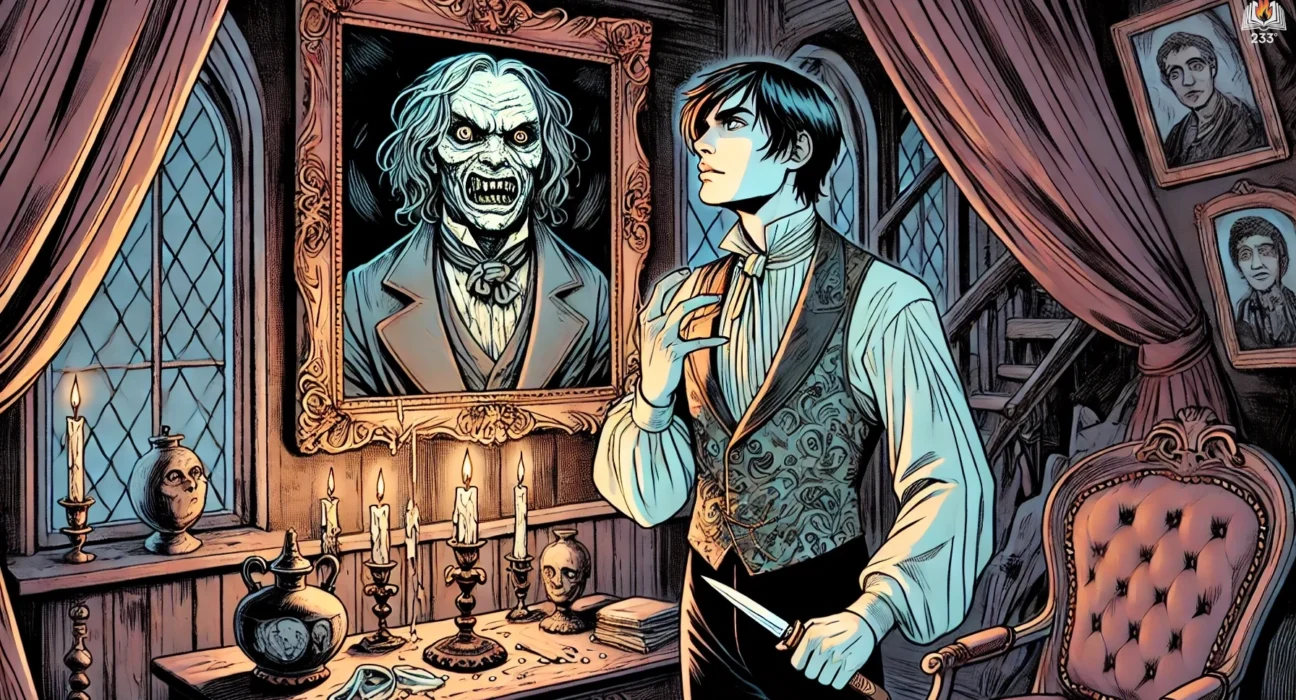
From that day forward, Dorian embraced the hedonistic life that Lord Henry had described. He indulged in every pleasure and vice that came his way, without regard for consequence. Meanwhile, Basil remained oblivious to the growing changes in Dorian’s character, seeing him as the same charming young man he had first painted. But Dorian’s secret lay hidden in his attic, where the portrait had begun to change. The youthful beauty of the painting started to deteriorate, showing signs of the moral corruption that Dorian had set in motion. Each sin, every act of cruelty, was etched into the canvas, leaving Dorian’s outward appearance untouched while the portrait reflected the monstrous truth of his soul.
Dorian’s descent into darkness deepened when he met Sibyl Vane, a beautiful young actress. For a brief time, he was enchanted by her talent and beauty. To him, Sibyl embodied the ideal of art; she was a living masterpiece, and he decided that he loved her. But when Sibyl, overwhelmed by her love for Dorian, faltered in her craft and gave a poor performance, Dorian’s affection for her crumbled. He cruelly ended their engagement, dismissing her as nothing more than a disappointment. Heartbroken, Sibyl took her own life, a tragedy that did not seem to weigh heavily on Dorian’s conscience. Instead, he saw her death as a mere inconvenience in his pursuit of pleasure. When he glanced at his portrait afterward, he noticed a faint sneer had formed on the painted lips. It was the first sign that his wish had been granted.
As the years passed, Dorian’s reputation became shrouded in whispers of scandal. While he remained outwardly youthful and handsome, those around him aged, and many who had once admired him now avoided him. Yet, his charm never fully waned, and his influence continued to corrupt those who fell into his orbit. Lord Henry, though fascinated by Dorian’s life, remained detached, amused by the chaos he had sown but never suspecting the full extent of Dorian’s moral decay. Basil, however, grew increasingly concerned. He could not understand how Dorian had changed so drastically. One fateful evening, Basil confronted Dorian, urging him to reform. But Dorian, enraged by the confrontation and terrified that Basil might uncover the truth of the portrait, decided to show him the painting.
In the secrecy of his attic, Dorian unveiled the grotesque, deformed image that had once been a reflection of his beauty. The sight horrified Basil. He could not fathom how such corruption could exist in the soul of someone he had loved and admired. In a moment of blind panic and rage, Dorian murdered Basil, silencing the only man who truly cared for him. With Basil’s body hidden, Dorian continued his reckless existence, though guilt and fear began to gnaw at his conscience.
In search of solace, Dorian turned to opium and other vices, trying to numb the growing dread within him. But the portrait loomed large in his mind, a constant reminder of his corruption. His charm no longer brought him peace, and even Lord Henry’s philosophies felt hollow. The weight of his sins grew unbearable, especially after an encounter with James Vane, Sibyl’s vengeful brother. James had long sought revenge for his sister’s death, and after recognizing Dorian’s unchanged face, he pursued him relentlessly. Dorian narrowly escaped James’ wrath when fate intervened, and James was killed in a hunting accident.
Despite the reprieve, Dorian’s fear of retribution haunted him. Desperate to escape the torment of his past, he decided to destroy the portrait, believing that by doing so, he could free himself from its curse. In a final act of despair, Dorian seized the same knife he had used to kill Basil and slashed the painting. But in doing so, he brought about his own destruction. Servants, hearing a cry of anguish from the attic, rushed to the scene. There, they found a disfigured, wrinkled man lying dead on the floor, the knife plunged into his chest. The portrait, restored to its original beauty, hung above him, ageless and untouched, as Dorian’s true form lay exposed in death.
Main Characters
- Dorian Gray: A young man of extraordinary beauty who becomes the subject of Basil Hallward’s painting. Initially innocent and pure, he is corrupted by Lord Henry’s hedonistic philosophy and embarks on a life of vice and cruelty. His wish to remain young leads to his eventual downfall.
- Lord Henry Wotton: A charming and cynical aristocrat who influences Dorian with his philosophy of aestheticism and hedonism. He believes in the pursuit of pleasure above all else and has a profound impact on Dorian’s life choices.
- Basil Hallward: A talented and moral artist who paints Dorian’s portrait. He is deeply fascinated by Dorian’s beauty and sees him as his muse. Basil remains loyal to Dorian but becomes a victim of Dorian’s descent into corruption.
Theme
- Aestheticism and Moral Corruption: The novel explores the idea that an obsession with beauty and sensory experiences can lead to moral decay. Dorian’s downfall is a result of valuing aesthetic pleasure over ethical conduct.
- The Duality of Human Nature: The portrait serves as a symbol of the duality within Dorian – his outward appearance remains beautiful, while his inner self becomes increasingly corrupt. This duality highlights the conflict between appearance and reality.
- Influence and Manipulation: The novel examines the impact of influence, particularly through the character of Lord Henry, whose philosophies lead Dorian down a path of destruction. It raises questions about personal responsibility and the power of external influences on one’s actions.
Writing Style and Tone
Oscar Wilde’s writing style in “The Picture of Dorian Gray” is characterized by its wit, elegance, and rich descriptive language. Wilde’s use of epigrams and paradoxes, often delivered through Lord Henry’s dialogue, adds a layer of sophistication and irony to the narrative. The tone of the novel shifts from light and charming to dark and foreboding as Dorian’s moral decline progresses. Wilde’s prose is lush and vivid, creating a sensual and immersive atmosphere that mirrors the novel’s themes of beauty and decadence. His exploration of complex moral and philosophical ideas is woven seamlessly into the narrative, making the novel both thought-provoking and engaging.
Quotes
The Picture of Dorian Gray – Oscar Wilde (1890) Quotes
“The books that the world calls immoral are books that show the world its own shame.”
“You will always be fond of me. I represent to you all the sins you never had the courage to commit.”
“Experience is merely the name men gave to their mistakes.”
“To define is to limit.”
“Nowadays people know the price of everything and the value of nothing.”
“I don't want to be at the mercy of my emotions. I want to use them, to enjoy them, and to dominate them.”
“Behind every exquisite thing that existed, there was something tragic.”
“The only way to get rid of temptation is to yield to it.”
“I am too fond of reading books to care to write them.”
“There is only one thing in the world worse than being talked about, and that is not being talked about.”
“Children begin by loving their parents; as they grow older they judge them; sometimes they forgive them.”
“When one is in love, one always begins by deceiving one's self, and one always ends by deceiving others. That is what the world calls a romance.”
“What of Art? -It is a malady. --Love? -An Illusion. --Religion? -The fashionable substitute for Belief. --You are a sceptic. -Never! Scepticism is the beginning of Faith. --What are you? -To define is to limit.”
“Never marry at all, Dorian. Men marry because they are tired, women, because they are curious: both are disappointed.”
“Some things are more precious because they don't last long.”
“Live! Live the wonderful life that is in you! Let nothing be lost upon you. Be always searching for new sensations. Be afraid of nothing.”
“Humanity takes itself too seriously. It is the world's original sin. If the cave-man had known how to laugh, History would have been different.”
“Nowadays most people die of a sort of creeping common sense, and discover when it is too late that the only things one never regrets are one's mistakes.”
“Nothing can cure the soul but the senses, just as nothing can cure the senses but the soul.”
“Every portrait that is painted with feeling is a portrait of the artist, not of the sitter.”
“The world is changed because you are made of ivory and gold. The curves of your lips rewrite history.”
“There is no such thing as a moral or an immoral book. Books are well written, or badly written. That is all.”
“Laughter is not at all a bad beginning for a friendship, and it is by far the best ending for one.”
“I have grown to love secrecy. It seems to be the one thing that can make modern life mysterious or marvelous to us. The commonest thing is delightful if only one hides it.”
“Whenever a man does a thoroughly stupid thing, it is always from the noblest motives.”
“The basis of optimism is sheer terror.”
“I am tired of myself tonight. I should like to be somebody else.”
“You must have a cigarette. A cigarette is the perfect type of a perfect pleasure. It is exquisite, and it leaves one unsatisfied. What more can one want?”
We hope this summary has sparked your interest and would appreciate you following Celsius 233 on social media:
There’s a treasure trove of other fascinating book summaries waiting for you. Check out our collection of stories that inspire, thrill, and provoke thought, just like this one by checking out the Book Shelf or the Library
Remember, while our summaries capture the essence, they can never replace the full experience of reading the book. If this summary intrigued you, consider diving into the complete story – buy the book and immerse yourself in the author’s original work.
If you want to request a book summary, click here.
When Saurabh is not working/watching football/reading books/traveling, you can reach him via Twitter/X, LinkedIn, or Threads
Restart reading!