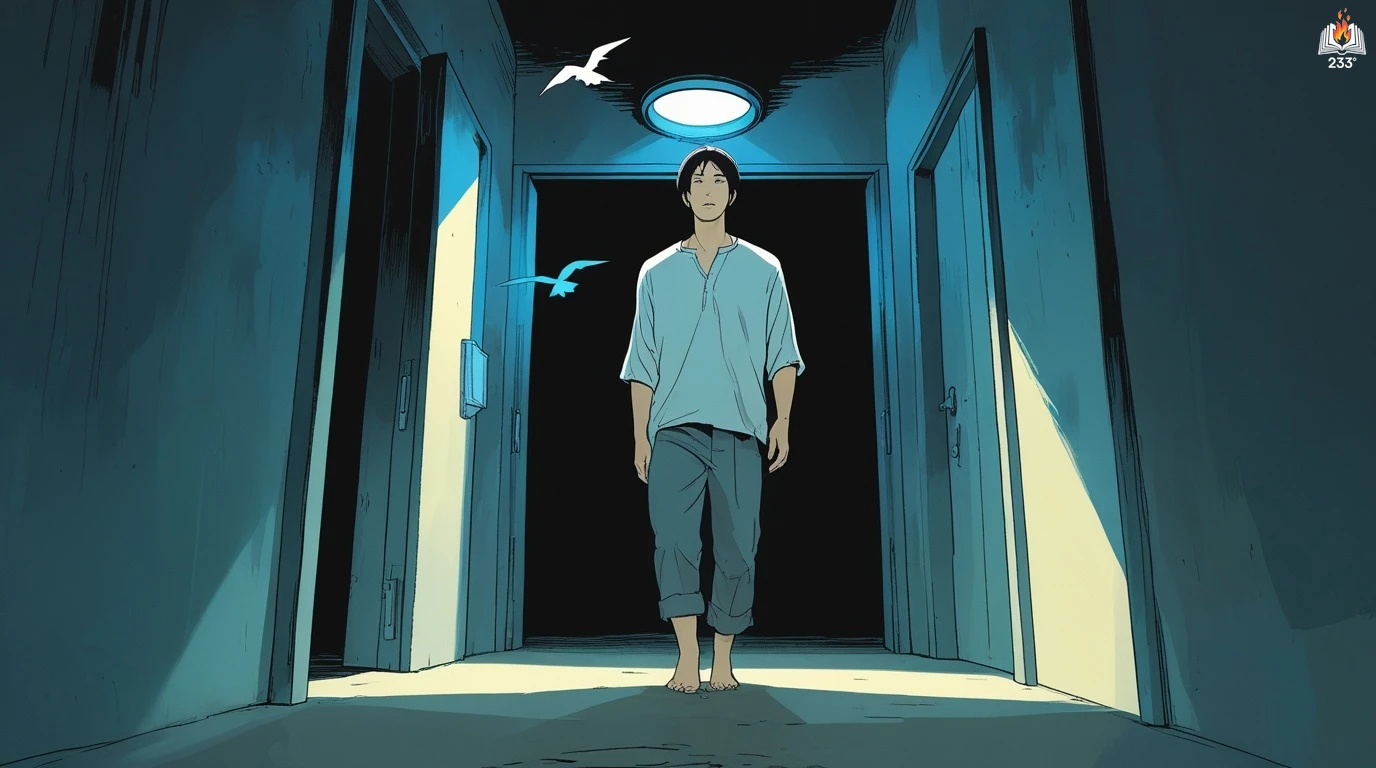

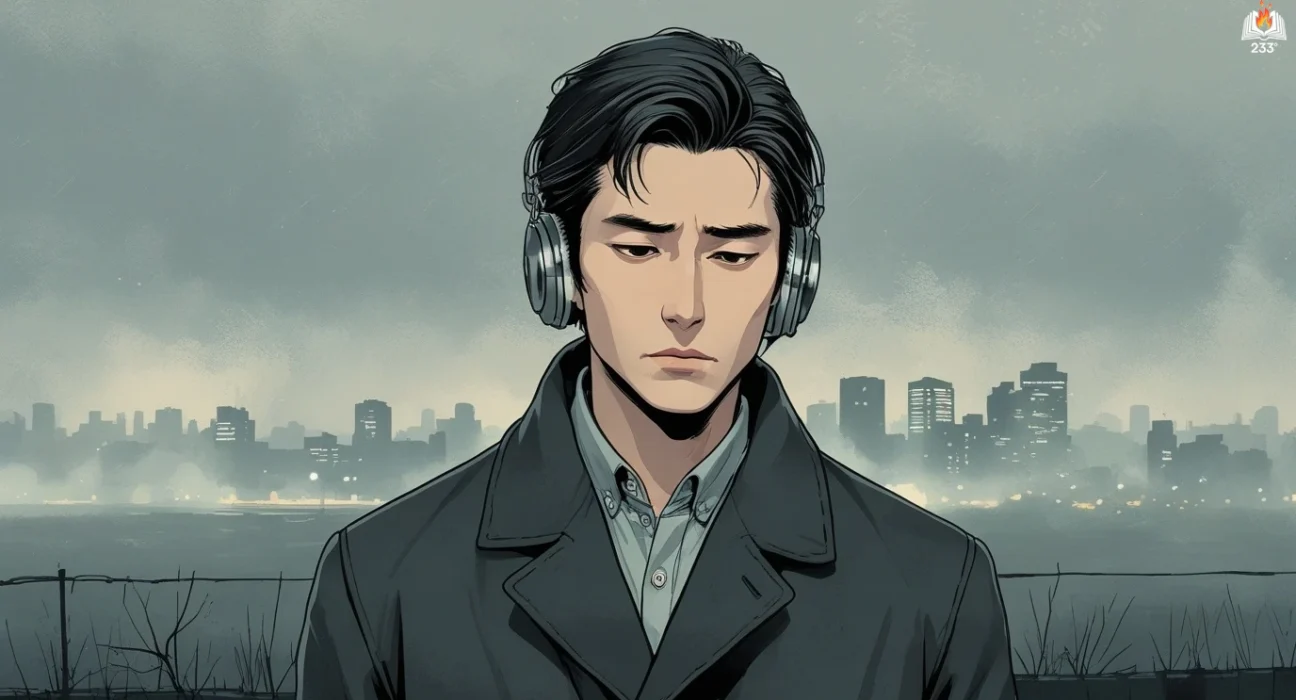
Norwegian Wood by Haruki Murakami, first published in 1987, is a haunting and melancholic coming-of-age novel set in late 1960s Tokyo. Widely regarded as the book that launched Murakami into literary stardom in Japan, it is a nostalgic and introspective narrative framed around the protagonist’s recollection of youth, love, loss, and the burdens of memory. When Toru Watanabe hears the Beatles’ song “Norwegian Wood” upon landing in Hamburg, it evokes a cascade of memories tied to his past – particularly his deep, painful connection to Naoko, the girlfriend of his best friend Kizuki, who died by suicide. The novel unfolds through Watanabe’s inner world as he grapples with love, death, and emotional disconnection.
Plot Summary
When a plane lands in Hamburg under a heavy November sky, the soft notes of a Beatles tune drift from the speakers. The music strikes deep in the heart of a man in his late thirties, awakening memories long buried – memories of youth, of loss, of a girl who once stood beside him in a windswept Tokyo meadow.
Eighteen years earlier, Toru Watanabe was a quiet student navigating the uncertain corridors of college life in the late 1960s. The world around him churned with student protests, political unrest, and sweeping changes, but his world was still reeling from something far more intimate – the suicide of his best friend, Kizuki. The suddenness of Kizuki’s death left behind a silence that echoed endlessly, one that Toru carried with him like a second skin.
In the aftermath, Toru found himself drawn to Naoko, Kizuki’s girlfriend. Bound by grief and an unspoken understanding, the two wandered the streets of Tokyo together, walking aimlessly for hours. Naoko was delicate, almost translucent in her sadness. Her eyes seemed to carry the weight of a world she could never fully explain. Their connection deepened, yet the spaces between their words grew wider. Naoko eventually withdrew further from the city, retreating into a secluded sanatorium nestled in the hills, a place where people spoke softly and healing was something slow and uncertain.
In her absence, Toru’s life moved with the inertia of someone drifting just beneath the surface. University passed in a haze of classes, books, and evenings spent in a dormitory run with rigid patriotism and quiet absurdities. He spent time with Nagasawa, a charismatic and confident upperclassman who read only dead authors and seduced women with a cold detachment. Nagasawa’s girlfriend, Hatsumi, bore her pain with grace, but her loneliness, much like Naoko’s, lingered like perfume in empty air.
Then came Midori – vibrant, unpredictable, and full of life. She asked bold questions, laughed in movie theaters, and challenged Toru’s passivity. Where Naoko moved like a shadow, Midori burned like a flame. Her father was dying in a hospital, and yet she faced the world with an honesty that unnerved Toru. Their conversations were laced with dark humor, flirtation, and vulnerability. Midori didn’t float above pain – she named it, stared it down, and kept walking.
Letters arrived from Naoko. They were tender, scattered thoughts stitched together with memories and longings. Toru wrote back, offering his own reflections. Eventually, he visited her at the sanatorium, a quiet place surrounded by mountains and pine woods. There, he met Reiko, Naoko’s older roommate – a former music teacher with a gentle resilience and a tragic past. The three of them spent a few serene days together, filled with piano music, long walks, and conversations that teetered on the edge of hope and heartbreak. But Naoko was still adrift. Though she smiled and held Toru’s hand, something inside her had receded too far to be called back easily.
Back in Tokyo, Toru’s heart grew heavier. His relationship with Midori deepened, but it remained tethered to hesitation. She wanted his love in full, but he could only offer fragments, unable to sever the invisible thread that still bound him to Naoko. When he learned of Naoko’s suicide, the news fell with a cold finality. The path she had walked – quiet, sorrowful, filled with trembling silences – had led her away from everyone who tried to reach her.
Grief returned like a tide. Toru wandered through cities, rode trains without direction, and disappeared into landscapes that blurred past windows. Words became difficult again, and even Midori’s voice – clear and insistent – seemed distant. Letters passed between him and Reiko, now a drifter with a guitar and a need to say goodbye to the world Naoko had left behind. Reiko came to visit, and one night, after speaking of pain, memory, and survival, she and Toru shared an intimate moment not born of desire, but of a need to touch warmth in a world turned cold.
Still, something in Toru refused to let go. He thought of Midori – her laughter, her demands, her refusal to be anyone’s shadow. And finally, he called her. But when she answered and asked where he was, he realized he did not know. The city around him was alive and bright, yet he felt suspended in air, untethered.
The call was a promise and a question. A step forward, uncertain but necessary.
Midori waited on the other end of the line.
And the world spun on, full of silences, full of sound.
Main Characters
Toru Watanabe: A quiet, introspective university student in Tokyo who narrates the story from his mid-thirties. Toru is intelligent, observant, and emotionally reserved, often caught in a fog of existential uncertainty. Haunted by the suicide of his friend Kizuki, Toru becomes involved in complicated relationships that challenge his ideas of love and morality. His inner conflict deepens as he tries to understand both the people around him and his own fragmented emotions.
Naoko: Naoko is beautiful, gentle, and emotionally fragile. Once Kizuki’s girlfriend, she forms a delicate bond with Toru following Kizuki’s death. Naoko struggles with mental health issues, likely rooted in unresolved trauma and deep-seated loneliness. Her story unfolds as a tender yet tragic meditation on vulnerability, memory, and the inability to truly connect despite overwhelming yearning.
Midori Kobayashi: Midori is lively, unpredictable, and uninhibited – a stark contrast to Naoko. She becomes a romantic interest for Toru, bringing with her a sense of freedom, curiosity, and earthy realism. While playful and forward, Midori harbors her own quiet pain, especially related to her family, yet she confronts it with a determined sense of agency.
Reiko Ishida: A former music teacher and Naoko’s confidante at the sanatorium where she retreats. Reiko is candid, supportive, and complex, offering wisdom laced with her own experiences of suffering and endurance. Her role as a surrogate mentor and mirror for both Naoko and Toru adds a layered perspective to the narrative’s emotional and psychological themes.
Kizuki: Though deceased before the main events of the novel, Kizuki’s presence looms large. Toru’s best friend and Naoko’s boyfriend, his unexpected suicide at 17 becomes the spiritual and emotional catalyst for the events that follow, symbolizing the impenetrable mystery of death and the void it leaves behind.
Theme
Memory and Nostalgia: The novel is drenched in memory, with Toru’s narration framed as a reflective journey through his past. Murakami portrays memory not as a static record but as a living, shifting presence that informs one’s identity, often blurring the line between the real and the remembered.
Death and Loss: The specter of death haunts nearly every character. Whether through suicide or emotional withdrawal, Murakami explores how individuals cope with loss, and how grief can distort, define, or paralyze those left behind. Death is shown not as an endpoint but as something that seeps into life.
Isolation and Emotional Disconnection: Despite being surrounded by others, the characters often feel fundamentally alone. Murakami delves into the inner worlds of people who struggle to articulate their pain or reach out, painting a portrait of emotional isolation in modern society.
Love and Sexuality: Love in Norwegian Wood is never simple or redemptive. It is bound up with guilt, need, memory, and desire. Physical intimacy often substitutes for emotional connection, but never fully satisfies it. Murakami interrogates both the healing and the destructive aspects of romantic attachment.
Mental Illness and Healing: The novel offers a sensitive, unflinching look at mental illness, showing how it can be both visible and invisible, and how healing is neither linear nor guaranteed. Through Naoko and Reiko, the story emphasizes the psychological toll of trauma and the limitations of care.
Writing Style and Tone
Murakami’s writing in Norwegian Wood is spare, lyrical, and laden with emotional undercurrents. He often employs a subdued, almost minimalist prose style that mirrors Toru’s introspection and detachment. Yet beneath this restraint lies a deep well of feeling – moments of poetic beauty, quiet revelations, and intimate truths emerge seamlessly within the mundane. His language avoids dramatic flourishes, instead evoking mood and atmosphere through imagery, memory, and subtle dialogue. The sensory details – weather, music, smells, textures – often carry the emotional weight that the characters cannot express directly.
The tone throughout the novel is elegiac and melancholic, suffused with a sense of quiet sorrow and longing. Murakami’s tone resonates with emotional clarity, especially in the way he explores existential questions without providing easy answers. While not devoid of warmth or humor (particularly through characters like Midori), the story is underscored by an aching awareness of impermanence, of people slipping away, of time that cannot be reclaimed. It’s a tone that invites introspection and lingers long after the final page.
Quotes
Norwegian Wood – Haruki Murakami (1987) Quotes
“If you only read the books that everyone else is reading, you can only think what everyone else is thinking.”
“What happens when people open their hearts?" "They get better.”
“Nobody likes being alone that much. I don't go out of my way to make friends, that's all. It just leads to disappointment. ”
“Don't feel sorry for yourself. Only assholes do that.”
“I want you always to remember me. Will you remember that I existed, and that I stood next to you here like this?”
“I was always hungry for love. Just once, I wanted to know what it was like to get my fill of it -- to be fed so much love I couldn't take any more. Just once. ”
“Despite your best efforts, people are going to be hurt when it's time for them to be hurt.”
“I have a million things to talk to you about. All I want in this world is you. I want to see you and talk. I want the two of us to begin everything from the beginning.”
“Letters are just pieces of paper," I said. "Burn them, and what stays in your heart will stay; keep them, and what vanishes will vanish.”
“What a terrible thing it is to wound someone you really care for and to do it so unconsciously.”
“Only the Dead stay seventeen forever.”
“If you're in pitch blackness, all you can do is sit tight until your eyes get used to the dark”
“What makes us the most normal," said Reiko, "is knowing that we're not normal.”
“I don't care what you do to me, but I don't want you to hurt me. I've had enough hurt already in my life. More than enough. Now I want to be happy.”
“People leave strange little memories of themselves behind when they die.”
“I didn't have much to say to anybody but kept to myself and my books. With my eyes closed, I would touch a familiar book and draw it's fragrance deep inside me. This was enough to make me happy.”
“So what’s wrong if there happens to be one guy in the world who enjoys trying to understand you?”
“Not that we were incompatible: we just had nothing to talk about.”
“She's letting out her feelings. The scary thing is not being able to do that. When your feelings build up and harden and die inside, then you're in big trouble.”
“Something inside me had dropped away, and nothing came in to fill the cavern.”
“It's because of you when I'm in bed in the morning that I can wind my spring and tell myself I have to live another good day.”
“So I made up my mind I was going to find someone who would love me unconditionally three hundred and sixty-five days a year. Watanabe: Wow, and did your search pay off? M: That's the hard part. I guess I've been waiting so long I'm looking for perfection. That makes it tough.”
“Which is why I am writing this book. To think. To understand. It just happens to be the way I'm made. I have to write things down to feel I fully comprehend them.”
We hope this summary has sparked your interest and would appreciate you following Celsius 233 on social media:
There’s a treasure trove of other fascinating book summaries waiting for you. Check out our collection of stories that inspire, thrill, and provoke thought, just like this one by checking out the Book Shelf or the Library
Remember, while our summaries capture the essence, they can never replace the full experience of reading the book. If this summary intrigued you, consider diving into the complete story – buy the book and immerse yourself in the author’s original work.
If you want to request a book summary, click here.
When Saurabh is not working/watching football/reading books/traveling, you can reach him via Twitter/X, LinkedIn, or Threads
Restart reading!