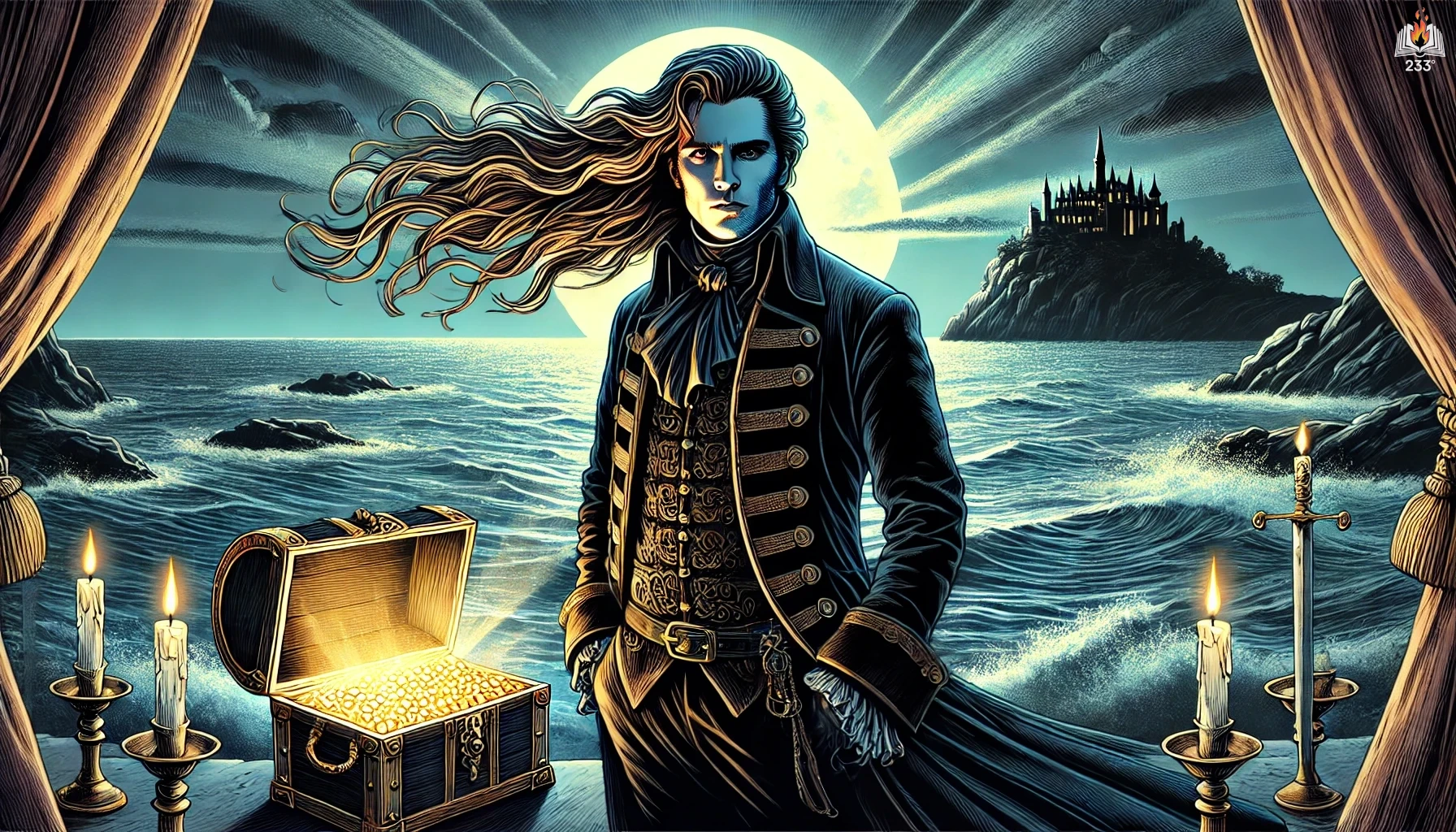
The Man in the Iron Mask by Alexandre Dumas, first published in 1850, is the final part of The Vicomte of Bragelonne and a continuation of Dumas’ d’Artagnan Romances, which began with The Three Musketeers. The novel intertwines historical fiction with adventure and political intrigue, centering around themes of power, loyalty, and betrayal, as it explores the destinies of its legendary characters.
Plot Summary
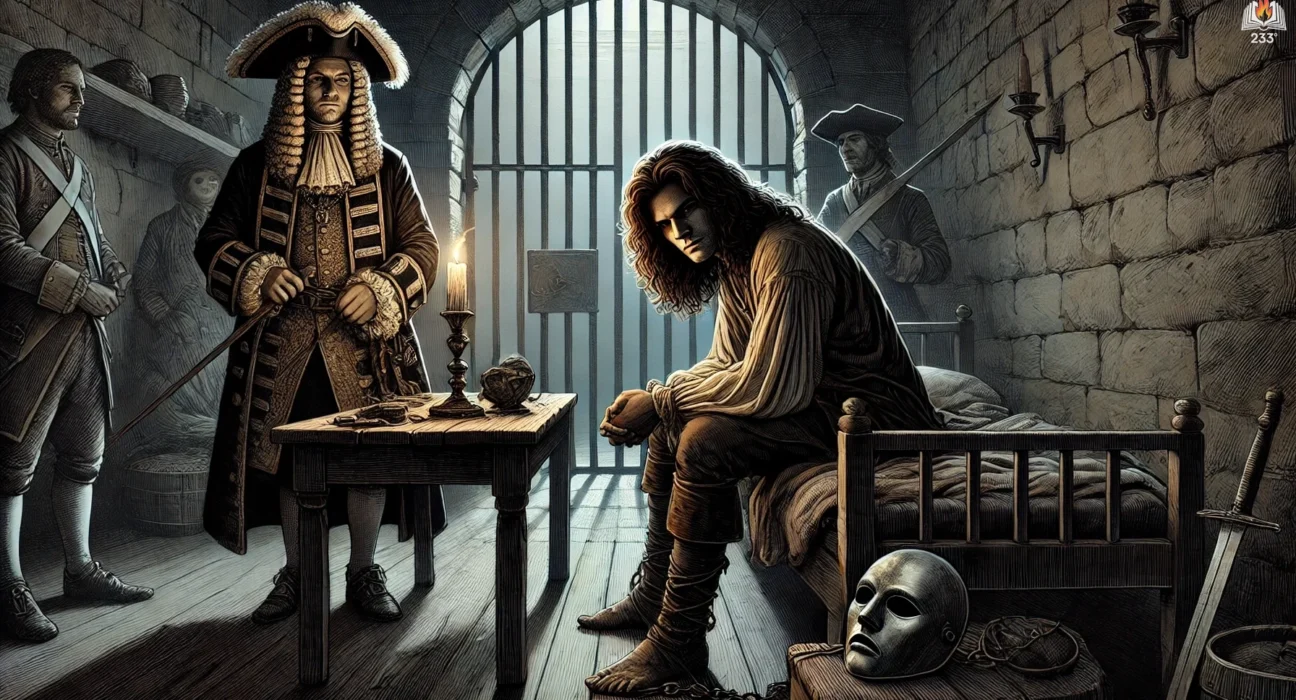
A calm night settled over the Bastille, where the steps of Aramis, the Bishop of Vannes, echoed through the cold stone walls. He followed the governor, Baisemeaux, as they made their way to the prison cell of a man who held the secret to one of France’s greatest mysteries. Inside, a young man lay on a humble bed, his face half-buried in his arms, unaware of the storm about to break upon his life.
The prisoner was Philippe, the twin brother of King Louis XIV, hidden away since birth, his existence concealed by a simple but terrible contraption—the iron mask that had bound his identity and destiny. Aramis, always plotting, had learned of Philippe’s existence and conceived a daring plan. The rightful king of France, Aramis believed, was not the man who sat upon the throne but this forgotten brother. He whispered promises of freedom and power to Philippe, igniting in him the hope of reclaiming the life he had been denied.
Meanwhile, in the glittering palace of Versailles, King Louis XIV ruled with an iron hand, surrounded by luxury and privilege. He reveled in his own power, unconcerned with the lives that trembled under his rule. Louis’s arrogance was boundless, and as he toyed with the affections of women like Louise de la Vallière and manipulated his ministers, he never suspected the treachery brewing in the shadows.
D’Artagnan, captain of the king’s musketeers, remained ever loyal to Louis, though his heart still yearned for the brotherhood he had shared with his fellow musketeers—Aramis, Porthos, and the now-retired Athos. Little did D’Artagnan know, Aramis’s ambition was about to tear them all apart.
The plot unfolded swiftly. Aramis convinced Porthos, whose strength was legendary, to help with the daring plan, although Porthos understood little of the full scope of the bishop’s scheme. Aramis arranged for the secretive transfer of Philippe from the Bastille to a secluded chateau, where he trained the young man in the ways of kingship. Philippe, though overwhelmed by the enormity of his situation, showed the same regal bearing as his brother. Soon, he would be ready to step into Louis’s shoes.
In a stunning coup, Aramis executed his plan. Under the cover of night, Philippe was smuggled into the palace and switched with Louis, who awoke the next morning in the same dark cell that had been his brother’s prison. Confused and enraged, Louis demanded to be freed, but the guards, seeing only a man in an iron mask, laughed at his claims. The king, now a captive, was powerless to stop the tide of events set in motion by Aramis’s manipulation.
Philippe took his place on the throne. He moved through the court with grace, fooling even the closest of Louis’s confidants, including the musketeer D’Artagnan. But despite his newfound power, Philippe found little joy in the crown. He had been thrust into a world of deception and intrigue, one where trust was fleeting, and where his own heart was weighed down by the moral implications of his brother’s fate.
As the days passed, Philippe grew increasingly uneasy. The heavy mantle of kingship did not sit well with him, and Aramis’s control over him tightened. The bishop had his own ambitions—greater than merely restoring Philippe to the throne. He sought to reshape France’s future under his guidance, with a puppet king to do his bidding. But Philippe, with a soul as noble as Louis’s was self-serving, began to resist the machinations of his would-be benefactor.
Meanwhile, the real king, Louis XIV, languished in his prison. His anger turned to desperation as he realized that the iron mask, once a tool of his oppression over Philippe, was now his own curse. Yet Louis was no ordinary man. His pride and indomitable will drove him to find a way to regain his throne. Slowly, through his cunning, he communicated with those still loyal to him.
D’Artagnan, sensing something was amiss, began to question the sudden changes in his king’s behavior. The king he had sworn to protect seemed different—softer, more thoughtful. Eventually, the captain’s suspicions grew too great to ignore, and he launched his own investigation. It wasn’t long before the pieces of Aramis’s plot fell into place.
In a dramatic confrontation, D’Artagnan learned the truth. The man he had served was not the real king. Torn between his duty and his loyalty to his friends, D’Artagnan faced an agonizing choice. Yet in his heart, D’Artagnan knew he could not allow France to be ruled by a lie. He acted swiftly, helping to free Louis and restore him to the throne.
Philippe, despite his potential for greatness, was defeated by the inevitable weight of his birth. Louis, once more the king, was merciless in his retribution. Aramis fled, his grand plans shattered, while Porthos, loyal but ignorant of the full plot, met a tragic fate during their escape. Philippe, who had tasted both the depths of despair and the heights of power, was returned to his prison, where the iron mask once again claimed his identity.
In the end, Louis XIV stood triumphant, but he would never forget how close he had come to losing everything. His cruelty and paranoia grew, knowing that even his own blood could rise against him. D’Artagnan, ever the faithful musketeer, continued his service, but the brotherhood that had once defined his life was broken forever. The shadow of the iron mask lingered over them all, a reminder of the fragility of power, the pain of ambition, and the price of loyalty.
Main Characters
D’Artagnan – The loyal captain of the musketeers, D’Artagnan is courageous, clever, and fiercely devoted to the king. Throughout the novel, he grapples with his loyalty to the crown and his friendship with his fellow musketeers.
Aramis – A former musketeer who has become a cunning and ambitious bishop, Aramis plays a central role in the plot. His scheming nature and desire for power lead him to initiate a daring plan involving the mysterious man in the iron mask.
Porthos – One of D’Artagnan’s closest friends, Porthos is a powerful, loyal, but somewhat naive character. His strength and good-hearted nature often contrast with the more strategic minds of his companions.
Philippe – The titular man in the iron mask, Philippe is the secret twin brother of King Louis XIV. His tragic story unfolds as he becomes a pawn in Aramis’s ambitious plot to replace Louis on the throne.
King Louis XIV – The reigning king of France, Louis XIV is portrayed as a self-centered and sometimes cruel monarch. His harsh treatment of those around him, including his brother Philippe, reflects his desire to maintain absolute power.
Theme
Power and Legitimacy: The central conflict of the novel revolves around the question of who has the legitimate claim to rule. Philippe, hidden away for years, is thrust into a position where he could take the throne from his brother. The theme of power and who deserves it is explored through this twin dynamic.
Loyalty and Betrayal: The novel is deeply concerned with the conflicting loyalties of its characters. D’Artagnan’s loyalty to the king is tested against his friendships with the other musketeers, while Aramis betrays both his allies and the crown in pursuit of his own goals.
Identity and Fate: Philippe’s hidden identity and the symbolic iron mask he wears represent not just his personal concealment but the broader theme of individuals being trapped by their roles in life. Fate seems inescapable for many characters, particularly Philippe, whose life is manipulated by others.
Brotherhood and Friendship: The bond between the musketeers is tested throughout the novel, particularly as they find themselves on opposite sides of political intrigue. Despite the passage of time and differing paths, their sense of brotherhood remains a poignant element of the story.
Writing Style and Tone
Alexandre Dumas’ writing in The Man in the Iron Mask blends vivid action with deep emotional and philosophical undertones. His narrative style is dramatic and filled with suspense, particularly in the scenes of political conspiracy and personal betrayal. Dumas excels at creating a sense of impending doom, as his characters are often caught between their duties and their desires. The dialogue is rich with period language, adding to the historical authenticity of the setting, and he masterfully shifts between grand, sweeping descriptions of royal courts and intimate, tension-filled moments of personal conflict.
The tone of the novel is a mix of adventurous and tragic. While the dashing exploits of D’Artagnan and his friends provide moments of excitement, the story is also marked by melancholy, particularly in its treatment of Philippe’s plight. The sense of inevitable loss and the shadow of political machinations give the narrative a somber, reflective quality.
Quotes
The Man in the Iron Mask – Alexandre Dumas (1847) Quotes
“I am strong against everything, except against the death of those I love. He who dies gains; he who sees others die loses.”
“Friendship throws out deep roots in honest hearts, D'Artagnan. Believe me, it is only the evil-minded who deny friendship; they cannot understand it.”
“Pain, anguish and suffering in human life are always in proportion to the strength with which a man is endowed.”
“Women and doors - did I not tell you, friend Porthos, that they are always to be managed by gentleness? - D'Artagnan”
“There are misfortunes in life that no one will accept; people would rather believe in the supernatural and the impossible.”
“A man is held to be criminal,sometimes, by the great ones of the earth,not because he has committed a crime himself but because he knows of one which has been committed.”
“In this world, all--men, women, and kings--must live for the present. We can only live for the future for God”
“When you are in doubt as to which you should serve forsake the material appearance for the invisible principle for this is everything.”
“The voice of human nature is nothing but one prolonged cry.”
“Great people only thank you for doing the impossible; what’s possible, they say they can effect themselves.”
“Man upon this earth must expect everything, and ought to face everything.”
“I never swear, Monseigneur. I say Yes or No, and as I am a gentleman, I keep my word.”
“Joyful friends, mostly loyal, they hadn't abandoned their protector before the gathering storm; and despite the threatening sky, despite the shuddering earth, they remained, smiling, considerate, and as devoted to misfortune as they had been to prosperity.”
“So like Athos." thought Aramis; "That which is actually good never alters.”
“Follow me. He who lives will see. - D'Artagnan”
“The plan is not wanting in grandeur; I see but one impediment.” “What is it?” “Impossibility.”
“Vengeance in bloom shone in her eyes and smiled on her lips.”
“Sleep is a very capricious goddess, and it is precisely when she is invoked that she delays coming. - Page 184”
“Political judgments are generally vain formalities, for the same passions which give rise to the accusation ordain the condemnation. Such is the atrocious logic of revolutions.”
“A man is bound to make for himself in this world, that fortune which heaven had refused him at his birth.”
“I have always heard it said that that is the rarest service, but the easiest to render. The remark struck me; I like to cite remarks that strike me.”
“I am orderly out of spirit of idleness, to save myself the trouble of looking after things...”
“In presence of this ingenuous greatness of soul, Aramis felt himself little. It was the second time he had been compelled to bend before real superiority of heart, much more powerful than splendour of mind.”
“What is offered from a generous heart should be accepted generously.”
“My lord,” said D’Artagnan, “Monsieur de Vallon [Porthos] is like me, he prefers service extraordinary—that is to say, enterprises that are considered mad and impossible.”
“Forward! Still forward!" said he. "When it shall be time, God will tell me, as he has told the others.”
“But you are quite of opinion, are you not, that Heaven will avenge me, d'Artagnan?" "And I know some persons on earth who will lend a helping hand," said the captain.”
We hope this summary has sparked your interest and would appreciate you following Celsius 233 on social media:
There’s a treasure trove of other fascinating book summaries waiting for you. Check out our collection of stories that inspire, thrill, and provoke thought, just like this one by checking out the Book Shelf or the Library
Remember, while our summaries capture the essence, they can never replace the full experience of reading the book. If this summary intrigued you, consider diving into the complete story – buy the book and immerse yourself in the author’s original work.
If you want to request a book summary, click here.
When Saurabh is not working/watching football/reading books/traveling, you can reach him via Twitter/X, LinkedIn, or Threads
Restart reading!