As You Like It is a pastoral comedy by William Shakespeare, first published in 1600. The play is set in the Forest of Arden and is one of Shakespeare’s most beloved works, blending romance, humor, and philosophical reflections on life. The story centers around themes of love, identity, and the complexities of human nature as characters seek refuge in the forest, where they encounter love, challenges, and transformation.
Plot Summary
In the duchy of France, the ruling Duke Frederick has usurped the throne of his elder brother, Duke Senior, forcing him into exile in the Forest of Arden. However, Duke Senior’s daughter, Rosalind, is allowed to remain at court, as she is the closest companion of Frederick’s daughter, Celia. Despite her father’s banishment, Rosalind continues to live under the protection of her uncle, though she remains heartbroken over her father’s exile.
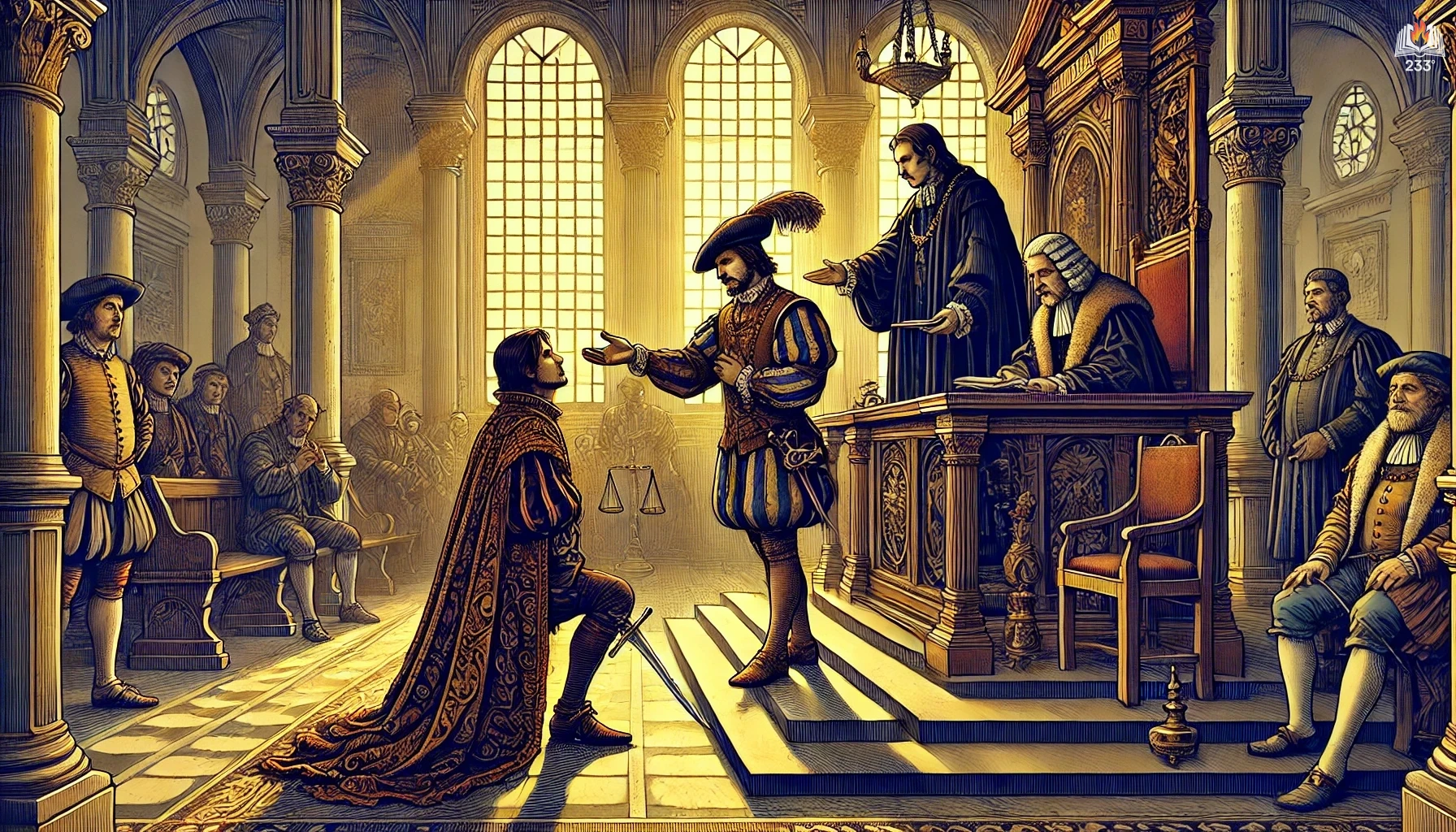
Orlando, a young nobleman, suffers at the hands of his cruel older brother, Oliver. Their father, Sir Rowland de Boys, has died, and Oliver neglects Orlando’s inheritance and education, treating him like a servant. When Orlando learns of a wrestling match held by Duke Frederick’s court, he decides to compete against the champion wrestler, Charles, to gain recognition. Orlando defeats Charles, much to everyone’s astonishment, and catches the eye of Rosalind, who instantly falls in love with his courage and strength. Orlando, too, is captivated by her.
Soon after, however, Duke Frederick becomes suspicious of Rosalind due to her connection to her banished father. In a fit of jealousy and fear, he banishes her from the court. Celia, determined to stay loyal to her cousin, decides to accompany Rosalind into exile. To protect themselves on their journey, Rosalind disguises herself as a young man named Ganymede, while Celia adopts the identity of Aliena, a shepherdess. They are joined by the court jester, Touchstone, who provides both companionship and comic relief during their travels. Together, they set out for the Forest of Arden, where they hope to find Rosalind’s father.
Meanwhile, Orlando learns that his brother Oliver has plotted to kill him. Warned by the loyal servant Adam, Orlando flees into the forest to escape Oliver’s deadly intentions. Unknown to him, Rosalind and Celia have also arrived there, seeking refuge among Duke Senior and his band of exiled followers.
In the forest, life takes on a simpler, more peaceful rhythm. Duke Senior and his loyal followers have adapted to their pastoral life, living like Robin Hood’s merry men. They enjoy the freedom of the forest, away from the intrigues of court life, though their thoughts occasionally turn to their lost positions and homes. Among them is Jaques, a melancholic and philosophical man who finds a deep, sorrowful wisdom in the natural world and often muses on the human condition.
When Orlando arrives in the forest, he unknowingly stumbles upon the exiled Duke’s camp. His love for Rosalind has grown stronger in her absence, and he expresses his feelings by hanging love poems dedicated to her on the trees. It is here that Rosalind, still disguised as Ganymede, encounters Orlando. Amused by the opportunity, she uses her disguise to test his affections. Pretending to offer him advice, Rosalind as Ganymede suggests that Orlando can cure himself of his lovesickness by pretending that Ganymede is Rosalind and wooing her in this guise. Orlando agrees, and a playful game of courtship ensues, with Rosalind skillfully probing the depths of his devotion while concealing her true identity.
During their time in the forest, other romances begin to blossom. Silvius, a simple shepherd, is madly in love with the disdainful shepherdess Phebe. Phebe, however, becomes infatuated with Ganymede, unaware that Ganymede is actually Rosalind in disguise. Silvius remains hopelessly devoted to her, despite her cruelty, while Rosalind, in the guise of Ganymede, tries to dissuade Phebe’s affections and encourage her to love Silvius instead.
In the meantime, Touchstone has also found a romantic prospect in the form of Audrey, a simple countrywoman. Though their courtship is less refined than the others, it is filled with Touchstone’s sharp wit and bawdy humor, providing moments of levity amid the other, more serious love stories.
As the forest works its magic on those who enter, even Oliver is transformed. Sent by Duke Frederick to find his brother Orlando, Oliver comes to the forest with the intent to do harm. However, after a life-threatening encounter with a lion, in which Orlando risks his life to save him, Oliver undergoes a change of heart. He and Orlando reconcile, and Oliver falls in love with Celia, whom he believes to be the shepherdess Aliena.
Eventually, all the tangled relationships begin to unravel. Rosalind, still disguised as Ganymede, promises to resolve the romantic confusion. She tells Orlando that she will conjure Rosalind herself to marry him, while also agreeing to marry Phebe if Phebe still insists on rejecting Silvius. A grand wedding ceremony is planned.
On the appointed day, Rosalind reveals her true identity, much to the astonishment and joy of Orlando, who is thrilled to discover that his beloved Ganymede is actually Rosalind. Phebe, realizing she has been in love with a woman, agrees to marry Silvius instead. Oliver and Celia declare their love, and Touchstone marries Audrey. The multiple couples are united in marriage, with Duke Senior blessing the unions.
Just as the play reaches its joyful conclusion, news arrives that Duke Frederick, having set out to confront Duke Senior, has met a holy man in the forest and undergone a spiritual conversion. He renounces his claim to the dukedom and restores his brother to power. With Duke Senior reinstated, the company prepares to return to court, though they leave the forest with a sense of fulfillment and transformation. As they prepare to leave, Jaques, ever the contemplative soul, decides to remain in the forest, choosing a life of solitude and reflection over the return to society.
The play ends with the promise of a new beginning for all the characters, who have found love, forgiveness, and self-awareness during their time in the Forest of Arden.
Main Characters
Rosalind: The play’s central figure, Rosalind is witty, intelligent, and resilient. After being banished by her uncle, Duke Frederick, she disguises herself as a young man named Ganymede to navigate the challenges of exile in the Forest of Arden. Her journey explores themes of love, freedom, and identity as she falls in love with Orlando.
Orlando: A young nobleman who is wronged by his elder brother, Oliver. Orlando is courageous and deeply romantic. He falls in love with Rosalind early in the play but is unaware of her disguise as Ganymede in the forest, leading to a series of comedic and tender encounters.
Celia: Rosalind’s loyal cousin and best friend. Celia is compassionate and accompanies Rosalind into exile, disguising herself as Aliena. Her devotion to Rosalind highlights the strong bond between the two women.
Jaques: A melancholic and philosophical character who provides a reflective counterpoint to the light-heartedness of the other characters. His famous “All the world’s a stage” monologue encapsulates the play’s existential themes.
Duke Senior: Rosalind’s father, who has been usurped by his brother, Duke Frederick. Duke Senior lives in exile in the Forest of Arden, where he enjoys a simpler life close to nature.
Touchstone: The court jester who accompanies Rosalind and Celia into the forest. His witty and often absurd commentary offers comic relief and satirical insights into love and society.
Theme
Love in its Many Forms: The play explores various types of love—romantic love, familial love, and friendship. The love between Rosalind and Orlando is the central romantic thread, while the deep bond between Rosalind and Celia exemplifies true friendship. Love is portrayed as both joyful and perplexing, with characters frequently discussing and debating its nature.
Identity and Transformation: Disguises and mistaken identities drive much of the plot. Rosalind’s transformation into Ganymede allows her to explore love and gender roles from a unique perspective. The forest setting serves as a space for characters to reinvent themselves and discover new aspects of their identity.
Nature vs. Court Life: The contrast between the corrupt, political world of the court and the idyllic, liberating environment of the Forest of Arden is a central motif. The forest represents a place of natural harmony and simplicity, where characters find freedom and self-awareness away from societal constraints.
Philosophical Reflections on Life: Through characters like Jaques, the play delves into existential questions about the meaning of life, the passage of time, and the roles people play in society. Jaques’ famous “All the world’s a stage” speech reflects on the human condition and the inevitable stages of life.
Writing Style and Tone
Shakespeare’s As You Like It is written in a mix of prose and verse, with the characters’ language often reflecting their social status or emotional state. The noble characters like Rosalind and Orlando frequently speak in verse, using rich metaphors and poetic language to express their thoughts, particularly about love. In contrast, the comic characters like Touchstone speak in prose, delivering witty and playful dialogue that adds humor to the narrative.
The tone of the play is predominantly light-hearted and comedic, even as it addresses deeper themes like exile and identity. Shakespeare’s clever use of wordplay, puns, and double entendres keeps the mood lively and engaging. However, moments of reflection, particularly through Jaques and his melancholic observations, lend the play a philosophical depth that invites the audience to ponder the complexities of life, love, and society.
Quotes
As You Like It – William Shakespeare (1599) Quotes
“The fool doth think he is wise, but the wise man knows himself to be a fool.”
“All the world's a stage, And all the men and women merely players; They have their exits and their entrances; And one man in his time plays many parts, His acts being seven ages.”
“Do you not know I am a woman? when I think, I must speak.”
“I pray you, do not fall in love with me, for I am falser than vows made in wine.”
“Love is merely a madness; and, I tell you, deserves as well a dark house and a whip as madmen do; and the reason why they are not so punish'd and cured is that the lunacy is so ordinary that the whippers are in love too.”
“And this our life, exempt from public haunt, finds tongues in trees, books in the running brooks, sermons in stones, and good in everything. I would not change it.”
“Men have died from time to time, and worms have eaten them, but not for love.”
“Sweet are the uses of adversity, Which, like the toad, ugly and venomous, Wears yet a precious jewel in his head; And this our life, exempt from public haunt, Find tongues in trees, books in the running brooks, Sermons in stones, and good in everything.”
“No sooner met but they looked; no sooner looked but they loved; no sooner loved but they sighed; no sooner sighed but they asked one another the reason; no sooner knew the reason but they sought the remedy; and in these degrees have they made a pair of stairs to marriage...”
“Time travels at different speeds for different people. I can tell you who time strolls for, who it trots for, who it gallops for, and who it stops cold for.”
“Most friendship is feigning, most loving mere folly.”
“Rosalind is your love's name? ORLANDO: Yes, just. JAQUES: I do not like her name. ORLANDO: There was no thought of pleasing you when she was christened.”
“I was too young that time to value her, But now I know her. If she be a traitor, Why, so am I. We still have slept together, Rose at an instant, learned, played, eat together, And wheresoe'er we went, like Juno's swans, Still we went coupled and inseparable.”
“But it is a melancholy of mine own, compounded of many simples, extracted from many objects, and indeed the sundry contemplation of my travels, which, by often rumination, wraps me in the most humorous sadness.”
“Men are April when they woo, December when they wed. Maids are May when they are maids, but the sky changes when they are wives.”
“Master, go on, and I will follow thee To the last gasp with truth and loyalty.”
“O wonderful, wonderful, and most wonderful wonderful! And yet again wonderful, and after that, out of all hooping.”
“What would you have? Your gentleness shall force More than your force move us to gentleness.”
“Under the greenwood tree, Who loves to lie with me And tune his merry note, Unto the sweet bird's throat; Come hither, come hither, come hither. Here shall he see No enemy But winter and rough weather.”
“I'll have no husband, if you be not he.”
“My affection hath an unknown bottom, like the Bay of Portugal.”
“Truly thou art damned, like an ill-roasted egg, all on one side.”
“Thou seest we are not all alone unhappy: This wide and universal theatre Presents more woeful pageants than the scene Wherein we play in.”
“It is far easier for me to teach twenty what were right to be done, than be one of the twenty to follow mine own teaching.”
“Totus mundus agit histrionem. (All the World's a Stage.) " [Motto of William Shakespeare's Globe Theatre (f. 1599) and its acting company, The King's Men; taken from the first play to be performed on the new stage.]”
“It is to be all made of fantasy, All made of passion and all made of wishes, All adoration, duty, and observance, All humbleness, all patience and impatience, All purity, all trial, all observance”
“We that are true lovers run into strange capers.”
“Last scene of all that ends this strange, eventful history, is second childishness and mere oblivion. I am sans teeth, sans eyes, sans taste, sans everything.”
“You and you are sure together, As the winter to foul weather.”
We hope this summary has sparked your interest and would appreciate you following Celsius 233 on social media:
There’s a treasure trove of other fascinating book summaries waiting for you. Check out our collection of stories that inspire, thrill, and provoke thought, just like this one by checking out the Book Shelf or the Library
Remember, while our summaries capture the essence, they can never replace the full experience of reading the book. If this summary intrigued you, consider diving into the complete story – buy the book and immerse yourself in the author’s original work.
If you want to request a book summary, click here.
When Saurabh is not working/watching football/reading books/traveling, you can reach him via Twitter/X, LinkedIn, or Threads
Restart reading!