The Grapes of Wrath by John Steinbeck, published in 1939, is a seminal American novel that chronicles the harrowing journey of the Joad family during the Great Depression. Forced from their Oklahoma farm due to the Dust Bowl and economic despair, the Joads travel west to California in search of a better life, only to encounter exploitation, poverty, and systemic injustice.
Plot Summary
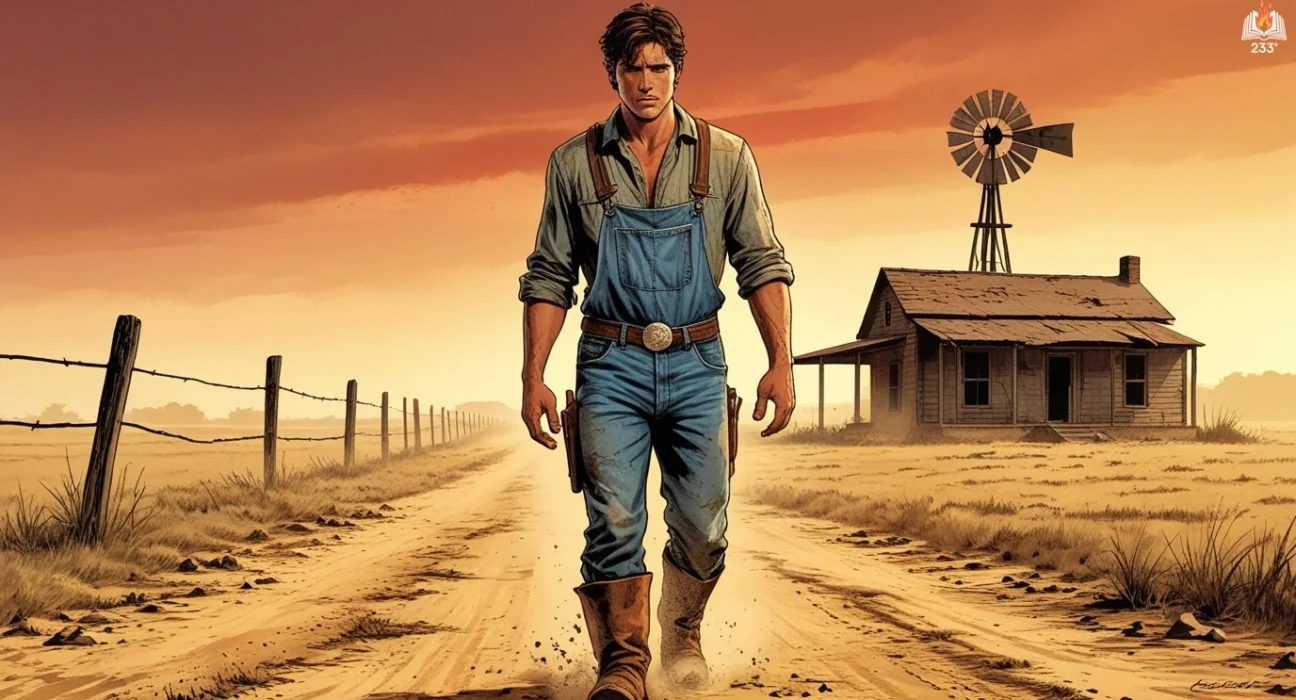
In the barren fields of Oklahoma, parched by drought and scoured by relentless winds, Tom Joad returns home after serving four years in prison for killing a man in self-defense. The land he remembers is cloaked in dust, its vitality stripped by nature’s fury and man’s greed. Along his journey, he meets Jim Casy, a former preacher wrestling with his lost faith. Together, they travel to the Joad family homestead, only to find it abandoned. The land, once teeming with life and promise, now bears the scars of industrial agriculture and economic ruin. They learn that the Joads, like so many tenant farmers, were driven out by landowners who turned to mechanized farming. The family prepares to leave for California, lured by handbills promising work and a better future.
The Joad family—Ma, Pa, Tom, his brothers Al and Noah, his sister Rose of Sharon, her husband Connie, the young children Ruthie and Winfield, and the frail grandparents—sets out on the treacherous road west. They pack their lives into a rickety truck, clinging to the hope of fertile land and opportunity. Along the way, the journey tests their strength. Grandpa, overwhelmed by leaving the land he loved, dies shortly after their departure, and they bury him along the roadside. Grandma’s health wanes as the journey continues, and she too passes away, her death mirroring the loss of the old ways and connections to the land.
On the road, the Joads encounter fellow travelers, each carrying stories of despair and resilience. They learn that California is not the promised land they had imagined. The roads are crowded with desperate families, and the handbills that beckoned them west were lies meant to flood the labor market and drive down wages. Still, the Joads press on, bound by Ma’s determination and the fragile unity of their family.
In California, the harsh realities of migrant life reveal themselves. The family camps in squalid Hoovervilles, facing hunger, hostility, and exploitation. They find that landowners wield enormous power, pitting workers against each other to suppress wages and prevent organizing. Casy, now a voice for justice, speaks out against the oppression. He is arrested after taking the blame for a fight that erupts when the authorities try to dismantle the migrant camp.
The family temporarily finds respite in a government-run camp that offers dignity and community. However, the scarcity of work forces them to leave, and they end up picking fruit at a large farm, where workers are kept in virtual servitude. It is here that Tom becomes deeply influenced by Casy’s teachings about collective action and the interconnectedness of humanity. When he reunites with Casy, he learns that the former preacher has been organizing strikes to demand fair wages. The reunion is short-lived; Casy is killed by hired thugs, and Tom, in a fit of rage, kills one of the attackers. Now a fugitive, Tom hides in the wilderness, vowing to carry on Casy’s mission of fighting for justice.
The family’s struggles intensify as they move from job to job, each opportunity more grueling and dehumanizing than the last. Al, the mechanically inclined younger brother, becomes engaged to a girl he meets on the road, while Rose of Sharon grows increasingly bitter about her husband Connie abandoning her and their unborn child. Their suffering reaches a crescendo when heavy rains flood the land, leaving the Joads homeless once again. They seek shelter in a barn, where they encounter a man dying of starvation and his young son.
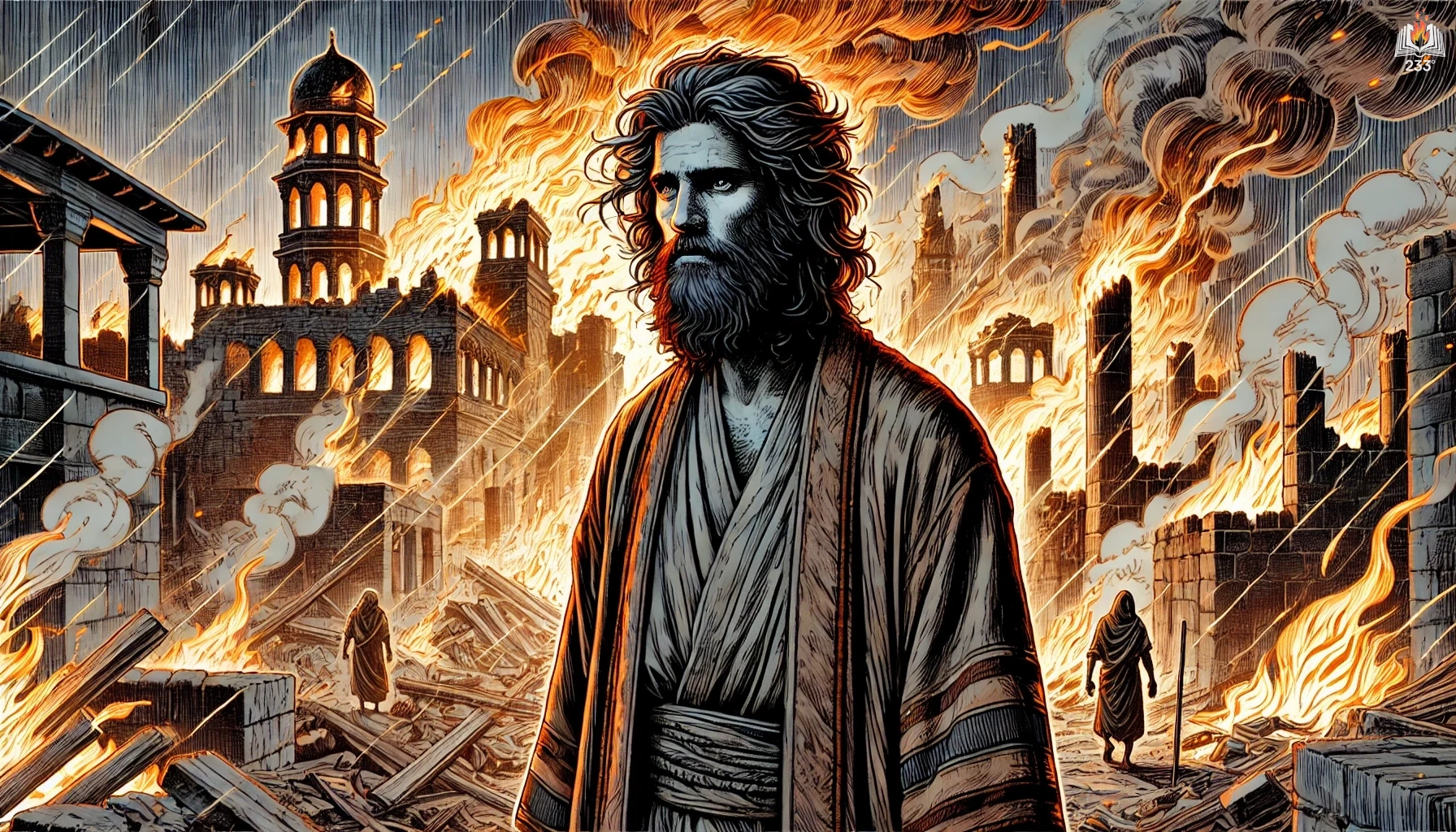
In this moment of profound desperation and humanity, Rose of Sharon, who has just suffered the stillbirth of her baby, nurses the starving man with her breast, offering a final act of life-giving compassion. Amid the rain-soaked devastation, this act becomes a symbol of hope, resilience, and the unyielding spirit of humanity, even in the face of overwhelming loss.
Main Characters
Tom Joad: Recently paroled, Tom is the story’s protagonist. He evolves from a self-centered man into a passionate advocate for social justice, embodying the spirit of resilience and change.
Ma Joad: The moral backbone of the family, Ma is a strong, compassionate matriarch whose unwavering hope and determination keep the family together amidst hardship.
Pa Joad: A hardworking farmer, Pa struggles with feelings of inadequacy as his traditional role as provider becomes increasingly untenable.
Jim Casy: A former preacher turned social activist, Casy is a philosophical figure who rejects organized religion in favor of collective human spirit and action.
Rose of Sharon (Rosasharn) Joad: Tom’s pregnant sister, Rosasharn undergoes a transformation from naive and self-focused to a symbol of hope and selflessness.
Grandpa and Grandma Joad: Elderly and tied to their land, their health and spirits deteriorate early in the journey, representing the loss of a past way of life.
Al Joad: Tom’s younger brother, obsessed with cars and women, Al provides mechanical skills and occasional comic relief.
Ruthie and Winfield Joad: The youngest siblings, their innocence and vulnerability contrast with the harsh realities faced by the family.
Theme
Migration and Displacement: The Joads’ journey west represents the displacement of thousands of families during the Dust Bowl, shedding light on the universal search for stability and belonging.
Social and Economic Injustice: The novel critiques the exploitation of migrant workers and highlights the systemic inequalities of capitalism, depicting labor strikes and struggles for dignity.
Family and Community: Steinbeck emphasizes the importance of familial bonds and communal solidarity as sources of strength against oppression and despair.
Human Resilience and Dignity: Despite suffering and loss, the characters demonstrate remarkable endurance and an unyielding quest for a better future.
The Land and Its Loss: The connection to the land is central, with its loss symbolizing the unraveling of identity, tradition, and self-worth for the tenant farmers.
Writing Style and Tone
Steinbeck’s writing in The Grapes of Wrath combines vivid naturalistic descriptions with lyrical prose. His intercalary chapters, which alternate between the Joads’ story and broader societal commentary, provide a panoramic view of the Depression-era experience. The language ranges from poetic and symbolic to stark and unflinching, mirroring the beauty and brutality of the era.
The tone shifts between empathetic and indignant, often reflecting the tension between human suffering and systemic cruelty. Steinbeck employs a Biblical cadence, with recurring allusions to themes of exodus, sacrifice, and redemption, creating a timeless and universal resonance. His use of dialogue captures the dialect and speech patterns of the time, grounding the novel in authenticity.
Quotes
The Grapes of Wrath – John Steinbeck (1939) Quotes
“There ain't no sin and there ain't no virtue. There's just stuff people do.”
“And the little screaming fact that sounds through all history: repression works only to strengthen and knit the repressed.”
“It was her habit to build up laughter out of inadequate materials.”
“How can we live without our lives? How will we know it's us without our past?”
“...and in the eyes of the people there is the failure; and in the eyes of the hungry there is a growing wrath. In the souls of the people the grapes of wrath are filling and growing heavy, growing heavy for the vintage.”
“The quality of owning freezes you forever in "I," and cuts you off forever from the "we.”
“You're bound to get idears if you go thinkin' about stuff”
“Death was a friend, and sleep was Death's brother.”
“Up ahead they's a thousan' lives we might live, but when it comes it'll on'y be one.”
“Muscles aching to work, minds aching to create - this is man.”
“If he needs a million acres to make him feel rich, seems to me he needs it 'cause he feels awful poor inside hisself, and if he's poor in hisself, there ain't no million acres gonna make him feel rich, an' maybe he's disappointed that nothin' he can do 'll make him feel rich.”
“Our people are good people; our people are kind people. Pray God some day kind people won't all be poor.”
“I'm jus' pain covered with skin.”
“And this you can know- fear the time when Manself will not suffer and die for a concept, for this one quality is man, distinctive in the universe.”
“If you're in trouble or hurt or need–go to poor people. They're the only ones that'll help–the only ones.”
“I’m gettin’ tired way past where sleep rests me.”
“The bank - the monster has to have profits all the time. It can't wait. It'll die. No, taxes go on. When the monster stops growing, it dies. It can't stay one size.”
“You got a God. Don't make no difference if you don' know what he looks like.”
“Man, unlike any other thing organic or inorganic in the universe, grows beyond his work, walks up the stairs of his concepts, and emerges ahead of his accomplishments.”
“And her joy was nearly like sorrow.”
We hope this summary has sparked your interest and would appreciate you following Celsius 233 on social media:
There’s a treasure trove of other fascinating book summaries waiting for you. Check out our collection of stories that inspire, thrill, and provoke thought, just like this one by checking out the Book Shelf or the Library
Remember, while our summaries capture the essence, they can never replace the full experience of reading the book. If this summary intrigued you, consider diving into the complete story – buy the book and immerse yourself in the author’s original work.
If you want to request a book summary, click here.
When Saurabh is not working/watching football/reading books/traveling, you can reach him via Twitter/X, LinkedIn, or Threads
Restart reading!