Orlando: A Biography by Virginia Woolf, published in 1928, is a groundbreaking novel that traverses centuries of history while exploring themes of identity, gender, and time. Woolf creates an eccentric, poetic narrative centered on Orlando, a young nobleman in Elizabethan England who mysteriously transforms into a woman and lives for centuries, experiencing different epochs and shifting social landscapes. Blurring the lines between fiction and biography, Woolf’s narrative is infused with her characteristic stream-of-consciousness style and wit.
Plot Summary
Orlando stood poised in the vast chambers of his ancestral home, a boy of noble birth under the reign of Queen Elizabeth I. The wind howled through the rafters, where the heads of his ancestors’ slain enemies swung like grim trophies. Tall and handsome, with skin flushed like a peach and eyes full of unspoken poetry, Orlando was destined for greatness, or so it seemed. His youthful days were spent dreaming of love and glory, but the sharp blade of ambition did not drive him as much as the musings of his own restless mind. Even as a youth, Orlando’s heart ached not for battle or politics, but for the beauty of the world — the skies, the rooks in flight, and the silent, meditative act of writing.
When Queen Elizabeth herself arrived at Orlando’s grand estate, her fondness for him was instant. She noticed the elegance in his demeanor, the fine cut of his legs, and the brightness in his eyes. Orlando was soon brought to court, where he dazzled the Queen with his youthful charm and became a favorite. Yet court life, with its pageantry and responsibilities, left Orlando restless. His true passions stirred when he fell deeply in love with Sasha, a mysterious Russian princess who appeared at court during the Great Frost. Sasha, with her sharp wit and icy beauty, swept Orlando into an intoxicating affair. They skated together on the frozen Thames, laughing and whispering in the cold air, their romance burning with intensity despite the frigid backdrop.
Yet the affair was fleeting, like the frost that would soon thaw. Sasha was bound to return to her homeland, and one night, Orlando discovered her embracing a seaman aboard a ship, the moment shattering his heart. As the ship sailed away, taking Sasha and Orlando’s dreams with it, a melancholy settled over him. The court, once a place of enchantment, now felt hollow. And so, Orlando retreated to his estate, seeking solace in solitude and his ever-growing collection of writings.
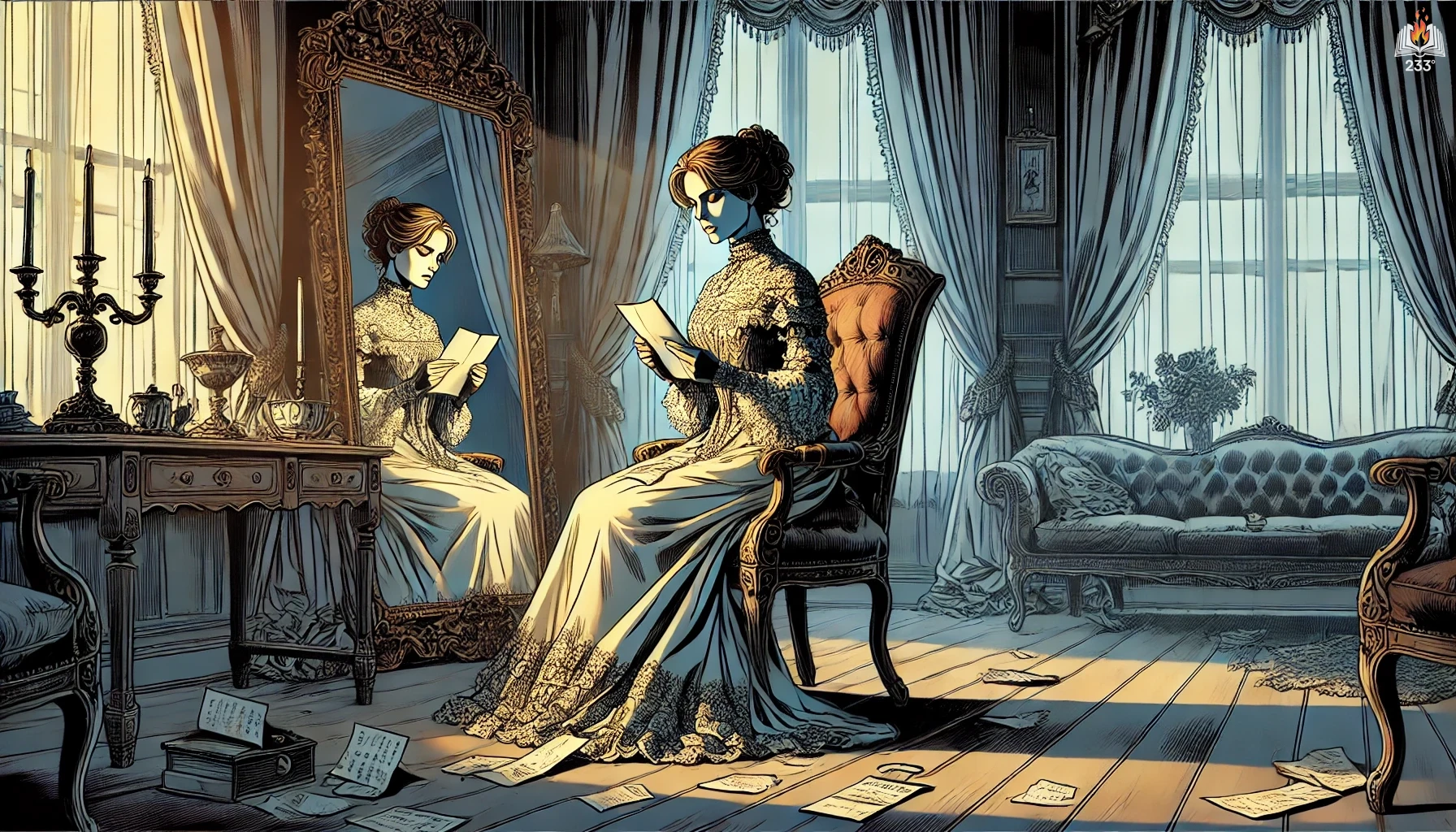
Years passed. Orlando devoted himself to writing, but life, ever strange and unpredictable, had different plans for him. One day, without warning or explanation, he fell into a deep slumber. When he awoke, the world had changed — and so had he. His body, once that of a young nobleman, was now unmistakably female. Orlando had become a woman. She gazed upon herself in astonishment, yet with little distress. Her soul remained intact, her desires and thoughts unchanged. She was still Orlando.
Life as a woman, however, brought new challenges and freedoms. No longer able to command the privileges once granted to her as a man, Orlando experienced the world from a different vantage point. She donned gowns, attended court, and marveled at the complexities of womanhood. Despite the outward change, Orlando’s inner life — her love of beauty, her poetic soul — remained constant. She lived through the ages, seemingly untouched by time, observing as England transformed around her, from the reign of King James to the rise of the Victorian era.
Throughout her long life, Orlando encountered figures from various walks of life. She met the Archduchess Harriet, who revealed herself to be Archduke Harry, a man obsessed with Orlando and desperate to win her affection. His relentless pursuit of her, regardless of her gender, added an absurd humor to Orlando’s already unusual life, and she dismissed his advances with grace and wit.
As the centuries rolled on, Orlando faced society’s ever-changing views on gender and identity. Living as both a man and a woman allowed her a rare perspective on the arbitrary rules and roles dictated by society. She saw the restrictions placed upon women — the expectations of marriage, modesty, and decorum — and compared them to the freedoms she had once enjoyed as a man. Yet, Orlando was never bound by these conventions, drifting in and out of societal expectations with a fluid grace that defied the rigid norms of any era.
By the 18th century, Orlando found herself embroiled in the literary world, befriending poets and writers, attending salons, and discussing art. Her own poetry, which had been a source of solace and reflection throughout her life, continued to grow in depth and complexity. Yet, despite her success, Orlando remained haunted by a sense of incompleteness, a longing that no era, no identity, could satisfy.
It was then that Marmaduke Bonthrop Shelmerdine entered her life, a sea captain with a spirit as adventurous and free as her own. Their meeting was electric, and for the first time, Orlando found in Shelmerdine a kindred soul who understood her fully. He, too, defied the conventions of gender and society, and together, they formed a bond that transcended the ordinary boundaries of love. They did not conform to the world’s expectations; instead, they carved out a space for themselves, one defined by mutual understanding and the rejection of limitation. Shelmerdine accepted Orlando as both man and woman, as neither, and as both.
Their union was one of equals, unbound by the laws of time or the strictures of gender. As Shelmerdine sailed away on another voyage, promising to return, Orlando stood in her sprawling estate, watching the skies shift from one century to the next. She felt the weight of history pressing down upon her, but she also felt light, as if she had finally understood the secret to living — to be free, to love without restraint, and to embrace the fluidity of existence.
As Orlando stood there, surrounded by the changing landscape of modern England, she held a manuscript in her hands. It was her life’s work, a culmination of centuries of observation, love, and poetry. In that moment, Orlando realized that time, gender, and identity were merely passing illusions, and that true existence lay beyond these constraints, in the eternal dance of life and art. The sound of Shelmerdine’s ship echoed in the distance, a reminder that their story was far from over, and that Orlando’s journey, too, would continue beyond the boundaries of time.
Main Characters
Orlando: The protagonist of the novel, Orlando starts as a young nobleman in Elizabethan England but transitions into a woman midway through the story. Orlando’s transformation is both physical and metaphysical, as she navigates the roles and expectations assigned by gender and society. Over the centuries, Orlando remains a deeply poetic soul, always in search of beauty, identity, and love.
Queen Elizabeth I: The Queen bestows favor upon Orlando in his youth, highlighting the connection between Orlando’s personal identity and the larger historical context. Her brief but pivotal role establishes Orlando’s early loyalty to the court and sets in motion his journey.
Sasha: A Russian princess with whom Orlando falls deeply in love. Their romance, set against the backdrop of a frozen Thames during the Great Frost, is both passionate and melancholic, foreshadowing Orlando’s future relationships and struggles with fleeting emotions.
Archduchess Harriet/Archduke Harry: A peculiar character who pursues Orlando persistently, first as a woman and then revealing himself as a man. Harry’s obsession and transformation parallel Orlando’s own gender-fluid journey, providing a satirical commentary on love, gender roles, and social expectations.
Marmaduke Bonthrop Shelmerdine: Orlando’s eventual love interest, Marmaduke is a free-spirited sea captain who embraces Orlando’s gender fluidity. Their relationship, built on mutual understanding and a rejection of conventional norms, symbolizes the novel’s progressive take on love and identity.
Theme
Gender Fluidity and Identity: The central theme of the novel is Orlando’s transformation from male to female, which Woolf uses to explore the social and cultural constructs of gender. By living as both a man and a woman, Orlando challenges rigid definitions of identity and reflects Woolf’s broader commentary on the fluidity of gender.
Time and Immortality: Orlando lives for over 300 years, witnessing different historical periods without aging significantly. This unique characteristic allows Woolf to explore the passage of time not as a linear progression but as a fluid and elastic experience. The novel questions the relevance of time in shaping identity and existence.
Art and Literature: Orlando is deeply connected to poetry and literature, with writing becoming a central part of Orlando’s self-expression. The novel also engages with literary history, referencing various styles and movements as Orlando interacts with famous literary figures of different eras.
Society and Class: Throughout the novel, Orlando navigates different social roles, from nobleman to woman of society, and interacts with various strata of class. Woolf critiques the restrictions imposed by social class and expectations, especially in relation to gender roles.
Writing Style and Tone
Virginia Woolf’s writing in Orlando is often described as lyrical, witty, and whimsical. Her use of stream-of-consciousness allows readers to delve deep into Orlando’s thoughts and perceptions, blurring the boundaries between inner reality and external events. Woolf’s playful manipulation of language and structure reflects the novel’s fluid exploration of identity and time. The prose often mimics poetry, with its rhythmic sentences and evocative imagery, especially when capturing Orlando’s contemplations on beauty, nature, and art.
The tone of Orlando shifts between satirical and romantic. Woolf imbues the narrative with humor and irony, particularly in her treatment of societal norms and gender expectations, while also creating moments of deep emotional intensity, especially in Orlando’s reflections on love and identity. The novel’s tone mirrors its thematic fluidity, oscillating between playful irreverence and philosophical depth.
Quotes
Orlando: A Biography – Virginia Woolf (1928) Quotes
“As long as she thinks of a man, nobody objects to a woman thinking.”
“Nothing thicker than a knife's blade separates happiness from melancholy.”
“Love, the poet said, is woman's whole existence.”
“All extremes of feeling are allied with madness.”
“Orlando naturally loved solitary places, vast views, and to feel himself for ever and ever and ever alone.”
“For it would seem - her case proved it - that we write, not with the fingers, but with the whole person. The nerve which controls the pen winds itself about every fibre of our being, threads the heart, pierces the liver.”
“I'm sick to death of this particular self. I want another.”
“Was not writing poetry a secret transaction, a voice answering a voice?”
“He who robs us of our dreams robs us of our life.”
“No passion is stronger in the breast of a man than the desire to make others believe as he believes. Nothing so cuts at the root of his happiness and fills him with rage as the sense that another rates low what he prizes high.”
“Better was it to go unknown and leave behind you an arch, then to burn like a meteor and leave no dust.”
“The taste for books was an early one. As a child he was sometimes found at midnight by a page still reading. They took his taper away, and he bred glow-worms to serve his purpose. They took the glow-worms away and he almost burnt the house down with a tinder.”
“By the truth we are undone. Life is a dream. 'Tis the waking that kills us. He who robs us of our dreams robs us of our life.”
“Illusions are to the soul what atmosphere is to the earth.”
“The flower bloomed and faded. The sun rose and sank. The lover loved and went. And what the poets said in rhyme, the young translated into practice.”
“To put it in a nutshell, he was afflicted with a love of literature. It was the fatal nature of this disease to substitute a phantom for reality.”
“Green in nature is one thing, green in literature another. Nature and letters seem to have a natural antipathy; bring them together and they tear each other to pieces.”
“For once the disease of reading has laid upon the system it weakens so that it falls an easy prey to that other scourge which dwells in the ink pot and festers in the quill. The wretch takes to writing. ”
“Her eyes are pure stars, and her fingers, if they touch you, freeze you to the bone.”
“. . . clumsiness is often mated with a love of solitude.”
“But Sasha was from Russia, where the sunsets are longer, the dawns less sudden and sentences are often left unfinished from doubt as how to best end them.”
“some we know to be dead even though they walk among us; some are not yet born though they go through all the forms of life; other are hundreds of years old though they call themselves thirty-six”
“Are we so made that we have to take death in small doses daily or we could not go on with the business of living?”
“Vain trifles as they seem, clothes have, they say, more important offices than to merely keep us warm. They change our view of the world and the world's view of us.”
“A million candles burnt in him without his being at the trouble of lighting a single one”
“Thoughts are divine.”
We hope this summary has sparked your interest and would appreciate you following Celsius 233 on social media:
There’s a treasure trove of other fascinating book summaries waiting for you. Check out our collection of stories that inspire, thrill, and provoke thought, just like this one by checking out the Book Shelf or the Library
Remember, while our summaries capture the essence, they can never replace the full experience of reading the book. If this summary intrigued you, consider diving into the complete story – buy the book and immerse yourself in the author’s original work.
If you want to request a book summary, click here.
When Saurabh is not working/watching football/reading books/traveling, you can reach him via Twitter/X, LinkedIn, or Threads
Restart reading!