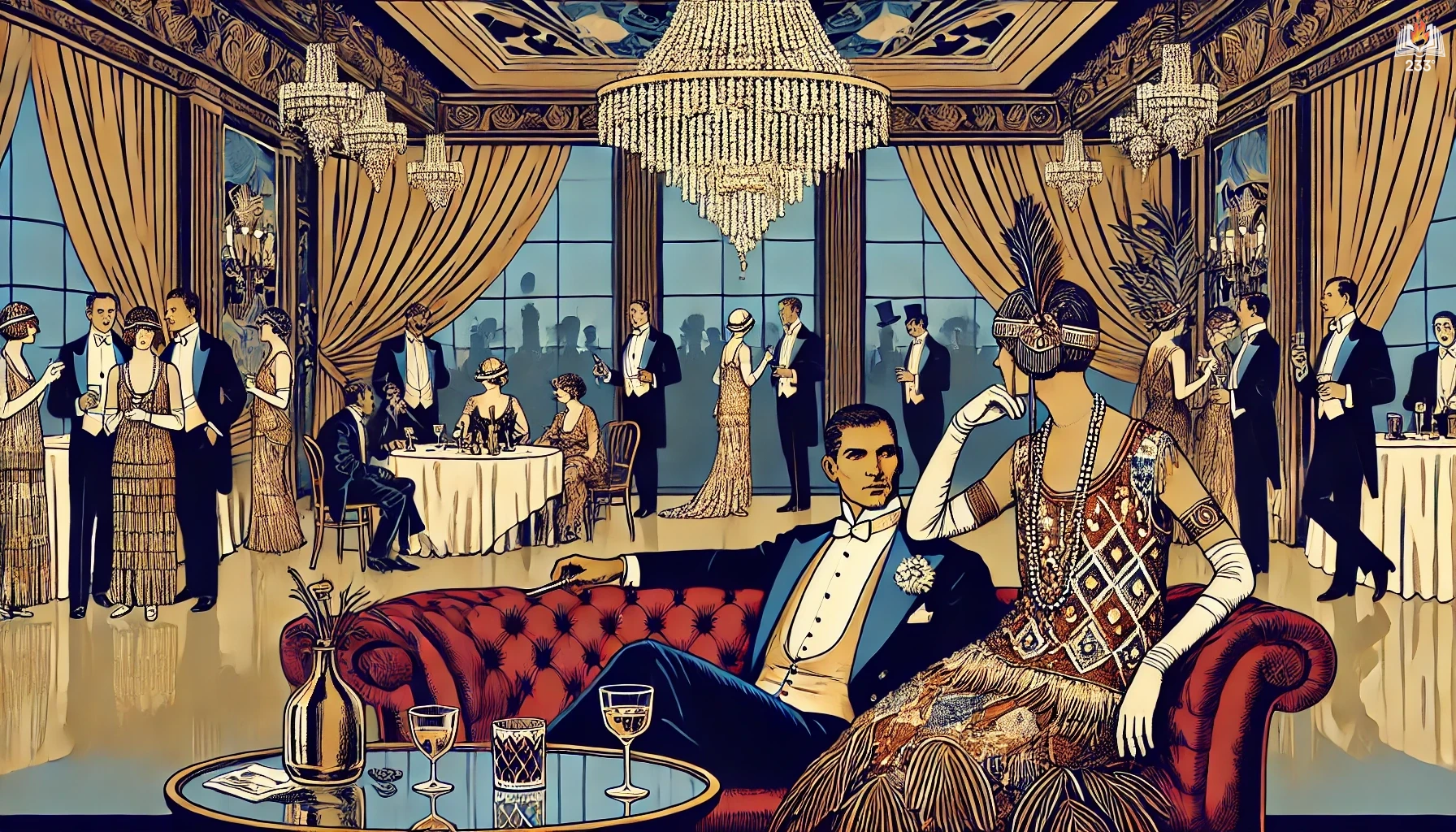

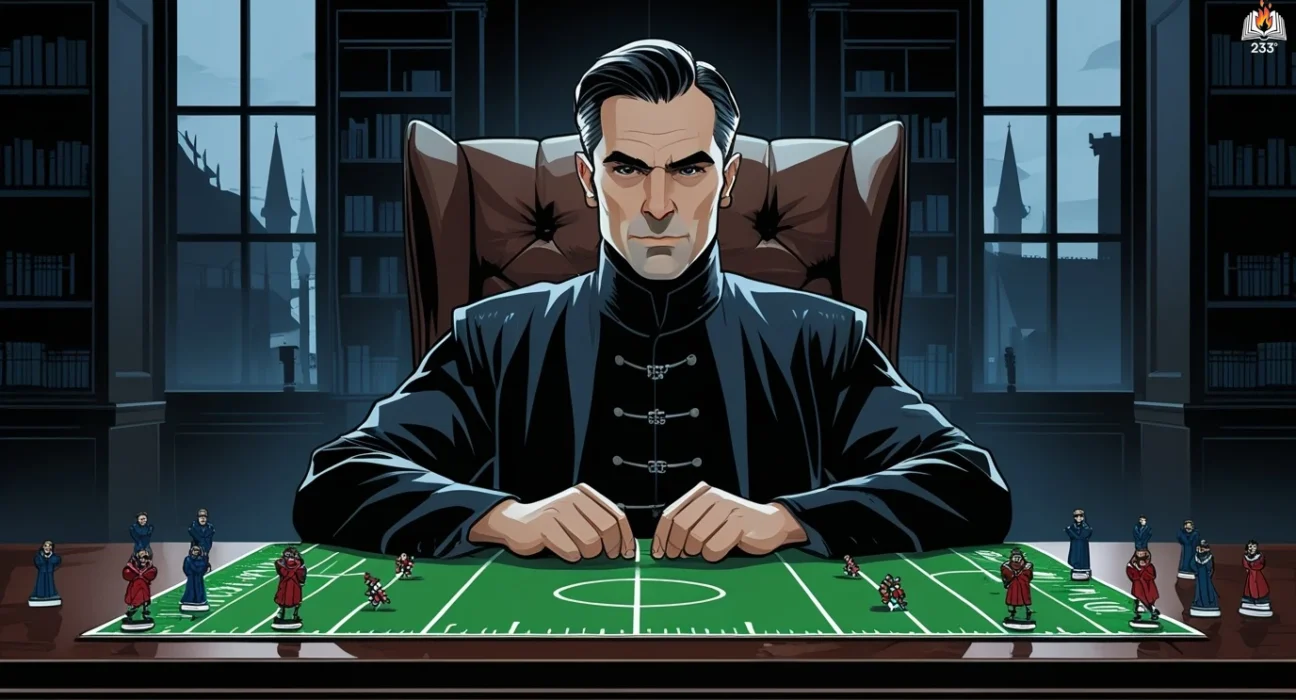
Unseen Academicals, penned by Terry Pratchett and published in 2009, is the 37th installment in the celebrated Discworld series. This novel uniquely blends the whimsical absurdity of Pratchett’s magical universe with the cultural phenomenon of football, centering around Unseen University’s reluctant entry into the world of organized sport to maintain a valuable bequest. While comic and satirical on the surface, the novel weaves deeper explorations of identity, tradition, and societal roles into its fantastical narrative.
Plot Summary
In the bustling heart of Ankh-Morpork, beneath the ancient spires of Unseen University, the scent of pies and the sharp clatter of cutlery fill the air of the Night Kitchen, where Glenda Sugarbean reigns with her practical mind and deep sense of responsibility. The wizards, grand in their robes and rituals, are oblivious to the quiet dramas unfolding below – until a bequest from a long-dead benefactor threatens to disturb their comfortable status quo. If they fail to form a football team and play a match, they stand to lose a considerable source of funding. And so, in a swirl of magic, mealtime politics, and a rather aggressive push from Lord Vetinari, the game is back on.
Football, in Ankh-Morpork, is no gentleman’s sport. It is a messy, often bloody affair played in the back alleys and muddy fields by men with more brawn than sense. But under the calculating eye of the wizards and the organizing touch of Ponder Stibbons, it must evolve – become respectable, rule-bound, and watchable. This is not simply sport. It is transformation. It is diplomacy through goalposts.
Among the candlelit corridors of the University, Mister Nutt toils in silence. No one is entirely certain where he came from or what he is. He is unfailingly polite, extraordinarily learned, and mysteriously powerful. With the quiet tenacity of someone determined to earn the right to exist, he washes pots, stacks books, and reads everything within reach. His presence is unsettling to some – unsettling in the way mirrors sometimes are when they show more than they should. Yet, it is in the kitchens, among Glenda and her friend Juliet, that he finds a kind of peace.
Juliet Stollop, golden-haired and breathtakingly beautiful, seems the least likely candidate to become the face of a dwarfish fashion revolution. Yet, one unexpected encounter and a dress spun from micromail later, she becomes the toast of Ankh-Morpork’s subterranean couture scene. Her walk, her smile, her utter bewilderment at it all – it speaks to something primal in the dwarfs, something they had not known they craved. And somewhere on the other side of the crowd, Trev Likely watches her with a heart too full for his lanky frame.
Trev, son of the legendary footballer Dave Likely, is a lad with fast feet and a faster mouth. He has sworn never to play the game, not after what it did to his father. But football is in his blood, and destiny – aided by Nutt’s eerie competence and Juliet’s sidelong glances – is not easily denied. He has his own pitch-side dramas to face, not least of which is surviving the brewing war between old-school street footballers and the new regime of organized play.
As the wizards bumble through their strategic sessions, devising absurd team names and fussing over uniform colors, the city shifts around them. Lord Vetinari watches from the shadows, as always, pulling invisible strings to ensure that chaos serves the greater order. The street gangs, particularly the violent and zealous Dimwell and Dolly Sisters teams, are less interested in reform than in domination. And into this tension steps Nutt, who with quiet, devastating grace, begins to change the game.
Nutt’s strength is immense, his understanding of tactics unmatched, but it is his inner conflict that truly shapes the match. For Nutt is not merely a man. He is an orc – a creature bred for war and reviled across the Disc. Yet he is also a scholar, a philosopher, and a soul desperate to prove that worth is earned, not given. His secret, when it comes to light, threatens to undo all he has built. Glenda stands beside him, not as a savior but as a companion who sees beyond the stories people tell about monsters.
The climactic match is a thing of beauty and absurdity. Wizards in ill-fitting shorts, Thud-like tactics on the pitch, and a crowd roaring with expectation. The ball – a carefully redesigned sphere crafted by the wizards – becomes the focal point of a struggle far larger than sport. Amid the roar and rush, Trev finds his feet, Juliet her place, and Nutt the courage to stand as himself.
Victory is not in the score, but in the playing. The rules hold. The violence is checked. And something new is born from the bruised turf and spilled pies – a vision of what football could be when it binds rather than breaks.
In the quiet after the match, with banners drooping and bruises gently swelling, life returns to its odd, comforting rhythm. Juliet continues to model, Trev finally scores in more ways than one, and Glenda, who never asked for change, finds that she rather likes the way things are becoming. Nutt stays, not because he is needed, but because he is wanted.
Above them all, the wizards toast their accidental success, oblivious once again to the fact that true magic had very little to do with spells. It had everything to do with people – messy, hopeful, and often foolish people – who dared to believe they could be more than what the world said they were.
Main Characters
Mister Nutt – A mysterious and intellectually gifted candle dribbler with an uncertain past and a secret heritage that challenges societal prejudices. His journey toward self-acceptance and recognition is central to the story’s thematic core.
Glenda Sugarbean – Head of the Night Kitchen at Unseen University, Glenda is practical, fiercely protective, and surprisingly insightful. Her developing relationship with Nutt and her evolving views about beauty and class provide emotional depth and grounding.
Juliet Stollop – A stunningly beautiful but dim-witted kitchen worker and Glenda’s friend, Juliet unexpectedly becomes a fashion icon among dwarfs, symbolizing the unpredictable nature of fame and the fluidity of societal expectations.
Trevor Likely (Trev) – Son of a football legend, Trev initially resists involvement in the sport. His arc centers on living up to or escaping his father’s legacy while navigating class and romance with Juliet.
Archchancellor Mustrum Ridcully – The commanding and often oblivious head of Unseen University. His leadership underpins the university’s reluctant plunge into the world of football.
Ponder Stibbons – A pragmatic wizard and the Master of The Traditions. His meticulous planning and role in administrating the game highlight themes of bureaucracy versus passion.
Theme
Identity and Prejudice: Through Mister Nutt, Pratchett explores the damaging effects of societal labeling and the journey to self-worth. Nutt’s origins and how others react to him challenge the reader’s own biases.
Tradition versus Change: The forced revival of football within Unseen University mirrors broader resistance to institutional change. Pratchett satirizes both blind adherence to tradition and the chaos of progress.
Class and Social Mobility: The novel examines class through characters like Glenda and Trev, who navigate love, labor, and societal roles. Juliet’s transformation into a fashion icon further complicates notions of status and identity.
Fandom and Tribalism: Football serves as a metaphor for societal divisions, loyalty, and irrational fervor. Pratchett critiques the violence and tribal mentality often associated with sports while acknowledging its communal power.
Writing Style and Tone
Terry Pratchett’s hallmark wit and sharp observational humor pervade Unseen Academicals. His prose is playful yet precise, utilizing footnotes, puns, and layered references that both entertain and provoke thought. Pratchett’s dialogue sparkles with character-specific quirks, enhancing the individuality of his vast cast.
The tone balances comic absurdity with sincere emotional exploration. Moments of slapstick humor often segue into poignant reflections on identity, loneliness, or societal constraints. Pratchett masterfully shifts between satire and sentiment, ensuring the fantastical setting remains grounded in human experience. His affectionate yet critical portrayal of football encapsulates his broader ability to blend parody with profound insight.
Quotes
Unseen Academicals – Terry Pratchett (2009) Quotes
“The female mind is certainly a devious one, my lord." Vetinari looked at his secretary in surprise. "Well, of course it is. It has to deal with the male one.”
“Juliet's version of cleanliness was next to godliness, which was to say it was erratic, past all understanding and was seldom seen.”
“Don't be smart. Smart is only a polished version of dumb. Try intelligence. It will surely see you through.”
“The thing about football - the important thing about football - is that it is not just about football.”
“Peace?' said Vetinari. 'Ah, yes, defined as period of time to allow for preparation for the next war.”
“And that's when I first learned about evil. It is built in to the very nature of the universe. Every world spins in pain. If there is any kind of supreme being, I told myself, it is up to all of us to become his moral superior.”
“I would like you to teach [the orcs] civilised behaviour," said Ladyship coldly. He appeared to consider this. "Yes of course, I think that would be quite possible," he said. "And who would you send to teach the humans?”
“If you try to to take my bananas from me, I will reclaim them from your cold dead hands.”
“The Librarian was not familiar with love, which had always struck him as a bit ethereal and soppy, but kindness, on the other hand, was practical. You knew where you were with kindness, especially if you were holding a pie it had just given you.”
“I see evil when I look in my shaving mirror. It is, philosophically, present everywhere in the universe in order, apparently, to highlight the existence of good. I think there is more to this theory, but I tend to burst out laughing at this point.”
“Apes had it worked out. No ape would philosophize, "The mountain is, and is not." They would think, "The banana is. I will eat the banana. There is no banana. I want another banana.”
“We play and are played and the best we can hope for is to do it with style.”
“You were safe on a troll. Anyone wanting to mug a troll would have to use a building on a stick.”
“The last thing she wanted was to see her friend getting ideas in her head. There was such a lot of room in there for them to bounce around and do damage.”
“There are all kinds of darkness, and all kinds of things can be found in them, imprisoned, banished, lost or hidden. Sometimes they escape. Sometimes they simply fall out. Sometimes they just can't take it any more.”
“the Ankh-Morpork Trespassers' Society was originally the Explorers' Society until Lord Vetinari forcibly insisted that most of the places 'discovered' by the society's members already had people in them, who were already trying to sell snakes to the newcomers.”
“Be one of the crowd? It went against everything a wizard stood for, and a wizard would not stand for anything if he could sit down for it, but even sitting down, you had to stand out.”
“It is considered in the Sto Plains that only scoundrels know the second verse of their national anthem, since anyone spending time memorizing that would be up to no good purpose.”
“The rising sun managed to peek around the vast column of smoke that forever rose from Ankh-Morpork, City of Cities, illustrating almost up to the edge of space that smoke means progress or, at least, people setting fire to things.”
“Well, yes, but it's not about the football." "You're saying that football is not about football?" "It's the sharing," she said. "It's being part of the crowd. It's chanting together. It's all of it. the whole thing.”
“I would not like it thought that I do not buy my own paperclips, sir. I enjoy owning my own paperclips. It means they are mine.”
We hope this summary has sparked your interest and would appreciate you following Celsius 233 on social media:
There’s a treasure trove of other fascinating book summaries waiting for you. Check out our collection of stories that inspire, thrill, and provoke thought, just like this one by checking out the Book Shelf or the Library
Remember, while our summaries capture the essence, they can never replace the full experience of reading the book. If this summary intrigued you, consider diving into the complete story – buy the book and immerse yourself in the author’s original work.
If you want to request a book summary, click here.
When Saurabh is not working/watching football/reading books/traveling, you can reach him via Twitter/X, LinkedIn, or Threads
Restart reading!