Gulliver’s Travels, written by Jonathan Swift and first published in 1726, is a satirical novel that follows the adventures of Lemuel Gulliver, a ship’s surgeon who embarks on multiple voyages to fantastical lands. Through Gulliver’s experiences, Swift critiques the politics, human nature, and society of his time, blending humor and cynicism. The novel is divided into four parts, each recounting Gulliver’s journey to strange worlds with their own unique cultures and beings.
Plot Summary
In a quiet village in Nottinghamshire lived Lemuel Gulliver, a man with a thirst for adventure. Educated in medicine and with a love for navigation, Gulliver set sail on several voyages, but it was one particular journey that would forever change his life. He embarked aboard the Antelope, headed for the South Seas, but the ship encountered a violent storm, and Gulliver, thrown into the sea, was cast ashore, unconscious, on an unknown island.
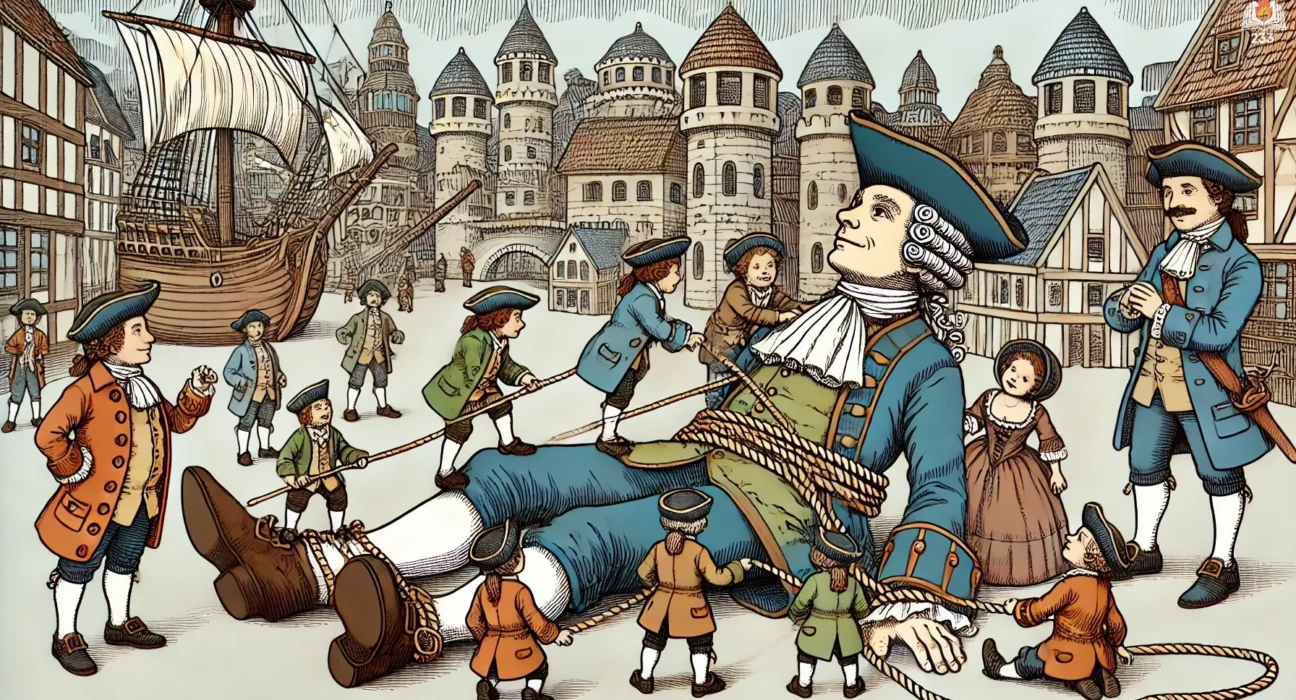
When he awoke, Gulliver found himself bound by numerous tiny ropes, his body held fast by the hands of a race of miniature people. These were the Lilliputians, a people no more than six inches tall, yet proud and full of ambition. Though initially cautious of this giant who had washed ashore, the Lilliputians soon saw potential in Gulliver. They treated him as a guest but also as a weapon. Their empire was embroiled in a bitter war with their rival, Blefuscu, over the proper way to crack eggs—one faction believed they should be broken on the larger end, while the other insisted on the smaller. Gulliver, towering above these tiny people, was recruited to aid Lilliput in its conflict. He complied, wading across the narrow sea to capture the enemy’s fleet. His great size made him both a protector and a threat, and while he was hailed as a hero at first, the court soon grew fearful of his power. A false accusation of treason was made against him, and he fled to Blefuscu, where, after some time, he found a way back to England.
Yet Gulliver’s desire for exploration did not wane, and soon he set sail once more. This time, his ship encountered the land of Brobdingnag, home to giants, each sixty feet tall. Here, Gulliver was no longer the giant—he was the tiny curiosity. Captured by a farmer, Gulliver was treated as an amusement, displayed across the land for money. Eventually, the queen of Brobdingnag took an interest in him, and he became a member of her court, living in a small box she carried. The king of Brobdingnag, a wise and thoughtful ruler, frequently conversed with Gulliver, who proudly recounted tales of his homeland, England. However, to Gulliver’s dismay, the king found much of his description of European politics, warfare, and society foolish and barbaric. The king’s simple but moral outlook on life revealed to Gulliver the deep flaws of his own world, yet Gulliver could not help but cling to the superiority of his people. Eventually, an accident involving a giant eagle carried Gulliver out to sea in his small box, where he was rescued by a passing ship and returned once more to England.
Undeterred by his past misfortunes, Gulliver ventured out again, this time arriving at the floating island of Laputa. The people of Laputa were obsessed with abstract mathematical and scientific theories, to the detriment of their practical lives. They floated above the land, controlling their subjects below with fear of being crushed by the island itself, which they could lower at will. The Laputans were distracted and impractical, often forgetting the very basics of human interaction in favor of their elaborate, often pointless calculations. Gulliver’s journey continued to the lands of Balnibarbi and Glubbdubdrib, where he encountered more oddities: philosophers so engrossed in theory that they ignored their collapsing society, and magicians who summoned the spirits of the dead to learn from the wisdom of ancient times. Here, Gulliver learned the transient nature of power and the folly of pursuing knowledge without purpose. Eventually, he left these lands, but not before realizing that even in the highest seats of intellect, there existed foolishness and vanity.
Gulliver’s final voyage took him to a land ruled by the Houyhnhnms, a noble race of horses who lived in harmony with reason and logic. In this land, the human-like Yahoos, wild and savage creatures, were ruled by the Houyhnhnms, who viewed them as brutish animals. Gulliver, initially horrified by the resemblance between the Yahoos and humans, began to admire the Houyhnhnms’ rational way of life. They lived without lies, greed, or malice, and Gulliver came to see them as the pinnacle of civilized existence. He grew to despise his own kind, seeing in the Yahoos the reflection of mankind’s worst traits—cruelty, selfishness, and irrationality. Gulliver’s time among the Houyhnhnms brought him peace, and he yearned to stay in their world of serene reason forever. However, the Houyhnhnms, after much deliberation, decided that Gulliver, despite his gentler nature, was too similar to the Yahoos and asked him to leave their land. Heartbroken, Gulliver built a small canoe and set out to sea.
Upon his return to England, Gulliver was no longer the same man. His experiences among the Lilliputians, Brobdingnagians, Laputans, and Houyhnhnms had altered his view of humanity forever. He could no longer bear the company of his fellow men, whom he saw as little more than refined Yahoos. He recoiled from their touch, preferring the company of his horses, in whom he saw traces of the noble Houyhnhnms. The voyages that once filled him with wonder had left him isolated, disillusioned, and bitter. While he had once been curious and optimistic about the world, Gulliver now spent his days in solitude, lamenting the flawed nature of mankind and yearning for the rational world of the Houyhnhnms, where he believed true virtue resided.
Main Characters
Lemuel Gulliver: The protagonist and narrator, Gulliver is an intelligent and curious man, though often naive in his assessments of the strange societies he encounters. His voyages cause him to question human nature, culminating in his growing misanthropy by the end of the novel.
The Lilliputians: Tiny, six-inch-tall people Gulliver meets during his first voyage. They represent the pettiness and self-importance of European politics. Despite their small stature, they are prideful and embroiled in meaningless conflicts.
The Brobdingnagians: A race of giants Gulliver meets on his second voyage. They are morally upright and treat Gulliver as a curiosity. Their society reflects Swift’s ideal of rational governance, contrasting with the corruption of European courts.
The Houyhnhnms: Rational, intelligent horses who embody pure reason. They rule over the brutish, human-like Yahoos. Gulliver’s time with them leads him to reject humanity, preferring the Houyhnhnms’ logical, emotionless society.
The Yahoos: Savage, bestial creatures that resemble humans, serving as a mirror for human depravity. Gulliver grows to despise humanity after encountering them, seeing them as a reflection of the worst aspects of mankind.
Theme
Human Nature and Morality: Swift delves into the flaws of human nature, exposing greed, corruption, and cruelty. Through Gulliver’s evolving perspectives, especially his eventual rejection of humanity, the novel questions whether humans can ever truly overcome their base instincts.
Political Satire: Much of Gulliver’s Travels is a critique of European governments, particularly the British monarchy and parliament. The Lilliputians’ absurd political conflicts, for instance, mirror the triviality of real-world politics.
Reason vs. Emotion: The Houyhnhnms represent pure reason, while the Yahoos embody unrestrained emotion and primal instincts. Gulliver’s eventual admiration for the Houyhnhnms highlights the Enlightenment’s emphasis on reason, though Swift questions whether total rationality is desirable.
Perspective and Relativity: Throughout the novel, Gulliver’s size relative to the inhabitants of each land changes dramatically, allowing Swift to explore the subjectivity of power and perspective. In Lilliput, Gulliver is a giant, while in Brobdingnag, he is tiny, illustrating how relative power shapes society and self-identity.
Writing Style and Tone
Jonathan Swift employs a satirical, often darkly humorous tone throughout Gulliver’s Travels. The novel is written in the first person, adopting the voice of Lemuel Gulliver, who narrates his adventures with a matter-of-fact, often naive tone that contrasts with the absurdity of his experiences. Swift’s use of straightforward, detailed descriptions heightens the irony, as Gulliver’s objective recounting of fantastical or ridiculous events exposes deeper societal critiques.
Swift’s language is accessible yet biting, using Gulliver’s observations to deliver sharp political commentary. His narrative often mirrors the travelogues of the time, lending a sense of realism to the fantastical elements. This style makes the satire more pointed, as the surreal elements are treated with seriousness, allowing Swift to critique human folly and vice without overt moralizing.
Quotes
Gulliver’s Travels – Jonathan Swift (1726) Quotes
“Every man desires to live long, but no man wishes to be old.”
“I cannot but conclude that the Bulk of your Natives, to be the most pernicious Race of little odious Vermin that Nature ever suffered to crawl upon the Surface of the Earth.”
“Undoubtedly, philosophers are in the right when they tell us that nothing is great or little otherwise than by comparison.”
“The tiny Lilliputians surmise that Gulliver's watch may be his god, because it is that which, he admits, he seldom does anything without consulting.”
“Difference in opinions has cost many millions of lives: for instance, whether flesh be bread, or bread be flesh; whether the juice of a certain berry be blood or wine.”
“This made me reflect, how vain an attempt it is for a man to endeavor to do himself honor among those who are out of all degree of equality or comparison with him.”
“... a wife should be always a reasonable and agreeable companion, because she cannot always be young.”
“...I hid myself between two leaves of sorrel, and there discharged the necessities of nature.”
“take a strict view of their excrements, and, from the colour, the odour, the taste, the consistence, the crudeness or maturity of digestion, form a judgment of their thoughts and designs; because men are never so serious, thoughtful, and intent, as when they are at stool...”
“Based on Gulliver's descriptions of their behaviour, the King describes Europeans as "the most pernicious race of little odious vermin that nature ever suffered to crawl upon the surface of the earth.”
“Of so little weight are the greatest services to princes, when put into the balance with a refusal to gratify their passions.”
“They have a notion, that when people are met together, a short silence does much improve conversation: this I found to be true; for during those little intermissions of talk, new ideas would arise in their minds, which very much enlivened the discourse.”
“Gulliver describes a royal personage inspiring awe among the tiny Lilliputians because he was taller than his brethren by the breadth of a human fingernail.”
“I winked at my own littleness, as people do at their own faults.”
“I desired that the Senate of Rome might appear before me in one large chamber, and a modern representative, in counterview, in another. The first seemed to be an assembly of heroes and demi-gods; the other, a knot of pedlars, pick-pockets, highwaymen, and bullies.”
We hope this summary has sparked your interest and would appreciate you following Celsius 233 on social media:
There’s a treasure trove of other fascinating book summaries waiting for you. Check out our collection of stories that inspire, thrill, and provoke thought, just like this one by checking out the Book Shelf or the Library
Remember, while our summaries capture the essence, they can never replace the full experience of reading the book. If this summary intrigued you, consider diving into the complete story – buy the book and immerse yourself in the author’s original work.
If you want to request a book summary, click here.
When Saurabh is not working/watching football/reading books/traveling, you can reach him via Twitter/X, LinkedIn, or Threads
Restart reading!