The Mysterious Island, written by Jules Verne and first published in 1874, is an adventurous tale of survival, ingenuity, and mystery. The story is set during the American Civil War and follows five men and a dog who escape their captivity in a Confederate prison using a hot-air balloon. They are stranded on a remote and uncharted island in the Pacific Ocean, where they must rely on their collective knowledge and resourcefulness to survive. Over time, they uncover the island’s hidden secrets, making this novel not just an adventure, but also a puzzle full of surprises.
Plot Summary
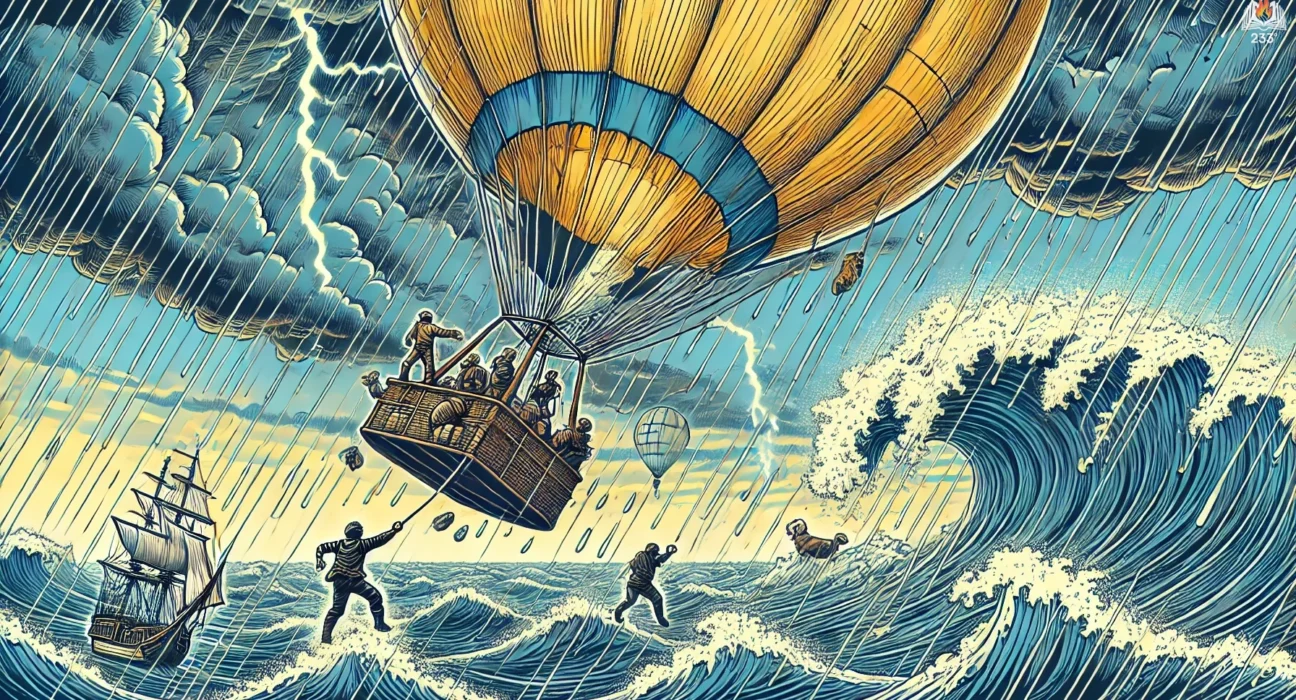
A violent storm raged over the Pacific in the late days of March 1865. Caught in this tempest was a hot-air balloon carrying five passengers: Cyrus Smith, an engineer; his servant, Neb; a sailor named Pencroff; young Herbert Brown; and a journalist, Gideon Spilett. Alongside them was a loyal dog, Top. The storm battered the balloon relentlessly, forcing them to throw everything overboard to stay aloft. But their efforts proved futile, and the balloon plummeted toward an unknown island.
The five men survived the crash landing, albeit scattered along the shores of this mysterious, uncharted island. They regrouped, but their leader, Cyrus Smith, was nowhere to be found. Desperate to find him, the group scoured the coastline, eventually finding him unconscious but alive, thanks to the faithful Top who had pulled his master from the water. With Cyrus recovered, they set out to explore their new environment.
The island was both a blessing and a curse. It offered an abundance of natural resources—wildlife for food, timber for shelter—but also posed dangers with its rugged terrain and strange occurrences. The men named it Lincoln Island, and together, they began the arduous task of building a new life. Cyrus, using his scientific knowledge, led the group in creating basic necessities from scratch: a kiln for pottery, a forge, and a loom. They also discovered caves in a granite plateau, which they named “Granite House,” and made it their home.
As the weeks turned into months, the men tamed their surroundings, cultivating crops and domesticating animals. However, they were not alone. Strange phenomena began to occur. Items would appear mysteriously—tools, supplies, and even food—seemingly out of nowhere. Their lives were saved on multiple occasions by this unseen benefactor. A message in a bottle washed ashore one day, revealing the presence of a castaway on a distant isle. Despite their own precarious situation, they built a boat and sailed to rescue the man.
They found a shipwreck survivor, Ayrton, who had once been a villainous mutineer but had since repented. With Ayrton’s help, the settlers continued to prosper on Lincoln Island. Yet, the mystery deepened. There were no footprints or signs of anyone else on the island, and they had no way of explaining the strange interventions that saved them time and again.
As they worked to unravel the secrets of their surroundings, they also had to contend with external threats. Pirates arrived on the island, posing a grave danger. A vicious battle ensued, and just as the situation seemed hopeless, the pirates were mysteriously defeated. Their ship was destroyed, and the crew was found dead or incapacitated, further adding to the puzzle.
The answer to these mysteries came in the form of an astonishing revelation. The island harbored a secret resident: Captain Nemo, the enigmatic commander of the Nautilus from Verne’s earlier tale, Twenty Thousand Leagues Under the Sea. The submarine had been hidden in a cavern beneath the island for years, and Nemo, now an old and dying man, had been living in isolation. It was he who had been watching over the settlers, intervening silently from the shadows to ensure their survival. His vast knowledge and technology had provided the means for their prosperity, and he revealed that he had chosen Lincoln Island as his final resting place.
Before his death, Captain Nemo told his story to the settlers, explaining his desire for peace and seclusion after years of wandering the oceans in rebellion against oppressive governments. He died peacefully and was buried in the depths of the sea, entombed within his beloved Nautilus.
With Nemo’s passing, the settlers turned their focus to the future. Their peaceful existence, however, was not to last. The island itself harbored a dormant volcano, which had begun to awaken. Earthquakes shook the land, and volcanic eruptions became increasingly frequent. The settlers realized that their island was doomed. They could do nothing but prepare for the inevitable.
In the final throes of destruction, Lincoln Island was consumed by the volcanic eruption, sinking into the sea. The settlers, now without a home, were adrift on the ocean, clinging to a small boat. It seemed as though all hope was lost, but fate intervened once again. A ship, the Duncan, appeared on the horizon, having come to search for Ayrton after his long absence. The settlers were rescued and brought back to civilization.
Though they had lost their island home, they carried with them the invaluable lessons learned during their time on Lincoln Island: lessons of perseverance, ingenuity, and the triumph of human spirit over adversity. United by their shared ordeal and the memory of Captain Nemo’s quiet heroism, they returned to the world not as victims, but as conquerors of the challenges they had faced.
Main Characters
Cyrus Smith (Cyrus Harding): A skilled engineer and natural leader, Cyrus is the backbone of the group. His knowledge of science, engineering, and leadership abilities is crucial to their survival. Throughout the novel, he is the embodiment of intelligence and resourcefulness, guiding his companions through numerous challenges.
Gideon Spilett: A courageous and intelligent journalist, Spilett provides a keen observational eye and serves as a reliable second-in-command to Cyrus. His bravery and commitment to recording their experiences adds to the depth of the story.
Pencroff: A seasoned sailor, Pencroff is hardworking, practical, and always optimistic. His seafaring skills prove essential, and his loyalty to Cyrus and the group is unwavering.
Herbert Brown: Pencroff’s young companion, Herbert is bright and eager to learn. His knowledge of botany and natural history contributes to their ability to identify useful plants and animals. Herbert’s curiosity and adaptability are key traits.
Nebuchadnezzar (Neb): Cyrus Smith’s loyal African-American servant, Neb is devoted and brave. Though portrayed with stereotypical limitations of the time, his dedication to his master and the group adds an emotional element to the story.
Captain Nemo: A mysterious and iconic figure from Verne’s earlier novel Twenty Thousand Leagues Under the Sea, Captain Nemo is revealed to be living secretly on the island. His hidden submarine, the Nautilus, and advanced knowledge become crucial to the story’s resolution.
Theme
Survival and Self-Reliance: The core theme of The Mysterious Island is survival. The characters use their scientific knowledge and resourcefulness to transform the island into a habitable place, demonstrating humanity’s ability to overcome nature’s challenges through intelligence and perseverance.
Science and Progress: Verne, a pioneer of science fiction, highlights the power of science and engineering as tools for survival. From constructing basic shelters to more advanced feats like making glass and bricks, the novel portrays the triumph of human intellect over the wild.
Nature and Exploration: The island itself is a character in the story, full of mysteries, hidden treasures, and dangers. The group’s exploration and interaction with nature reflect a theme of discovery and the importance of understanding and respecting the natural world.
The Unknown and Mystery: Throughout the novel, the island presents unexplained phenomena, such as strange disappearances and assistance from an unseen force. These mysteries keep the reader engaged and build toward the eventual revelation of Captain Nemo’s role in the story.
Brotherhood and Community: The camaraderie between the men is a central theme. Despite their different backgrounds, they work together, pooling their knowledge and skills for mutual survival. This unity illustrates the importance of cooperation in overcoming adversity.
Writing Style and Tone
Jules Verne’s writing style in The Mysterious Island is detailed, methodical, and driven by his fascination with science and technology. Verne meticulously describes the scientific processes the characters use to survive, giving the story a realistic grounding despite its adventurous premise. His narrative often pauses to explain how things work, which can slow the pacing at times, but it adds a sense of authenticity and wonder to the story.
The tone of the novel is optimistic and triumphant, reflecting Verne’s belief in human ingenuity and progress. Even when faced with adversity, the characters remain hopeful and determined, trusting in their ability to solve problems through intellect and hard work. Verne’s tone also carries a sense of wonder and mystery, especially as the island gradually reveals its secrets, leading to the climactic discovery of Captain Nemo.
Quotes
The Mysterious Island – Jules Verne (1874) Quotes
“It seems wisest to assume the worst from the beginning...and let anything better come as a surprise.”
“It is a great misfortune to be alone, my friends; and it must be believed that solitude can quickly destroy reason.”
“Before all masters, necessity is the one most listened to, and who teaches the best.”
“What pen can describe this scene of marvellous horror; what pencil can portray it?”
“All great actions return to God, from whom they are derived.”
“In presence of Nature's grand convulsions man is powerless.”
“What a big book, captain, might be made with all that is known!" "And what a much bigger book still with all that is not known!”
“He who is mistaken in an action which he sincerely believes to be right may be an enemy, but retains our esteem.”
“Solitude, isolation, are painful things, and beyond human endurance.”
“So is man's heart. The desire to perform a work which will endure, which will survive him, is the origin of his superiority over all other living creatures here below. It is this which has established his dominion, and this it is which justifies it, over all the world.”
“Man is never perfect, nor contended.”
“To the sheepfold!”
“Better have two strings to one’s bow than none at all!”
“Oh!' cried Neb, 'suppose it's jam!' 'I hope not,' replied the reporter.”
“The colonists had no library at their disposal; but the engineer was a book which was always at hand, always open at the page which one wanted, a book which answered all their questions, and which they often consulted.”
“Are we rising again?" "No. On the contrary." "Are we descending?" "Worse than that, captain! we are falling!”
“One's native land!―there should one live! there die!”
“an energetic man will succeed where an indolent one would vegetate and inevitably perish.”
“It is never worth while to do anything by halves.”
“Better to put things at the worst at first," replied the engineer, "and reserve the best for a surprise.”
“Frightful indeed was the situation of these unfortunate men. They were evidently no longer masters of the machine.”
“But the past was no guarantee of the future.”
We hope this summary has sparked your interest and would appreciate you following Celsius 233 on social media:
There’s a treasure trove of other fascinating book summaries waiting for you. Check out our collection of stories that inspire, thrill, and provoke thought, just like this one by checking out the Book Shelf or the Library
Remember, while our summaries capture the essence, they can never replace the full experience of reading the book. If this summary intrigued you, consider diving into the complete story – buy the book and immerse yourself in the author’s original work.
If you want to request a book summary, click here.
When Saurabh is not working/watching football/reading books/traveling, you can reach him via Twitter/X, LinkedIn, or Threads
Restart reading!