“The Yellow Wallpaper” is a short story written by Charlotte Perkins Gilman in 1892. This semi-autobiographical narrative is a powerful exploration of mental health, societal expectations, and the repression of women during the late 19th century. Gilman, a prominent sociologist and feminist, wrote this story to address the dangers of the “rest cure” prescribed to women experiencing postpartum depression or other nervous disorders. The story is both haunting and vivid, drawing readers into the protagonist’s gradual mental unraveling while confined to a room with oppressive yellow wallpaper.
Plot Summary
In the quiet of the summer, the narrator and her husband, John, arrive at a colonial mansion they’ve rented for the season. From the beginning, there is a strange air about the place. The narrator muses about its peculiarities, wondering why such a grand estate has stood empty for so long, and imagines a history of mystery lurking within its walls. John, ever practical and scientific, laughs at her fancies. He is a physician, firm in his belief that his wife is simply suffering from a temporary “nervous condition” after the birth of their child. He insists that rest, quiet, and isolation will restore her health, forbidding her to write, socialize, or engage in any creative activity. The narrator, however, longs for something more — for work, for freedom, for understanding.
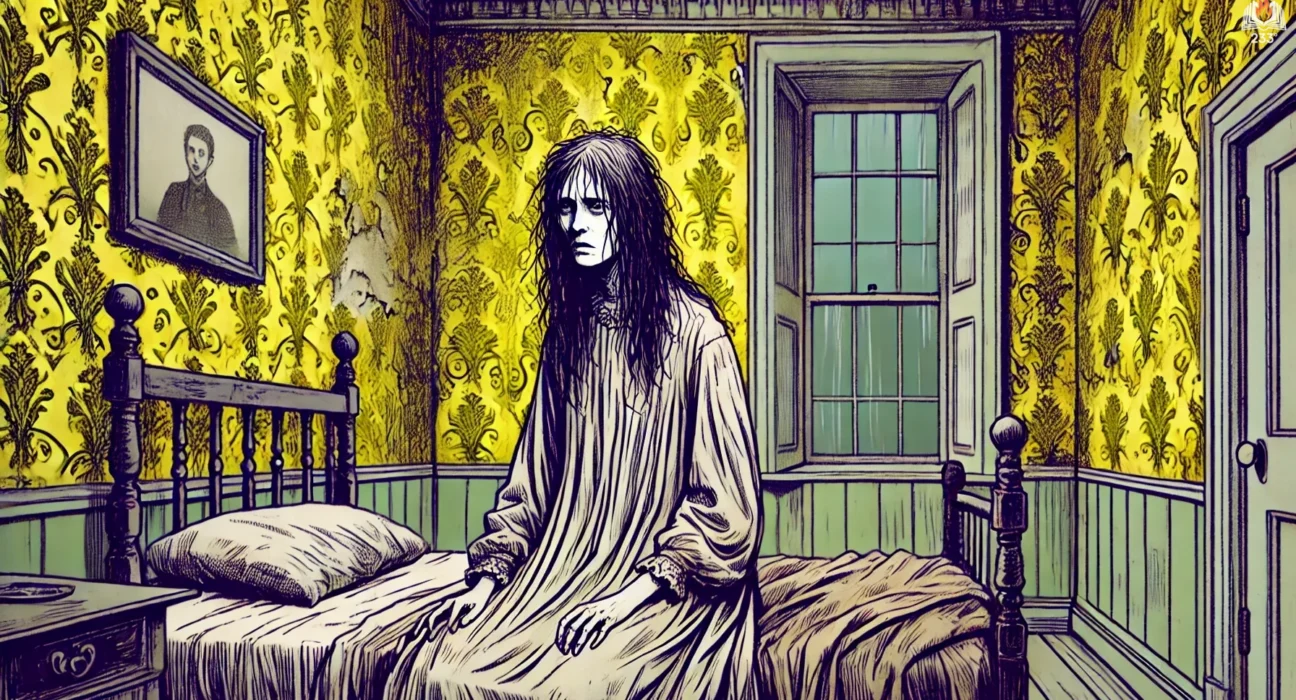
The mansion is large, surrounded by beautiful gardens and shaded arbors, yet the narrator is confined to a single room at the top of the house, once a nursery. It is a peculiar room with barred windows, worn-out furniture, and most disturbingly, the wallpaper: a sickly yellow with a chaotic, twisting pattern. From the start, she despises the wallpaper, finding it repugnant in both color and design. Its garish, sprawling forms seem to mock her as they run across the walls in uneven, suffocating waves. But John dismisses her concerns. He sees no harm in the room, considering it airy and full of sunlight — perfect for her rest cure.
As the days stretch on, the narrator grows increasingly isolated. John is often away, absorbed in his medical practice, leaving her alone in the room with nothing to do but observe her surroundings. She begins to notice the wallpaper more acutely, finding in it a sinister quality that unnerves her. The pattern is erratic and nonsensical, refusing to conform to any logic or symmetry. The more she stares at it, the more the shapes within it seem to move, crawling and slithering across the walls like some grotesque creature. A growing sense of unease fills her mind, but she dares not speak of it to John, who continues to assure her that her condition is improving.
Night after night, the narrator lies awake, staring at the wallpaper by the dim light of the moon. The shapes seem to come alive in the darkness, twisting into forms that she cannot explain. She begins to imagine a figure trapped behind the wallpaper, a woman struggling to free herself from the confines of the chaotic design. During the day, this figure is subdued, but at night, when the house is quiet and still, the woman stirs, pressing against the walls, trying to break free. The narrator becomes obsessed with this vision, spending hours tracing the lines of the wallpaper, determined to unravel its mystery.
John grows increasingly concerned about her fixation on the wallpaper. He insists that she is getting better, that the quiet and rest are working, but the narrator knows differently. She feels her mind slipping further into darkness, consumed by the patterns that swirl before her eyes. Yet she continues to write in secret, keeping a journal of her thoughts and observations, despite John’s prohibition. Writing is the only outlet she has left, though it drains her of what little strength she has.
As her obsession deepens, the narrator’s behavior becomes more erratic. She begins to see the woman in the wallpaper not just at night, but during the day as well. She imagines her creeping behind the chaotic lines, trapped, much like herself, in a prison of domesticity and repression. The narrator feels a kinship with this woman, and as the days pass, she becomes determined to help her escape. She begins to pull at the wallpaper, peeling it away piece by piece, hoping to set the woman free.
John, unaware of the extent of her fixation, remains confident that she is improving. He dismisses her complaints and treats her with the same paternalistic care that has kept her confined for so long. His sister, Jennie, helps around the house, and although she means well, she too views the narrator’s condition as something trivial, easily cured with rest and obedience. Jennie often comments on how well the narrator is doing, how lucky she is to have such a devoted husband. But inside, the narrator feels trapped, suffocated by the weight of her husband’s control and the oppressive walls of the nursery.
As the final days of their stay in the mansion approach, the narrator’s sense of reality begins to unravel completely. She is no longer just an observer of the woman in the wallpaper; she becomes convinced that she is the woman, imprisoned within the yellow walls. Desperately, she continues to strip away the wallpaper, determined to free herself from its stifling hold. She locks herself in the room, refusing to let anyone in, not even John. When he finally returns and demands to be let in, she tells him the key is outside, under a plantain leaf. When he retrieves it and enters, he is horrified by what he sees.
The room is in disarray, the wallpaper shredded and hanging in tatters. The narrator is crawling around the perimeter of the room, following the long, smudged path she has worn into the floor. She tells him that she has finally escaped, that she has freed herself from the wallpaper and from the prison it represented. “I’ve got out at last,” she says, looking at him with wild, triumphant eyes, “in spite of you and Jane. And I’ve pulled off most of the paper, so you can’t put me back!” John, overwhelmed by the sight, faints, collapsing in her path. But the narrator continues to crawl, stepping over him as she circles the room, her mind fully consumed by the madness that has taken hold.
Main Characters
The Narrator: An unnamed woman suffering from postpartum depression. She is trapped in her role as a wife and mother, denied creative expression, and isolated under the guise of medical treatment. Her descent into madness is narrated through her growing obsession with the wallpaper in her room.
John: The narrator’s husband, a physician who embodies the authoritative, rational male figure of the time. He believes that his wife’s illness is minor, diagnosing her with “temporary nervous depression” and insisting on a strict regimen of rest, effectively dismissing her pleas for mental stimulation.
Jennie: John’s sister, who helps care for the house. Jennie represents the conventional role of a woman during the period, appearing to accept her domestic duties without question. She contrasts with the narrator’s increasing desperation for freedom.
Theme
The Oppression of Women: The story critiques the societal expectations placed on women, particularly the dismissal of their mental health concerns. The narrator’s confinement to a domestic space and lack of agency reflect the broader cultural repression of women’s independence and intellect.
Mental Illness and the Rest Cure: The story is a direct response to the treatment of mental illness, especially the “rest cure” that forbade any mental stimulation. This leads to the narrator’s increasing obsession with the wallpaper as she spirals into psychosis, reflecting the harmful effects of denying autonomy and creativity.
The Yellow Wallpaper: The wallpaper itself is a central motif, symbolizing the confinement and entrapment of the narrator. Its chaotic pattern and disturbing color become metaphors for her fragmented mental state. The wallpaper transforms from a mere annoyance into an all-consuming fixation, mirroring her growing desperation to escape her psychological prison.
Patriarchal Authority: John’s control over the narrator is indicative of the paternalistic authority men held over women during the period. His well-meaning but patronizing attitude exemplifies how societal power structures disempowered women, keeping them in infantilized, dependent roles.
Writing Style and Tone
Gilman’s writing in The Yellow Wallpaper is marked by an intimate first-person perspective, drawing readers directly into the mind of the narrator. The story unfolds through a series of journal entries that reveal her inner thoughts, frustrations, and eventual unraveling. This narrative choice gives the story an intensely personal tone, immersing the reader in the protagonist’s psychological state.
The tone shifts from a casual, almost whimsical recounting of events to a darker, more fragmented voice as the narrator becomes increasingly obsessed with the wallpaper. Gilman’s use of repetition and stream-of-consciousness techniques effectively captures the disjointed nature of the narrator’s thoughts as her sanity deteriorates. The prose is often laced with irony, particularly in the way the narrator comments on her situation with a sense of detachment or misguided optimism, even as her mental state worsens.
Quotes
The Yellow Wallpaper – Charlotte Perkins Gilman (1892) Quotes
“It is the same woman, I know, for she is always creeping, and most women do not creep by daylight.”
“But I MUST say what I feel and think in some way
“It does not do to trust people too much.”
“I cry at nothing, and cry most of the time.”
“There are things in that paper that nobody knows but me, or ever will.”
“Now why should that man have fainted? But he did,and right across my path by the wall, so that I had to creep over him every time!”
“Nobody would believe what an effort it is to do what little I am able, - to dress and entertain, and order things”
“I am glad my case is not serious! But these nervous troubles are dreadfully depressing. John does not know how much I really suffer. He knows there is no reason to suffer, and that satisfies him.”
“I never saw a worse paper in my life. One of those sprawling flamboyant patterns committing every artistic sin.”
“John laughs at me, of course, but one expects that in marriage.”
“You think you have mastered it, but just as you get well underway in following, it turns a back-somersault and there you are. It slaps you in the face, knocks you down, and tramples upon you. It is like a bad dream.”
“I'm sure I never used to be so sensitive. I think it is due to this nervous condition.”
“John doesn't know how much I really suffer. He knows there is no reason to suffer, and that satisfies him. It is getting to be a great effort for me to think straight. Just this nervous weakness I suppose.”
“I always lock the door when I creep by daylight.”
“It is the strangest yellow, that wallpaper! It makes me think of all the yellow things I ever saw - not beautiful ones like buttercups, but old foul, bad yellow things.”
“I never saw so much expression in an inanimate thing before, and we all know how much expression they have! I used to lie awake as a child and get more entertainment and terror out of blank walls and plain furniture than most children could find in a toy-store.”
“It is so hard to talk with John about my case, because he is so wise, and because he loves me so.”
“Most men’s eyes, when you look at them critically, are not like that. They may look at you very expressively, but when you look at them, just as features, they are not very nice.”
“I don't like to look out of the windows even--there are so many of those creeping women, and they creep so fast. I wonder if they all come out of that wallpaper as I did?”
“He is very careful and loving, and hardly lets me stir without special direction. I have a schedule prescription for each hour in the day; he takes all care from me, and so I feel basely ungrateful not to value it more.”
“This was not life, this was a nightmare.”
“And there was you - your fair self, always delicately dressed, with white firm fingers sure of touch in delicate true work. I loved you then.”
“I’ve got out at last,” said I, “in spite of you and Jane. And I’ve pulled off most of the paper, so you can’t put me back!”
We hope this summary has sparked your interest and would appreciate you following Celsius 233 on social media:
There’s a treasure trove of other fascinating book summaries waiting for you. Check out our collection of stories that inspire, thrill, and provoke thought, just like this one by checking out the Book Shelf or the Library
Remember, while our summaries capture the essence, they can never replace the full experience of reading the book. If this summary intrigued you, consider diving into the complete story – buy the book and immerse yourself in the author’s original work.
If you want to request a book summary, click here.
When Saurabh is not working/watching football/reading books/traveling, you can reach him via Twitter/X, LinkedIn, or Threads
Restart reading!