Veronika Decides to Die by Paulo Coelho, published in 1998, explores existential questions and mental health through the lens of a young woman’s transformative journey. Set in Slovenia, the novel begins with Veronika’s decision to end her life, only to wake up in a psychiatric hospital where she is given an unexpected chance to reevaluate her choices and find meaning in her existence.
Plot Summary
On a cold November afternoon in Ljubljana, Veronika meticulously prepares for the end of her life. Her days have been consumed by a dull repetition of tasks, and her future seems to promise little more. Feeling that she has experienced all life has to offer, she swallows a handful of sleeping pills. As the world outside her window moves on—children playing, musicians performing, people hurrying about their lives—Veronika feels an odd peace, believing she is leaving a world indifferent to her existence. But instead of the oblivion she craves, she awakens in a sterile hospital room, her body tethered to tubes and machines. She has failed to die.
Veronika soon learns she has been transferred to Villette, a psychiatric hospital with a sinister reputation. The doctor informs her of an unexpected twist—her overdose has damaged her heart irreparably, leaving her with only days to live. This knowledge stirs conflicting emotions in Veronika. On the one hand, her wish to escape life remains; on the other, the finality of this sentence sparks a strange curiosity about the time she has left.
In Villette, Veronika encounters a cast of patients, each confined within the walls of their own struggles. Zedka, a woman fighting depression, becomes one of Veronika’s first connections. Zedka offers her a new lens through which to view life, speaking of love and loss with a clarity that begins to chip away at Veronika’s detachment. Their conversations reveal how many of the patients in Villette are less “insane” than victims of a world that rejects their uniqueness.
As Veronika adjusts to the rhythms of Villette, she meets Mari, a former lawyer who surrendered her high-powered career to debilitating panic attacks. Mari embodies a quiet wisdom born from suffering, and her guidance helps Veronika navigate her existential doubts. Mari’s words encourage Veronika to question whether her dissatisfaction with life came not from its predictability, but from her unwillingness to embrace its unpredictability.
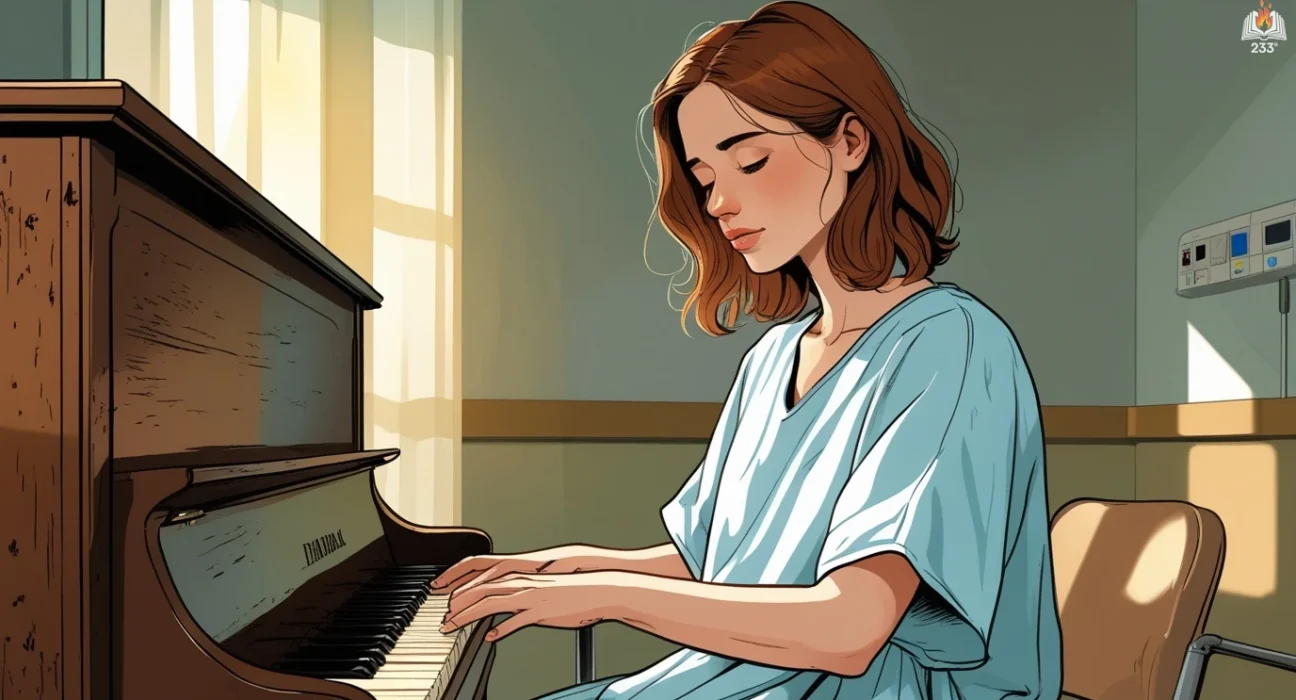
A pivotal moment in Veronika’s journey occurs when she stumbles upon a piano in the hospital. Drawn to its keys, she plays a melody that attracts the attention of Eduard, a fellow patient whose schizophrenia has isolated him from those around him. Eduard listens with rapt attention, his silence speaking volumes. Music becomes their shared language, forging a bond that grows stronger with each encounter. Veronika, for the first time, feels seen—not as a patient, not as a failure, but as someone capable of eliciting emotion and connection.
The days slip by, and Veronika’s understanding of herself begins to shift. The finality of her impending death gives weight to every sensation, every interaction. What once seemed mundane now feels precious. She marvels at the way sunlight dances on the walls, the comfort of shared laughter, and the bittersweet taste of hope. Each moment is sharper, more vibrant, as if life is revealing its hidden beauty just as she prepares to leave it.
Yet, amid her personal awakening, Veronika grapples with Dr. Igor’s peculiar role in her life. She discovers that her diagnosis of impending death is part of an experiment. The doctor, driven by his theory on vitriol—a psychological poison he believes drives despair—has orchestrated this charade to shock her into reclaiming her will to live. Though furious at the manipulation, Veronika realizes she has gained something invaluable: a desire to embrace life fully, regardless of its imperfections.
Her relationship with Eduard deepens, and together, they explore the possibility of love even in a place shadowed by pain and uncertainty. Eduard’s art and Veronika’s music become their sanctuary, a space where they are free from judgment and fear. Their connection transcends words, kindling a passion that fills Veronika’s remaining days with meaning.
As her heart weakens, Veronika feels both a rising urgency and a deepening peace. She begins to see the world not as a prison but as a canvas of infinite possibilities. The pain and struggles of those around her no longer seem like burdens but shared experiences that bind humanity together. Even Villette, with its flaws and darkness, becomes a place of healing and transformation.
In the final moments of her time at Villette, Veronika makes a bold decision. She takes Eduard’s hand, and together, they escape the confines of the hospital. They walk into the night, leaving behind the shadows of their pasts. For Veronika, the future remains uncertain, but that uncertainty no longer frightens her. She has learned that life’s value lies not in its length but in the intensity with which it is lived. With Eduard by her side, she chooses to face whatever comes, not as someone awaiting death, but as someone ready to embrace life.
In the quiet stillness of the early hours, Dr. Igor receives word of Veronika’s disappearance. He smiles, satisfied that his experiment has succeeded. Unbeknownst to her, Veronika’s heart remains healthy. She has been given not just a second chance but the knowledge and courage to make the most of it.
Main Characters
Veronika: A 24-year-old woman who feels trapped in the monotony of her life. After a failed suicide attempt, she confronts her fears, desires, and unspoken dreams during her stay at the Villette asylum. Her character evolves as she learns to embrace life and its unpredictability.
Dr. Igor: The enigmatic psychiatrist at Villette who plays a crucial role in Veronika’s journey. He employs unconventional methods to provoke her into finding a new perspective on life, driven partly by his own experimental theories about mental health.
Zedka: A fellow patient at Villette, Zedka struggles with depression and provides Veronika with insights about love and life. Her philosophical reflections on freedom deeply influence Veronika.
Eduard: A patient diagnosed with schizophrenia, Eduard is withdrawn and immersed in his own world of artistic expression. He forms a connection with Veronika that helps both of them rediscover their passions.
Mari: A former lawyer grappling with panic attacks, Mari becomes a mentor-like figure for Veronika, offering wisdom about the value of self-discovery and resilience.
Theme
The Search for Meaning: The novel delves into the existential quest for purpose. Veronika’s journey highlights how confronting mortality can lead to a profound appreciation of life’s small joys and inherent unpredictability.
Mental Health and Society: Through its setting in Villette, the novel critiques societal stigmas around mental illness and explores the idea that many people conform to societal norms at the cost of personal authenticity.
Freedom and Rebellion: Veronika’s choice to die is framed as an act of rebellion against a world she perceives as indifferent. Her gradual embrace of life signifies the liberation found in living authentically and fearlessly.
Love and Human Connection: The relationships Veronika forms in Villette emphasize the transformative power of love, understanding, and compassion in healing emotional wounds.
Time and Mortality: The awareness of a limited lifespan drives Veronika to live more intensely. The motif of time serves as a reminder to cherish the fleeting moments of existence.
Writing Style and Tone
Paulo Coelho’s prose is introspective, poetic, and philosophical, blending simplicity with profound depth. His language often incorporates metaphor and allegory, allowing readers to engage with universal themes on a deeply personal level. He employs an omniscient narrative voice, interspersed with moments of Veronika’s internal monologues, to provide a multidimensional view of her transformation.
The tone of the novel is reflective and empathetic, evoking a sense of both melancholy and hope. Coelho balances the gravity of Veronika’s circumstances with moments of lightness and humor, making the narrative emotionally resonant. His storytelling seamlessly merges realism with spiritual undertones, inviting readers to contemplate their own lives and choices.
Quotes
Veronika Decides to Die – Paulo Coelho (1998) Quotes
“The two hardest tests on the spiritual road are the patience to wait for the right moment and the courage not to be disappointed with what we encounter.”
“People never learn anything by being told, they have to find out for themselves.”
“Be crazy! But learn how to be crazy without being the center of attention. Be brave enough to live different.”
“You are someone who is different, but who wants to be the same as everyone else. And that in my view is a serious illness. God chose you to be different. Why are you disappointing God with this kind of attitude?”
“You have two choices, to control your mind or to let your mind control you.”
“Haven't you learned anything, not even with the approach of death? Stop thinking all the time that you're in the way, that you're bothering the person next to you. If people don't like it, they can complain. And if they don't have the courage to complain, that's their problem”
“If one day I could get out of here, I would allow myself to be crazy. Everyone is indeed crazy, but the craziest are the ones who don't know they're crazy; they just keep repeating what others tell them to.”
“She didn't quite know what the relationship was between lunatics and the moon, but it must be a strong one, if they used a word like that to describe the insane.”
“Nothing in this world happens by chance”
“Collective madness is called sanity ..”
“I want to continue being crazy; living my life the way I dream it, and not the way the other people want it to be.”
“Be like the fountain that overflows, not like the cistern that merely contains.”
“She would consider each day a miracle - which indeed it is, when you consider the number of unexpected things that could happen in each second of our fragile existences.”
“Nothing in this world happens by chance.”
“You say they create their own reality," said Veronika, "but what is reality?”
“Many people don't allow themselves to love...because there are a lot of things at risk a lot of future and a lot of past.”
“Death frees from the fear of dying”
“If only everyone could know and live with their inner craziness. Would the world be a worse place for it? No, people would be fairer and happier.”
“The danger of an adventure is worth a thousand days of ease and comfort”
“We all live in our own world. But if you look up at the starry sky - you'll see that all the different worlds up there combine to form constellations, solar systems, galaxies.”
“The happier people can be, the unhappier they are.”
“Personal growth has its price, and she was paying it without complaint.”
“Life is always a matter of waiting for the right moment to act.”
We hope this summary has sparked your interest and would appreciate you following Celsius 233 on social media:
There’s a treasure trove of other fascinating book summaries waiting for you. Check out our collection of stories that inspire, thrill, and provoke thought, just like this one by checking out the Book Shelf or the Library
Remember, while our summaries capture the essence, they can never replace the full experience of reading the book. If this summary intrigued you, consider diving into the complete story – buy the book and immerse yourself in the author’s original work.
If you want to request a book summary, click here.
When Saurabh is not working/watching football/reading books/traveling, you can reach him via Twitter/X, LinkedIn, or Threads
Restart reading!