The Magician’s Nephew by C.S. Lewis, published in 1955, is the sixth book in The Chronicles of Narnia in publication order but the first chronologically. This prequel unveils the origins of Narnia, the creation of Aslan’s world, and the entrance of evil into it, setting the stage for the series’ later events. It follows Digory and Polly as they traverse magical worlds and grapple with profound moral dilemmas.
Plot Summary
In a time when Victorian London was filled with stiff collars and quiet gardens, a young boy named Digory Kirke found himself uprooted from a countryside life filled with ponies and rivers. His move to the dreary city was due to his mother’s grave illness, forcing him to stay with his stern Aunt Letty and eccentric Uncle Andrew. One day, while playing in the garden, he met Polly Plummer, a spirited girl from the house next door. Their meeting was the spark for a series of adventures that would change their lives forever.
The children’s friendship blossomed quickly. One rainy day, they decided to explore the row of connected attics above their homes. Their escapade led them to what they thought was an empty house, but instead, they stumbled into Uncle Andrew’s forbidden study. A tall, peculiar man with sharp eyes and a tangle of gray hair, Uncle Andrew was no ordinary uncle. He was a magician, dabbling in experiments far beyond his understanding. Trapping the children with his cunning, he persuaded Polly to touch a small yellow ring, causing her to vanish instantly.
A horrified Digory demanded answers, and Uncle Andrew, brimming with self-importance, explained his “great experiment.” The rings, made from dust of an ancient and magical world, allowed travelers to journey between dimensions. The yellow ring sent Polly away, while a green ring could bring her back. However, Uncle Andrew was too cowardly to go after her himself and manipulated Digory into retrieving Polly.
Determined to save his friend, Digory put on a yellow ring and was whisked away to a tranquil, dreamlike wood. This serene place, known as the Wood between the Worlds, was dotted with countless pools, each leading to a different universe. Digory found Polly there, and together they discovered the power of the rings to leap between worlds. Curiosity overcame caution as the children chose a pool at random and jumped into the unknown.
They arrived in a desolate, dying world called Charn. The city was in ruins, bathed in a strange red light, and utterly silent. Wandering through the eerie emptiness, they came across a hall filled with lifelike statues of regal figures, their expressions shifting from noble to cruel as they walked deeper. At the hall’s center was a golden bell and hammer, accompanied by an inscription urging the adventurous to strike it. Against Polly’s protests, Digory rang the bell, shattering the silence and awakening the last of Charn’s rulers—a tall, imposing woman named Jadis.
Jadis, once a queen, recounted the fall of her world. A tyrant of immense power, she had spoken the “Deplorable Word,” a spell that annihilated every living being in Charn save herself. The children realized the danger they had unleashed, but before they could escape, Jadis seized their arms and accompanied them back to the Wood between the Worlds.
From there, events spiraled further into chaos. The children, with Jadis in tow, accidentally returned to London. The queen’s immense strength and arrogance quickly led to mayhem as she wreaked havoc in the city, dragging Uncle Andrew into her schemes. Desperate to undo their mistake, Digory and Polly managed to lure Jadis back to the Wood. Hoping to leave her there, they leapt into another pool, but instead of a barren or ruined world, they landed in a place of pure emptiness—a world that was just beginning.
In this void, they witnessed an extraordinary event. A great lion, Aslan, walked across the barren land, singing a song that brought creation to life. Trees sprouted, rivers flowed, and the sky filled with light. Aslan’s song wove the world of Narnia into existence, teeming with creatures who awoke to life and joy. But Jadis, terrified of Aslan’s power, fled to the mountains, vowing to return.
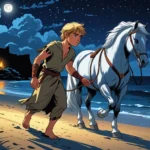
Aslan turned to Digory, recognizing the boy’s troubled heart and his yearning to heal his mother. The lion entrusted him with a task: to retrieve a fruit from a far-off garden. This fruit would plant a tree that would protect Narnia from Jadis’s influence. With Polly and a now-enchanted horse named Fledge, Digory embarked on the journey. They flew over breathtaking landscapes, eventually reaching the garden.
Within its gates, Digory found the tree and the fruit, its scent rich and tempting. A voice, like a whispering wind, filled his mind, urging him to eat the fruit and take it to his mother. Yet Digory resisted, remembering Aslan’s instructions. He plucked one for Narnia and returned to the lion.
Aslan commended Digory for his obedience and allowed him to take another fruit home to heal his mother. The lion planted the first fruit in Narnia, and from it grew a magnificent tree, whose power would shield the land from evil for generations.
When the children returned to London, Digory gave his mother the fruit. Her recovery was almost immediate, filling their home with light and hope once more. Digory buried the fruit’s core in his backyard, and years later, a great tree grew in its place—a tree whose wood would one day become the wardrobe leading to Narnia.
Though their adventures came to an end, the memories of Narnia remained etched in their hearts. The Wood between the Worlds, Charn’s desolation, Aslan’s song, and the tree of protection all became part of a tale that would echo across ages.
Main Characters
- Digory Kirke: A curious and brave boy burdened by his mother’s illness. Digory’s impulsive nature drives much of the plot, but he matures into a thoughtful and selfless hero.
- Polly Plummer: Digory’s friend and partner in adventure. Polly is practical, courageous, and serves as a counterbalance to Digory’s impulsiveness.
- Uncle Andrew Ketterley: A manipulative, selfish magician whose reckless experiments with magic lead the children to other worlds. He represents unchecked ambition and greed.
- Jadis, the White Witch: A formidable and cruel queen of Charn. Her ambition and lust for power symbolize the destructive consequences of unchecked evil.
- Aslan: The noble lion and creator of Narnia. Aslan embodies wisdom, love, and divine power, offering redemption and guidance.
Theme
- Creation and Origins: The story explores the creation of Narnia, emphasizing the beauty of beginnings and the responsibilities tied to them.
- Good vs. Evil: Through characters like Aslan and Jadis, the story examines the eternal battle between good and evil, showing how choices define morality.
- Temptation and Consequences: Digory’s struggles with temptation, especially regarding the magic apple, highlight the moral cost of desires and the courage needed to resist them.
- Sacrifice and Redemption: Acts of selflessness and Aslan’s overarching grace underscore themes of forgiveness and renewal.
- The Natural World: The vivid depiction of Narnia’s creation celebrates the wonder and sanctity of nature.
Writing Style and Tone
C.S. Lewis employs a narrative style that is both whimsical and profound, blending the simplicity of a children’s tale with deep philosophical and theological undertones. His use of rich descriptions makes settings like Narnia’s creation and Charn’s desolation vivid and memorable.
The tone shifts throughout the story, alternating between playful and solemn, reflecting the dual nature of the narrative as both a fantasy adventure and a moral allegory. Lewis’s use of conversational asides invites readers of all ages into the story, giving it a timeless charm. His allegorical elements, often subtle, weave seamlessly into the plot, enriching the tale without overshadowing the adventure.
Quotes
The Magician’s Nephew – CS Lewis (1955) Quotes
“What you see and what you hear depends a great deal on where you are standing. It also depends on what sort of person you are.”
“Now the trouble about trying to make yourself stupider than you really are is that you very often succeed.”
“Make your choice, adventurous Stranger, Strike the bell and bide the danger, Or wonder, till it drives you mad, What would have followed if you had.”
“Oh, Adam’s sons, how cleverly you defend yourselves against all that might do you good!”
“No great wisdom can be reached without sacrifice.”
“For what you see and hear depends a good deal on where you are standing: it also depends on what sort of person you are.”
“Pooh! Grown-ups are always thinking of uninteresting explanations.”
“You know me better than you think, you know, and you shall know me better yet.”
“Wouldn't he know without being asked?' said Polly. 'I've no doubt he would,' said the Horse (still with his mouth full). 'But I've a sort of an idea he likes to be asked.”
“All get what they want; they do not always like it.”
“this is a book about something”
“Well, you know how it feels if you begin hoping for something that you want desperately badly; you almost fight against the hope because it is too good to be true; you've been disappointed so often before.”
“Look for the valleys, the green places, and fly through them. There will always be a way through.”
“In those days Mr. Sherlock Holmes was still living in Baker Street and the Bastables were looking for treasure in the Lewisham Road.”
“But I cannot tell that to this old sinner, and I cannot comfort him either; he has made himself unable to hear my voice. If I spoke to him, he would hear only growlings and roarings. Oh, Adam's son, how cleverly you defend yourself against all that might do you good!”
“Things always work according to their nature.”
“But length of days with an evil heart is only length of misery and already she begins to know it. All get what they want; they do not always like it.”
“Child, that is why all the rest are now a horror to her. That is what happens to those who pluck and eat fruits at the wrong time and in the wrong way. Oh, the fruit is good, but they loath it ever after.”
“Grief is great. Only you and I in this land know that yet. Let us be good to one another.”
“By gum,' said Digory, 'Don't I just wish I was big enough to punch your head!”
“Digory never spoke on the way back, and the others were shy of speaking to him. He was very sad and he wasn't even sure all the time that he had done the right thing; but whenever he remembered the shining tears in Aslan's eyes he became sure.”
“But he always liked to get visitors alone in the billiard room and tell them stories about a mysterious lady, a foreign royalty, with whom he had driven about London. 'A devilish temper she had,' he would say. 'But she was a dem fine woman, sir, a dem fine woman.”
We hope this summary has sparked your interest and would appreciate you following Celsius 233 on social media:
There’s a treasure trove of other fascinating book summaries waiting for you. Check out our collection of stories that inspire, thrill, and provoke thought, just like this one by checking out the Book Shelf or the Library
Remember, while our summaries capture the essence, they can never replace the full experience of reading the book. If this summary intrigued you, consider diving into the complete story – buy the book and immerse yourself in the author’s original work.
If you want to request a book summary, click here.
When Saurabh is not working/watching football/reading books/traveling, you can reach him via Twitter/X, LinkedIn, or Threads
Restart reading!