Out of the Silent Planet by C.S. Lewis, first published in 1938, is the inaugural novel in Lewis’s acclaimed Space Trilogy. It blends science fiction and theology, following Dr. Elwin Ransom, a philologist, as he is kidnapped and taken to the alien world of Malacandra (Mars). There, he encounters wondrous creatures, explores complex moral and spiritual questions, and uncovers the dark motives of his captors.
Plot Summary
As twilight deepened across a quiet English countryside, Dr. Elwin Ransom, a philologist on a solitary walking tour, found himself stranded after being denied lodging at a small village inn. With the prospect of a long journey to the next town, he stumbled upon a cottage where a distraught woman lamented her son Harry’s tardy return from work at a nearby estate known as The Rise. Moved by her worry, Ransom decided to visit the estate and ensure Harry’s safe return.
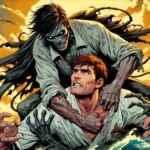
The Rise stood eerily silent, its overgrown drive and neglected appearance exuding unease. Ransom’s calls went unanswered until he encountered two men struggling with a frightened boy. One of them, to Ransom’s surprise, was an old school acquaintance named Dick Devine. The other, a cold and commanding figure, introduced himself as Professor Weston. Devine’s apparent camaraderie persuaded Ransom to accept an invitation to rest. But as fatigue dulled his senses, he failed to notice the strange drink pressed into his hand.
Ransom awoke in a metallic room bathed in unnatural heat and light. Slowly, the realization dawned: he was aboard a spacecraft hurtling away from Earth. Weston and Devine revealed their destination, a planet they called Malacandra, though their reasons for bringing him were shrouded in vague assertions about necessity and sacrifice. The voyage, though fraught with physical disorientation, awakened Ransom’s sense of wonder. Outside the vessel, the heavens shimmered with stars more radiant and abundant than any he had known on Earth.
Upon their arrival, Ransom was thrust into a world both alien and magnificent. Malacandra’s landscape stretched in surreal hues of blue and green, punctuated by towering spires and vast waters. Before he could take in the spectacle, he found himself fleeing his captors, his instincts compelling him into the unknown. He soon discovered he was not alone.
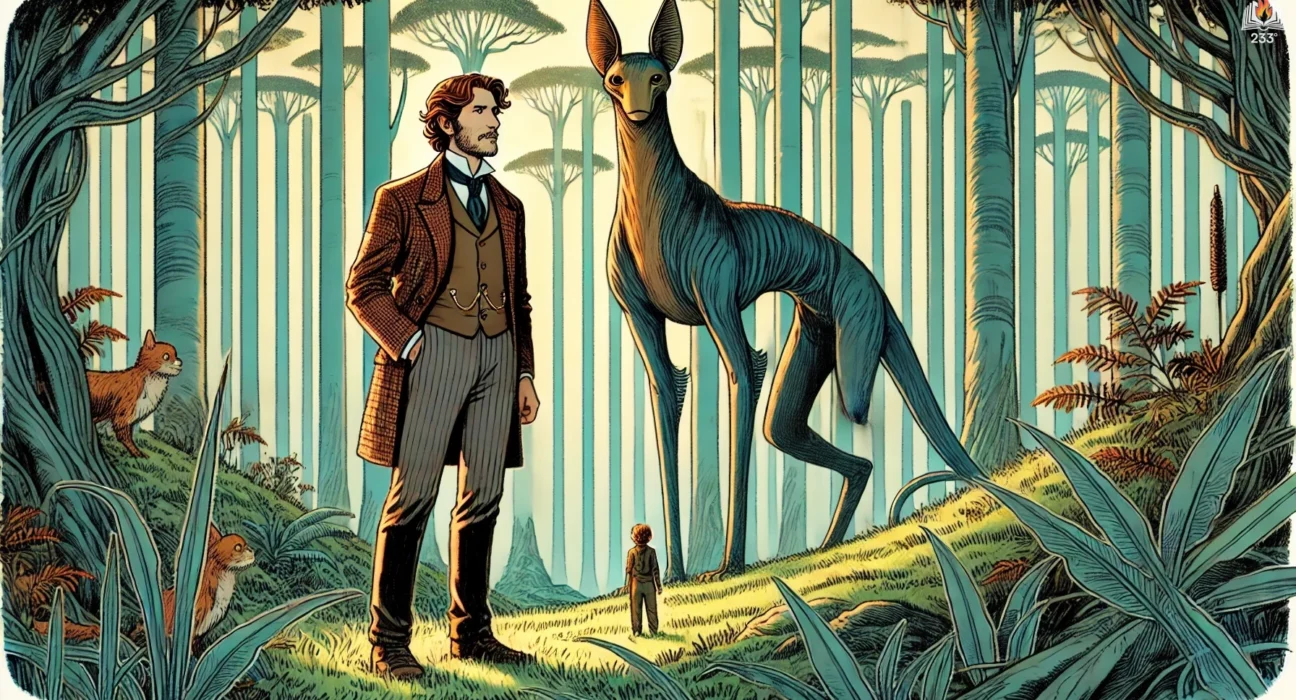
In a tranquil forest, Ransom encountered a creature unlike anything he had imagined: a hross, a seal-like being standing upright and speaking a language both musical and strange. This hross, named Hyoi, treated Ransom with warmth and curiosity, offering him shelter and a glimpse into the harmonious life of the hrossa. Their community, marked by a simplicity and nobility that humbled Ransom, revered their ruler Oyarsa and lived in balance with the land. Ransom began to feel a connection to their values, contrasting starkly with the ambitions of his abductors.
Hyoi taught Ransom their language, a task that deepened their bond and revealed the depth of Malacandra’s culture. Together, they hunted hnakra, a fearsome aquatic creature whose pursuit symbolized bravery. The hunt forged a deep friendship between the two, but it also ended in tragedy. As they celebrated their victory, Hyoi was struck by a bullet fired by Weston or Devine, who were pursuing Ransom. With his dying breaths, Hyoi urged Ransom to seek Oyarsa and uncover the true purpose of his journey.
Ransom’s path to Oyarsa led him across Malacandra’s varied landscapes and introduced him to the sorns, tall, wise beings who towered over him but bore no malice. The sorns shared knowledge of the planet’s history and hinted at Earth’s isolation. Ransom learned that Earth, known as the “Silent Planet,” had been cut off from the cosmic order due to its corruption by an evil force. Malacandra, by contrast, thrived under the guidance of Oyarsa, a spiritual being who maintained peace and harmony among the planet’s species.
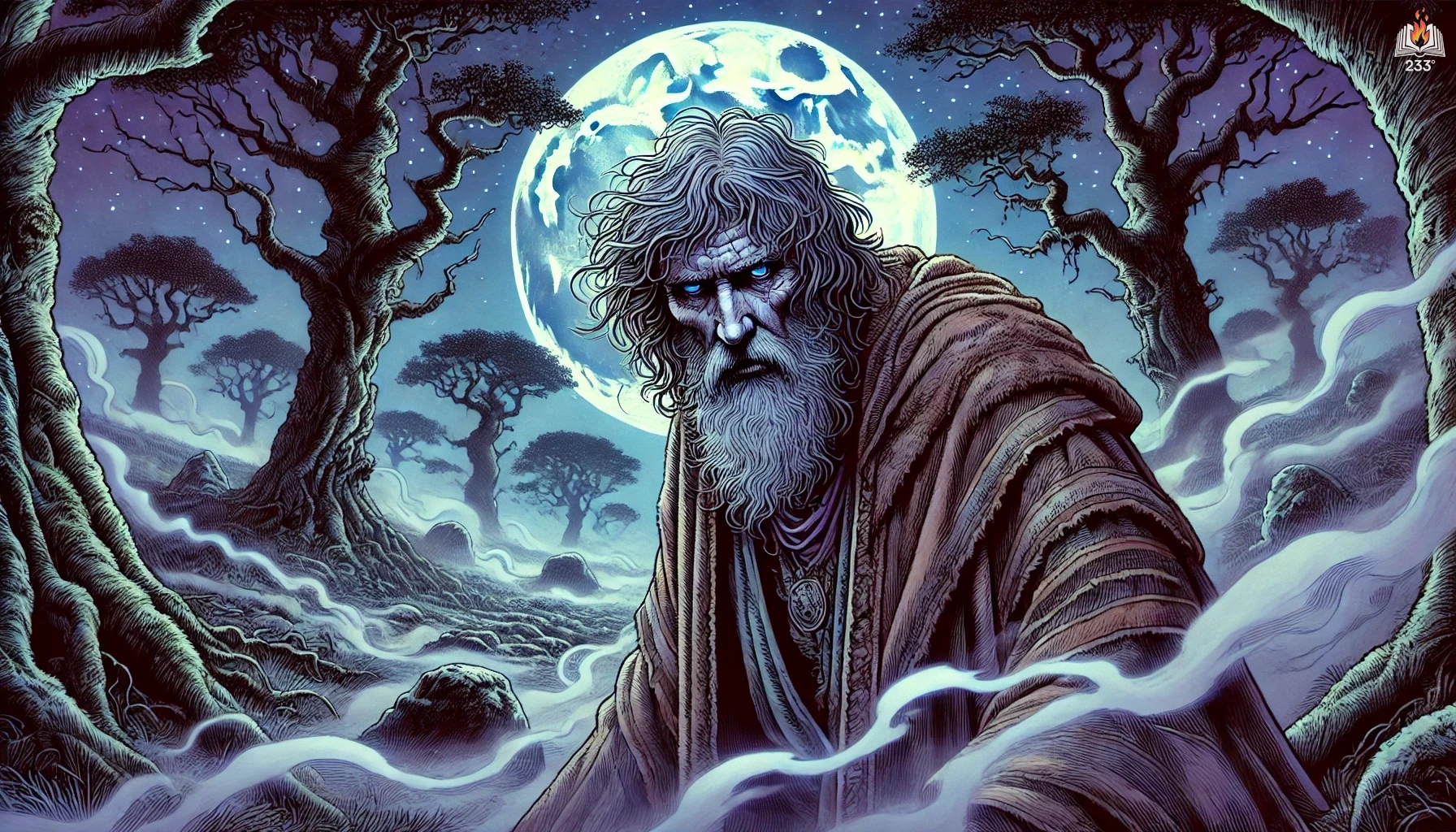
When Ransom finally reached Oyarsa, he was brought before a gathering of the planet’s three intelligent species—the hrossa, sorns, and pfifltriggi, the latter being skilled craftsmen. Oyarsa, neither seen nor entirely comprehensible to Ransom, exuded an aura of authority and wisdom. Under Oyarsa’s questioning, Weston and Devine were brought forth, their motives laid bare. Weston, driven by a warped sense of human superiority, sought to colonize Malacandra and exploit its resources. Devine, ever the opportunist, desired Malacandra’s gold.
Oyarsa’s judgment was both merciful and stern. He decreed that Weston and Devine must return to Earth, taking Ransom with them, and warned that humanity’s self-destructive path would lead only to ruin unless it sought harmony with the greater cosmic order. The journey back to Earth was fraught with tension, as Weston and Devine’s resentments simmered. Yet Ransom, transformed by his time on Malacandra, felt a profound clarity about humanity’s place in the universe.
When they crash-landed on Earth, Ransom’s heart was heavy with the knowledge that few would believe his tale. He resolved to write down his experiences, hoping they might one day inspire others to question humanity’s course and seek the deeper truths of existence.
Main Characters
- Dr. Elwin Ransom: A Cambridge philologist and the protagonist, Ransom is intelligent, curious, and deeply introspective. His journey to Malacandra transforms his understanding of life, morality, and humanity’s place in the cosmos.
- Professor Weston: A physicist and antagonist, Weston embodies scientific arrogance and imperialistic ambitions. He views Malacandra’s inhabitants as inferior beings to exploit.
- Dick Devine: A greedy and unscrupulous businessman, Devine aids Weston for profit. His cynicism contrasts sharply with Ransom’s moral sensitivity.
- Oyarsa: The spiritual ruler of Malacandra, Oyarsa is a benevolent and wise eldil (a celestial being). They represent divine authority and cosmic harmony.
- Hyoi: A hross (one of the intelligent species on Malacandra) who befriends Ransom, Hyoi introduces him to the Malacandrian way of life and its harmonious values.
Theme
- Colonialism and Exploitation: Through Weston and Devine’s actions, the novel critiques the colonial mindset, highlighting its arrogance and disregard for other cultures.
- Good vs. Evil: The book examines moral dichotomies, with Ransom embodying curiosity and empathy, while Weston and Devine represent selfish ambition and exploitation.
- Cosmic Order and Spirituality: Lewis explores a universe governed by divine order, contrasting human hubris with the humility of Malacandra’s inhabitants.
- The Nature of Humanity: Ransom’s encounters with Malacandra’s species challenge his assumptions about human superiority and force him to confront humanity’s flaws.
Writing Style and Tone
C.S. Lewis’s prose in Out of the Silent Planet is rich and evocative, combining scientific descriptions with poetic imagery to vividly depict Malacandra’s alien landscapes and cultures. He uses precise and accessible language, integrating philosophical and theological musings seamlessly into the narrative.
The tone shifts throughout the novel, from suspenseful during Ransom’s abduction, to awe-inspiring as he explores Malacandra, and contemplative as he reflects on humanity’s place in the universe. Lewis’s tone is often didactic, inviting readers to ponder deeper moral and spiritual questions. His balance of storytelling and intellectual exploration makes the book both entertaining and thought-provoking.
Quotes
Out of the Silent Planet – CS Lewis (1938) Quotes
“The love of knowledge is a kind of madness.”
“And I say also this. I do not think the forest would be so bright, nor the water so warm, nor love so sweet, if there were no danger in the lakes.”
“And how could we endure to live and let time pass if we were always crying for one day or one year to come back--if we did not know that every day in a life fills the whole life with expectation and memory and that these are that day?”
“A pleasure is full grown only when it is remembered.”
“Bent creatures are full of fears”
“A pleasure is full grown only when it is remembered. You are speaking, Hmán, as if pleasure were one thing and the memory another. It is all one thing.”
“It is because they have no Oyarsa,' said one of the pupils. It is because everyone of them wants to be a little Oyarsa himself,' said Augray.”
“You are speaking...as if the pleasure were one thing and the memory another. It is all one thing... what you call remembering is the last part of the pleasure.”
“You are guilty of no evil, Ransom of Thulcandra, except a little fearfulness. For that, the journey you go on is your pain, and perhaps your cure: for you must be either mad or brave before it is ended.”
“He [The Bent One] has left you this way because a bent hnau can do more evil than a broken one.”
“Weston did not know the Malacandrian word for laugh: indeed, it was not a word he understood very well in any language.”
“It was all there in that little disc-London, Athens, Jerusalem, Shakespeare. There everyone had lived and everything had happened; and there, presumably, his pack was still lying in the porch of an empty house near Sterk.”
“now that the very name "space" seemed a blasphemous libel for this empyrean ocean of radiance in which they swam. He could not call it 'dead'; he felt life pouring in at every moment.”
“He was only too well aware that such resolutions might look very different when the moment came, but he felt an unwonted assurance that somehow or other he would be able to go through with it. It was necessary, and the necessary was always possible.”
“The weakest of my people does not fear death. It is the Bent One, the lord of your world, who wastes your lives and befouls them with flying from what you know will overtake you in the end. If you were the subjects of Maleldil you would have peace.”
“We do not truly see light, we only see slower things lit by it, so that for us light is on the edge-the last thing we know before things become too swift for us.”
“Now that he was navigating, his celestial mood was shattered. Wild, animal thirst for life, mixed with homesick longing for the free airs and the sights and smells of earth-for grass and meat and beer and tea and the human voice-awoke in him.”
“The weakest of my people does not fear death. It is the Bent One, the lord of your world, who wastes your lives and befouls them with flying from what you know will overtake you in the end. If you were subjects of Maleldil you would have peace.”
“The stars in their courses were fighting against Weston.”
“The weakest of my people does not fear death. It is the Bent One, the lord of your world, who wastes your lives and befouls them with flying from what you know will overtake you in the end.”
“There I drank life because death was in the pool. That was the best of drinks save one.” “What one?” Asked Ransom “Death itself in the day I drink it and go to Maleldil.”
“He would have made them as your people are now- wise enough to see the death of their kind approaching but not wise enough to endure it.”
“They were astonished at what he had to tell them of human history—of war, slavery and prostitution. “It is because they have no Oyarsa,” said one of the pupils. “It is because every one of them wants to be a little Oyarsa himself,” said Augray.”
“I don't believe your theory that "readers never notice that sort of thing." I'm sure I should.”
“The hrossa used to have many books of poetry,” they added. “But now they have fewer. They say that the writing of books destroys poetry.”
We hope this summary has sparked your interest and would appreciate you following Celsius 233 on social media:
There’s a treasure trove of other fascinating book summaries waiting for you. Check out our collection of stories that inspire, thrill, and provoke thought, just like this one by checking out the Book Shelf or the Library
Remember, while our summaries capture the essence, they can never replace the full experience of reading the book. If this summary intrigued you, consider diving into the complete story – buy the book and immerse yourself in the author’s original work.
If you want to request a book summary, click here.
When Saurabh is not working/watching football/reading books/traveling, you can reach him via Twitter/X, LinkedIn, or Threads
Restart reading!