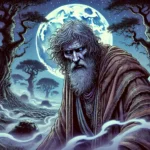


Perelandra by C.S. Lewis, published in 1943, is the second novel in the Space Trilogy. Set primarily on Venus (Perelandra), it follows Dr. Elwin Ransom on a cosmic journey to prevent the planet’s fall into sin. Through vivid landscapes and allegorical depth, Lewis explores themes of temptation, free will, and divine grace, blending theology, philosophy, and speculative fiction into a compelling narrative.
Plot Summary
Dr. Elwin Ransom, having already ventured into the cosmic unknown, finds himself drawn into a new divine mission. A message from the eldila summons him to the lush and untainted world of Perelandra, known to humans as Venus. In this vibrant world, the forces of good and evil are poised for a fateful confrontation. The eldila transport Ransom across the void in a celestial coffin, delivering him to the surface of the alien planet.
Perelandra is a world of fluid beauty. Its golden skies and floating islands teem with life, both familiar and fantastical. The land is mutable, rising and falling with the waves of an endless ocean. Here, Ransom finds himself free of earthly burdens, his senses heightened by the purity of his surroundings. He marvels at the abundance and harmony, each moment infused with wonder. Yet, his arrival is not one of leisure. A great purpose lies before him, though its full shape remains concealed.
Amid this living paradise, Ransom encounters the Green Lady, Tinidril, a radiant being embodying innocence and wisdom. She is the queen of Perelandra, created to live in communion with Maleldil and her King, who has yet to arrive. Her presence is a revelation to Ransom, who is struck by her purity and the childlike curiosity with which she views the world. Yet her innocence is untested, and her King’s absence leaves her vulnerable. Ransom understands that his purpose is tied to her, though he cannot yet discern how.
Perelandra’s peace is shattered by the arrival of Professor Weston, whose transformation horrifies Ransom. Once a man of science, Weston has become a vessel for malevolent forces. He is now the Un-Man, a being of cunning and malice, intent on sowing corruption. The Un-Man’s presence twists the harmony of Perelandra, his every action calculated to disrupt and ensnare. He sets his sights on Tinidril, determined to lure her away from Maleldil’s will and into rebellion.
Ransom quickly realizes that he is no mere observer in this struggle. As the Un-Man weaves his insidious arguments, Ransom must counter with truth and reason. The Green Lady’s choice, uncoerced and free, becomes the battleground. She is captivated by the Un-Man’s rhetoric, which promises autonomy and the allure of forbidden wisdom. Ransom watches as her trust in Maleldil falters, her innocence strained by doubt. The moral weight of the struggle bears down on him, and he begins to understand the cosmic stakes of his presence on Perelandra.
The battle between Ransom and the Un-Man is both physical and spiritual. They argue with words that shape the destiny of the Green Lady and Perelandra itself. Ransom struggles against despair, for the Un-Man’s cunning seems boundless, and the Green Lady’s innocence leaves her ill-equipped to counter his deceit. Ransom’s faith in Maleldil sustains him, even as he wrestles with the fear that he may fail.
At last, Ransom understands what he must do. The battle cannot remain confined to words. Maleldil has sent him not merely as a speaker but as a warrior. He confronts the Un-Man in brutal combat, wrestling with the demonic force inhabiting Weston’s body. The fight rages across the landscape of Perelandra, through water and over the floating islands. Ransom’s physical strength and spiritual resolve are tested to their limits, but he presses on, driven by a higher purpose.
The Un-Man is vanquished, and its influence shattered. Ransom emerges victorious but wounded, bearing a scar upon his heel, a mark of the struggle. Tinidril, her trust in Maleldil restored, is spared from the fall. She is now prepared to take her place alongside her King, ensuring that Perelandra’s innocence endures. The cosmic order remains intact, and the shadow of rebellion is banished from this world.
As Ransom prepares to leave, he witnesses a sacred union between Tinidril and her King, a moment of divine beauty that resonates with the harmony of Perelandra. Ransom’s mission is complete, though the weight of what he has witnessed lingers. He is returned to Earth, forever changed by his journey, carrying with him the knowledge of the great cosmic battle in which he played a part.
Main Characters
Dr. Elwin Ransom: A philologist and protagonist, Ransom is a reluctant hero chosen for a spiritual mission. Courageous and reflective, he grapples with profound moral challenges while embodying sacrificial love and duty.
The Un-Man (Professor Weston): Representing evil, Weston is possessed by demonic forces seeking to corrupt Perelandra’s innocence. His rhetoric and manipulation serve as a stark contrast to Ransom’s virtue.
The Green Lady (Tinidril): Perelandra’s Eve-like figure, she is innocent, wise, and in harmony with her planet. Her vulnerability to temptation and her faith in Maleldil (God) form the crux of the moral battle.
Maleldil: The divine presence guiding events. Though unseen, Maleldil’s will shapes the narrative, offering strength to Ransom and representing providence.
Theme
Temptation and Free Will: The novel parallels the Biblical fall, depicting how Tinidril is tested by the Un-Man. The battle between coercion and trust in divine providence underscores human freedom to choose righteousness.
Good vs. Evil: A cosmic struggle unfolds as Ransom and the Un-Man represent opposing forces. Lewis explores the nature of moral absolutism, emphasizing the triumph of good through faith and sacrifice.
The Nature of Innocence: Perelandra’s unspoiled beauty symbolizes purity and prelapsarian existence. The story meditates on whether innocence can remain uncorrupted when confronted with knowledge of evil.
Divine Order and Cosmic Harmony: Lewis imagines a universe ruled by divine will. The eldila and planetary beings reflect a celestial order, presenting a grand vision of the cosmos aligned with Christian theology.
Writing Style and Tone
C.S. Lewis’s writing style in Perelandra is richly descriptive, combining poetic prose with philosophical depth. His detailed portrayal of Venus’s vibrant, otherworldly landscapes immerses readers in a sensory experience, with color, texture, and sound vividly brought to life. The narrative’s rhythm alternates between calm reflection and intense conflict, mirroring the spiritual stakes.
The tone is reverent, contemplative, and often awe-inspiring. Lewis’s theological underpinnings infuse the story with allegorical weight, but he balances this with accessible storytelling. The dialogue, particularly between Ransom and the Un-Man, is intellectually and morally charged, demonstrating his skill in embedding philosophical debates within an engaging plot.
Quotes
Perelandra – CS Lewis (1943) Quotes
“Whatever you do, He will make good of it. But not the good He had prepared for you if you had obeyed him.”
“The world is so much larger than I thought. I thought we went along paths--but it seems there are no paths. The going itself is the path.”
“Be confident small immortals. You are not the only voice that all things utter, nor is there eternal silence in the places where you cannot come.”
“I think He made one law of that kind in order that there might be obedience. In all these other matters what you call obeying Him is but doing what seems good in your own eyes also. Is love content with that?”
“Be comforted, small one, in your smallness. He lays no merit on you. Receive and be glad.”
“you had nothing to say about it and yet made the nothing up into words.”
“In the name of the Father, and of the Son and of the Holy Ghost, here goes-I mean Amen.”
“When they told him this, Ransom at last understood why mythology was what it was -- gleams of celestial strength and beauty falling on a jungle of filth and imbecility.”
“God can make good use of all that happens, but the loss is real.”
“Perhaps the experience had been so complete that repetition would be vulgarity - like asking to hear the same symphony twice in a day.”
“A man who has been in another world does not come back unchanged.”
“Where can you taste the joy of obeying unless He bids you do something for which His bidding is the only reason?”
“Pure, spiritual, intellectual love shot from their faces like barbed lightning. It was so unlike the love we experience that its expression could easily be mistaken for ferocity.”
“The beasts would not think it hard if I told them to walk on their heads. It would become their delight to walk on their heads. I am His beast, and all His biddings are joys.”
“Well,' said Ransom, 'if it is a delusion, it's a pretty stubborn one.”
“We call bad one who rejects the fruit he is given for the fruit he is expecting or the fruit he was given last time.”
“The joy came from finding at last what hatred was made for.”
“Inner silence is for our race a difficult achievement. There is a chattering part of the mind which continues, until it is corrected, to chatter on even in the holiest places.”
“Every joy is beyond all others.”
“The word 'human' refers to something more than the bodily form or even the rational mind. It refers also to that community of blood and experience which unites all men and women on the Earth.”
“Did Maleldil suggest that our own world might have been saved if the elephant had accidentally trodden on the serpent a moment before Eve was about to yield?”
We hope this summary has sparked your interest and would appreciate you following Celsius 233 on social media:
There’s a treasure trove of other fascinating book summaries waiting for you. Check out our collection of stories that inspire, thrill, and provoke thought, just like this one by checking out the Book Shelf or the Library
Remember, while our summaries capture the essence, they can never replace the full experience of reading the book. If this summary intrigued you, consider diving into the complete story – buy the book and immerse yourself in the author’s original work.
If you want to request a book summary, click here.
When Saurabh is not working/watching football/reading books/traveling, you can reach him via Twitter/X, LinkedIn, or Threads
Restart reading!