
“To the Lighthouse” by Virginia Woolf, published in 1927, is a pioneering modernist novel that explores the complexities of family life and the passage of time. Set in the Ramsay family’s summer home on the Isle of Skye in Scotland, the novel unfolds over a decade, delving into the inner thoughts and emotions of its characters. Woolf’s narrative technique, employing stream-of-consciousness, reveals the subtle and profound intricacies of human relationships, the nature of perception, and the ephemeral quality of life.
Plot Summary
The Ramsay family spends their summers in a large, rambling house on the Isle of Skye, surrounded by the sea and mountains. The house is a place of gathering, not just for the Ramsays but for a rotating cast of visitors—scholars, artists, and friends—who come to bask in the warmth of Mrs. Ramsay’s hospitality. The family’s life revolves around her, a beautiful and nurturing woman whose presence seems to bind everyone together. She is the epitome of grace and traditional femininity, effortlessly managing the household while providing emotional support to all who cross her path.
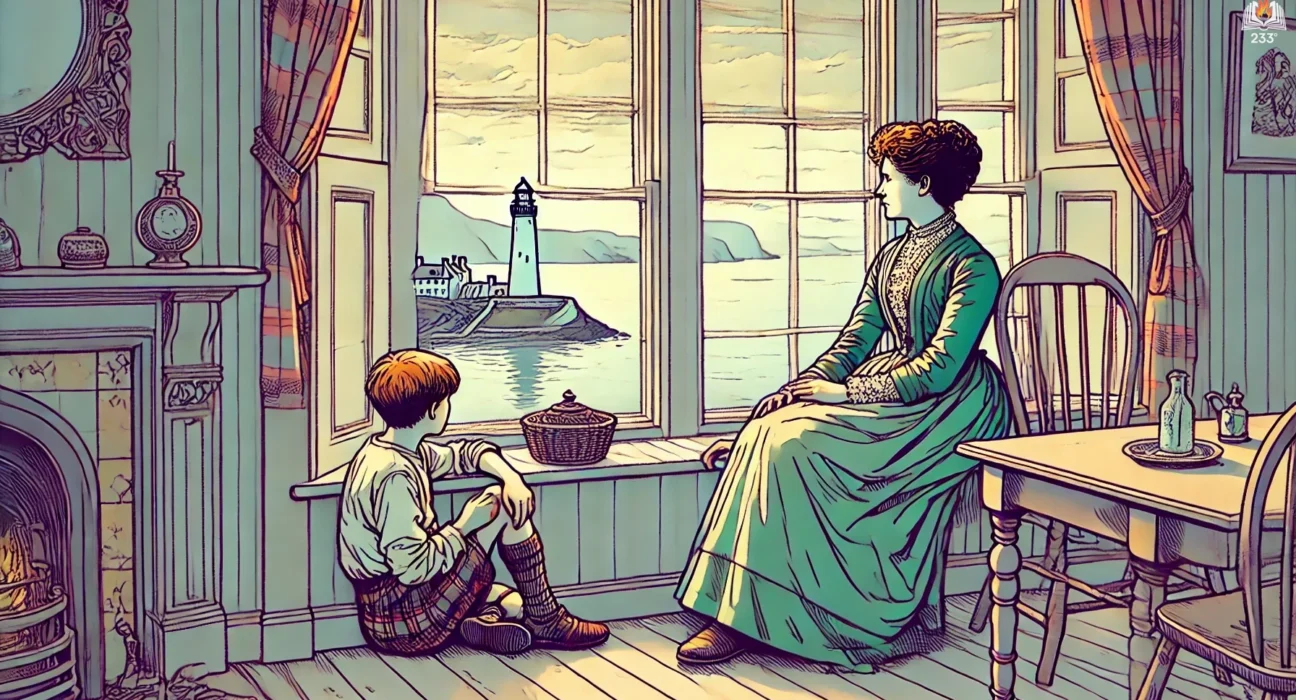
Among the Ramsay children, young James is particularly close to his mother. He harbors an intense longing to visit the lighthouse, which looms in the distance across the bay. For him, the lighthouse symbolizes an almost mystical goal, a promise of adventure and happiness. Mrs. Ramsay encourages this hope, telling James they will go if the weather permits. However, Mr. Ramsay, a stern and intellectual figure, quickly dashes this hope, insisting that the weather will be unfavorable. James is filled with a mixture of rage and disappointment, emotions that he often directs towards his father.
Mr. Ramsay is a man consumed by his own sense of inadequacy and the pursuit of intellectual achievement. He oscillates between seeking praise and belittling those around him. His need for reassurance often leads to tension within the family, particularly with Mrs. Ramsay, who feels compelled to bolster his fragile ego. Despite her efforts to maintain harmony, a subtle undercurrent of dissatisfaction runs through her thoughts. She questions the traditional roles that have defined her life, even as she continues to fulfill them with apparent devotion.
Lily Briscoe, a young painter and family friend, is a frequent visitor to the Ramsays’ home. She is an observer of the family dynamics, particularly the relationship between Mr. and Mrs. Ramsay. Lily struggles with her own creative aspirations, feeling the weight of societal expectations that suggest a woman’s true role is to marry and bear children. She resists this narrative, finding solace and expression in her art. Yet, she also grapples with self-doubt, wondering if she will ever create something of lasting value.
As the summer unfolds, the house becomes a microcosm of human interaction, a space where the characters’ innermost thoughts and desires are laid bare. Mrs. Ramsay orchestrates social gatherings, such as a grand dinner party, where she weaves a delicate web of connection among her guests. She sits at the head of the table, her beauty and charm uniting everyone in a fleeting moment of harmony. Yet even in this moment, she feels the inexorable passage of time, sensing that such moments are ephemeral and will soon be lost.
Years pass, and the world outside the house changes dramatically. The Great War rages, altering lives and reshaping the world. Within the house, the passage of time brings loss and decay. Mrs. Ramsay dies suddenly, leaving a void that disrupts the delicate balance of the family. Her death reverberates through the lives of those who knew her, casting a shadow over the house. Without her, the once vibrant summer home falls into neglect, its rooms gathering dust and silence.
In the absence of Mrs. Ramsay, Mr. Ramsay becomes more introspective, haunted by the fear of his own insignificance. The lighthouse, once a distant and seemingly unattainable goal, takes on a new meaning for him. He decides to undertake the journey to the lighthouse, accompanied by James and his daughter, Cam. This journey becomes a test of their strained relationships, a way to bridge the emotional gaps that have widened over the years.
Meanwhile, Lily returns to the house, now a place filled with ghosts of the past. She is determined to finish the painting she started during that last summer with Mrs. Ramsay. Standing before her canvas, she confronts her own insecurities and the memories that the house evokes. The image of Mrs. Ramsay looms large in her mind, representing both an ideal of beauty and the complex, often unspoken truths of womanhood. As Lily paints, she seeks to capture something essential about life and art, something that transcends the boundaries of time and memory.
On the journey to the lighthouse, the sea is calm, and the boat glides through the water with an almost dreamlike quality. Mr. Ramsay, sitting at the stern, broods in silence, his mind a whirl of thoughts and emotions. He is a man who has lived his life in pursuit of intellectual greatness, yet now he finds himself grappling with the realization of his own mortality. James, now older and more reserved, sits quietly, still harboring the childhood resentment toward his father. Cam, too, is lost in her thoughts, caught between her loyalty to her father and her longing for independence.
As they draw nearer to the lighthouse, something shifts within James. He steers the boat with a newfound sense of purpose, his father’s silent presence a challenge he finally feels ready to confront. In this moment, James achieves a quiet victory over his past bitterness, guiding the boat with a steady hand. Mr. Ramsay, sensing this change in his son, allows himself a rare moment of pride and connection, a silent acknowledgment of the bond between them.
Back at the house, Lily stands before her easel, the painting nearing completion. She realizes that capturing the essence of Mrs. Ramsay is an impossible task, yet in the act of painting, she discovers a new understanding of herself and her place in the world. The lighthouse, visible from the window, becomes a symbol of both an unreachable ideal and the clarity that comes from accepting life’s impermanence. With a final brushstroke, Lily achieves a moment of artistic vision, a fleeting glimpse of the wholeness she has sought.
As the boat reaches the lighthouse, Mr. Ramsay, James, and Cam experience a moment of silent resolution. The journey has not brought them answers, but it has allowed them to come to terms with their memories and their grief. The lighthouse stands as it always has, a beacon of constancy amidst the ever-changing sea, its light now a part of their own inner landscapes.
In this convergence of art and life, of memory and reality, the characters find a quiet peace. The house, the lighthouse, and the sea all bear witness to the passage of time, to the moments of beauty and pain that make up the fabric of existence. And in the stillness, there is a sense of completion, of having touched upon something true, even if only for a moment.
Main Characters
Mrs. Ramsay: The matriarch of the Ramsay family, Mrs. Ramsay is nurturing, beautiful, and embodies traditional gender roles. She serves as an emotional anchor for the family and guests, using her charm and empathy to bring people together. Her influence is profound, yet she grapples with her own inner conflicts and desires.
Mr. Ramsay: A prominent philosopher, Mr. Ramsay is characterized by his stern demeanor and intellectual rigor. He often seeks validation for his work and intelligence, leading to a complex and sometimes strained relationship with his family. His need for emotional support contrasts with his often cold exterior.
James Ramsay: The youngest of the Ramsay children, James is deeply attached to his mother and harbors a strong desire to visit the lighthouse. He has a tumultuous relationship with his father, which oscillates between admiration and resentment.
Lily Briscoe: An aspiring painter and family friend, Lily represents the struggle of the artist, particularly as a woman in a male-dominated society. Her journey throughout the novel is one of self-discovery, as she grapples with her art and the lasting influence of Mrs. Ramsay.
Theme
The Passage of Time: The novel poignantly captures the relentless and indifferent nature of time. The structure of the book itself, with its shift from the detailed present in the first part to the rapid passage of years in the middle section, mirrors the impermanence of human life and experiences. Time erodes physical beauty, alters relationships, and changes the landscape of memory.
Perception and Reality: Woolf explores how individuals perceive the world differently, influenced by their thoughts, emotions, and memories. The same event is experienced in varied ways by different characters, emphasizing the subjective nature of reality. This theme is central to Woolf’s modernist exploration of consciousness.
Gender Roles and Expectations: Through characters like Mrs. Ramsay and Lily Briscoe, Woolf critiques the societal expectations placed on women. Mrs. Ramsay embodies the traditional feminine ideal of beauty and nurturing, while Lily challenges these norms through her pursuit of art and independence. The novel delves into the tension between these roles and the characters’ personal desires.
Writing Style and Tone
Woolf’s writing style in “To the Lighthouse” is characterized by her use of stream-of-consciousness and free indirect discourse, which allows readers to delve into the inner lives of her characters. The narrative flows seamlessly between the minds of different characters, often within the same paragraph or sentence, reflecting the fluid and interconnected nature of thoughts and perceptions. This technique creates a rich tapestry of internal monologues, memories, and sensory experiences, giving depth to the characters’ inner worlds.
The tone of the novel is meditative and introspective, with a melancholic undertone that underscores the themes of transience and the passage of time. Woolf employs lyrical and poetic language, particularly in her descriptions of nature and the surrounding environment, which serves as a backdrop to the internal dramas of the characters. The prose is rhythmic and often abstract, capturing the fleeting moments of consciousness and the complexity of human emotions. The narrative’s contemplative quality invites readers to reflect on the ephemeral nature of life and the enduring impact of art and memory.
Quotes
To the Lighthouse – Virginia Woolf (1927) Quotes
“And all the lives we ever lived and all the lives to be are full of trees and changing leaves.”
“He smiled the most exquisite smile, veiled by memory, tinged by dreams.”
“To want and not to have, sent all up her body a hardness, a hollowness, a strain. And then to want and not to have- to want and want- how that wrung the heart, and wrung it again and again!”
“She felt... how life, from being made up of little separate incidents which one lived one by one, became curled and whole like a wave which bore one up with it and threw one down with it, there, with a dash on the beach.”
“Friendships, even the best of them, are frail things. One drifts apart.”
“About here, she thought, dabbling her fingers in the water, a ship had sunk, and she muttered, dreamily half asleep, how we perished, each alone.”
“Beauty was not everything. Beauty had this penalty
“So fine was the morning except for a streak of wind here and there that the sea and sky looked all one fabric, as if sails were stuck high up in the sky, or the clouds had dropped down into the sea.”
“No, she thought, one could say nothing to nobody. The urgency of the moment always missed its mark. Words fluttered sideways and struck the object inches too low.”
“The very stone one kicks with one's boot will outlast Shakespeare.”
“All the being and the doing, expansive, glittering, vocal, evaporated; and one shrunk, with a sense of solemnity, to being oneself, a wedge-shaped core of darkness, something invisible to others.”
“Yes, she thought, laying down her brush in extreme fatigues, I have had my vision.”
“for it was not knowledge but unity that she desired, not inscriptions on tablets, nothing that could be written in any language known to men, but intimacy itself, which is knowledge”
“But nevertheless, the fact remained, it was almost impossible to dislike anyone if one looked at them.”
“Was there no safety? No learning by heart of the ways of the world? No guide, no shelter, but all was miracle, and leaping from the pinnacle of a tower into the air? Could it be, even for elderly people, that this was life?--startling, unexpected, unknown?”
“One wanted, she thought, dipping her brush deliberately, to be on a level with ordinary experience, to feel simply that's a chair, that's a table, and yet at the same time, It's a miracle, it's an ecstasy.”
“A sort of transaction went on between them, in which she was on one side, and life was on another, and she was always trying to get the better of it, as it was of her.”
“Never did anybody look so sad. Bitter and black, halfway down, in the darkness, in the shaft which ran from the sunlight to the depths, perhaps a tear formed; a tear fell; the waves swayed this way and that, received it, and were at rest. Never did anybody look so sad.”
“Our apparitions, the things you know us by, are simply childish. Beneath it is all dark, it is all spreading, it is unfathomably deep; but now and again we rise to the surface and that is what you see us by.”
“I am drowning, my dear, in seas of fire.”
“So that is marriage, Lily thought, a man and a woman looking at a girl throwing a ball”
“If Shakespeare had never existed, he asked, would the world have differed much from what it is today? Does the progress of civilization depend upon great men? Is the lot of the average human being better now that in the time of the Pharaohs?”
“The sigh of all the seas breaking in measure round the isles soothed them; the night wrapped them; nothing broke their sleep, until, the birds beginning and the dawn weaving their thin voices in to its whiteness”
We hope this summary has sparked your interest and would appreciate you following Celsius 233 on social media:
There’s a treasure trove of other fascinating book summaries waiting for you. Check out our collection of stories that inspire, thrill, and provoke thought, just like this one by checking out the Book Shelf or the Library
Remember, while our summaries capture the essence, they can never replace the full experience of reading the book. If this summary intrigued you, consider diving into the complete story – buy the book and immerse yourself in the author’s original work.
If you want to request a book summary, click here.
When Saurabh is not working/watching football/reading books/traveling, you can reach him via Twitter/X, LinkedIn, or Threads
Restart reading!