

“The Waves” by Virginia Woolf, published in 1931, is a modernist novel renowned for its innovative narrative technique and lyrical prose. Woolf, a leading figure in the Bloomsbury Group, explores the inner lives of six characters from childhood to old age, using a series of soliloquies to capture their thoughts and emotions. The novel delves into themes of individuality, the passage of time, and the interconnectedness of human experiences.
Plot Summary
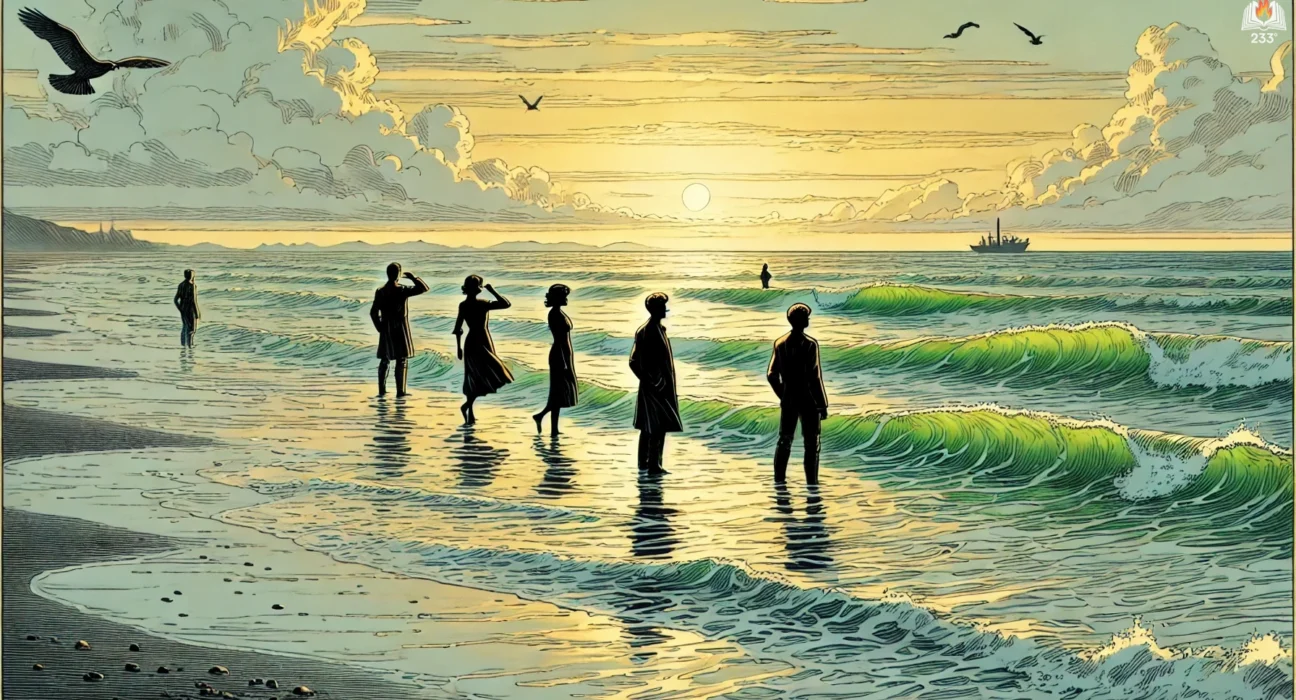
The sea and the sky are almost indistinguishable in the early dawn light, separated only by a faint dark line on the horizon. The waves follow one another in a perpetual dance, rising and breaking on the shore with a gentle sigh, like a sleeper breathing in deep slumber. Slowly, the sky and sea shift, the horizon line sharpening as the sun begins its ascent, casting hues of gold and green, setting the world alight. This serene beginning marks the interwoven lives of six individuals—Bernard, Susan, Rhoda, Neville, Jinny, and Louis.
As children, they are introduced to the world through the lens of their unique perceptions. In the garden, Bernard sees a ring of light, and Susan catches a glimpse of a yellow slab spreading into a purple stripe. Rhoda hears the chirping of birds, a rhythmic sound that resonates with her isolated nature. Neville sees a globe hanging against a hill, Jinny sees a crimson tassel, while Louis hears the stamping of a beast’s foot, chained and restless. Their days are filled with the sights and sounds of their surroundings, each observation a reflection of their inner lives. They live in a boarding school, where the rhythms of the day shape their early years, each of them finding solace or turmoil in the structured environment.
Bernard, ever the storyteller, delights in words and the way they can shape reality. He is the thread that binds the group together, always searching for meaning, for the perfect phrase to encapsulate an experience. Susan, on the other hand, is grounded in the natural world. She yearns for the countryside and its simplicity, feeling a deep connection with the earth, the changing seasons, the cycle of life and death. Her spirit rebels against the confines of their structured life, seeking instead the vastness of fields and the solitude of trees.
Rhoda, the most ethereal and fragile of them all, struggles to anchor herself in the world. She sees the world through a lens of detachment, often feeling like an outsider. Her sense of self is tenuous, her reality often dissolving into fragments. The ordinary world terrifies her; she seeks refuge in dreams and the idea of an escape from the reality that she finds unbearable. Neville, precise and intellectual, is consumed by a love that can never be fulfilled. His feelings for Percival, the charismatic figure who captivates them all, shape his existence. He is drawn to order and structure, finding solace in the cadences of literature and the possibility of beauty in precision.
Jinny thrives in the physical world, her beauty and vivacity drawing others to her. She revels in her own attractiveness, in the attention it brings her. Life, for Jinny, is a series of sensual moments, each one as vibrant and fleeting as a butterfly’s wing. Yet beneath her confidence lies a fear of time, of the inevitable fading of her allure. Louis, the outsider marked by his Australian accent, is driven by an intense need to belong. He is haunted by a sense of inferiority, a feeling of being on the periphery of the world he so desperately wants to be a part of. Success becomes his measure of self-worth, a way to bridge the gap between who he is and who he longs to be.
As they grow older, the characters move into adulthood, each following their own path yet remaining connected by invisible threads of memory and shared experience. Percival, though largely silent, is the axis around which their lives turn. His departure to India and subsequent death cast a long shadow over them, a loss that each of them grapples with in their own way. Bernard marries and becomes a father, yet continues to question the coherence of his life story. He seeks unity in the fragmented experiences of his existence, but the more he searches, the more he realizes the elusiveness of such unity.
Susan returns to the countryside, finding solace in the cycles of nature, in the act of nurturing life. Her role as a mother and caretaker becomes her anchor, the fulfillment of the yearning she felt in childhood. Yet, even in this, there is an undercurrent of restlessness, a sense of something unfulfilled. Rhoda’s isolation deepens as she moves through life, her sense of being outside the circle of life intensifying. She cannot escape the feeling of being a shadow, a presence that flickers and fades. Ultimately, her struggle becomes too great, and she chooses to end her life, a tragic coda to her lifelong search for solidity in a world of shifting shadows.
Neville achieves academic success, yet Percival’s absence leaves an indelible mark on his life. He clings to the structure and order of his scholarly pursuits, but underneath lies a vein of melancholy, a longing for what could never be. Jinny remains in London, embracing the social whirl and the pleasures of the body. But even as she immerses herself in the vitality of the present, the specter of aging haunts her. The realization that beauty is transient, that her allure will fade, casts a shadow on her existence.
Louis climbs the ladder of professional success, but the specter of inadequacy never fully releases its grip. He achieves the outward markers of success, yet inside, he remains the boy on the periphery, watching and yearning. His outsider status, once a source of pain, becomes a part of his identity, a lens through which he views the world.
In the twilight of their lives, Bernard reflects on the passage of time and the fragmented nature of existence. He recounts the stories of their lives, seeking to find a narrative thread that binds them together. Yet he comes to realize that life is not a single, coherent story but a series of moments, each complete in its own right. The unity he seeks is not in the telling but in the lived experience, in the way their lives have touched and shaped each other. As the sun sets and the waves continue their perpetual dance, the world they have known fades into darkness, yet their voices, their thoughts, and their memories linger, echoing through the silence.
Main Characters
- Bernard: The central storyteller, Bernard is a reflective and imaginative character who seeks to understand life through narratives. His journey is one of seeking coherence amidst life’s inherent chaos.
- Susan: Connected deeply to the natural world, Susan finds her identity in rural life and motherhood. Her story is one of yearning for the simplicity and continuity of the countryside.
- Rhoda: The most introspective and fragile character, Rhoda battles a profound sense of alienation and ultimately succumbs to her inner turmoil through suicide.
- Neville: An intellectual with a precise mind, Neville’s life is marked by his deep, unfulfilled love for Percival and his pursuit of academic success.
- Jinny: Vibrant and socially confident, Jinny’s existence revolves around physical beauty and social interactions. Her fear of aging contrasts sharply with her outward confidence.
- Louis: An outsider striving for acceptance, Louis’s journey is driven by his need to prove himself and find cultural legitimacy.
Theme
- Individuality and Identity: Each character’s soliloquies reveal their unique struggles with self-identity and their efforts to carve out a distinct existence.
- Time and Transience: The novel’s structure, moving from sunrise to sunset, mirrors the passage of time in the characters’ lives, highlighting the fleeting nature of existence.
- Interconnectedness: Despite their individual paths, the characters’ lives are deeply interconnected, their stories weaving together to form a collective narrative.
- Nature and the Rhythms of Life: The natural world serves as a backdrop and a metaphor for the characters’ experiences, emphasizing cycles of growth, change, and decay.
Writing Style and Tone
Virginia Woolf’s writing in “The Waves” is characterized by its lyrical and poetic quality, creating a dreamlike atmosphere that blurs the boundaries between prose and poetry. The novel employs a stream-of-consciousness technique, capturing the inner thoughts and emotions of the characters in a fluid and continuous flow. Woolf’s use of imagery and symbolism enriches the narrative, imbuing it with layers of meaning and enhancing the readers’ engagement with the text.
The tone of the novel is contemplative and introspective, with a deep sensitivity to the nuances of human experience. Woolf’s language is richly descriptive, painting vivid pictures of both the external world and the internal landscapes of the characters’ minds. This intricate interplay of thoughts and sensations creates a textured and immersive reading experience, inviting readers to explore the depths of the characters’ psyches and the beauty of Woolf’s literary artistry.
Quotes
The Waves – Virginia Woolf (1931) Quotes
“There was a star riding through clouds one night, & I said to the star, 'Consume me'.”
“How much better is silence; the coffee cup, the table. How much better to sit by myself like the solitary sea-bird that opens its wings on the stake. Let me sit here for ever with bare things, this coffee cup, this knife, this fork, things in themselves, myself being myself.”
“I am made and remade continually. Different people draw different words from me.”
“Alone, I often fall down into nothingness. I must push my foot stealthily lest I should fall off the edge of the world into nothingness. I have to bang my head against some hard door to call myself back to the body.”
“When I cannot see words curling like rings of smoke round me I am in darkness—I am nothing.”
“For this moment, this one moment, we are together. I press you to me. Come, pain, feed on me. Bury your fangs in my flesh. Tear me asunder. I sob, I sob.”
“I feel a thousand capacities spring up in me. I am arch, gay, languid, melancholy by turns. I am rooted, but I flow.”
“Let us again pretend that life is a solid substance, shaped like a globe, which we turn about in our fingers. Let us pretend that we can make out a plain and logical story, so that when one matter is despatched—love for instance—we go on, in an orderly manner, to the next. ”
“I need silence, and to be alone and to go out, and to save one hour to consider what has happened to my world, what death has done to my world.”
“And the poem, I think, is only your voice speaking.”
“I want someone to sit beside after the day's pursuit and all its anguish, after its listening, and its waitings, and its suspicions. After quarrelling and reconciliation I need privacy - to be alone with you, to set this hubbub in order. For I am as neat as a cat in my habits.”
“I begin to long for some little language such as lovers use, broken words, inarticulate words, like the shuffling of feet on pavement.”
“I was always going to the bookcase for another sip of the divine specific.”
“I am not one and simple, but complex and many.”
“I see nothing. We may sink and settle on the waves. The sea will drum in my ears. The white petals will be darkened with sea water. They will float for a moment and then sink. Rolling over the waves will shoulder me under. Everything falls in a tremendous shower, dissolving me.”
“But when we sit together, close,’ said Bernard, ‘we melt into each other with phrases. We are edged with mist. We make an unsubstantial territory.”
“Happiness is in the quiet, ordinary things. A table, a chair, a book with a paper-knife stuck between the pages. And the petal falling from the rose, and the light flickering as we sit silent.”
“On the outskirts of every agony sits some observant fellow who points.”
“I have made up thousands of stories; I have filled innumerable notebooks with phrases to be used when I have found the true story, the one story to which all these phrases refer. But I have never yet found the story. And I begin to ask, Are there stories?”
“The moment was all; the moment was enough.”
“And you wish to be a poet; and you wish to be a lover.”
“To let oneself be carried on passively is unthinkable.”
“I do not want to be admired. I want to give, to be given, and solitude in which to unfold my possessions.”
“We are cut, we are fallen. We are become part of that unfeeling universe that sleeps when we are at our quickest and burns red when we lie asleep.”
“These moments of escape are not to be despised. They come too seldom.”
“I think sometimes I am not a woman, but the light that falls on this gate, on this ground. I am the seasons, I think sometimes, January, May, November; the mud, the mist, the dawn.”
We hope this summary has sparked your interest and would appreciate you following Celsius 233 on social media:
There’s a treasure trove of other fascinating book summaries waiting for you. Check out our collection of stories that inspire, thrill, and provoke thought, just like this one by checking out the Book Shelf or the Library
Remember, while our summaries capture the essence, they can never replace the full experience of reading the book. If this summary intrigued you, consider diving into the complete story – buy the book and immerse yourself in the author’s original work.
If you want to request a book summary, click here.
When Saurabh is not working/watching football/reading books/traveling, you can reach him via Twitter/X, LinkedIn, or Threads
Restart reading!