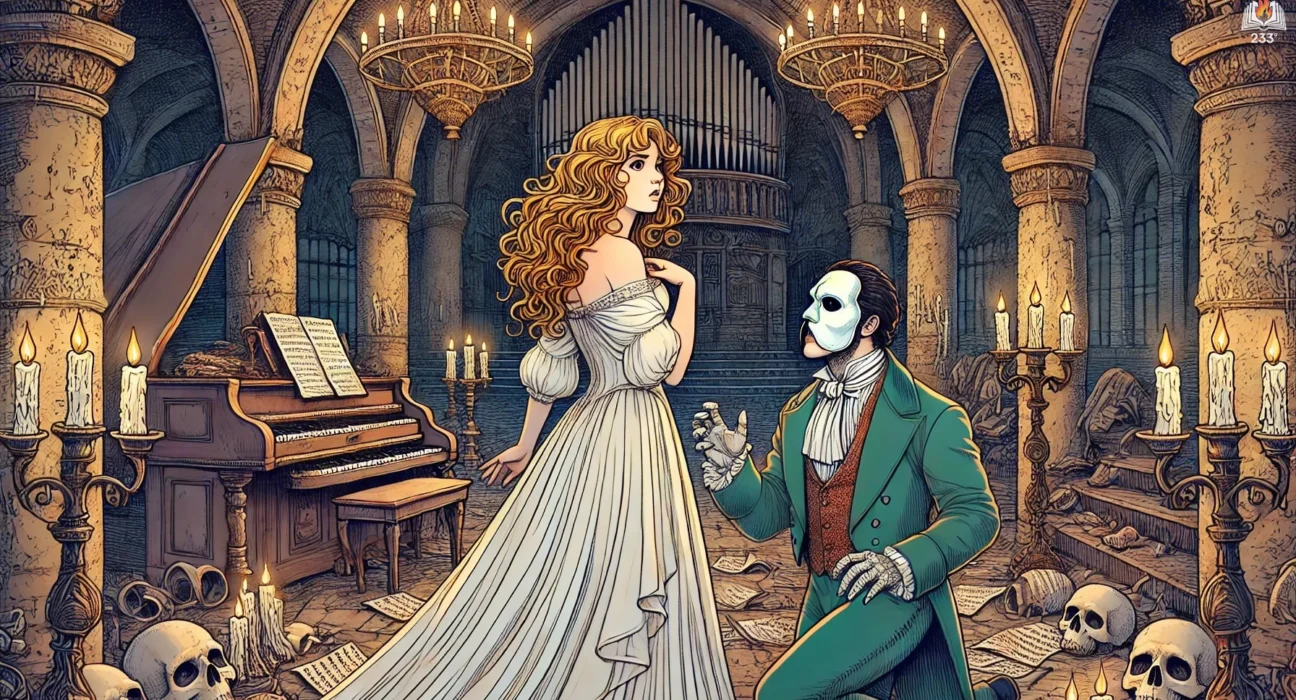
The Phantom of the Opera by Gaston Leroux, published in 1910, is a Gothic mystery novel set in the grand Paris Opera House. At its core, the story is a tragic romance exploring obsession, beauty, and darkness through the enigmatic “Opera Ghost” who haunts the opera house’s labyrinthine underbelly. Leroux’s background as a journalist lends the novel an air of authenticity, as he presents the tale in a documentary style, claiming to reveal real events. The novel has inspired countless adaptations in film, theater, and music, most famously Andrew Lloyd Webber’s 1986 musical, underscoring the lasting appeal of this story of haunting love.
Plot Summary
On a chilly evening in Paris, whispers of the infamous “Opera Ghost” echo through the opulent corridors of the grand Palais Garnier, stirring both laughter and terror among the performers. For months, tales of a mysterious figure stalking the shadows have haunted the ballet dancers and stagehands. They speak of strange occurrences: a pale figure in evening attire who drifts through walls, haunting Box Five during performances, demanding his payment in a peculiar letter penned in red ink. Most laugh, others shudder, but the legend soon proves more than rumor. With the arrival of Christine Daaé, a beautiful, shy chorus girl who stuns audiences with her soaring voice, the ghost is drawn from the shadows.
Christine, orphaned young, has grown up in the care of her late father’s friends and finds solace in her singing. Longing to honor her father, a talented musician who once spoke of an “Angel of Music,” she convinces herself that this spirit has come to teach her. Christine’s enchanting voice fills the opera house, impressing all but especially captivating the Opera Ghost, who reveals himself to her, though masked. Erik, as he is known only to himself, takes Christine into his confidence, tutoring her in music from his hidden lair deep within the opera’s secret passages. She hears only his voice, which flows from the walls, the shadows, and from a mysterious mirror in her dressing room. He is her “angel,” her protector, though his love grows obsessive and dark.
Raoul, Vicomte de Chagny, Christine’s childhood friend, recognizes her unusual beauty and grace and is drawn to her again with a renewed passion after hearing her sing. The two reconnect, and as they share memories of their youth, a mutual attraction blossoms. But Erik’s watchful eyes are everywhere, and he quickly becomes aware of Raoul’s intentions. Consumed with jealousy and the desperate desire to keep Christine close, Erik warns her against seeing Raoul, reminding her of the angel’s promise to her father. Torn between her “angel” and her childhood love, Christine’s heart is divided. Her attempts to balance these affections lead her into a dangerous game of deception.
The ghost’s demands on the opera house intensify as he insists on Christine’s place as the prima donna, sidelining the reigning diva, Carlotta. When the opera’s new managers refuse to honor these requests, chaos ensues. Erik sabotages Carlotta’s performance, replacing her voice with a ghastly croak. The chandelier plummets from the ceiling in a catastrophic crash, sending fear through the audience and killing a spectator. Behind the scenes, Christine is trapped in Erik’s web of control. He whisks her away to his underground lair, hoping that she will see past his monstrous visage and return his obsessive love.
In the darkness of his lair, Christine discovers the extent of Erik’s misery and loneliness. His face, disfigured and skull-like, strikes horror into her heart, but she pities him, recognizing the pain of his isolation. Erik’s home reflects his tortured existence: it is a space of grandeur and decay, filled with instruments, operatic scores, and a bed shaped like a coffin. He confesses his love to Christine, his hopes and dreams of a life together. She is torn between sympathy and fear, promising only to return on condition that he let her go. Heartbroken but trusting her word, Erik reluctantly agrees.
Frightened and desperate, Christine meets Raoul and tells him of Erik’s demands and the horrifying encounter. She fears for her life, and they resolve to leave Paris, hoping to escape Erik’s vengeful eyes. However, Erik is never far; he overhears their plans and lays a trap of his own. To prevent her from fleeing, he issues an ultimatum: Christine must marry him or watch Raoul die.
At Christine’s final performance, Erik’s plan unfolds. He abducts her from the stage, descending into the opera’s hidden depths. Raoul, frantic with worry, enlists the help of the Persian, an enigmatic figure who knows Erik’s secret past. Together, they venture into the opera’s maze-like underground, where the Persian reveals Erik’s former life as a talented architect and illusionist, a man shunned by society for his deformity but revered for his genius.
Erik’s lair is filled with traps and illusions designed to ward off intruders, but Raoul and the Persian press forward. After nearly succumbing to Erik’s infamous torture chamber—a room of mirrored walls that reflect and amplify light, sound, and heat—they find Christine and Erik. She is torn by pity and horror, yet when Erik shows her a side of himself that is more vulnerable, she relents and agrees to stay with him if it means saving Raoul’s life.
In this desperate moment, Erik’s love is finally returned, not with passion, but with empathy. Christine’s compassion breaks through his bitterness. Deeply moved by her kindness, Erik finally understands the impossibility of his dreams. He knows he cannot keep Christine against her will; her love for Raoul, pure and unselfish, touches him in a way that his obsession never could. In an ultimate act of sacrifice, Erik releases them both, asking only for a kiss—a human connection he has never known. Christine grants him this final act of mercy.
Erik’s anguish is immeasurable as he watches them go. His lair becomes a tomb of shattered hopes, yet in releasing Christine, he finds a peace that has eluded him all his life. Alone, Erik retreats to the shadows, his heart broken, his life bound to the opera house’s darkness. Days later, he dies in solitude, his existence fading into the realms of legend and myth.
Christine and Raoul, forever marked by their experiences, find solace in each other and leave Paris, seeking a life unshadowed by Erik’s ghostly presence. And yet, within the walls of the opera house, whispers persist, legends live on, and the tale of the “Opera Ghost” becomes a haunting refrain, a mysterious melody woven into the very foundation of the Palais Garnier.
Main Characters
Erik, the Phantom: The Phantom, or “Opera Ghost,” is a brilliant yet deformed and reclusive musician who lives in the cellars of the Paris Opera House. Both a villain and a tragic hero, Erik’s genius is intertwined with his unrequited love for Christine and his yearning for acceptance despite his deformities. His actions swing between terrorizing the opera house and desperately seeking Christine’s affection, making him a complex symbol of both darkness and sympathy.
Christine Daaé: A beautiful and talented young singer, Christine is the novel’s heroine and the object of Erik’s obsession. Orphaned as a child and haunted by memories of her father’s tales, she believes she hears the “Angel of Music” that her father promised to send her—a belief that Erik exploits. Her innocence and compassion are tested as she becomes entangled in a dangerous love triangle.
Raoul, Vicomte de Chagny: Christine’s childhood friend and devoted suitor, Raoul is a nobleman with a genuine love for Christine. His straightforward courage and loyalty stand in stark contrast to the Phantom’s dark allure. Throughout the novel, Raoul’s resolve to protect Christine leads him into perilous encounters with the Phantom.
The Persian: Known only as “the Persian,” he is a mysterious figure and former acquaintance of Erik’s from his time in Persia. As a shadowy mentor to Erik, he reveals key information about the Phantom’s past and helps Raoul navigate the opera’s secret passages in a rescue attempt. His presence is integral to unraveling the Phantom’s enigmatic history.
Theme
Obsession and Unrequited Love: The Phantom’s deep obsession with Christine drives the novel’s action, highlighting the torment of unrequited love and the lengths to which it can drive a person. His fixation becomes both a prison and a source of purpose, encapsulating the destructive nature of possessive love.
Appearance vs. Reality: The contrast between Erik’s genius and his monstrous appearance explores how society often values surface appearances over inner qualities. This theme critiques how people judge others, as Christine initially sympathizes with Erik, only to recoil from his “hideousness” when confronted with his darker deeds.
Isolation and Alienation: Erik’s tragic loneliness is a focal point of the story. Cast out by society due to his appearance, he becomes a reclusive genius, creating a kingdom for himself beneath the opera house. This isolation shapes his actions and outlook, creating sympathy for his plight even as his deeds horrify.
Beauty and Deformity: Leroux juxtaposes beauty and deformity to question society’s definitions of worth. Erik’s disfigurement brands him an outcast, while Christine’s beauty renders her cherished. The novel challenges these stereotypes, suggesting that true monstrosity lies in actions rather than physical form.
Writing Style and Tone
Gaston Leroux crafts The Phantom of the Opera with an atmospheric Gothic style, blending elements of horror, romance, and suspense. His writing captures the decadence of the opera house through lush descriptions and sharp contrasts between light and dark spaces, mirroring the dual nature of his characters. Leroux’s background in journalism manifests in a narrative structure that combines fiction with journalistic authenticity, often presenting the story as a factual investigation into the opera ghost’s existence. This approach heightens the sense of mystery and realism, drawing readers into the suspense as if they are uncovering clues alongside the characters.
Leroux’s tone is simultaneously melodramatic and tragic, echoing the operatic setting and intense emotions of his characters. Through omniscient narration and detailed character perspectives, he paints Erik not only as a frightening figure but as a deeply tortured soul. The tone shifts from suspense to sympathy, compelling readers to feel for both the Phantom and his victims. His complex and layered prose, tinged with theatrical flair, lends the novel its timeless charm, while his keen sense of pacing maintains a gripping suspense throughout.
Quotes
The Phantom of the Opera – Gaston Leroux (1910) Quotes
“If I am the phantom, it is because man's hatred has made me so. If I am to be saved it is because your love redeems me.”
“All I wanted was to be loved for myself." (Erik)”
“Erik is not truly dead. He lives on within the souls of those who choose to listen to the music of the night.”
“I tore off my mask so as not to lose one of her tears... and she did not run away!...and she did not die!... She remained alive, weeping over me, weeping with me. We cried together! I have tasted all the happiness the world can offer.”
“He had a heart that could have held the entire empire of the world; and, in the end, he had to content himself with a cellar.”
“Know that it is a corpse who loves you and adores you and will never, never leave you!...Look, I am not laughing now, crying, crying for you, Christine, who have torn off my mask and who therefore can never leave me again!...Oh, mad Christine, who wanted to see me!”
“Are people so unhappy when they love?" "Yes, Christine, when they love and are not sure of being loved.”
“You are crying! You are afraid of me! And yet I am not really wicked. Love me and you shall see! All I wanted was to be loved for myself.”
“Tonight I gave you my soul, and I am dead." - Christine, from Gaston Leroux's: The Phantom of the Opera.”
“They played at hearts as other children might play at ball; only, as it was really their two hearts that they flung to and fro, they had to be very, very handy to catch them, each time, without hurting them.”
“Erik: Are you very tired? Christine: Oh, tonight I gave you my soul, and I am dead. Erik: Your soul is a beautiful thing, child. No emperor received so fair a gift. The angels wept to-night.”
“None will ever be a true Parisian who has not learned to wear a mask of gaiety over his sorrows and one of sadness, boredom, or indifference over his inward joy.”
“Blood!...Blood!... That's a good thing! A ghost who bleeds is less dangerous!”
“She's singing to-night to bring the chandelier down!”
“He stared dully at the desolate, cold road and the pale, dead night. Nothing was colder or more dead than his heart. He had loved an angel and now he despised a woman.”
“But do you love me? If Erik were good-looking, would you love me, Christine?”
“Holy angel, in Heaven blessed, My spirit longs with thee to rest”
“Does he love you so much?" "He would commit murder for me.”
“And, despite the care which she took to look behind her at every moment, she failed to see a shadow which followed her like her own shadow, which stopped when she stopped, which started again when she did and which made no more noise than a well-conducted shadow should.”
“why do you condemn a man whom you have never met, whom no one knows and about whom even you yourself know nothing?”
“When a woman has seen me, as you have, she belongs to me. She loves me forever.”
“He loved her so much that it almost took his breath away.”
We hope this summary has sparked your interest and would appreciate you following Celsius 233 on social media:
There’s a treasure trove of other fascinating book summaries waiting for you. Check out our collection of stories that inspire, thrill, and provoke thought, just like this one by checking out the Book Shelf or the Library
Remember, while our summaries capture the essence, they can never replace the full experience of reading the book. If this summary intrigued you, consider diving into the complete story – buy the book and immerse yourself in the author’s original work.
If you want to request a book summary, click here.
When Saurabh is not working/watching football/reading books/traveling, you can reach him via Twitter/X, LinkedIn, or Threads
Restart reading!