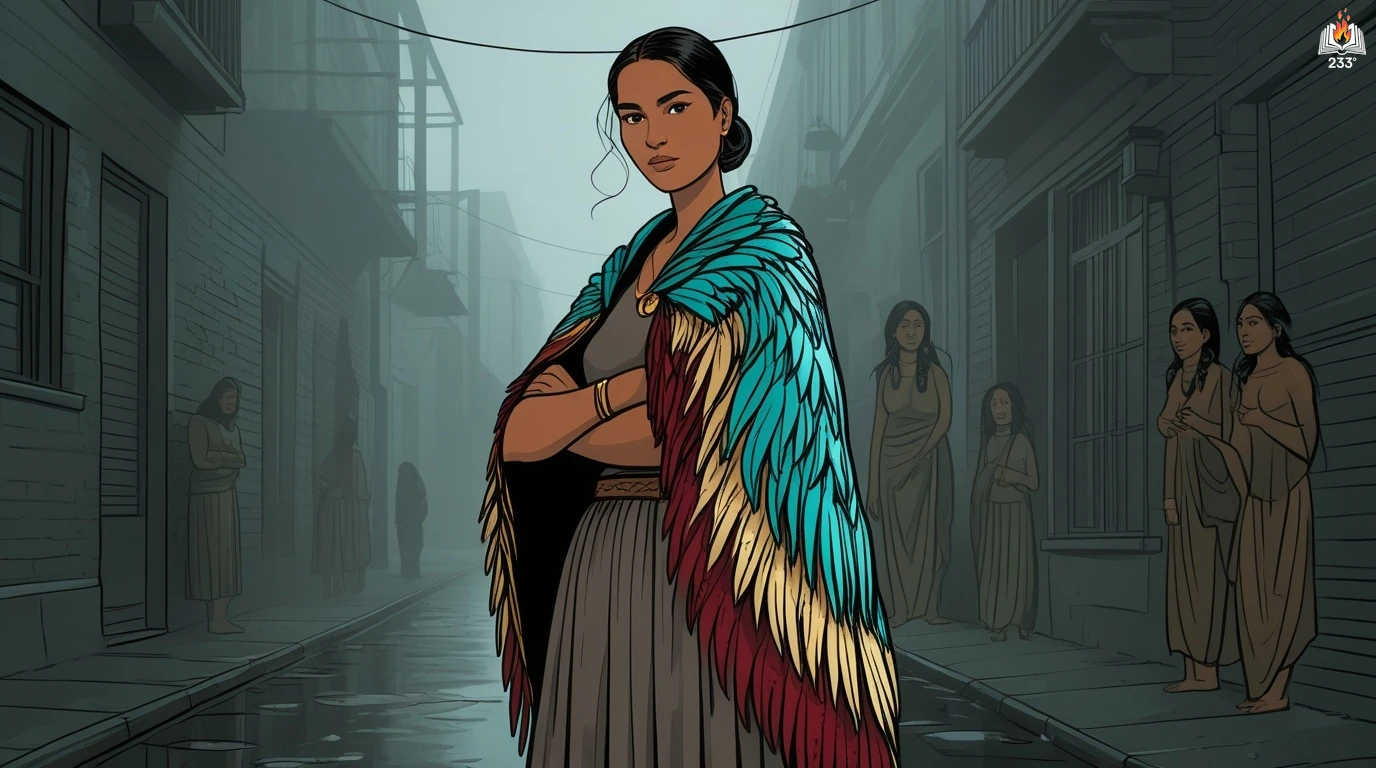
Our Mutual Friend by Charles Dickens, published in 1865, is a novel set against the backdrop of Victorian London. The story begins with a grim discovery in the River Thames and unravels into a complex tale of love, deception, and social commentary. Dickens explores the dark underbelly of society, the greed and ambition that drive individuals, and the redemptive power of love and kindness.
Plot Summary
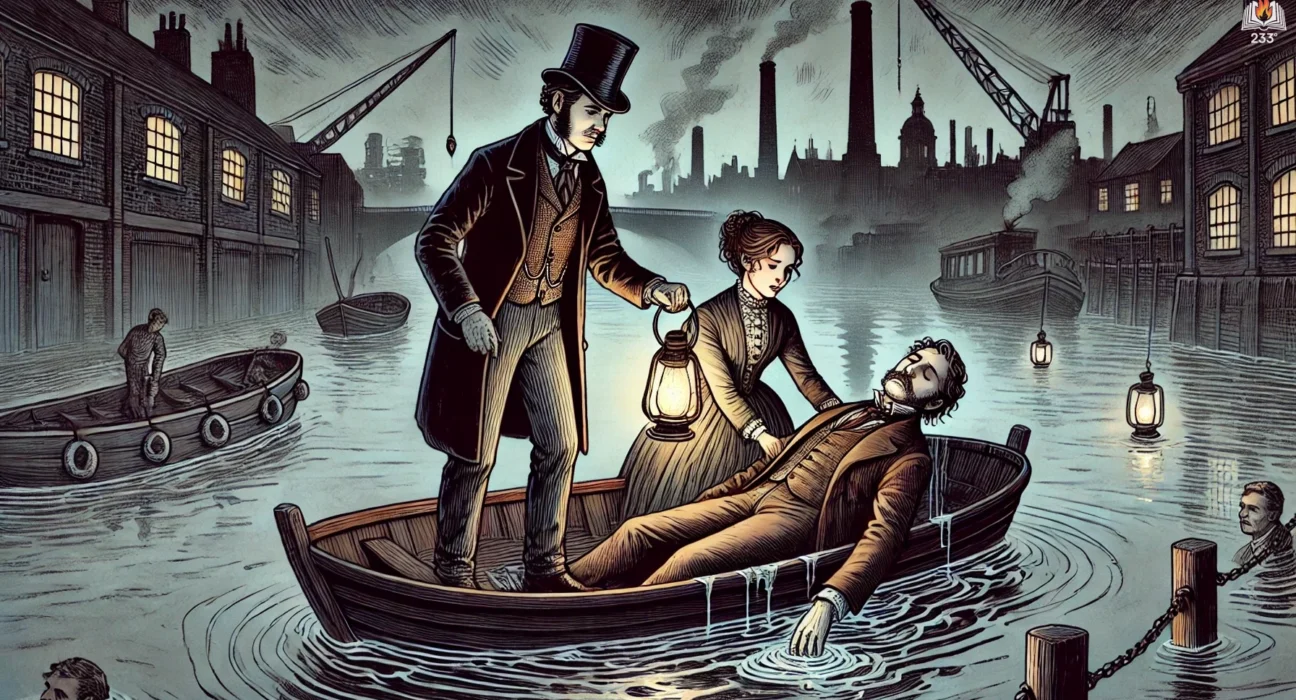
In the shadowy depths of the River Thames, as evening descends, a boat drifts ominously. In it are Gaffer Hexam and his daughter, Lizzie. They are river scavengers, their grim task to find bodies that have met their end in the murky waters. This night, they haul aboard the corpse of John Harmon, the wealthy heir to a fortune, whose death sets in motion a chain of events that entangle the lives of many.
John Harmon, on his way back to London to claim his inheritance, was to marry Bella Wilfer, a condition of his father’s will. Now, with his death, the fortune passes to the Boffins, a kind and simple couple who once served the elder Harmon. Mr. and Mrs. Boffin, suddenly thrust into wealth, navigate their new status with generosity and open hearts, contrasting sharply with the greed that swirls around them.
But all is not as it seems. John Harmon is not dead. He has returned under the alias John Rokesmith, observing the lives of those around him, especially the Boffins and Bella Wilfer. He watches as the Boffins, particularly Mr. Boffin, undergo a strange transformation, feigning a miserly demeanor that disturbs Bella, who comes to detest the greed she once thought she admired. Rokesmith, in his guise, becomes Mr. Boffin’s secretary, growing closer to Bella and falling in love with her. However, Bella is still drawn to the idea of wealth and initially views Rokesmith with disdain.
Elsewhere in London, the social scene buzzes with the Veneerings, new moneyed socialites who host opulent dinners and gather around them a mix of the ambitious and the frivolous. Among their circle is Eugene Wrayburn, a bored lawyer, and his friend Mortimer Lightwood. Wrayburn, with his cynical outlook on life, becomes infatuated with Lizzie Hexam, much to the consternation of Bradley Headstone, a schoolmaster whose obsessive love for Lizzie turns him into a dark, vengeful figure. Headstone’s jealousy spirals into madness as he perceives Eugene as a rival, leading him down a path of violence.
As Rokesmith continues his charade, he witnesses the Boffins’ benevolence, even as Mr. Boffin’s false miser act grows harsher. Mr. Boffin hires Silas Wegg, a one-legged street vendor, to read to him, hoping to better himself. Wegg, however, is a schemer. He discovers a supposed second will and plots to blackmail the Boffins. He becomes the embodiment of the parasitic greed that Dickens paints in the darker corners of his narrative.
Bella, living with the Boffins and observing Mr. Boffin’s increasing miserly ways, becomes disillusioned with wealth. When she learns of Rokesmith’s love for her, she initially rebuffs him, still caught between her upbringing and her burgeoning realization that love holds more value than money. However, the coldness of Mr. Boffin’s newfound greed and the warmth she feels for Rokesmith lead her to change her mind. She marries him, unaware of his true identity as John Harmon.
Parallel to this is the dangerous dance between Eugene Wrayburn and Bradley Headstone. Eugene, though initially toying with Lizzie’s affections, finds himself genuinely falling for her. Headstone, unable to contain his rage and jealousy, follows Eugene one night and attacks him, nearly killing him by the river. Lizzie, in a courageous act of love, rescues Eugene from the water, nursing him back to health. Eugene, moved by Lizzie’s bravery and selflessness, marries her, defying the rigid class structures of the time.
The climax comes when Wegg’s plot is exposed. Rokesmith, having seen enough of Wegg’s machinations, reveals the truth about the supposed second will, proving it to be a forgery. In a twist, Mr. Boffin reveals that his transformation into a miser was a ruse designed to test Bella’s character. He had hoped to show her the ugliness of greed and the beauty of a life lived for love. Bella, who has already proven herself by choosing Rokesmith over wealth, passes this test with grace. In the end, she learns of Rokesmith’s true identity as John Harmon, the man she was meant to marry all along.
John Harmon and Bella find joy in their union, now free to use their wealth for good, knowing its true value. They decide to live a life not defined by riches but by the love and generosity that have proven more precious. The Boffins, too, are vindicated as paragons of kindness and integrity, showing that wealth can be a force for good in the right hands.
Lizzie and Eugene, despite their different social standings, find happiness together, challenging the rigid class norms. Bradley Headstone, consumed by his own hatred and jealousy, meets a tragic end, a cautionary tale of the dangers of unchecked obsession.
Through these intertwined lives, the currents of the Thames continue to flow, a silent witness to the greed, love, redemption, and the unyielding passage of time. The river that brings death also brings life, as the characters navigate their fortunes, both literal and metaphorical, in the vast, turbulent sea of human experience.
Main Characters
- John Harmon / John Rokesmith: The true heir of the Harmon fortune, presumed dead but living under an alias. He is central to the novel’s themes of identity and redemption.
- Bella Wilfer: Initially portrayed as materialistic, she evolves into a character who values love and integrity over wealth.
- Mr. and Mrs. Boffin: Former servants who inherit the Harmon fortune, their goodness and generosity contrast with the greed surrounding them.
- Lizzie Hexam: The daughter of Gaffer Hexam, she represents purity and selflessness. Her love for Eugene Wrayburn defies societal norms.
- Eugene Wrayburn: A lawyer who becomes obsessed with Lizzie. His character arc takes him from cynicism to genuine love.
- Bradley Headstone: A schoolmaster whose obsessive love for Lizzie turns him into a villainous figure.
- Silas Wegg: A schemer aiming to exploit the Boffins, symbolizing the parasitic nature of greed.
Theme
- The Corrupting Power of Money: The novel explores how wealth influences and corrupts individuals and relationships. Through characters like Bella and the Boffins, Dickens critiques society’s obsession with money.
- Identity and Transformation: John Harmon’s adoption of a new identity allows Dickens to explore themes of personal change and the search for true self.
- Social Critique: Dickens provides a biting commentary on the social stratification of Victorian England, highlighting the disparities between the rich and poor.
- Redemption and Forgiveness: The story emphasizes the possibility of redemption, as characters like Bella and Eugene transform through love and compassion.
Writing Style and Tone
Dickens employs a rich, intricate narrative style, weaving together multiple plotlines and a vast array of characters. His tone varies from dark and gothic in describing the grim life on the Thames, to satirical in his depiction of society’s elite. The novel is characterized by its vivid descriptions, humor, and a deep sense of irony. Dickens’ use of metaphor and symbolism, such as the recurring imagery of the river, underscores the themes of life, death, and rebirth.
Quotes
Our Mutual Friend – Charles Dickens (1865) Quotes
“And O there are days in this life, worth life and worth death.”
“No one who can read, ever looks at a book, even unopened on a shelf, like one who cannot.”
“Give me a moment, because I like to cry for joy. It's so delicious, John dear, to cry for joy.”
“Is it better to have had a good thing and lost it, or never have had it?”
“Love, though said to be afflicted with blindness, is a vigilant watchman.”
“A heart well worth winning, and well won. A heart that, once won, goes through fire and water for the winner, and never changes, and is never daunted.”
“And O there are days in this life, worth life and worth death. And O what a bright old song it is, that O 'tis love, 'tis love, 'tis love that makes the world go round!”
“And this is the eternal law. For, Evil often stops short at istelf and dies with the doer of it! but Good, never.”
“[She wasn't] a logically reasoning woman, but God is good, and hearts may count in heaven as high as heads.”
“No one is useless in this world,' retorted the Secretary, 'who lightens the burden of it for any one else.”
“Meow says the cat ,quack says the duck , Bow wow wow says the dog ! Grrrr!”
“This reminds me, Godmother, to ask you a serious question. You are as wise as wise can be (having been brought up by the fairies), and you can tell me this: Is it better to have had a good thing and lost it, or never to have had it?”
“And O there are days i this life, worth life and worth death”
“Are you thankful for not being young?' 'Yes, sir. If I was young, it would all have to be gone through again, and the end would be a weary way off, don't you see?...”
“and he glanced at the backs of the books, with an awakened curiosity that went below the binding. No one who can read, ever looks at a book, even unopened on a shelf, like one who cannot.”
“I have made up my mind that I must have money, Pa. I feel that I can't beg it, borrow it, or steal it; and so I have resolved that I must marry it.”
“You hear, Eugene?' said Lightwood over his shoulder. 'You are deeply interested in lime.' 'Without lime,' returned that unmoved barrister at law, 'my existence would be unilluminated by a ray of hope.”
“I am in a ridiculous humour,' quoth Eugene; 'I am a ridiculous fellow. Everything is ridiculous. Come along!”
“But he is only stunned by the unvanquishable difficulty of his existence.”
“There was an innocent piece of dinner-furniture that went upon easy castors and was kept over a livery stable-yard in Duke Street, Saint James's, when not in use, to whom the Veneerings were a source of blind confusion. The name of this article was Twemlow.”
“what I mean is, that I am under the influence of some tremendous attraction which I have resisted in vain, and which overmasters me”
“Wish me everything that you can wish for the woman you dearly love, and I have as good as got it, John. I have better than got it, John.”
We hope this summary has sparked your interest and would appreciate you following Celsius 233 on social media:
There’s a treasure trove of other fascinating book summaries waiting for you. Check out our collection of stories that inspire, thrill, and provoke thought, just like this one by checking out the Book Shelf or the Library
Remember, while our summaries capture the essence, they can never replace the full experience of reading the book. If this summary intrigued you, consider diving into the complete story – buy the book and immerse yourself in the author’s original work.
If you want to request a book summary, click here.
When Saurabh is not working/watching football/reading books/traveling, you can reach him via Twitter/X, LinkedIn, or Threads
Restart reading!