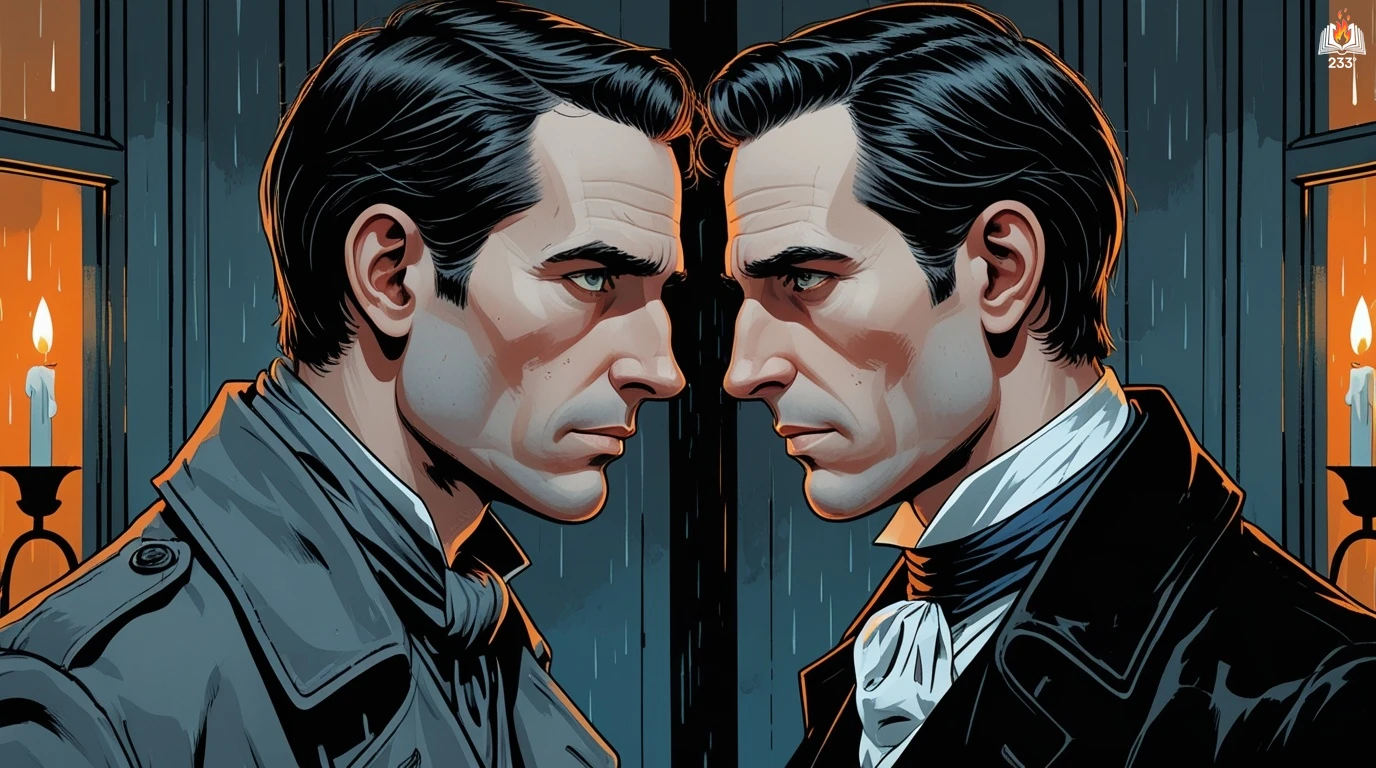

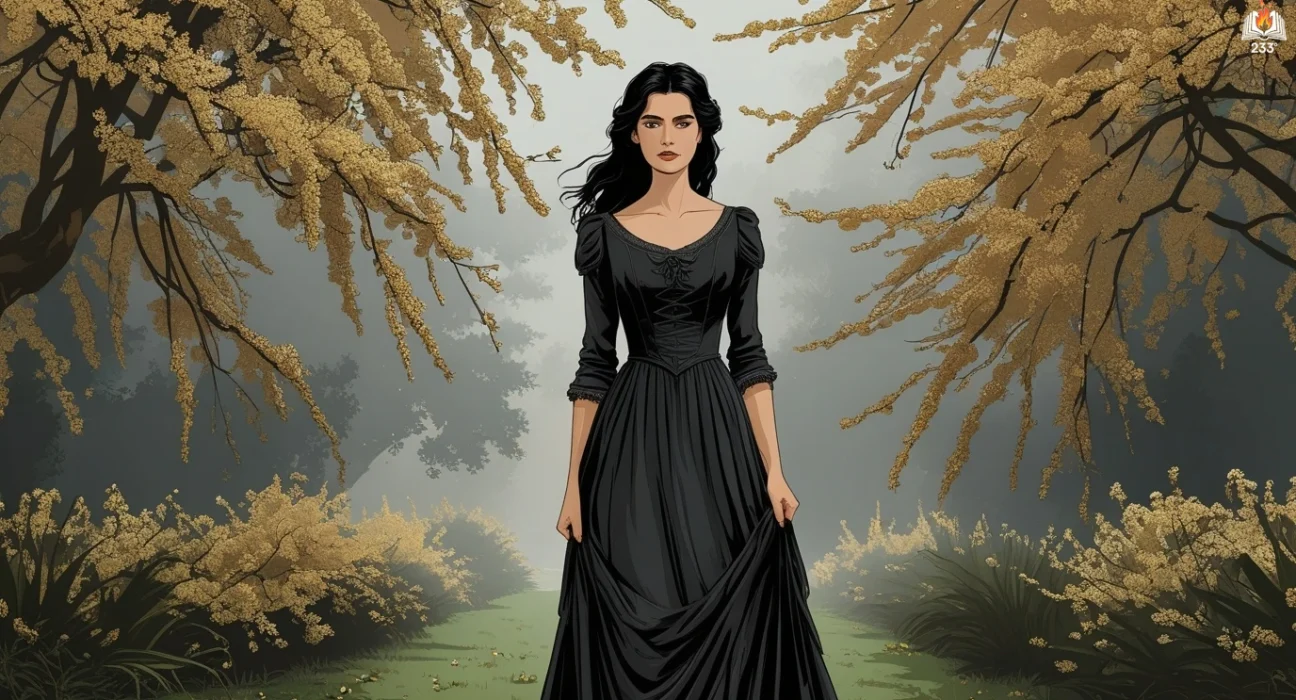
My Cousin Rachel, penned by British author Daphne du Maurier in 1951, is a suspenseful psychological mystery set against the haunting backdrop of Cornwall and Florence. Building on the dark romanticism and ambiguity she had previously mastered in works like Rebecca, du Maurier weaves an enigmatic tale about obsession, inheritance, and the unknowable nature of another person’s intentions. The novel stands as a masterclass in unreliable narration and thematic complexity, confronting its readers with a lingering question: can we ever truly know another’s heart?
Plot Summary
In a quiet corner of Cornwall, where the wind howls through ancient trees and the house sits wrapped in ivy and solitude, young Philip Ashley grows under the watchful eye of his older cousin, Ambrose. A bachelor of strong convictions and gentle eccentricities, Ambrose raises the orphaned Philip as a son. Together, they live in an all-male household where women are absent, laughter is rare, and duty is everything. The estate, surrounded by damp fields and bramble-thick woods, becomes their sanctuary – one untouched by society’s distractions.
Each year, Ambrose seeks warmth abroad to soothe his worsening health. On one such trip, he settles in Florence, where letters begin to arrive – cheerful at first, filled with talk of gardens and architecture. Then, slowly, a new name surfaces. Rachel. A distant cousin, half-English, half-Italian, recently widowed, surrounded by debts and mystery. Ambrose’s admiration for her grows steadily, transforming into something deeper. And then, without warning, comes the announcement – he has married her.
Philip, stunned by the suddenness, masks his jealousy behind polite approval. Raised in a household that feared and rejected female influence, he struggles to imagine Ambrose yielding to a woman’s presence. Yet more troubling than the marriage are the letters that follow. They become fragmented, fearful. Ambrose speaks of illness, of suspicions, of being watched. His handwriting grows unstable. And then silence falls.
With dread pressing on his chest, Philip journeys to Italy. But when he arrives in Florence, it is too late. Ambrose is dead. The villa is shuttered. Rachel is gone. A physician offers the diagnosis – a brain tumor. But in Philip’s hands is one final note from Ambrose, a plea for rescue, scribbled in desperation, accusing Rachel of bringing about his end.
Philip returns home with the seeds of suspicion already sprouting. Though the will leaves everything to Philip, no mention is made of Rachel. She has nothing. Yet instead of vanishing into the shadows of Italy, Rachel arrives at the estate, quiet and composed, seeking only civility and closure. She is nothing like Philip imagined – elegant, refined, intelligent. Not the harpy he feared, nor the seductress he dreaded. In her presence, his resolve begins to crack.
The house, once cold and austere, begins to breathe with life. She brings color, warmth, laughter. Servants once loyal to Ambrose now dote on her. Philip, despite himself, is drawn to her grace. Suspicion dulls into curiosity, then admiration. Soon, fascination overtakes him. He is no longer the master of the house, nor master of his own heart.
Letters from Florence, which he had once hoarded like relics, now gather dust. Rachel becomes his world. Her past, her grief, her silence on Ambrose’s final days – all are cloaked in ambiguity. She speaks of his illness with tenderness but evades his most pointed questions. The more Philip wants to hate her, the more he becomes enchanted.
On his twenty-fifth birthday, the age at which he is to inherit the estate, he prepares a gift – not for himself, but for her. In a gesture born of infatuation, he signs over the property to Rachel, believing she will share his life, his home, and perhaps, his name. There is no proposal, no declaration. Only assumption, the dangerous sort that festers when pride masquerades as love.
But Rachel does not return his devotion. What Philip imagines as betrothal, she sees as hospitality. What he gives freely, she accepts with grace, not promise. The distance between them widens with each passing day, filled now with Rachel’s excursions, her letters to Rainaldi in Italy, her evasions. Philip’s adoration sours into doubt.
When illness strikes him – headaches, weakness, confusion – old fears return. He begins to suspect the tisanas Rachel prepares for him, the herbal infusions she insists are for his health. He recalls Ambrose’s final words, his madness, his terror. The specter of poisoning hovers once again, whispering that Rachel has done this before and will do it again.
Driven by paranoia, Philip confronts her. But she offers no defense, no anger. Only sorrow. She makes no effort to fight for his trust, nor to stay. Then, without fanfare, she announces her plan to leave for Florence. The house begins to empty of her presence, just as it once filled with it.
Philip, recovering from his illness, seeks proof – something, anything to justify his suspicions. In the library, among the volumes Ambrose left behind, he discovers a botanical note on laburnum seeds – deadly, especially when brewed in a certain way. He recalls the golden clusters Rachel once admired in the garden. The pieces tremble but do not fit.
Then, unexpectedly, he learns that a bridge near the garden path has collapsed – the very bridge Rachel would have to cross on her morning ride. She has not been warned. A letter she had sent to Italy days before remains unposted. Her plans, her departure – they were not feigned. They were real. And now, it may be too late to take it all back.
Philip races to the garden, but already the air carries whispers of what has passed. Rachel is dead – fallen, broken, perhaps betrayed by the very land she tried to tame. The question of her guilt or innocence fades like morning mist. There is no answer. Only the echo of possibilities.
Left behind is the estate, now colder than ever. Philip, older and more haunted, walks its halls in silence. Ambrose’s ghost no longer guides him. Rachel’s perfume lingers in curtains and stone. And the question – was she a murderer or a misunderstood woman – will never be answered.
Only one certainty remains. A man can inherit land and titles, but not peace. Not clarity. Not truth.
Main Characters
Philip Ashley – The young, brooding narrator and heir to his cousin Ambrose’s estate. Raised in isolation by Ambrose, Philip is sheltered, emotionally naïve, and fiercely loyal. His world is thrown into turmoil following Ambrose’s death and the arrival of the mysterious Rachel. Through his increasingly obsessive gaze, readers experience the psychological descent that blurs love, suspicion, and vengeance. Philip is both pitiable and culpable – a study in youthful pride, inherited misogyny, and tragic ignorance.
Rachel Ashley – The elusive and captivating widow of Ambrose Ashley. Half-English and half-Italian, Rachel is a woman of grace, charm, and unsettling ambiguity. Her behavior, motivations, and emotional honesty are continuously questioned throughout the novel. Is she a grieving widow or a cunning murderess? A victim of male power or its subverter? Rachel’s character operates at the heart of the novel’s suspense, embodying dualities that never resolve cleanly.
Ambrose Ashley – Philip’s guardian and cousin, whose letters from Italy ignite the mystery. Though he dies before the main events unfold, his presence lingers. Initially portrayed as a paternal figure, Ambrose’s later descent into paranoia raises questions about his mental state and Rachel’s role in his death. His past shapes Philip’s worldview, establishing a dangerous legacy of distrust and rigid masculinity.
Rainaldi – Rachel’s confidant and advisor in Florence. To Philip, he represents the foreign, the corrupt, and the inscrutable. Rainaldi’s polite but guarded demeanor incites Philip’s jealousy and deepens the suspicion surrounding Rachel. His character functions as a contrast to the English characters, highlighting cultural tensions and the novel’s theme of perception vs. truth.
Louise Kendall – Daughter of Philip’s godfather, Louise is intelligent, sensible, and emotionally perceptive. Though she is a minor character, her grounded nature and growing concern for Philip provide a subtle counterpoint to the feverish emotionalism of the central drama.
Theme
Ambiguity of Truth and Perception: At the core of the novel lies the slippery nature of truth. Philip’s narration is biased and emotionally charged, making Rachel’s guilt or innocence impossible to determine. Du Maurier masterfully disorients the reader, compelling us to question not only Rachel’s motives but also Philip’s reliability.
Gender Power and Misogyny: The novel exposes the entrenched misogyny of its male characters, particularly Ambrose and Philip. Women are treated as possessions and threats. Rachel’s attempts to assert independence are viewed through a lens of fear and suspicion. Du Maurier subtly critiques patriarchal structures while exploring the consequences of male obsession and control.
Inheritance, Possession, and Identity: Legal inheritance and personal possession intertwine with deeper existential questions. Rachel becomes a contested figure – as property, threat, and desire. Ambrose’s and Philip’s identities are bound up in their estate, their status, and their sense of legacy, leading to tragic outcomes when control slips from their grasp.
Poison – Literal and Symbolic: Poison hovers as both a plot device and metaphor. Did Rachel poison Ambrose? Is she poisoning Philip? More compellingly, the novel suggests that emotional manipulation, patriarchal dominance, and unchecked jealousy are the real poisons – infecting lives with paranoia, obsession, and destruction.
Writing Style and Tone
Du Maurier’s writing is richly atmospheric, laced with psychological tension and elegant, Gothic undertones. Her narrative unfolds with a precision that is both seductive and unsettling. She uses first-person narration not as a transparent lens but as a warped mirror, showing how love, fear, and inherited prejudice can distort reality. Her prose flows with lyrical melancholy, often infused with sensory detail – the misty Cornish moors, the opulence of the Florentine villa, the bitter taste of Rachel’s tisanas.
The tone of the novel is hauntingly ambiguous, constantly oscillating between romantic longing and sinister foreboding. Du Maurier never gives the reader emotional stability; rather, she sustains a creeping sense of unease that mirrors Philip’s inner turmoil. The tone deepens the moral uncertainty that pervades the book – readers are never told what to believe, only given the tools to doubt everything. Even the lush descriptions are edged with menace, reinforcing a world where beauty hides peril.
Quotes
My Cousin Rachel – Daphne du Maurier (1951) Quotes
“The point is, life has to be endured, and lived. But how to live it is the problem.”
“There is no going back in life, no return, no second chance. I cannot call back the spoken word or the accomplished deed.”
“She has done for me at last, Rachel my torment.”
“She had contemplated life so long it had become indifferent to her.”
“I wondered how it could be that two people who had loved could yet have such a misconception of each other and, with a common grief, grow far apart. There must be something in the nature of love between a man and a woman that drove them to torment and suspicion.”
“They used to hang men at Four Turnings in the old days. Not anymore, though.”
“I am no traveller, you are my world.”
“Because I believe there is nothing so self-destroying, and no emotion quite so despicable, as jealousy.”
“I would not be young again, if you offered me the world. But then I'm prejudiced.' 'You talk,' I said, 'as if you were ninety-nine.' 'For a woman I very nearly am,' she said. 'I'm thirty five.”
“There are some women, Philip, good women very possibly, who through no fault of their own impel disaster. Whatever they touch, somehow turns to tragedy.”
“But a lonely man is an unnatural man, and soon comes to perplexity. From perplexity to fantasy. From fantasy to madness.”
“A man’s jealousy is like a child’s, fitful and foolish, without depth. A woman’s jealousy is adult, which is very different.”
“People who mattered could not take the humdrum world. But this was not the world, it was enchantment; and all of it was mine.”
“Ambrose used to say to me in Florence that it was worth the tedium of visitors to experience the pleasure of their going.”
“It is strange how in moments of great crisis the mind whips back to childhood.”
“Someday, somehow, I would repay my cousin Rachel.”
“...Women are not so, Philip. Their moods vary with the days and nights, sometimes even with the hours, just as a man’s can do. We are human, that is our failing.”
“..If we killed women for their tongues all men would be murderers.”
“At twenty-three it takes very little to make the spirits soar.”
“I had left the land of fantasy, to her to enter into it. Two persons therefore could not share a dream. Except in darkness, as in make-believe. Each figure, then, a phantom.”
“Truth was something intangible, unseen, which sometimes we stumbled upon and did not recognize, but was found, and held, and understood only by old people near their death, or sometimes by the very pure, the very young.”
We hope this summary has sparked your interest and would appreciate you following Celsius 233 on social media:
There’s a treasure trove of other fascinating book summaries waiting for you. Check out our collection of stories that inspire, thrill, and provoke thought, just like this one by checking out the Book Shelf or the Library
Remember, while our summaries capture the essence, they can never replace the full experience of reading the book. If this summary intrigued you, consider diving into the complete story – buy the book and immerse yourself in the author’s original work.
If you want to request a book summary, click here.
When Saurabh is not working/watching football/reading books/traveling, you can reach him via Twitter/X, LinkedIn, or Threads
Restart reading!