
The Road by Cormac McCarthy, published in 2006, is a haunting, Pulitzer Prize-winning novel set in a bleak post-apocalyptic landscape. It follows a father and his young son as they journey through a scorched, ash-covered America in search of warmth, sustenance, and hope. This novel, a profound meditation on love, survival, and desolation, stands as one of McCarthy’s most celebrated works.
Plot Summary
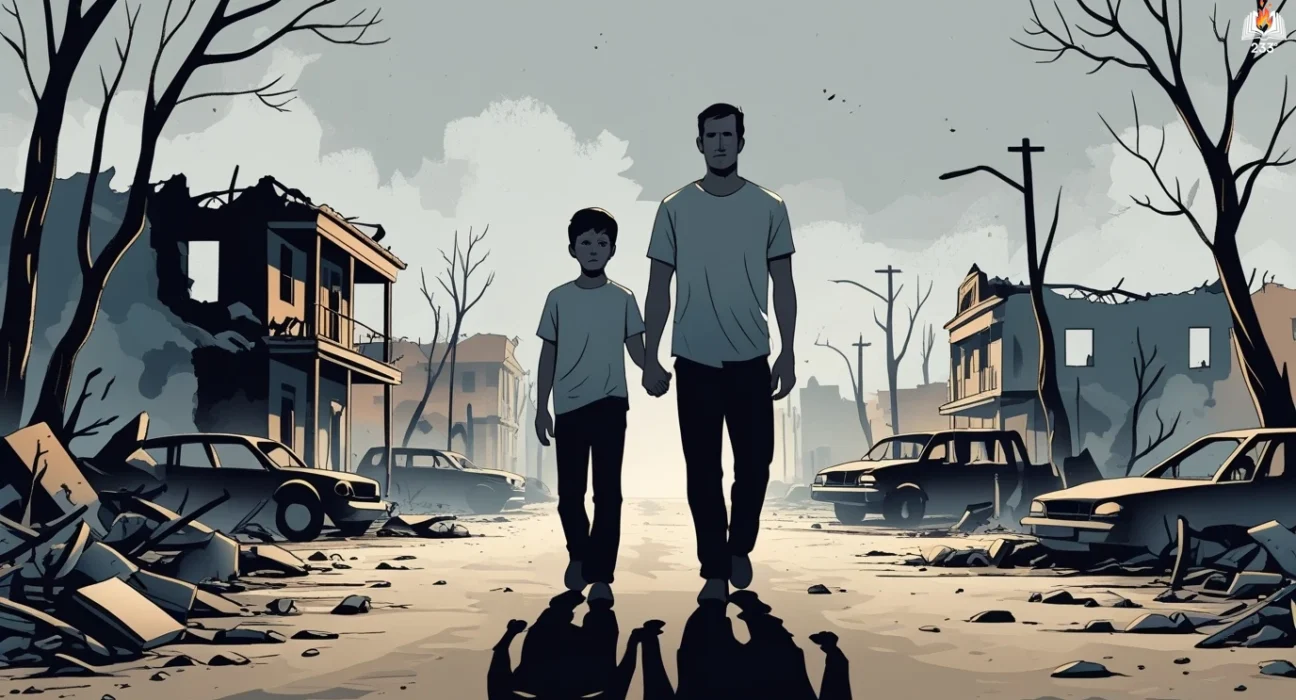
Ash falls from the sky like dry snow and the sun no longer rises, only drags itself faintly across the clouds like a dying eye. A man and a boy walk down the road, pushing a grocery cart filled with all that remains of their world – blankets, scavenged food, and a pistol with two bullets. Around them stretches a landscape of ruin and silence, burnt trees, dead towns, and a grayness that covers everything. They are heading south, away from the cold and toward the possibility of warmth, though the man does not know if such a place exists anymore.
He coughs blood into the ash and wipes it away. The sickness is growing, and he knows he is dying. The boy, no older than ten, watches him with eyes wide and solemn, clinging to his father’s presence like a compass. They sleep under tarps and in abandoned houses, wrapped in blankets and each other. Hunger gnaws at them daily. They find a dried ham in an old smokehouse, a can of peaches behind a rusted shelf, and once – miraculously – a locked cellar filled with preserved food, blankets, and a functioning lamp. For a moment, they eat and sleep in warmth, like creatures recalling some distant peace. But the road calls them forward, always forward.
The world they move through is not merely dead – it is haunted. Charred skeletons of cities, burned fields where crops once stood, houses ransacked and gutted. The roads are not empty. Others survive – ragged bands of men who have abandoned all decency. Cannibals, thieves, the desperate and the deranged. The man watches the road behind them through a mirror tied to the cart, his hand never far from the pistol. One wrong move and the fire he carries for the boy will be snuffed out.
The boy, despite all he has seen, remains a quiet beacon of innocence. He speaks of helping others, of doing good, of being one of the good guys. When they pass a man struck by lightning, burned and dying in the road, the boy weeps and begs to help him. The man says no. They have nothing to give. This burden lives in the boy’s chest, as does the memory of his mother, who chose death over this broken earth. She left before the boy could know her, her absence a silence that echoes between father and son.
They speak little of the past. What use is memory in a world without a future? Yet the man sometimes recalls his childhood – fishing with his uncle, Christmas by the fire, the soft touch of a woman’s hand. Dreams return to him in fractured images, full of color and warmth, but he forces himself to wake. In dreams lie death. He has to stay in this world, as brutal as it is, because the boy is still alive.
Sometimes the road offers kindness. An unopened can of soda, given to the boy as a treasure. A bunker filled with supplies hidden beneath the ground. A waterfall where they bathe, ghost-pale and trembling, the boy’s laughter echoing off the rocks. They eat mushrooms by the fire and the boy listens to stories of courage and justice. These moments are fleeting, almost too precious, and always followed by more gray, more ash.
They reach a house, hollowed out and wind-burnt, its boards stripped away. The man stops and stares. This is the house he grew up in. He walks its ruined halls, sees the mark where stockings once hung, the bed where he dreamed as a child. The boy is afraid. The place is full of shadows and ghosts. They leave quickly, as they always do.
Through mountains and sleet they push the cart, the man’s health fading faster. He coughs more now, rests more, leans on the boy. The boy notices. He says little. They camp in snow, wrap their feet in sacks, sleep huddled against boulders and frozen creek beds. A truck filled with armed men passes them on the road and they run into the trees, heartbeats like gunfire. One of the men comes too close. The man draws the pistol. A single shot could end it all. He threatens the stranger, cold and steady, and the man leaves. But the boy watches everything.
They find a man on the road, starving, covered in ash, eyes burnt shut. The boy wants to help again. The man says they cannot. The boy is angry, silent, disappointed. That night they burn the last of their firewood and eat the last of their food. The man takes out a photograph of his wife and lays it down in the road. There is nothing left to remember.
They reach the coast. The sea is gray, the sand full of bones. It is not the salvation the man had hoped for. There are no fish, no warmth. They stay in a half-collapsed house by the water. The man is coughing blood more often. He knows the end is near. He tells the boy to always carry the fire. The boy does not understand, not fully, but he agrees. The man teaches him how to survive, what to do if he dies. He sleeps more, walks less. Then one day, he does not rise.
The boy lies beside him in the night, listening to the man’s last breath. He speaks to him, asks if he can still hear. In the morning, the man is gone. The boy covers him with a blanket and stays by his side for three days.
Then a man finds him. A stranger with a kind face, a wife, two children. The boy is cautious, but the man speaks gently. He says they are good guys, that they carry the fire too. The boy asks if he can come with them. The man says yes. The boy steps off the road and joins them, the fire still burning in his chest.
Main Characters
The Man – A stoic, protective, and increasingly frail father who clings to his son as the last remnant of meaning in a ruined world. His love for the boy is unwavering, driving every action he takes. Despite illness and despair, he persists in his mission to keep the boy alive and teach him values in a world that has lost all moral compass.
The Boy – Innocent, empathetic, and remarkably resilient, the boy acts as a moral compass and emotional anchor throughout their journey. His sensitivity and insistence on kindness, even in the face of brutality, challenge his father’s hardened survivalism and bring a fragile light to their dark odyssey.
The Woman – Though present only in memory and in flashback, the boy’s mother plays a critical emotional role. Her decision to end her life rather than endure the suffering of the post-apocalyptic world casts a long shadow over the father’s motivations and philosophical struggles.
Theme
Survival and Moral Integrity – The novel interrogates what it means to survive in a world stripped of civilization. Through the father’s pragmatism and the boy’s unwavering compassion, McCarthy explores whether morality can endure in the absence of society.
Parental Love and Sacrifice – At its core, The Road is a love story between father and son. The father’s every decision is rooted in an overwhelming desire to protect the boy, even at the cost of his own health and life. The boy, in turn, symbolizes purity, hope, and the possibility of a moral future.
The Persistence of Hope – Despite the ash, death, and despair, the novel clings to a fragile hope – “carrying the fire” becomes a mantra and metaphor for sustaining humanity, memory, and goodness amid the void.
Isolation and Human Connection – The road is both literal and symbolic: a path through desolation and a test of endurance. Encounters with others are rare and fraught, highlighting the tension between fear and the innate human need for connection.
Writing Style and Tone
Cormac McCarthy’s prose in The Road is austere, poetic, and stripped to its elemental core, mirroring the stark landscape it describes. His rejection of conventional punctuation – absence of quotation marks, minimal commas – enhances the novel’s dreamlike, timeless quality. The language is at once brutal and lyrical, often shifting between short, declarative sentences and profound, mythic imagery. This stylistic spareness creates an immediacy and intimacy that forces the reader to dwell within the desolation and find beauty in the smallest glimmers of tenderness.
The tone of the novel is overwhelmingly somber, often veering into existential dread, yet it remains underscored by a quiet reverence for the sacredness of love and life. This juxtaposition – the bleak with the tender, the void with the warmth of a father’s hand – defines the emotional resonance of the work. McCarthy evokes not just a ruined world, but the persistence of the human spirit moving through it, as fragile and vital as a breath in the cold.
Quotes
The Road – Cormac McCarthy (2006) Quotes
“You forget what you want to remember, and you remember what you want to forget.”
“Nobody wants to be here and nobody wants to leave.”
“Keep a little fire burning; however small, however hidden.”
“There is no God and we are his prophets.”
“Just remember that the things you put into your head are there forever, he said. You might want to think about that. You forget some things, dont you? Yes. You forget what you want to remember and you remember what you want to forget.”
“What's the bravest thing you ever did? He spat in the road a bloody phlegm. Getting up this morning, he said.”
“You have my whole heart. You always did.”
“He knew only that his child was his warrant. He said: If he is not the word of God God never spoke.”
“If trouble comes when you least expect it then maybe the thing to do is to always expect it.”
“You have to carry the fire." I don't know how to." Yes, you do." Is the fire real? The fire?" Yes it is." Where is it? I don't know where it is." Yes you do. It's inside you. It always was there. I can see it.”
“Borrowed time and borrowed world and borrowed eyes with which to sorrow it.”
“When you die it's the same as if everybody else did too.”
“If only my heart were stone.”
“If you break little promises, you'll break big ones.”
“Then they set out along the blacktop in the gunmetal light, shuffling through the ash, each the other's world entire.”
“Listen to me, he said, when your dreams are of some world that never was or some world that never will be, and you're happy again, then you'll have given up. Do you understand? And you can't give up, I won't let you.”
“Where men can't live gods fare no better.”
“No lists of things to be done. The day providential to itself. The hour. There is no later. This is later. All things of grace and beauty such that one holds them to one's heart have a common provenance in pain. Their birth in grief and ashes.”
“By day the banished sun circles the earth like a grieving mother with a lamp.”
“Query: How does the never to be differ from what never was?”
“What would you do if I died? If you died I would want to die too. So you could be with me? Yes. So I could be with you. Okay.”
“Can you do it? When the time comes? When the time comes there will be no time. Now is the time. Curse God and die.”
“When one has nothing left make ceremonies out of the air and breathe upon them.”
“Perhaps in the world's destruction it would be possible at last to see how it was made. Oceans, mountains. The ponderous counterspectacle of things ceasing to be. The sweeping waste, hydroptic and coldly secular. The silence.”
“You have my whole heart. You always did. You're the best guy. You always were.”
“When he went back to the fire he knelt and smoothed her hair as she slept and he said if he were God he would have made the world just so and no different.”
“He thought each memory recalled must do some violence to its origins. As in a party game. Say the words and pass it on. So be sparing. What you alter in the remembering has yet a reality, known or not.”
We hope this summary has sparked your interest and would appreciate you following Celsius 233 on social media:
There’s a treasure trove of other fascinating book summaries waiting for you. Check out our collection of stories that inspire, thrill, and provoke thought, just like this one by checking out the Book Shelf or the Library
Remember, while our summaries capture the essence, they can never replace the full experience of reading the book. If this summary intrigued you, consider diving into the complete story – buy the book and immerse yourself in the author’s original work.
If you want to request a book summary, click here.
When Saurabh is not working/watching football/reading books/traveling, you can reach him via Twitter/X, LinkedIn, or Threads
Restart reading!