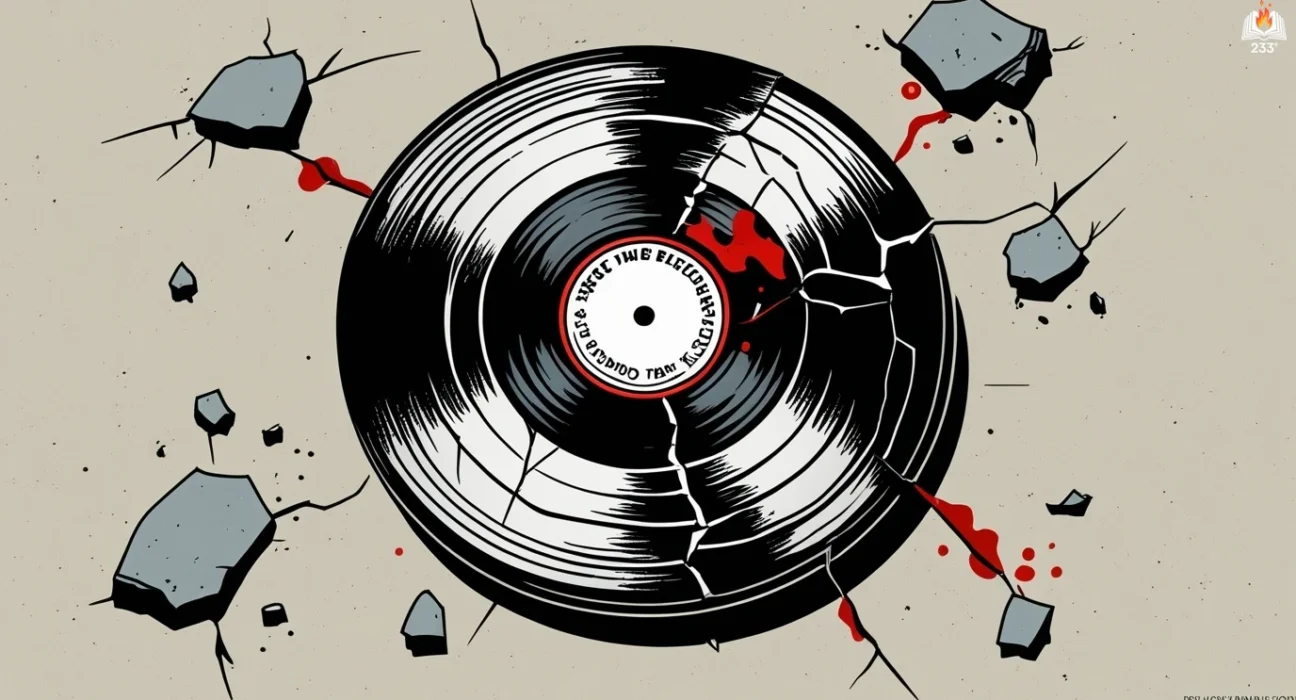
Lullaby by Chuck Palahniuk, published in 2002, is a darkly satirical horror novel that threads together elements of gothic mystery, media critique, and apocalyptic suspense. Known for his transgressive fiction, Palahniuk constructs a story where language itself becomes lethal: a mysterious African “culling song” kills anyone to whom it’s read aloud—or even silently recited. With biting commentary on consumerism, noise pollution, and the seduction of power, Lullaby unravels through the voice of Carl Streator, a journalist whose investigation into sudden infant death syndrome uncovers a chilling pattern and a deadly secret. This is a narrative about grief, obsession, and the terrifying power of words.
Plot Summary
In a world that screams with static, where silence has been outlawed by constant sound, Carl Streator moves like a ghost among the living. A journalist assigned to a series on sudden infant death syndrome, he begins his journey in nurseries filled with teddy bears, powdery scents, and quiet cribs. Too quiet. His visits to these homes leave him haunted, not just by the sorrow of grieving parents, but by a pattern so invisible it nearly escapes him. A children’s book, Poems and Rhymes from Around the World, open to page 27 in every case. A lullaby, ancient and gentle, yet fatal.
Carl’s discovery is not academic. Years earlier, he read that very lullaby to his wife and child. They never woke up. The words have etched themselves into his mind, burned in like a curse. He tries not to think about them, tries not to read them, even silently. Because now he knows: thinking the culling song, even silently, can kill.
Driven by grief and guilt, Carl makes it his mission to find every remaining copy of the book and destroy it. He crosses paths with Helen Hoover Boyle, a real estate agent dealing in haunted houses, a woman with pink clouds of hair and a history that mirrors his own. Her son, too, had died after hearing the lullaby. She’s rich, refined, and ruthless, having built an empire from flipping cursed homes that no one dares keep. Helen keeps a library of supernatural texts locked away, her collection a vault of whispered death.
Together, they begin a quiet war. Helen provides addresses, Carl supplies matches. Libraries, used bookstores, private collections – all scoured and purged. But nothing stays simple for long.
They are joined by Mona Sabbat, Helen’s Wiccan assistant, and her anarchist boyfriend Oyster, who sees in the culling song a chance to unmake the world. Where Carl wants silence, Oyster wants revolution. Where Carl seeks control, Oyster worships chaos. He dreams of broadcasting the song, of wiping the slate clean, of turning death into liberation.
What begins as a partnership becomes a road trip fueled by dread. They travel in Helen’s massive Lincoln, a four-person crusade against a book, against a sentence, against the sound of destruction. They sleep in motels, raid libraries, and dig through trash bins. Helen and Carl, bound by their shared losses, orbit a connection neither of them names. Mona and Oyster, full of youthful fire, begin to drift into something darker, more dangerous.
In secret moments, Carl tests the song’s power. A pestering hotel clerk. A rude driver. People fall dead, painlessly, effortlessly. The words dance in his head like a loaded gun on a hair trigger. He rationalizes the deaths – they’re mercy, they’re justice, they’re necessity. But the song starts to seduce him, whispering promises of purity through silence. He becomes both executioner and addict.
The group learns about grimoire versions of the culling song – variations, amplifications, fragments of old spells capable of destroying buildings, souls, perhaps even memories. The road becomes a descent. Carl fears Mona is memorizing the words, practicing them. Oyster has no fear at all. He wants power, the kind that lives in language, the kind that brings presidents to their knees or bodies to the floor.
A turn in their journey leads them to the Stuarts – a wealthy couple who purchased a historic home with plans to tear it down. Helen sees in them the erasure of history, of soul, and cannot abide it. Their deaths come fast, clean, in bed with the television still on. Carl suspects Helen used the song, just as she suspects Carl. Neither denies it. Neither admits it.
Oyster eventually betrays them. He steals Helen’s grimoire, kidnaps Mona, and vanishes. His plan: to chant the lullaby over loudspeakers, radio waves, mass media – a plague through the airwaves. Carl and Helen give chase, but Oyster remains ahead, driven by a purity of madness no one can negotiate with. His dream is apocalypse.
Carl and Helen track him to a radio station, but not before Oyster sets the machinery in motion. At the last moment, Carl recites the song – not to Oyster, not to Mona, but to the sound itself. To the pulse of the speakers, to the metal walls. And the station collapses, not with an explosion, but with a shudder, a collapse of frequency and silence. The transmission ends in a whisper of dust.
Only Mona survives. Oyster, burned by his own fire, leaves behind echoes and ashes. Carl tries to erase everything – every copy, every page, every phoneme. But the song lingers. Helen disappears, or perhaps hides in plain sight. Her real estate signs vanish from the lawns of cursed houses. Mona leaves to walk her own path, the crystal around her neck catching the light like a memory.
Carl returns to building dollhouses. Miniature homes with perfect lawns, paper curtains, and glowing windows. A ritual of control, of forgetting. He plants tiny gardens, glues tiny welcome mats, and stomps them into ruin when the weight of memory becomes too much. Silence, he tells himself, is its own form of heaven.
But the culling song remains. Inside him. Around him. In the cracks of radio static and the rustle of forgotten pages. A lullaby, soft and sweet, waiting to be sung again.
Main Characters
Carl Streator – A middle-aged journalist who begins the novel investigating crib deaths for a soft-news feature. Haunted by the death of his own wife and child, he uncovers a deadly lullaby and becomes increasingly obsessed with eradicating every copy of it. Carl is an unreliable narrator struggling with guilt, control, and the weight of his past. His transformation from a passive observer to an active destructor drives the novel’s ethical dilemmas.
Helen Hoover Boyle – A former real estate agent who now sells “distressed” haunted houses. She lost her son to the culling song and has since become obsessed with real estate manipulation and paranormal activity. Helen is intelligent, stylish, cynical, and morally ambiguous. She shares Carl’s drive to find and destroy all remaining copies of the song, but her motivations shift between vengeance and power.
Mona Sabbat – Helen’s young Wiccan secretary and spiritual enthusiast. Mona is earnest, naive, and idealistic, believing in the mystical world without questioning the real consequences of her beliefs. Her journey mirrors a transition from quirky comic relief to a dangerous believer in her own magical agency.
Oyster – Mona’s anarchist boyfriend and a charismatic environmental activist who believes in radical change and dismantling societal systems. His extremist philosophies and willingness to weaponize the culling song make him a volatile force. Oyster challenges Carl’s morality and complicates the group’s mission.
Theme
The Power of Language – Central to the novel is the idea that words can kill—literally. The culling song becomes a metaphor for media influence, propaganda, and the way communication can manipulate, control, or destroy. Palahniuk explores how language shapes thought, reality, and ultimately fate.
Grief and Guilt – The emotional catalyst for many characters is loss. Carl’s unresolved grief over his wife and child, Helen’s haunted past, and the other parents devastated by crib deaths highlight how grief warps behavior and morality. Guilt fuels their obsession and their justification for violence.
Control vs. Chaos – Whether it’s Carl building meticulous dollhouses or Helen curating haunted homes, the characters seek control in a world gone mad. The culling song represents chaos incarnate—something they try to suppress, manipulate, or destroy.
Noise and Distraction – The novel critiques modern society’s addiction to noise—literal and metaphorical. Carl reflects on how media saturation dulls imagination and attention. Silence, then, becomes sacred but also terrifying—a space where the self might confront its truth.
Ethics of Power – When Carl and Helen discover they can kill with a thought, the story becomes a philosophical investigation into who deserves to wield that kind of power. The temptation to act as judge, jury, and executioner echoes through Carl’s internal monologues and actions.
Writing Style and Tone
Chuck Palahniuk’s prose in Lullaby is sparse, staccato, and deliberately fragmented. His signature minimalism pulses with tension, often delivered in short, declarative sentences that mimic the rhythms of spoken thought. The narration toggles between detached reportage and introspective confession, reflecting Carl’s background as a journalist and his descent into personal mania. Palahniuk uses repetition—both syntactically and thematically—as a device to build rhythm, heighten dread, and reinforce the obsessive nature of his characters. The narrative voice often slips into dark wit or irony, revealing deeper social critiques under the surface horror.
The tone is one of pervasive unease, coated with black humor and existential dread. Palahniuk’s world is one of haunted houses, unrelenting noise, and psychological ghosts, but beneath the macabre exterior lies a biting commentary on modern life. The tone shifts effortlessly from tragic to absurd, from poignant to grotesque, creating an atmosphere where the reader is never sure whether to laugh, cry, or shudder. The prose is both clinical and lyrical, making Lullaby feel like a chilling lullaby itself—beautiful and dangerous in equal measure.
Quotes
Lullaby – Chuck Palahniuk (2002) Quotes
“Big Brother isn’t watching. He’s singing and dancing. He’s pulling rabbits out of a hat. Big Brother’s busy holding your attention every moment you’re awake. He’s making sure you’re always distracted. He’s making sure you’re fully absorbed.”
“Maybe you don't go to hell for the things you do. Maybe you go to hell for the things you don't do. The things you don't finish.”
“Are these things really better than the things I already have? Or am I just trained to be dissatisfied with what I have now?”
“In a world where vows are worthless.Where making a pledge means nothing. Where promises are made to be broken, it would be nice to see words come back into power.”
“No matter how much you love someone, you still want to have you own way.”
“History is filled with brilliant people who wanted to fix things and just made them worse.”
“When you think about it, Johnny Appleseed was a fucking ecological terrorist.”
“The voice says, maybe you don't go to hell for the things you do. Maybe you go to hell for the things you don't do. The things you don't finish.”
“We're all of us haunted and haunting.”
“Anymore, no one's mind is their own.”
“Do you know why most survivors of the Holocaust are vegan? It's because they know what it's like to be treated like an animal.”
“Doesn't reincarnation strike you as just another form of procrastination?”
“We're the culture that cried wolf.”
“Some people still think knowledge is power.”
“His computer password is "password.”
“Sticks and stones may break your bones but words can hurt like hell.”
“We come from a generation of people who need their TV or stereo playing all the time. These people so scared of silence. These soundaholics, these quietophobics.”
“Maybe humans are just the pet alligators that God flushed down the toilet.”
“These days, most of the people you hear laughing are dead.”
“All you can do is hope for a pattern to emerge, and sometimes it never does. Still, with a plan, you only get the best you can imagine. I'd always hoped for something better than that.”
“You turn up your music to hide the noise. Other people turn up their music to hide yours. You turn up yours again. Everyone buy s a bigger stereo system. This is the arms race of sound. You don't win with a lot of treble.”
“The problem with every story is you tell it after the fact.”
“There are worse things you can do to the people you love than kill them. The regular way is just to watch the world do it. Just read the newspaper.”
“After long enough, everyone in the world will be you enemy.”
“You tell yourself that noise is what defines silence. Without noise, silence would not be golden. Noise is the exception. Think of deep outer space, the incredible cold and quiet where your wife and kid wait. Silence, not heaven, would be reward enough.”
We hope this summary has sparked your interest and would appreciate you following Celsius 233 on social media:
There’s a treasure trove of other fascinating book summaries waiting for you. Check out our collection of stories that inspire, thrill, and provoke thought, just like this one by checking out the Book Shelf or the Library
Remember, while our summaries capture the essence, they can never replace the full experience of reading the book. If this summary intrigued you, consider diving into the complete story – buy the book and immerse yourself in the author’s original work.
If you want to request a book summary, click here.
When Saurabh is not working/watching football/reading books/traveling, you can reach him via Twitter/X, LinkedIn, or Threads
Restart reading!