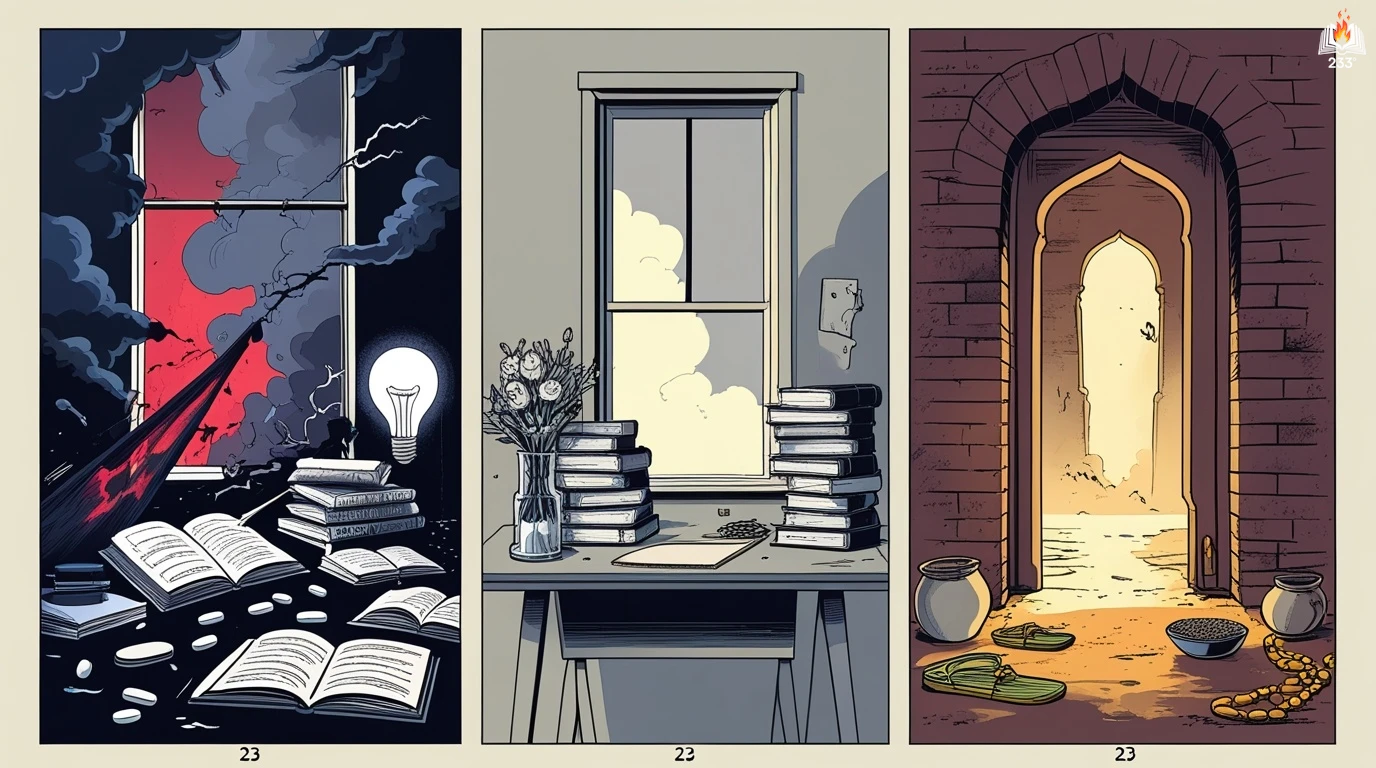
Middlesex by Jeffrey Eugenides, published in 2002, is a Pulitzer Prize-winning novel that traces the journey of Cal Stephanides, an intersex man born as Calliope in Detroit, Michigan, in 1960. Blending elements of Greek-American family saga, historical fiction, and a deeply personal coming-of-age narrative, Middlesex spans three generations of the Stephanides family, beginning in Asia Minor in the early 20th century and culminating in Cal’s personal reckoning with gender identity in contemporary America. With wit, lyricism, and emotional intensity, Eugenides explores the intersection of biology, identity, culture, and history through a unique lens.
Plot Summary
On a clear winter day in Detroit, 1960, a baby was born and named Calliope Helen Stephanides. She arrived wrapped in pink, declared a girl, and her family rejoiced. No one knew then that buried within her fifth chromosome lay a dormant secret – a genetic mutation passed silently from generation to generation, gathering strength across oceans, cultures, and lifetimes until it bloomed within her.
But before Calliope, there was Desdemona, tending her silkworms in the mountains above Bursa in Asia Minor, watching the silk shimmer and tighten like secrets about to snap. Desdemona, who could feel her heart stutter like a prophecy, lived beside her brother Lefty in a house steeped in the Old World, yet destined to unravel in the New. When war and exile swept through their village in 1922, the siblings fled the smoldering ruins of Smyrna aboard a ship to America. Bound by grief and an intimacy that had long since turned into something unspoken and forbidden, they made a decision in the shadows of the Atlantic – to marry and begin anew under different names, in a land where no one would know.
Detroit offered them anonymity. There they built a life of silkworms abandoned, coffee houses frequented, and American customs awkwardly learned. Desdemona never stopped mourning the sin of her union or watching for its consequences in her descendants. Her husband-brother Lefty found a strange kind of joy in the newness of things – jazz music, fast cars, and his experiments in American ambition.
Their son Milton, raised on Greek traditions and American dreams, married his cousin Tessie. They opened a diner, sold hot dogs, bought a pink house, and raised two children – Chapter Eleven, the boy who’d later bankrupt the family business, and Calliope, the girl with the long eyelashes and the dark, uncertain destiny.
In the warmth of the Stephanides home, Calliope grew tall and thin, shy and observant. She loved books, Latin, and her first taste of confusion – her attraction to a classmate she called the Obscure Object. At fourteen, her body remained stubbornly undeveloped. There were no curves where there should have been, no bleeding to signal womanhood’s arrival. Puzzled and concerned, her parents took her from doctor to doctor, until finally she arrived at the office of Dr. Peter Luce, a celebrated sexologist in New York. He probed her mind and body, read her diary like a sacred text, and concluded that Calliope should undergo surgery to become what everyone believed she already was – a girl.
But Calliope had read the same diary. She had seen in it not only confusion but clarity, not sickness but truth. In the dark of a hospital bathroom, she fled. With hair shorn and skirt exchanged for pants, she boarded a train west, leaving behind Calliope and stepping uncertainly into the skin of Cal.
From there began a journey that took him through the fringes of America – through peep shows and hippie communes, through lies told for survival and names invented on the spot. He moved like a shadow, trying on manhood, testing its weight and awkwardness, running from the idea that he was anything less than whole.
In San Francisco, Cal found a clinic where intersex people were not subjects but citizens. He was no longer a secret or an anomaly. There, amid the palm trees and fog, he accepted the name on his German driver’s license: Cal. With this name, he stitched together the two halves of himself – the girl who once was, the boy he had become.
Back in Detroit, years passed. The city changed. So did the people. Milton, stubborn and proud, died in a car chase with kidnappers during the city’s descent into violence. Tessie aged into a quiet woman who couldn’t look at her son without seeing the daughter she once dressed in pigtails. Desdemona, now an old widow, still lived in the attic with her parakeets, still praying, still fearing the judgment of God.
Cal returned home as a man, unrecognizable to the neighborhood, but still his mother’s child, still the bearer of the family’s strange and winding inheritance. He dug through old letters, questioned the silences of his childhood, and began to trace the genetic river that had shaped him – a single mutation, a recessive gene, carried from Desdemona and Lefty, hidden in their union, passed to Milton and Tessie, and then to him.
Through it all, Cal remained the product of many worlds – Greek and American, man and woman, past and present. His life spanned continents, genders, and decades, bound together not by certainty but by continuity. The body he lived in was both his history and his future, a map drawn in flesh and chromosomes, and in it he found peace.
In the end, the child born twice stood in the sun, forty-one years old, writing the story of how he came to be. And with each word he wrote, the silences of his ancestors softened, their burdens lessened, and a new lineage, not of secrecy but of truth, took root.
Main Characters
Cal (Calliope) Stephanides – The narrator and protagonist, born with 5-alpha-reductase deficiency, Cal is raised as a girl named Calliope until adolescence, when he discovers his intersex identity and transitions to life as a man. Intelligent, introspective, and often witty, Cal’s journey of self-discovery is as much about genetics and anatomy as it is about family legacy and cultural assimilation.
Desdemona Stephanides – Cal’s Greek grandmother, whose life is defined by superstition, guilt, and secrets. A silkworm farmer turned immigrant matriarch, Desdemona’s marriage to her brother Lefty and her anxiety over the family’s genetic fate shape the multigenerational arc of the novel.
Lefty Stephanides (Eleutherios) – Desdemona’s brother and husband, an eccentric, poetic soul with a taste for gambling and a flair for reinvention. His incestuous relationship with Desdemona becomes the cornerstone of the Stephanides family’s complex genetic legacy.
Tessie Stephanides – Cal’s mother, gentle and loving, yet emotionally guarded. Torn between modernity and tradition, Tessie navigates a strained marriage and complex family dynamics while raising her children in postwar Detroit.
Milton Stephanides – Cal’s father, an ambitious and entrepreneurial man whose American dream is epitomized by his hot dog business. Milton is proud, patriotic, and ultimately blind to some of the deeper fissures within his family.
Chapter Eleven – Cal’s older brother, who embodies the family’s Greek-American aspirations. Often comical and oblivious, Chapter Eleven’s nickname hints at future financial and personal troubles.
Dr. Peter Luce – A renowned sexologist who attempts to “diagnose” Calliope’s condition, representing the scientific establishment’s limitations and assumptions regarding gender and identity.
Theme
Gender Identity and Fluidity – Central to Middlesex is the exploration of gender beyond binaries. Cal’s journey challenges societal norms and emphasizes that gender is not purely determined by biology but also shaped by psychology, experience, and culture.
Nature vs. Nurture – The novel is a living experiment in this dichotomy. Eugenides uses Cal’s intersex condition to delve into the debate, showing how genetics and upbringing both inform identity.
Immigration and Assimilation – The Stephanides family’s emigration from Asia Minor to Detroit mirrors the transformation of identity over generations. Eugenides portrays the tension between preserving one’s heritage and embracing a new national identity.
Family and Secrets – Hidden truths – from Desdemona and Lefty’s incestuous marriage to the concealment of Cal’s condition – drive the narrative. Eugenides suggests that secrets shape, haunt, and ultimately define families.
Fate and Free Will – The novel often references Greek mythology and tragedy, particularly the concept of fate. Yet, Cal’s decisions represent a break from determinism, suggesting that identity is ultimately a matter of agency.
Science and Myth – Eugenides masterfully interlaces scientific discourse (genetics, endocrinology) with mythic storytelling, particularly in his frequent invocation of classical Greek epics, underscoring the timelessness of Cal’s quest.
Writing Style and Tone
Jeffrey Eugenides’s writing in Middlesex is richly textured, lyrical, and frequently intertextual. The narrative voice is marked by wit, intelligence, and an expansive historical consciousness. Cal’s first-person narration shifts seamlessly between detailed family history and philosophical introspection, often imbued with poetic flourishes and Homeric allusions. Eugenides’s use of nonlinear storytelling and the metafictional self-awareness of Cal as both narrator and subject give the novel an epic scope, despite its deeply intimate concerns.
The tone of the novel ranges from humorous and ironic to melancholic and reflective. Eugenides skillfully balances pathos and levity, particularly when navigating emotionally or morally complex terrain. Cal’s voice is deeply human—honest about pain, tender with memory, and unflinchingly candid. The blending of personal confession with mythic resonance creates a tonal depth that allows the novel to grapple with difficult subjects without losing warmth or clarity.
Quotes
Middlesex – Jeffrey Eugenides (2002) Quotes
“Biology gives you a brain. Life turns it into a mind.”
“It was one of those humid days when the atmosphere gets confused. Sitting on the porch, you could feel it: the air wishing it was water.”
“Can you see me? All of me? Probably not. No one ever really has.”
“I live my own life and nurse my own wounds. It's not the best way to live. But it's the way I am.”
“There was nowhere I could go that wouldn't be you.”
“Maybe the best proof that the language is patriarchal is that it oversimplifies feeling.”
“Everyone struggles against despair, but it always wins in the end. It has to. It's the thing that lets us say goodbye.”
“The essential matrimonial facts: that to be happy you have to find variety in repetition; that to go forward you have to come back to where you begin.”
“She understood that her heart operated on its own instructions, that she had no control over it or, indeed, anything else.”
“The mind self-edits. The mind airbrushes. It's a different thing to be inside a body than outside. From outside, you can look, inspect, compare. From inside there is no comparison.”
“But in the end it wasn't up to me. The bigs things never are. Birth, I mean, and death. And love. And what love bequeaths to us before we're born.”
“I was born twice: first, as a baby girl, on a remarkably smogless Detroit day in January of 1960; and then again, as a teenage boy, in an emergency room near Petoskey, Michigan, in August of 1974.”
“The only way we know it's true is that we both dreamed it. That's what reality is. It's a dream everyone has together.”
“So do boys and men announce their intentions. They cover you like a sarcophagus lid. And call it love.”
“I went into the desert to forget about you. But the sand was the color of your hair. The desert sky was the color of your eyes. There was nowhere I could go that wouldn't be you.”
“Regret, already sogging me down, burst its dam. It seeped into my legs, it pooled in my heart.”
“Whereas I, even now, persist in believing that these black marks on white paper bear the greatest significance, that if I keep writing I might be able to catch the rainbow of consciousness in a jar.”
“It's often said that a traumatic experience early in life marks a person forever, pulls her out of line, saying, "Stay there. Don't move.”
“Emotions, in my experience, aren't covered by single words. I don't believe in "sadness", "joy", or "regret". Maybe the best proof that the language is patriarchal is that is oversimplifies feeling. I'd like to have at my disposal complicated hybrid emotions.”
“The Statue of Liberty's gender changed nothing. It was the same here as anywhere: men and their wars.”
“Planning is for the world's great cities, for Paris, London, and Rome, for cities dedicated, at some level, to culture. Detroit, on the other hand, was an American city and therefore dedicated to money, and so design had given way to expediency.”
“You used to be able to tell a person's nationality by the face. Immigration ended that. Next you discerned nationality via the footwear. Globalization ended that.”
“This can't be true but I remember it.”
We hope this summary has sparked your interest and would appreciate you following Celsius 233 on social media:
There’s a treasure trove of other fascinating book summaries waiting for you. Check out our collection of stories that inspire, thrill, and provoke thought, just like this one by checking out the Book Shelf or the Library
Remember, while our summaries capture the essence, they can never replace the full experience of reading the book. If this summary intrigued you, consider diving into the complete story – buy the book and immerse yourself in the author’s original work.
If you want to request a book summary, click here.
When Saurabh is not working/watching football/reading books/traveling, you can reach him via Twitter/X, LinkedIn, or Threads
Restart reading!