Fire and Blood by George R.R. Martin, published in 2018, is a historical account of the Targaryen dynasty in Westeros. Set 300 years before the events of A Song of Ice and Fire, it offers a richly detailed chronicle of the Targaryen kings and queens, their conquests, conflicts, and intrigues. Written as a pseudo-history by an archmaester, the book spans from Aegon the Conqueror’s unification of the Seven Kingdoms to the early stages of the Dance of the Dragons, presenting the rise and struggles of the legendary dragonlords.
Plot Summary
Aegon Targaryen stood on the shores of Westeros, flanked by his sister-wives, Visenya and Rhaenys, and their mighty dragons, Balerion, Vhagar, and Meraxes. From the volcanic isle of Dragonstone, they gazed upon a fractured land of seven quarrelsome kingdoms. Aegon’s ambitions soared higher than any dragon could fly. He sought not a corner of the realm but the entirety of Westeros, united under one throne of fire and blood. With a handful of loyal bannermen and the iron will of his siblings, he declared himself king, sending ravens far and wide to herald the rise of a new ruler. Those who knelt were spared; those who resisted faced ruin.
The wars began with blood and flame. Harren the Black, a tyrant who ruled the riverlands from the towering halls of Harrenhal, scoffed at Aegon’s demands. His fortress, he boasted, could withstand any assault. Yet stone, for all its strength, was no match for dragonfire. Balerion’s black flames consumed Harrenhal, melting its grand towers and reducing Harren’s line to ashes. To the south, Argilac the Arrogant, last of the Storm Kings, rode out to meet Aegon’s forces in open battle. Though a seasoned warrior, his armies faltered before the might of dragon and steel. He died with his sword in hand, and his lands passed to Orys Baratheon, Aegon’s trusted general and rumored half-brother.
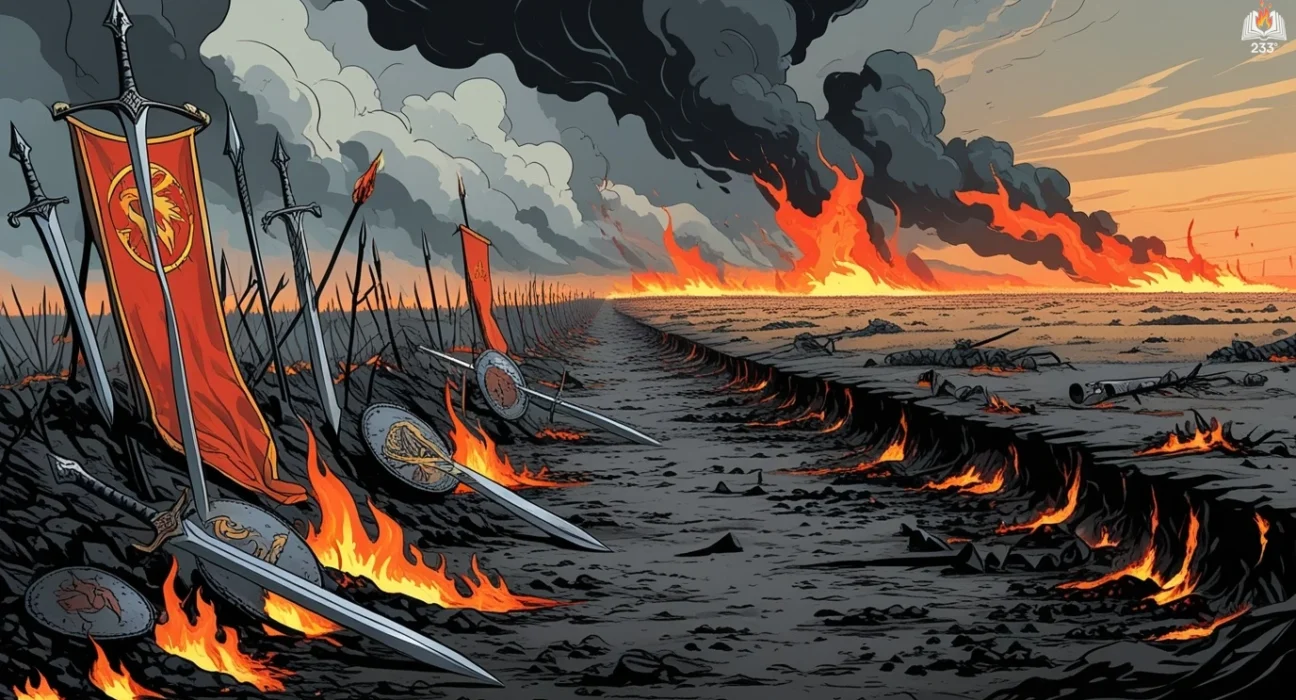
The conquest marched onward. In the Field of Fire, the combined forces of the Reach and the Westerlands, commanded by King Mern Gardener and King Loren Lannister, challenged Aegon’s smaller host. The dragons descended, their flames turning the dry grasses into an inferno that engulfed thousands. King Mern perished with his kin, ending House Gardener’s ancient rule. King Loren bent the knee, earning his life and his lands as Warden of the West.
In the North, King Torrhen Stark, faced with tales of dragonfire and the smoldering ruins of Harrenhal, chose caution over valor. He knelt before Aegon on the banks of the Trident, earning the title “the King Who Knelt” but sparing his people the wrath of dragons. To the east, Visenya ascended to the lofty heights of the Eyrie, where the young King Ronnel Arryn eagerly bent the knee, dazzled by the sight of a dragon. Only Dorne defied conquest. Rhaenys flew to Sunspear, where Princess Meria Martell refused to submit, vowing that her people would not bow to fire or blood.
With the unification of much of Westeros, Aegon established his seat of power at King’s Landing, a city rising from humble fishing huts on the Blackwater. Here, atop Aegon’s High Hill, he forged the Iron Throne from the swords of his defeated foes, a seat of power as sharp and unyielding as the rule it symbolized. Yet, peace proved elusive. In the years following the conquest, rebellions erupted. The Three Sisters declared independence, pirates threatened the coasts, and the Dornish remained defiant.
The First Dornish War was a bitter and protracted conflict. Aegon, his queens, and his armies marched through the burning deserts, finding only empty castles and poisoned wells. The Dornish lords had vanished into the sands, emerging only to harass and ambush. Rhaenys returned to the Hellholt, where her dragon Meraxes fell to a scorpion bolt. Rhaenys herself was either killed or captured, her fate shrouded in mystery. Though Aegon burned Dornish strongholds in retaliation, he could not break their spirit. The war dragged on for years, a cycle of raids, retaliations, and assassination.
Amidst the chaos of expansion, the Targaryens faced challenges from within. The rule of Aegon’s successors was marked by triumphs and tragedies. His son, Aenys I, lacked his father’s strength and struggled to quell uprisings. Aenys’s half-brother, Maegor the Cruel, seized the throne with brute force, ruling through terror. Though he completed the Red Keep and enforced the construction of the Dragonpit, his reign left scars on the realm.
The rise of King Jaehaerys I marked a period of peace and prosperity. Known as the Conciliator, Jaehaerys mended the fractures of Maegor’s rule, rebuilt alliances, and strengthened the realm. Alongside his queen, Alysanne, he implemented reforms that benefited both lords and smallfolk. Their reign brought stability, yet not without personal losses, as they endured the deaths of their children, each one a blow to their legacy.
The latter years of Targaryen rule chronicled in the text reveal the seeds of discord that would culminate in civil war. The question of succession haunted the dynasty, particularly under King Viserys I. Though he named his daughter Rhaenyra as heir, the birth of a son to his second wife fractured the realm. Upon Viserys’s death, the rival claims of Rhaenyra and her half-brother Aegon II erupted into the Dance of the Dragons. This brutal civil war saw dragon pitted against dragon, family torn asunder, and the land scarred by fire and blood.
By its end, the Targaryen dynasty was diminished. Dragons, once symbols of their might, were all but extinct, and their dominion over Westeros, though intact, had grown fragile. The survivors of the Dance inherited a realm wary of their rule, their throne a precarious seat atop the ashes of war.
The chronicle concludes not with the end of the Targaryens, but with a portrait of their enduring impact. They shaped the history of Westeros, leaving behind a legacy of ambition, conquest, and tragedy. The Iron Throne they forged remained a symbol of power, a testament to their rise and fall, and a warning of the cost of ruling with fire and blood.
Main Characters
- Aegon I Targaryen (The Conqueror): The first Targaryen king of Westeros, he unifies the Seven Kingdoms through conquest. His enigmatic leadership is marked by both ruthlessness and mercy.
- Visenya Targaryen: Aegon’s stern, warrior queen sister-wife, known for her skill in combat and rumored to dabble in dark arts. She wields the Valyrian sword, Dark Sister.
- Rhaenys Targaryen: Aegon’s other sister-wife, playful and adventurous, who loves flying her dragon Meraxes and exploring the unknown. Her charisma contrasts with Visenya’s austerity.
- Jaehaerys I Targaryen: Known as the “Conciliator,” his long reign is characterized by peace, prosperity, and the strengthening of the realm.
- Rhaenyra Targaryen: A central figure in the Dance of the Dragons, her ambition and claim to the throne ignite a devastating civil war.
- Daemon Targaryen: A fiery and unpredictable prince, often at odds with convention, whose actions play a significant role in Targaryen politics and conflict.
Theme
- Power and Legacy: The book explores the burden of ruling and the ways Targaryens wield power through dragons, marriage, and warfare to maintain their legacy.
- Conflict and Division: From external conquests to internal strife like the Dance of the Dragons, the Targaryen dynasty’s history is shaped by ambition and betrayal.
- Tradition vs. Change: The Targaryens’ Valyrian customs often clash with Westerosi traditions, creating tension in their rule.
- The Role of Dragons: Dragons are both a symbol of power and a destructive force, pivotal in shaping the Targaryens’ rise and their eventual downfall.
- Historical Bias: The narrative underscores the unreliable nature of history, as events are filtered through the perspectives of biased maesters and chroniclers.
Writing Style and Tone
Martin’s writing emulates a medieval chronicler, blending formal historical prose with vivid storytelling. He employs in-world sources like maesters’ accounts, folklore, and court gossip to construct a layered narrative, rich in ambiguity and subjective interpretations. The tone oscillates between objective historical reporting and evocative dramatization of key events, often leaving readers to decipher the truth amidst conflicting accounts.
Martin’s meticulous attention to world-building, including elaborate descriptions of political intrigue, battles, and cultural details, immerses the reader in the grandeur and tragedy of the Targaryens’ story. His use of irony and subtle humor adds depth, especially when exploring the contradictions and follies of the powerful.
Quotes
Fire and Blood – George RR Martin (2018) Quotes
“Then the storm broke, and the dragons danced.”
“A ruler needs a good head and a true heart,” she famously told the king. “A cock is not essential.”
“Words are wind, but wind can fan a fire. My father and my uncle fought words with steel and flame. We shall fight words with words, and put out the fires before they start.”
“The seeds of war are oft planted during times of peace.”
“Only you could have won me away from the sea. I came back from the ends of the earth for you.”
“I fed my last husband to my dragon. If you make me take another, I may eat him myself.”
“The vilest of men and the wickedest of women likewise may do good from time to time, for love and compassion and pity may be found in even the blackest of hearts.”
“The Iron Throne will go to the man who has the strength to seize it.”
“We are as the gods made us. Strong and weak, good and bad, cruel and kind, heroic and selfish. Know that if you would rule over the kingdom of men.”
“Thrones are won with swords, not quills. Spill blood, not ink.”
“Let no man think that the fire of the Targaryens did not burn in his veins.”
“It was a time for warm embraces, for smiles, for toasts and reconciliations, for renewing old friendships and making new ones, for laughter and kisses. It was a good time, a golden autumn, a time of peace and plenty. But winter was coming.”
“I will not fight you,” Princess Meria told Rhaenys, “nor will I kneel to you. Dorne has no king. Tell your brother that.” “I shall,” Rhaenys replied, “but we will come again, Princess, and the next time we shall come with fire and blood.”
“They call me Baelon the Brave,” the prince told his wife at her bedside, “but I would sooner fight a dozen battles than do what you’ve just done.”
“Surely the Mother Above loved my children more. She took so many of them away from me.”
“Such a fierce little thing she is, they say, she has no need of comfort. They are wrong in that, I fear. All men need comfort.”
“The next morning the sea was calm again, the sun was shining, and the water was so blue and innocent a man might never know that under it my brother floated, dead with all his men.”
“When the gods are silent, lords and kings will make themselves heard.”
“Will you not weep?” “I do not have the time for tears.”
“This is a night for song and sin and drink, for come the morrow, the virtuous and the vile burn together.”
“It is always winter now.”
“A twisted spine condemned him to walk with a limp, but as he said famously, “I do not limp when I read, nor when I write.”
“Pride goes before a fall.”
“Brother, you need never kneel to me again. We shall rule this realm together, you and I.”
“The Queen Who Never Was; what did Viserys ever have that she did not? A little sausage? Is that all it takes to be a king? Let Mushroom rule, then. My sausage is thrice the size of his.”
“Familiarity is the father of acceptance.”
“Yet unbeknownst to all but a few, storm clouds were gathering on the horizon, and faintly in the distance wise men could hear a rumble of thunder.”
“The Father made men curious, some say to test our faith. It is my own abiding sin that whenever I come upon a door I must needs see what lies upon the farther side, but certain doors are best left unopened.”
We hope this summary has sparked your interest and would appreciate you following Celsius 233 on social media:
There’s a treasure trove of other fascinating book summaries waiting for you. Check out our collection of stories that inspire, thrill, and provoke thought, just like this one by checking out the Book Shelf or the Library
Remember, while our summaries capture the essence, they can never replace the full experience of reading the book. If this summary intrigued you, consider diving into the complete story – buy the book and immerse yourself in the author’s original work.
If you want to request a book summary, click here.
When Saurabh is not working/watching football/reading books/traveling, you can reach him via Twitter/X, LinkedIn, or Threads
Restart reading!