The Year of the Flood (2009) by Margaret Atwood is the second installment in the MaddAddam trilogy, which explores a world devastated by ecological collapse and a pandemic called the “Waterless Flood.” It follows the lives of survivors tied to God’s Gardeners, a religious-ecological group, as they navigate the aftermath of societal downfall. This novel interweaves with events from Oryx and Crake (2003), the first book in the trilogy, and sets the stage for the conclusion in MaddAddam (2013), offering a multifaceted exploration of humanity’s resilience, folly, and connection.
Plot Summary
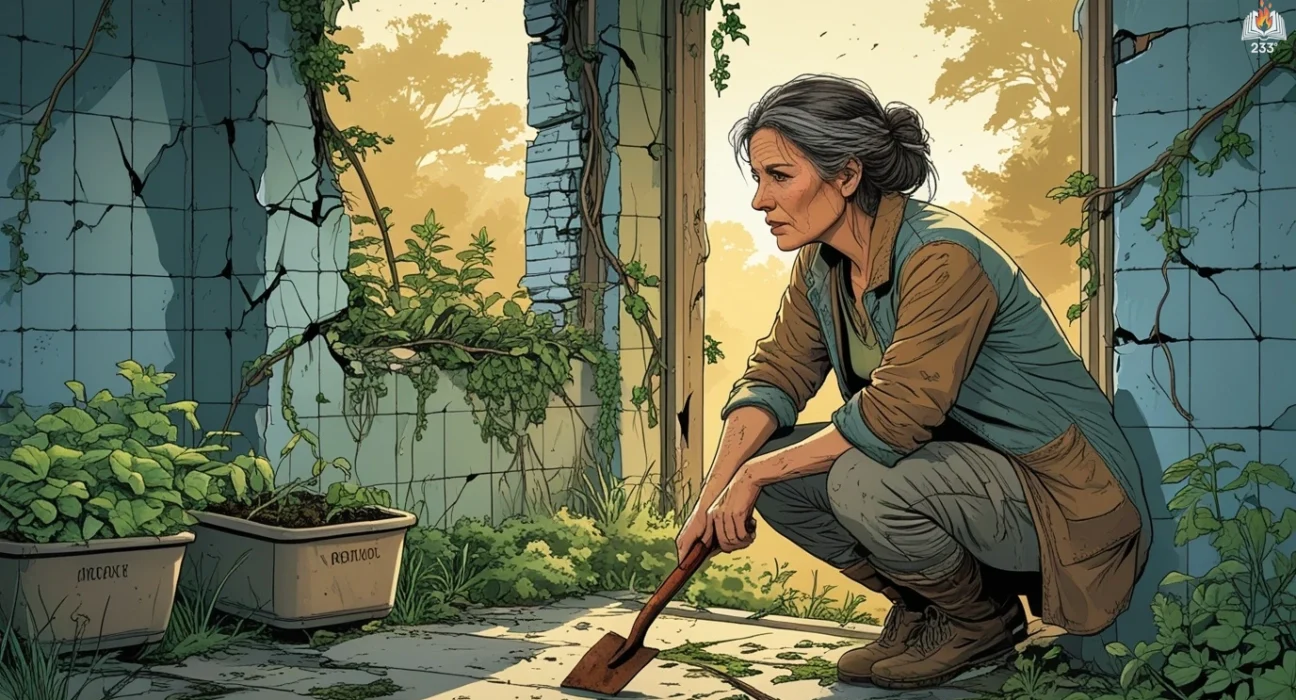
The world is unrecognizable, ravaged by the “Waterless Flood,” a pandemic that has swept away much of humanity, leaving behind ruins where nature begins to reclaim its dominion. In this desolate landscape, two women endure, their lives intertwined by a past bound to God’s Gardeners, a peculiar religious sect devoted to ecological harmony. The first is Toby, hardened by years of suffering and survival, who now fortifies herself in an abandoned spa, watching the world outside with wary eyes. The second is Ren, trapped in a quarantine chamber at a sex club, her fragile hope sustained by memories of her childhood among the Gardeners and the friendships she once cherished.
Toby’s survival has been a hard-fought battle. Once an ordinary young woman, her life spiraled into chaos when her family fell victim to corporate greed and personal tragedy. Fleeing predators and exploitation, she eventually found refuge with God’s Gardeners, where she learned to tend the earth, heal with herbs, and revere the fragile balance of life. The Gardeners, led by the enigmatic and philosophical Adam One, preached ecological stewardship and warned of an impending cataclysm—the Flood—that would sweep away the corrupt and unworthy. Toby, pragmatic and skeptical, absorbed their lessons but never fully embraced their spiritual convictions. Even as she grew to admire their dedication, she remained on the periphery, her inner walls shielding her from full faith.
Ren, on the other hand, came to the Gardeners as a child, brought there by her mother after a failed relationship. Among the rooftop gardens and hymn-singing disciples, she found solace and companionship, particularly in her friendship with Amanda, a daring and free-spirited girl who later left the group to forge her own path. Ren’s life took her far from the Gardeners, leading her to work at the upscale Scales and Tails club, where she performed for wealthy clients while keeping a guarded distance from the exploitative undercurrents of her profession. When the pandemic struck, she was isolated in the club’s sterile quarantine zone, an unintentional blessing that saved her life.
As the narrative unfolds, past and present intertwine, revealing the struggles that shaped these women and their connection to the larger tapestry of survival. Toby, entrenched in her spa refuge, relies on the skills she honed with the Gardeners. She tends a makeshift garden and watches the encroaching wilderness, haunted by memories of the sect’s teachings and the faces of those she once knew—Adam One, the wise leader; Pilar, the nurturing beekeeper; and Zeb, the pragmatic and mysterious man who alternately inspired and unsettled her.
Ren, confined in her glass-bricked room, reflects on her youth and the lessons of the Gardeners, whose foresight now seems prophetic. Her friendship with Amanda remains a lifeline, even in memory, as she waits for a rescue that may never come. Amanda herself is not far away, navigating the post-pandemic world with courage and cunning, her resourcefulness honed by years of living on the margins.
The remnants of society, fractured and desperate, take many forms. There are the Painballers, violent men who survived gladiatorial corporate punishment and now roam as feral predators, embodying the collapse of civilization’s moral core. Corporations and genetic engineering have left their marks, creating strange hybrid creatures like the rakunks and luminous green rabbits that populate this new, wild world. Amid this chaos, Toby encounters Zeb, who becomes a source of tentative camaraderie and shared purpose. Together, they face the persistent threats that lurk in the shadows—both human and nonhuman.
Ren’s plight takes a turn when Amanda, accompanied by two former God’s Gardeners, finds her trapped in the club. The reunion is bittersweet, as the world outside offers little comfort, but their bond strengthens their resolve. As they navigate this perilous new existence, they encounter Painballers, whose savagery poses a dire threat. Ren and Amanda’s resilience is tested to its limits, but they cling to the lessons of their past and their belief in the possibility of renewal.
For Toby, the Gardeners’ teachings linger, shaping her actions and providing moments of solace. Adam One’s sermons, once dismissed as quaint or overly idealistic, now resonate with the stark reality of a world undone by humanity’s hubris. Even as she fights for survival, she plants seeds—literal and metaphorical—nurturing the possibility of life and hope amidst the ruins.
In this broken world, the surviving Gardeners find one another, their community fragile but enduring. The resilience they cultivated in their faith and practices helps them rebuild, one small step at a time. In a landscape where the remnants of humanity are scattered and scarred, their unity becomes a beacon, however faint, against the darkness.
As the story closes, nature’s inexorable reclamation continues. The Gardeners’ hymns echo faintly in the memories of those who once sang them, blending with the rustle of leaves and the calls of hybrid creatures in the growing wild. The survivors persist, carrying the seeds of renewal within them, even as the shadow of the Flood lingers on the horizon.
Main Characters
Toby: A resilient, resourceful survivor who has endured great personal loss and abuse. Formerly a member of the God’s Gardeners, she adapts to post-pandemic life with determination, balancing her pragmatic instincts with lingering traces of the Gardeners’ teachings.
Ren: A former member of God’s Gardeners, Ren is an empathetic and introspective character. She is trapped in quarantine at a sex club when the pandemic hits, her journey one of reconnection and rediscovery.
Adam One: The charismatic leader of God’s Gardeners. Adam One is philosophical and kind, embodying the group’s spiritual mission and ecological values.
Zeb: A rugged and enigmatic figure who straddles the line between the pragmatic and the idealistic. Zeb provides physical and moral support to the group and becomes a key player in their survival.
Amanda: Ren’s close friend, a practical and courageous character who faces significant dangers but remains fiercely loyal.
Theme
Environmental Degradation: The novel highlights humanity’s destructive impact on the planet, from genetic engineering to climate change, urging a return to ecological balance.
Religion and Morality: Through God’s Gardeners, Atwood explores spirituality, blending ecological activism with religious doctrine, and questioning humanity’s ethical compass.
Survival and Resilience: In the aftermath of the pandemic, characters navigate a harsh new world, showcasing the adaptability and strength needed to endure.
The Dangers of Scientific Hubris: The novel critiques unchecked genetic engineering and corporate greed, portraying them as catalysts for the pandemic and societal collapse.
Isolation and Connection: The pandemic forces characters into isolation, but their journeys also reflect the human need for community and belonging.
Writing Style and Tone
Margaret Atwood employs a richly layered narrative style, interweaving multiple timelines and perspectives. Her prose is vivid, blending poetic descriptions of nature with stark, often grotesque depictions of societal decay. The story alternates between introspective monologues, religious hymns from God’s Gardeners, and moments of sharp dialogue, creating a tapestry that reflects the complexity of the world she builds.
The tone is a mix of satirical, somber, and hopeful. Atwood critiques human failings with biting wit but tempers it with moments of tenderness and redemption. The contrast between the beauty of the natural world and the grotesque consequences of humanity’s excesses deepens the narrative’s impact.
Quotes
The Year of the Flood – Margaret Atwood (2009) Quotes
“What am I living for and what am I dying for are the same question.”
“You can forget who you are if you're alone too much.”
“Maybe that's what love is, I thought: it's being pissed off.”
“...we must be a beacon of hope, because if you tell people there's nothing they can do, they will do worse than nothing.”
“Human understanding is fallible, and we see through a glass, darkly. Any religion is a shadow of God. But the shadows of God are not God.”
“Remember,' she'd tell her staff, 'every customer wants to feel like a princess, and princesses are selfish and overbearing.”
“How easy it is, treachery. You just slide into it.”
“Without the light, no chance; without the dark, no dance.”
“Amazing how the heart clutches at anything familiar, whimpering Mine!Mine!”
“We shouldn't have been so scornful; we should have had compassion. But compassion takes work, and we were young.”
“She said love was useless, because it led you into dumb exchanges in which you gave too much away, and then you got bitter and mean.”
“Why are we designed to see the world as supremely beautiful just as we're about to be snuffed? Do rabbits feel the same as the fox teeth bite down on their necks? Is it mercy?”
“Maybe sadness was a kind of hunger, she thought. Maybe the two went together.”
“As with all knowledge, once you knew it, you couldn't imagine how it was that you hadn't known it before. Like stage magic, knowledge before you knew it took place before your very eyes, but you were looking elsewhere.”
“Now I can see how that can happen. You can fall in love with anybody--a fool, a criminal, a nothing. There are no good rules.”
“Mushrooms were the roses in the garden of that unseen world, because the real mushroom plant was underground. The parts you could see - what most people called a mushroom - was just a brief apparition. A cloud flower.”
“I'm fine," said Pilar, "for the moment. And the moment is the only time we can be fine in.”
“You couldn’t leave words lying around where our enemies might find them.”
“If you really want to stay the same age you are now forever and ever, she'd be thinking, try jumping off the roof: death's a sure-fire method for stopping time.”
“But reality has too much darkness in it. Too many crows”
“She knows she's deceiving herself about that, but she prefers to deceive herself. She desperately needs to believe such pure joy is still possible.”
“It's better to hope than mope!”
“Thus the time passed. Toby stopped counting it. In any case, time is not a thing that passes, said Pilar: it’s a sea on which you float.”
“The Adams and the Eves used to say, We are what we eat, but I prefer to say, we are what we wish. Because if you can't wish, why bother?”
“Hunger is the best sauce.”
We hope this summary has sparked your interest and would appreciate you following Celsius 233 on social media:
There’s a treasure trove of other fascinating book summaries waiting for you. Check out our collection of stories that inspire, thrill, and provoke thought, just like this one by checking out the Book Shelf or the Library
Remember, while our summaries capture the essence, they can never replace the full experience of reading the book. If this summary intrigued you, consider diving into the complete story – buy the book and immerse yourself in the author’s original work.
If you want to request a book summary, click here.
When Saurabh is not working/watching football/reading books/traveling, you can reach him via Twitter/X, LinkedIn, or Threads
Restart reading!