1Q84, written by Haruki Murakami and originally published in Japan in 2009-2010 in three volumes, is a surreal, genre-bending literary work that blends elements of speculative fiction, alternate realities, and romantic mystery. Set in Tokyo in 1984, the novel follows two seemingly unconnected characters – a fitness instructor turned assassin and a math teacher turned ghostwriter – as they navigate a world subtly transformed by a hidden reality they call “1Q84.” The book stands as one of Murakami’s most ambitious narratives, evoking the psychological complexity and metaphysical intrigue found in his earlier works, such as Kafka on the Shore and The Wind-Up Bird Chronicle.
Plot Summary
The traffic had stopped long ago on the elevated expressway above Tokyo, and time itself seemed to join it in stillness. A woman named Aomame sat in a Toyota Crown Royal Saloon, lulled by the haunting brass of Janáček’s Sinfonietta. Her high heels pressed softly against the floor as she studied the cab’s quietness, its unnatural calm. The driver, peculiar in his pauses and words, suggested an emergency stairwell – a hidden passage off the gridlocked road, down to the world below. He warned her gently before she stepped out, his voice marked by knowing: once she descended, things might not look the same.
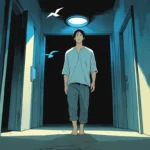
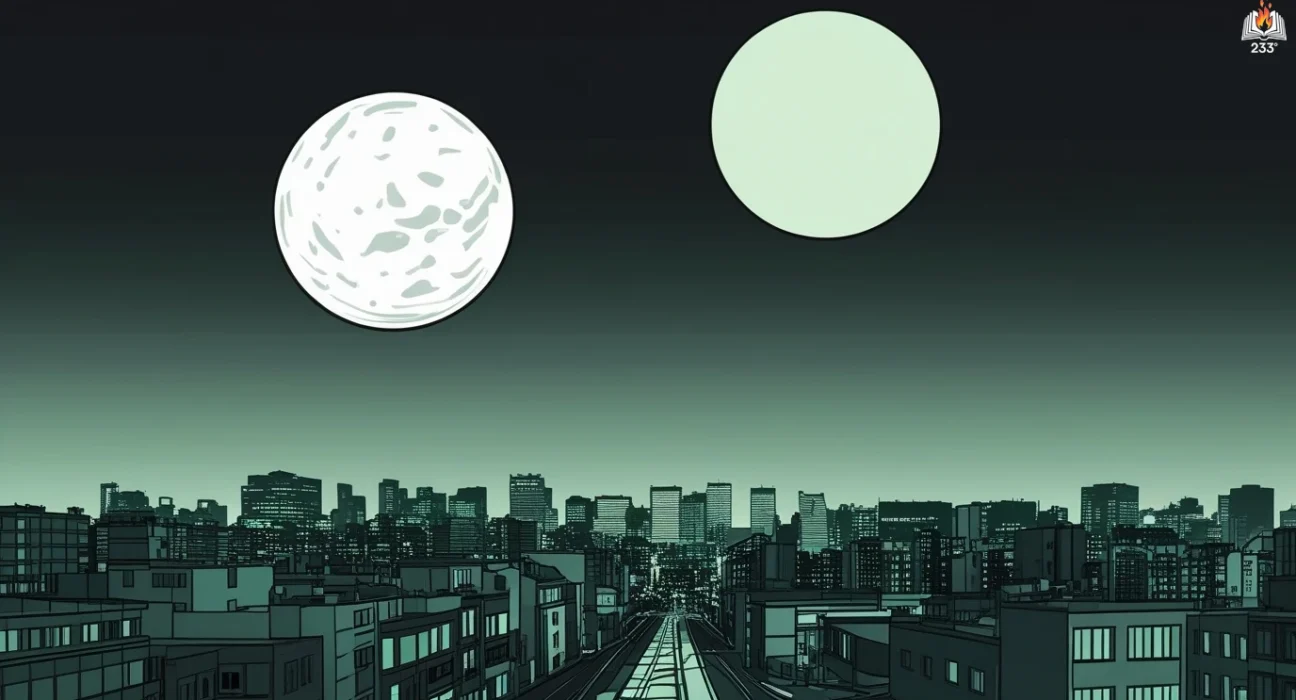
She climbed down barefoot, slipping out of one world and into another that resembled 1984, yet trembled with small distortions. Tokyo still bustled, trains still arrived, and schoolchildren still crossed streets with satchels bouncing on their backs, but now the sky held two moons – one bright and round, the other smaller and greenish, as if a secret eye had opened. Somewhere in this altered reality, a man named Tengo Kawana lived quietly. He taught mathematics in a cram school, wrote fiction in solitude, and carried within him the weight of a memory – of a girl’s hand held tightly in his own when he was ten.
Tengo’s life curved in a new direction when Komatsu, a chain-smoking editor with a taste for manipulation, approached him with a proposal. A strange manuscript titled Air Chrysalis, written by a 17-year-old girl named Fuka-Eri, had landed on his desk. It was raw and unpolished, but powerful. Tengo was to rewrite it, ghostwrite it, breathe shape into its strange rhythms while the world believed Fuka-Eri to be its sole author. He hesitated, then agreed, drawn not only by the editor’s cunning logic but by the inexplicable force within the manuscript’s dreamlike core.
Fuka-Eri, with her flat, expressionless tone and quiet beauty, lived under the guardianship of Professor Ebisuno. Once, she had belonged to a commune called Sakigake – a religious group with a secretive past. She had fled it in silence, bringing with her memories of little men with round faces and the sinister work of hidden forces. Air Chrysalis was no fiction, she insisted. The Little People were real. What seemed metaphor in her words pulsed with strange truth.
As Tengo rewrote the tale, reality quivered. He began to sense changes not only in the world outside but within himself. In the world of 1Q84, time bent softly, and memory carried the texture of dream. He wandered through each day with heightened awareness, the two moons above marking him like distant watchers. Aomame, too, found herself shifting. Her work with the dowager – a wealthy woman sheltering abused women – had led her to become an elegant assassin, methodical and precise. Her latest mission: eliminate the Leader of Sakigake, a man whose followers believed he could channel the Little People and whose actions had twisted the lives of young girls.
In a private, soundproofed apartment high above the city, she waited with a needle in hand, masked in calm. The Leader arrived, knowing who she was and what she intended to do. He welcomed it. His body ached from within, and the voices of the Little People buzzed too loudly. Aomame carried out the act, but his last words hinted at a link beyond death – a bond that pulled the threads of her fate and Tengo’s tighter than before.
Now hunted by Sakigake, Aomame vanished from the visible world, secluding herself in a hidden safe house provided by the dowager. She watched the moons through her window, her body hollow with waiting. Each day passed with Tengo’s image growing sharper in her thoughts, his hand held in a memory from long ago. In the same invisible rhythm, Tengo found himself being watched, followed, interrogated by the grotesque yet clever private investigator Ushikawa, who had been tasked by Sakigake to trace the link between Air Chrysalis and the Leader’s death.
Ushikawa pieced together the web slowly – Fuka-Eri, the manuscript, Tengo, Aomame – but he worked too close to the truth. Tengo’s quiet defiance, Aomame’s invisibility, and the looming gaze of the Little People circled him. One night, in his temporary apartment filled with cigarette smoke and photos pinned to corkboards, Ushikawa was met by silent visitors. The shadows moved. The air grew heavy. He was erased without trace.
Tengo returned to his hometown, called by the failing health of his estranged father. The old man, once a cold and distant NHK fee collector, lay comatose in a sanatorium. In the quiet of that sterile room, Tengo felt the final severance of a lifeline he had never known how to hold. Grief unfolded in a slow, abstract wave. When he left, the air outside felt sharper, his footsteps heavier. The path forward curved toward the place Aomame waited.
In her hidden shelter, Aomame began to feel the tug of life – of something forming within her. She was pregnant, though she had not lain with anyone. The new reality did not move by old rules. The child inside her, she knew, belonged to Tengo, born of a deeper connection, written into them by the force that governed this shadowed version of the world. She waited, and he searched.
Eventually, the lines they had drawn through time and space crossed. On a quiet night in Tokyo, Aomame and Tengo found each other again. No longer children, they held hands as they once had. The moons glowed above them, both present still, both silent. A door had opened, and behind it, a world that pulsed with strange laws and hidden forces still turned. But hand in hand, the pull of gravity felt different. With each step, they moved further from 1Q84 and closer to a world where perhaps only one moon waited – but where they could begin again.
Main Characters
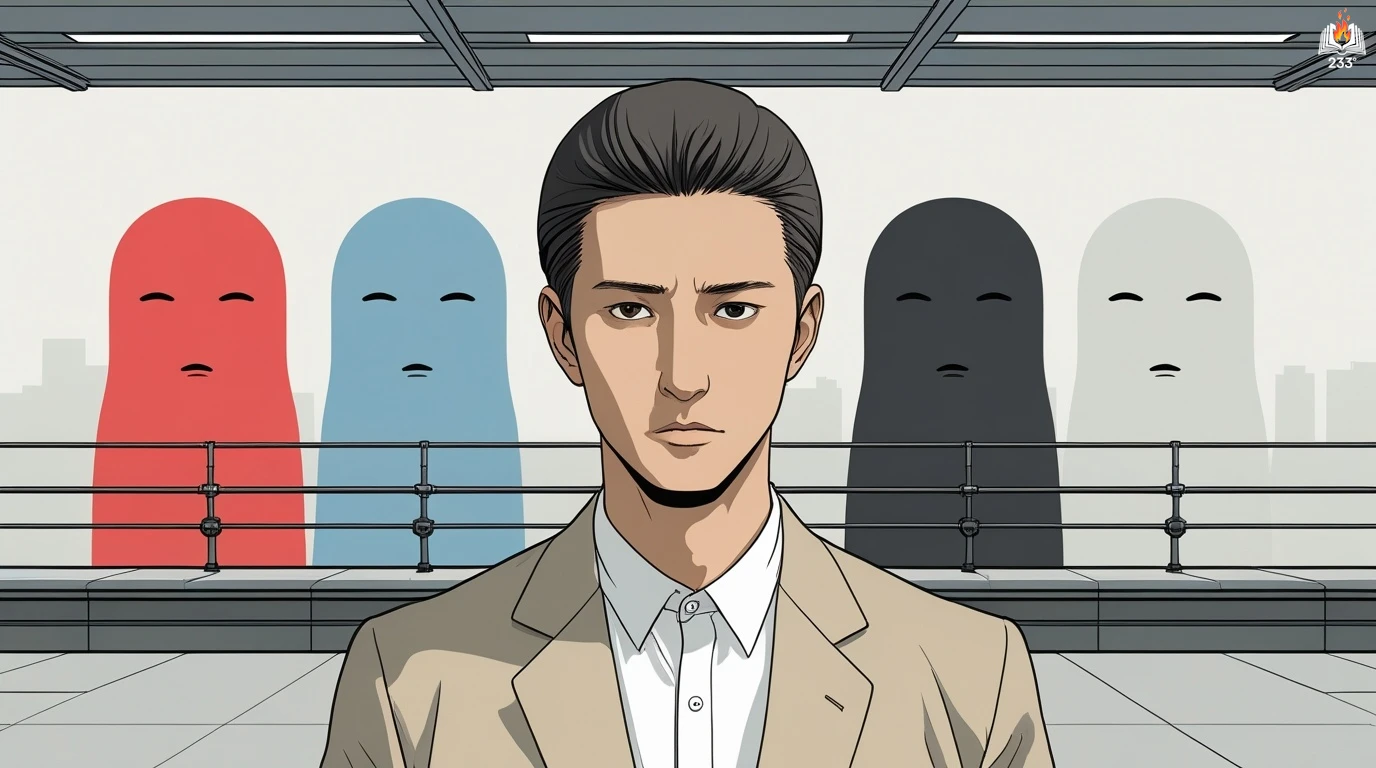
Aomame – A 30-year-old fitness instructor who moonlights as an assassin targeting abusive men. She is calm, precise, and deeply introspective. Haunted by her painful past and the emotional void in her life, Aomame’s journey through the strange parallel reality of “1Q84” becomes a quest not only for survival but for spiritual and emotional reunion with a long-lost childhood connection.
Tengo Kawana – A quiet, physically imposing math teacher and aspiring novelist. Tengo’s life changes dramatically when he’s asked to rewrite a strange and powerful manuscript by a mysterious girl. He becomes entangled in a web of deception, metaphysical tension, and suppressed memories, all while struggling to understand his recurring childhood vision of a girl he once held hands with in school.
Fuka-Eri (Eriko Fukada) – A 17-year-old enigmatic girl with a flat, affectless speech and a haunting past. She is the original author of the manuscript Air Chrysalis, which becomes the spark for the story’s unfolding mystery. Fuka-Eri grew up in a religious cult called Sakigake, and her escape from it and cryptic knowledge of hidden forces suggest she may be more conduit than creator.
Komatsu – An unscrupulous literary editor who recruits Tengo to secretly rewrite Air Chrysalis. Witty, cynical, and manipulative, Komatsu operates in moral gray zones, pushing others into ethically dubious situations while shielding himself with plausible deniability.
Leader – The terrifying yet serene head of the cult Sakigake. He possesses unsettling psychic powers and a disturbing connection to the Little People – mysterious entities central to the alternate world’s mythology.
Ushikawa – A grotesquely unattractive yet sharp private investigator hired by Sakigake. Though repulsive in appearance and morally flexible, Ushikawa is intelligent and thorough, becoming a third narrative lens in the final third of the novel.
Theme
Alternate Reality and the Nature of Truth: The concept of “1Q84” as a subtly altered version of 1984 explores how reality can be subjective and unstable. As Aomame and Tengo step into this world, the presence of two moons and other anomalies prompt deep questions about perception, belief, and the hidden layers of existence.
Loneliness and Human Connection: A profound sense of isolation pervades the lives of Aomame and Tengo. Their separate paths through the labyrinthine plot are driven by a shared yearning for genuine connection – not with the world, but with each other. The emotional resonance of their distant bond forms the story’s heart.
Power, Control, and Resistance: The secretive cult Sakigake, the manipulation by the Little People, and the rewriting of a manuscript all reflect struggles for power – both external and internal. Murakami poses questions about authoritarian control, fate versus free will, and the costs of passive complicity.
The Supernatural and the Unseen: From invisible entities like the Little People to dreamlike memories and parallel timelines, the novel repeatedly introduces supernatural elements that blur the line between reality and imagination. These forces shape the world of 1Q84 and challenge the characters’ sanity and choices.
The Written Word as Portal: Literature itself becomes a mystical act in 1Q84. The rewriting of Air Chrysalis alters reality, underscoring the power of stories to transform both personal lives and entire worlds. Writing and memory merge into a metaphysical key unlocking hidden truths.
Writing Style and Tone
Murakami’s writing in 1Q84 is calm, hypnotic, and methodical, with a rhythmic precision that reflects the internal lives of his characters. His prose often dwells on mundane details – meals cooked, clothes worn, streets walked – to build an atmosphere where the surreal feels entirely plausible. This deliberate pacing gives the narrative a dreamlike quality, as though the reader is slowly slipping into another dimension with the characters. Dialogue is sparse and often elliptical, especially when involving Fuka-Eri or the Little People, enhancing the novel’s eerie tension.
The tone oscillates between detached observation and aching emotional intimacy. Murakami captures alienation with quiet poignancy and infuses even the strangest scenes with psychological realism. At times chilling and other times tender, the book sustains a sense of suspense by layering philosophical introspection over a slowly tightening plot. Repetition is used as a stylistic tool – phrases, thoughts, and imagery recur like motifs in a symphony, binding the narrative’s disparate elements into a coherent, if haunting, whole.
Quotes
1Q84 – Haruki Murakami (2009) Quotes
“If you can love someone with your whole heart, even one person, then there's salvation in life. Even if you can't get together with that person.”
“I can bear any pain as long as it has meaning.”
“That's what the world is , after all: an endless battle of contrasting memories.”
“I'm a very ordinary human being; I just happen to like reading books.”
“It is not that the meaning cannot be explained. But there are certain meanings that are lost forever the moment they are explained in words.”
“Even if we could turn back, we'd probably never end up where we started.”
“You can keep as quiet as you like, but one of these days somebody is going to find you.”
“If you can't understand it without an explanation, you can't understand it with an explanation.”
“Life is not like water. Things in life don't necessarily flow over the shortest possible route.”
“In a sense, I'm the one who ruined me: I did it myself.”
“I am nothing. I’m like someone who’s been thrown into the ocean at night, floating all alone. I reach out, but no one is there. I call out, but no one answers. I have no connection to anything.”
“What I want is for the two of us to meet somewhere by chance one day, like, passing on the street, or getting on the same bus.”
“Loneliness becomes an acid that eats away at you.”
“A person learns how to love himself through the simple acts of loving and being loved by someone else.”
“But there are certain meanings that are lost forever the moment they are explained in words.”
“Such wounds to the heart will probably never heal. But we cannot simply sit and stare at our wounds forever.”
“Everyone, deep in their hearts, is waiting for the end of the world to come.”
“I'm a coward when it comes to matters of the heart. That is my fatal flaw.”
“Knowledge and ability were tools, not things to show off.”
“Life is so uncertain: you never know what could happen. One way to deal with that is to keep your pajamas washed.”
“Please remember: things are not what they seem.”
We hope this summary has sparked your interest and would appreciate you following Celsius 233 on social media:
There’s a treasure trove of other fascinating book summaries waiting for you. Check out our collection of stories that inspire, thrill, and provoke thought, just like this one by checking out the Book Shelf or the Library
Remember, while our summaries capture the essence, they can never replace the full experience of reading the book. If this summary intrigued you, consider diving into the complete story – buy the book and immerse yourself in the author’s original work.
If you want to request a book summary, click here.
When Saurabh is not working/watching football/reading books/traveling, you can reach him via Twitter/X, LinkedIn, or Threads
Restart reading!