Robinson Crusoe, published in 1719, is one of the most famous adventure novels by Daniel Defoe. It is regarded as one of the earliest novels in the English language and is inspired by real-life events. The story follows the adventures of Robinson Crusoe, a man who is shipwrecked on a deserted island for 28 years. Defoe explores themes of survival, self-reliance, and the nature of human society through Crusoe’s resourcefulness and spiritual journey.
Plot Summary
Robinson Crusoe was born in the year 1632, in the city of York, to a family of German descent. His father, a wise and grave man, advised him against seeking adventure and urged him to lead a quiet, stable life. But Crusoe, filled with wanderlust, yearned to go to sea and experience the world. Ignoring his father’s warnings, he set out on his first voyage in 1651. It was a decision that would shape the rest of his life.
The sea proved unforgiving from the start. Crusoe’s first voyage ended in disaster, with a violent storm nearly claiming his life. Shaken but undeterred, he embarked on another journey, this time to Guinea, where he hoped to make his fortune. Once again, fortune eluded him. His ship was attacked by pirates, and Crusoe was captured and sold into slavery in Morocco. For two years, he lived as a slave until he seized an opportunity to escape, fleeing on a small boat with a young Moor named Xury.
Crusoe’s escape was perilous, but after many days at sea, he was rescued by a Portuguese captain, who treated him kindly and brought him to Brazil. In Brazil, Crusoe established a modest plantation and seemed destined for the life of stability that his father had wished for him. But the call of the sea still tugged at his heart. When an opportunity arose to join an expedition to acquire slaves from Africa, Crusoe could not resist. He set sail once again, unaware that this voyage would change his life forever.
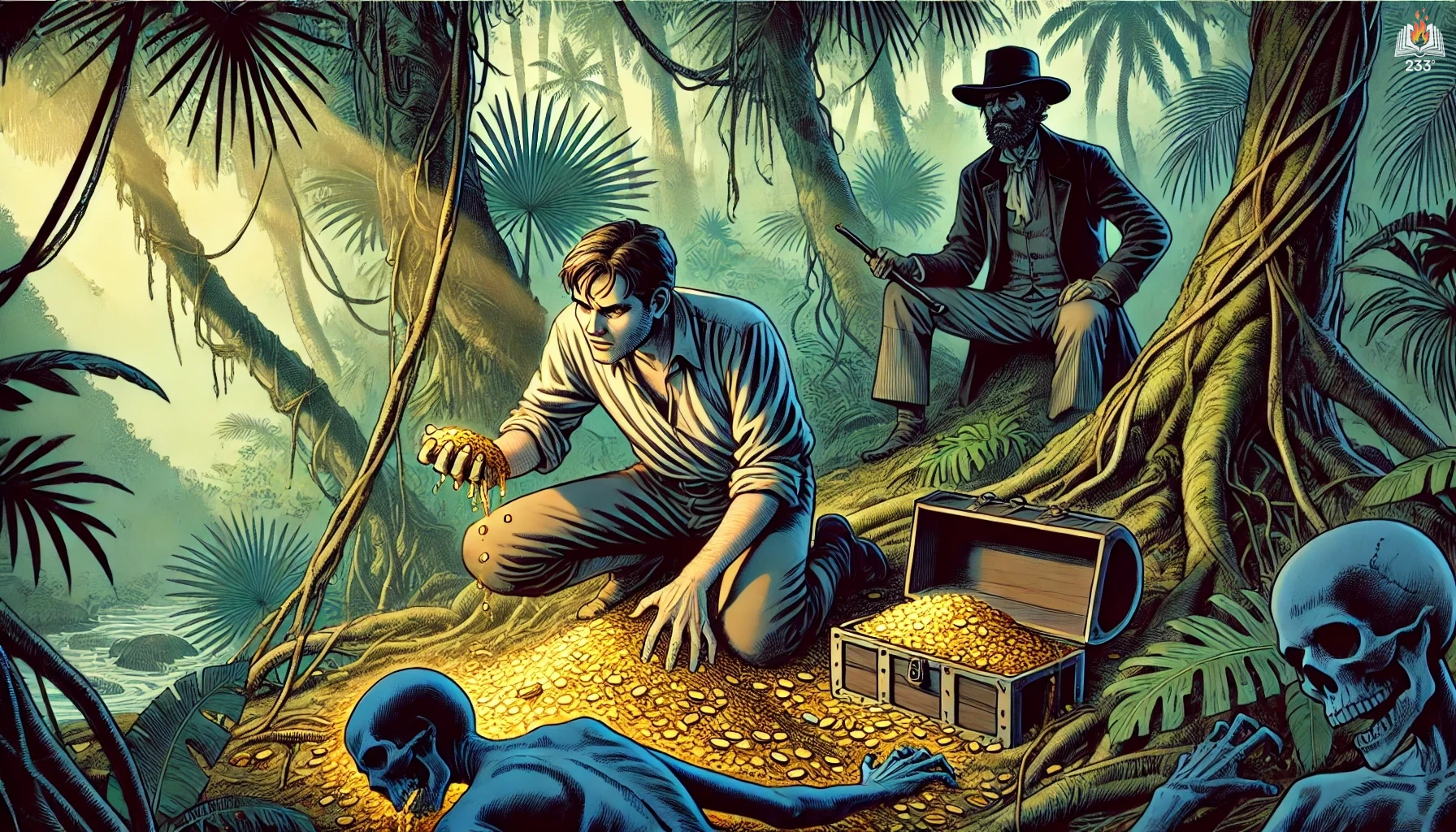
A fierce storm struck Crusoe’s ship, and it wrecked on a desolate island somewhere near the mouth of the Orinoco River. Crusoe was the sole survivor. Stranded on this remote island, he quickly realized that his survival depended entirely on his own resourcefulness. He salvaged what he could from the wrecked ship — tools, supplies, and weapons — and set about building a life for himself. He constructed a shelter, grew crops, and raised goats. With ingenuity and hard work, he transformed the island into a small, self-sustaining world of his own making.
Despite his practical success, Crusoe struggled with loneliness. He kept a journal to mark the passage of time and often reflected on his fate, wondering whether God had brought him to the island as punishment for his sins. As the years passed, he experienced spiritual awakening and repentance, realizing that his earlier life had been marked by pride and ingratitude.
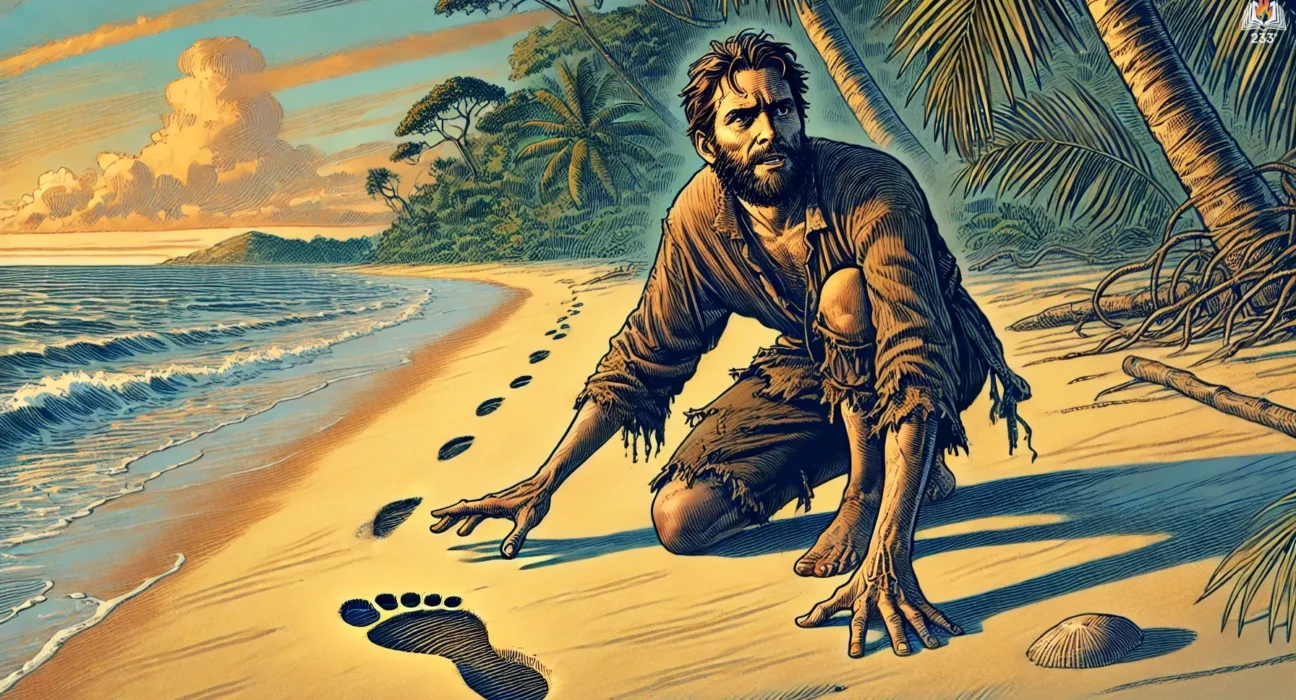
Crusoe’s life on the island took a dramatic turn when he discovered a footprint in the sand. He realized he was not alone. After some time, Crusoe witnessed a group of native cannibals bringing prisoners to the island to be eaten. Although horrified, Crusoe watched from a distance, too afraid to intervene. But when another such group arrived, Crusoe saw an opportunity to rescue one of the prisoners. He attacked the cannibals, killing several of them, and saved the life of a man who would become his companion.
Crusoe named the man Friday, after the day of his rescue. Friday was eager to learn Crusoe’s language and customs, and in time, the two men formed a close bond. Crusoe taught Friday about Christianity, and Friday proved to be an invaluable ally, helping Crusoe with the day-to-day tasks of survival. Crusoe’s long isolation was finally broken, and his existence became more hopeful with Friday by his side.
Their peace was disrupted when more cannibals arrived on the island, this time with two prisoners. Crusoe and Friday mounted a rescue, freeing both men — one of whom turned out to be Friday’s father. The other prisoner was a Spaniard who informed Crusoe that there were more survivors of a shipwreck on the mainland. Crusoe, Friday, and the Spaniard devised a plan to rescue the others, but before they could act, another ship appeared on the horizon.
The ship, however, was not a rescue vessel but a mutinous crew of English sailors who had seized control of their captain’s ship. Crusoe and Friday, using their knowledge of the island, captured the mutineers and freed the captain. In gratitude, the captain offered Crusoe passage back to England. After 28 long years on the island, Crusoe was finally rescued.
Returning to England, Crusoe found his family gone, his former life now distant. He journeyed to Lisbon to claim the wealth he had left behind from his plantation in Brazil. Reunited with his fortune, Crusoe briefly returned to Brazil, but his restless spirit did not allow him to settle for long. He eventually ventured back into the world, embarking on new adventures before retiring in his later years, still haunted by the memory of his time on the island but also grateful for the lessons it had taught him.
His time on the island had transformed him from a reckless youth into a man of wisdom and faith. Crusoe had not only survived but had learned to reflect deeply on the nature of solitude, the power of God’s providence, and the resilience of the human spirit. The island had been both his prison and his salvation, and in the end, it had given him a deeper understanding of himself and the world around him.
Main Characters
Robinson Crusoe: The protagonist and narrator of the novel. Crusoe is an adventurous and determined man, driven by a desire to explore the world despite warnings. His time on the island reveals his resourcefulness, adaptability, and moral reflections. Throughout the novel, Crusoe’s character evolves as he struggles for survival and searches for meaning in his isolation.
Friday: Crusoe’s companion, whom he rescues from cannibals. Friday is portrayed as loyal, obedient, and quick to learn. His relationship with Crusoe is pivotal to the story, offering themes of colonialism, master-servant dynamics, and cross-cultural interaction.
The Portuguese Captain: A figure of kindness and integrity, the captain helps Crusoe in one of his first escapes from slavery. He provides Crusoe with a safe passage to Brazil, and their interaction is a positive moment in Crusoe’s otherwise troubled journey.
Xury: A young Moorish boy who escapes with Crusoe after they flee captivity. Xury’s devotion and willingness to follow Crusoe mark him as another loyal character, although Crusoe eventually sells Xury into service, reflecting the complexities of Crusoe’s views on slavery.
Crusoe’s Father: He represents the voice of reason early in the novel, advising Crusoe against going to sea. His advice about a “middle station” in life serves as a moral anchor for Crusoe, even though Crusoe initially disregards it.
Theme
Survival and Self-Sufficiency: Crusoe’s struggle to survive on the island, using only the materials at hand and his wit, is central to the novel. His journey showcases human resilience and the capacity for innovation in isolation.
Divine Providence and Repentance: Crusoe often interprets his experiences as acts of God, leading to moments of repentance and spiritual awakening. The island becomes a place where Crusoe reflects on his previous life, his sins, and his relationship with God.
Colonialism and Slavery: The novel reflects the attitudes of its time toward colonialism and the superiority of European culture. Crusoe’s interactions with Friday and Xury reveal the hierarchical worldview of European colonial powers and highlight themes of mastery and domination.
Civilization vs. Nature: The contrast between Crusoe’s previous life in society and his life on the island underpins the novel. His efforts to recreate a microcosm of civilization on the island, through farming, domesticating animals, and building shelters, suggest that civilization is a fundamental human need.
Isolation and Human Connection: Crusoe’s long period of isolation forces him to confront his humanity. The arrival of Friday marks a shift in the narrative, emphasizing the need for companionship and human interaction, even in the most remote circumstances.
Writing Style and Tone
Daniel Defoe’s writing style in Robinson Crusoe is straightforward and detailed, which reflects the novel’s origins as a fictional autobiography. Defoe employs a first-person narrative, allowing readers to immerse themselves in Crusoe’s thoughts, feelings, and experiences. This style also serves to lend authenticity to the story, making it feel like a real account of a man’s survival rather than a work of fiction. Defoe’s use of minute details, especially regarding Crusoe’s survival strategies, adds a layer of realism that makes the story highly engaging.
The tone of the novel shifts throughout, from adventurous and defiant at the beginning to contemplative and spiritual as Crusoe grapples with his fate. Crusoe’s reflections on his past life, his sins, and his eventual repentance contribute to the novel’s moralistic undertone. Defoe’s tone is also didactic at times, especially when Crusoe reflects on the benefits of hard work, discipline, and faith in God. The overall tone can be seen as a blend of realism and moral instruction, fitting the novel’s role as both an adventure tale and a meditation on human nature and divine will.
Quotes
Robinson Crusoe – Daniel Defoe (1719) Quotes
“It is never too late to be wise.”
“Thus fear of danger is ten thousand times more terrifying than danger itself.”
“Those people cannot enjoy comfortably what God has given them because they see and covet what He has not given them. All of our discontents for what we want appear to me to spring from want of thankfulness for what we have.”
“Thus we never see the true state of our condition till it is illustrated to us by its contraries, nor know how to value what we enjoy, but by the want of it.”
“Thus fear of danger is ten thousand times more terrifying than danger itself when apparent to the eyes ; and we find the burden of anxiety greater, by much, than the evil which we are anxious about : ...”
“All our discontents about what we want appeared to me to spring from the want of thankfulness for what we have.”
“Redemption from sin is greater then redemption from affliction.”
“For sudden Joys, like Griefs, confound at first. ”
“And I add this part here, to hint to whoever shall read it, that whenever they come to a true Sense of things, they will find Deliverance from Sin a much greater Blessing than Deliverance from Affliction.”
“All evils are to be considered with the good that is in them, and with what worse attends them.”
“I know not what to call this, nor will I urge that it is a secret, overruling decree, that hurries us on to be the instruments of our own destruction, even though it be before us, and that we rush upon it with our eyes open.”
“[...] and now I saw, though too late, the folly of beginning a work before we count the cost, and before we judge rightly of our own strength to go through with it.”
“...in the course of our lives, the evil which in itself we seek most to shun, and which, when we are fallen into, is the most dreadful to us, is oftentimes the very means or door of our deliverance, by which alone we can be raised again from the affliction we are fallen into...”
“This grieved me heartily ; and now I saw, though too late, the folly of beginning a work before we count the cost, and before we judge rightly of our own strength to go through with it.”
“But, he says again, if God much strong, much might as the Devil, why God no kill the Devil, so make him no more do wicked? I was strangely surprised at his question, [...] And at first I could not tell what to say, so I pretended not to hear him...”
“Man is a short-sighted creature, sees but a very little way before him; and as his passions are none of his best friends, so his particular affections are generally his worst counselors.”
“It is as reasonable to represent one kind of imprisonment by another as it is to represent anything that really exists by that which exists not.”
“Wait on the Lord, and be of good cheer, and he shall strengthen thy heart; wait, I say, on the Lord.”
“In the first place , I was removed from all the wickedness of the world here. I had neither the lust of the flesh, the lust of the eye, or the pride of life. I had nothing to covet; for I had all that I was now capable of enjoying.”
“My father, a wise and grave man, gave me serious and excellent counsel against what he foresaw was my design. ”
We hope this summary has sparked your interest and would appreciate you following Celsius 233 on social media:
There’s a treasure trove of other fascinating book summaries waiting for you. Check out our collection of stories that inspire, thrill, and provoke thought, just like this one by checking out the Book Shelf or the Library
Remember, while our summaries capture the essence, they can never replace the full experience of reading the book. If this summary intrigued you, consider diving into the complete story – buy the book and immerse yourself in the author’s original work.
If you want to request a book summary, click here.
When Saurabh is not working/watching football/reading books/traveling, you can reach him via Twitter/X, LinkedIn, or Threads
Restart reading!