
Till We Have Faces: A Myth Retold is a 1956 novel by C.S. Lewis that reimagines the myth of Cupid and Psyche from the perspective of Orual, Psyche’s older sister. Set in the fictional kingdom of Glome, the story is a profound exploration of love, faith, and the human relationship with the divine.
Plot Summary
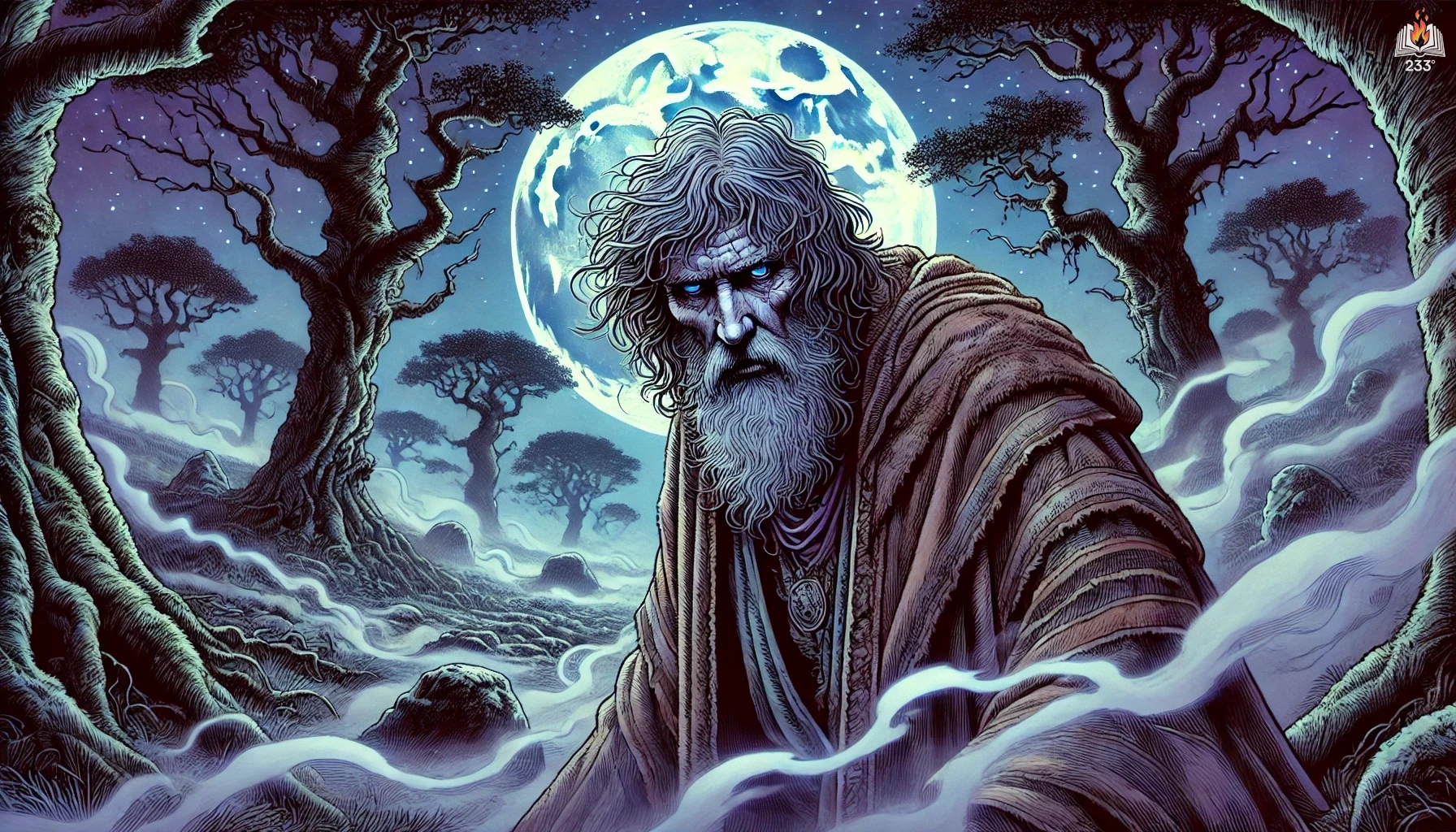
In the ancient kingdom of Glome, a land of stark beauty and harsh customs, Orual, the eldest daughter of King Trom, recounts her life and the events that shaped her destiny. Born into a brutal household, Orual grows up in the shadow of her father’s disdain, her own perceived ugliness, and the bitter loss of her mother. The Fox, a Greek slave and philosopher, becomes her tutor and imparts wisdom tempered with a rationalistic view of the gods. His teaching becomes a counterpoint to the mysticism of the Priest of Ungit, who serves the dark goddess worshipped in Glome.
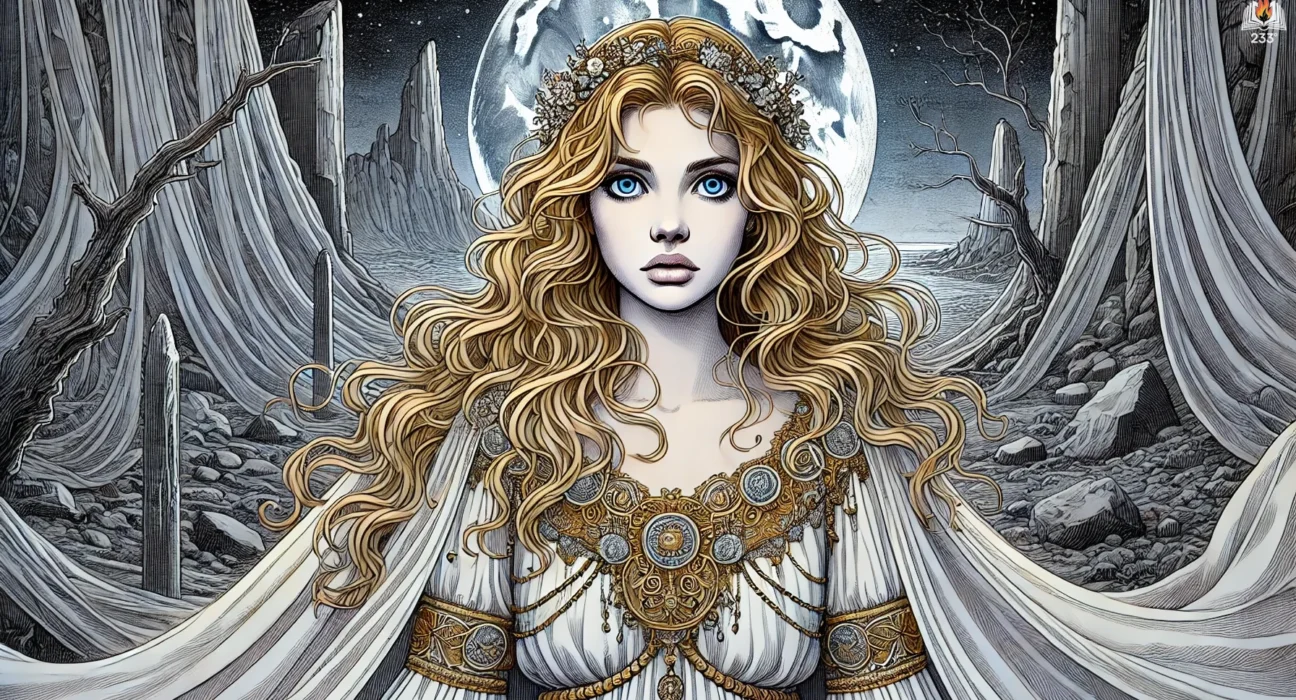
Orual finds solace in her bond with her half-sister Psyche, a girl of extraordinary beauty and purity. From a young age, Psyche radiates a light that draws people to her, a fact that fills Orual with a mixture of love and possessive jealousy. Psyche’s innocence and beauty become a source of both admiration and unease, for in Glome, the gods are capricious and their favor unpredictable.
As famine, pestilence, and drought ravage the kingdom, the people grow restless, blaming their suffering on divine wrath. The Priest of Ungit declares that only the sacrifice of Psyche, the “Accursed,” will appease the gods and end their afflictions. Orual, torn between rage at the gods and fear for her sister, tries to save Psyche, but the King, eager to protect his reign, agrees to the offering. Psyche is adorned as a bride and left on the Mountain to meet her fate with the god of the Grey Mountain.
Unable to accept this cruel decree, Orual ventures to the Mountain with the intention of recovering Psyche’s body. Instead, she finds her sister alive, living in a state of bliss and claiming to be the wife of a divine being. Psyche describes her life in a palace invisible to mortal eyes and insists on the reality of her union with the god. Orual, unable to see the palace or the god, believes Psyche to be delusional and fears she has fallen prey to some monstrous creature. Overcome by her love and possessiveness, Orual devises a plan to “save” Psyche by forcing her to disobey her husband’s command not to look upon his face.
Psyche, succumbing to Orual’s manipulation, uses a lamp to gaze upon her husband as he sleeps. In doing so, she breaks his trust, and the god, revealed as the son of Ungit, abandons her. The invisible palace vanishes, leaving Psyche to wander in penance and suffering. Orual is left with the bitter weight of her actions, convinced she acted out of love, though the consequences suggest otherwise.
Orual ascends to the throne of Glome following her father’s death, donning a veil to hide her face and symbolically burying her identity. As queen, she proves to be a wise and just ruler, winning the loyalty of her people and securing the kingdom’s stability. Yet, her reign is haunted by the absence of Psyche and the unresolved bitterness she harbors against the gods. She becomes estranged from the Fox and Bardia, her loyal captain, as her self-imposed isolation deepens.
Years pass, and Orual wrestles with her memories and the unanswered questions surrounding Psyche’s fate. She writes a complaint against the gods, accusing them of injustice and cruelty. Her heart is heavy with resentment, but her words carry the hope that one day they will be judged by a fair tribunal. She pours her bitterness into her account, believing she has unmasked the gods’ tyranny.
As her life nears its end, Orual is granted a vision in which she encounters Psyche and witnesses her trials. Psyche, tasked with seemingly impossible labors, displays an unwavering faith and love that contrast sharply with Orual’s doubts and despair. Through this vision, Orual comes to understand the true nature of the gods and the depth of her own selfishness. She realizes that her love for Psyche had been possessive and suffocating, born of her need to control and be needed.
In the final moments of her life, Orual is called before the gods in a dreamlike tribunal. She recites her complaint, only to discover that her accusations are hollow and self-absorbed. The gods, silent and serene, reflect her words back to her, and she sees her own face for the first time, unmasked and laid bare. The veil falls away, revealing not the ugliness she had always feared, but the truth of her soul.
Orual’s story ends with her finding peace in the understanding that the gods’ ways, though often inscrutable, are rooted in a love that transcends mortal comprehension. Her complaint is answered, not with words, but with the realization that she had to lose herself to truly see and be seen. Reconciled to her humanity and the divine, she embraces her final moments with humility and grace
Main Characters
Orual – The narrator and protagonist, Orual is the eldest daughter of King Trom. A deeply intelligent but physically unattractive woman, she struggles with jealousy, love, and the gods’ apparent cruelty. Her journey toward understanding herself and her relationship with the divine drives the story.
Psyche (Istra) – Orual’s younger half-sister, renowned for her extraordinary beauty and purity. Psyche is loved by all but becomes the target of the gods’ jealousy and wrath. Her role in the myth and her unwavering faith challenge Orual’s perceptions of love and reality.
The Fox – A Greek slave and mentor to Orual and Psyche, the Fox imparts rational, philosophical wisdom but struggles to reconcile his skepticism with the mystical events unfolding around him.
King Trom – Orual and Psyche’s tyrannical father, whose harsh rule and lack of affection deeply affect Orual’s early life.
The Priest of Ungit – A figure embodying the ancient, ritualistic religion of Glome, he serves as a counterpart to the Fox’s rationalism. His beliefs often seem cruel but have their own profound truths.
Bardia – A loyal soldier of Glome, Bardia is Orual’s trusted ally and an object of her unspoken affection. His grounded personality provides a counterbalance to Orual’s inner turmoil.
Theme
Love and Jealousy – The novel explores different forms of love—familial, romantic, and divine—and the destructive power of possessiveness. Orual’s love for Psyche becomes a central conflict as it veers into obsession.
Faith and Doubt – The tension between belief and skepticism is embodied by the Fox and the Priest. Orual’s struggle to comprehend the gods reflects the human journey of grappling with the divine.
Beauty and Ugliness – Physical beauty, as embodied by Psyche, contrasts with Orual’s perceived ugliness. The theme examines how outward appearances influence identity and relationships.
Sacrifice and Redemption – Psyche’s sacrificial role echoes religious and mythic traditions, while Orual’s ultimate confrontation with her faults highlights the theme of redemption.
Identity and Masking – Orual hides her face behind a veil for much of her reign, symbolizing her internal struggles with self-worth and truth.
Writing Style and Tone
C.S. Lewis employs a rich, reflective prose style that mirrors the voice of Orual, who narrates the story as an elderly queen recounting her life. The first-person perspective provides an intimate look into Orual’s psyche, laden with emotional depth and introspection. Lewis’s language is imbued with both mythic grandeur and a raw, personal authenticity, creating a bridge between the divine and the human.
The tone shifts throughout the novel, moving from the bitterness of Orual’s accusations against the gods to a humbled reverence as she gains insight. This progression reflects Orual’s journey from anger and misunderstanding to self-awareness and spiritual reconciliation. The mythical setting is rendered with vivid detail, blending the mystical with the mundane to evoke a timeless, allegorical quality.
Quotes
Till We Have Faces – CS Lewis (1956) Quotes
“The sweetest thing in all my life has been the longing
“I was with book, as a woman is with child.”
“It was when I was happiest that I longed most...The sweetest thing in all my life has been the longing...to find the place where all the beauty came from.”
“Holy places are dark places. It is life and strength, not knowledge and words, that we get in them. Holy wisdom is not clear and thin like water, but thick and dark like blood.”
“Are the gods not just?" "Oh no, child. What would become of us if they were?”
“I ended my first book with the words 'no answer.' I know now, Lord, why you utter no answer. You are yourself the answer. Before your face questions die away. What other answer would suffice? Only words, words; to be led out to battle against other words.”
“Death opens a door out of a little, dark room (that's all the life we have known before it) into a great, real place where the true sun shines and we shall meet.”
“No man can be an exile if he remembers that all the world is one city.”
“I felt ashamed." "But of what? Psyche, they hadn't stripped you naked or anything?" "No, no, Maia. Ashamed of looking like a mortal -- of being a mortal." "But how could you help that?" "Don't you think the things people are most ashamed of are things they can't help?”
“Did I hate him, then? Indeed, I believe so. A love like that can grow to be nine-tenths hatred and still call itself love.”
“There must, whether the gods see it or not, be something great in the mortal soul. For suffering, it seems, is infinite, and our capacity without limit.”
“but who can feel ugly, when their heart feels joy”
“As for all I can tell, the only difference is that what many see we call a real thing, and what only one sees we call a dream.”
“You don’t think – not possibly – not as a mere hundredth chance – there might be things that are real though we can’t see them? ... If there are souls, could there not be soul-houses?”
“I wonder do the gods know what it feels like to be a man.”
“I have said that she had no face; but that meant she had a thousand faces”
“Till that word can be dug out of us, why should they hear the babble that we think we mean? How can they meet us face to face till we have faces?”
“It may well be that by trickery of priests men have sometimes taken a mortal's voice for a god's. But it will not work the other way. No one who hears a god's voice takes it for a man's.”
“What began the change was the very writing itself. Let no one lightly set about such a work. Memory, once waked, will play the tyrant.”
“the Divine Nature wounds and perhaps destroys us merely by being what it is.”
“She made beauty all round her. When she trod on mud, the mud was beautiful; when she ran in the rain, the rain was silver. When she picked up a toad - she had the strangest and, I thought, unchanciest love for all manner of brutes - the toad became beautiful.”
“But I was wrong to weep and beg and try to force you by your love. Love is not a thing to be so used.”
“The change which the writing wrought in me (and of which I did not write) was only a beginning; only to prepare me for the gods' surgery. They used my own pen to probe my wound. ”
We hope this summary has sparked your interest and would appreciate you following Celsius 233 on social media:
There’s a treasure trove of other fascinating book summaries waiting for you. Check out our collection of stories that inspire, thrill, and provoke thought, just like this one by checking out the Book Shelf or the Library
Remember, while our summaries capture the essence, they can never replace the full experience of reading the book. If this summary intrigued you, consider diving into the complete story – buy the book and immerse yourself in the author’s original work.
If you want to request a book summary, click here.
When Saurabh is not working/watching football/reading books/traveling, you can reach him via Twitter/X, LinkedIn, or Threads
Restart reading!