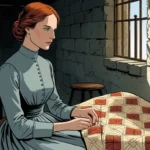
The Blind Assassin by Margaret Atwood, published in 2000, is a layered narrative blending family drama, forbidden love, and a fantastical story within a story. The novel explores themes of betrayal, memory, and survival through the life of Iris Chase Griffen, an aging woman recounting her family’s tragic past intertwined with her sister Laura’s mysterious death and a posthumously published novel, The Blind Assassin.
Plot Summary
Iris Chase Griffen stands on the brink of her fading years, burdened by a past filled with love, betrayal, and guilt. Her tale begins in 1945 when her younger sister, Laura Chase, drives a car off a bridge and plunges to her death. The aftermath reveals Laura’s novel, The Blind Assassin, a posthumously published work that propels her to literary fame. Iris, however, harbors a private understanding of the truth behind both Laura’s death and her enigmatic novel, one she will only unravel as her memories wind through the corridors of time.
The Chase sisters grow up in the declining grandeur of their family estate, Avilion, under the shadow of their father, Norval Chase. Once a prosperous industrialist, he is reduced to a broken man by the Great Depression and the demands of running his failing button factory. Their mother’s death early in their lives casts a long shadow, leaving the girls to navigate a world of expectations, duty, and loss. Reenie, the housekeeper, assumes the role of caretaker, providing warmth and wisdom but unable to shield them from the unfolding tragedies.
The world of privilege they inhabit begins to crumble, leaving them vulnerable to forces beyond their control. In a desperate bid to save the family’s fortunes, Norval arranges for Iris to marry Richard Griffen, a wealthy and influential businessman. At just eighteen, Iris is thrust into a marriage of cold calculations and suffocating power. Richard exerts control over every aspect of her life, while his sister, Winifred, supervises Iris’s behavior and ensures her compliance with societal norms. Avilion is sold, and Iris is whisked into a life of luxury that feels more like imprisonment.
Meanwhile, Laura remains in Iris’s life, her ethereal presence and peculiar moral rigidity a constant reminder of what Iris has sacrificed. Laura’s relationship with Alex Thomas, a political agitator fleeing accusations of arson, becomes a hidden thread binding the sisters and Richard in a web of lies and secrets. Alex is charming and mysterious, a man whose allure disrupts the careful facade of the Griffen household. He seeks refuge with the sisters, sparking a connection that entwines him with both of them. For Laura, Alex represents a forbidden love, pure and tragic. For Iris, he is an escape from her stifling marriage, igniting a passion she never imagined.
As the sisters grow closer to Alex, tensions rise. Richard’s manipulations tighten, and his true nature as a cruel and controlling figure emerges. Laura, consumed by her ideals and guilt, retreats further into her own world. Iris, torn between duty and desire, struggles to shield her sister from Richard’s wrath. The sisters’ bond strains under the weight of secrets too heavy to bear, and Laura, always sensitive and vulnerable, begins to unravel.
In the background of their lives is Laura’s manuscript. The tale-within-a-tale, set in a fantastical world, revolves around a blind assassin and a sacrificial virgin who fall in love. It is a story of betrayal, forbidden desire, and the cost of survival, mirroring the complexities of the sisters’ lives. Through the metaphorical lens of this fictional universe, Laura weaves her experiences, fears, and longings into a narrative that holds the key to understanding her perspective.
Laura’s eventual death, though ruled an accident, carries the weight of intention. The mystery of her suicide is intertwined with the manuscript she leaves behind. In its pages lies a veiled confession, a reflection of the events that led her to that fateful moment. The novel within the manuscript becomes an artifact of Laura’s inner torment and unspoken truths, her final gift to the world that failed to understand her.
Years later, Iris, now an aging widow, reflects on the events that shaped her life. Her marriage to Richard ended with his death, but not before he inflicted lasting damage. Her daughter, Aimee, estranged and troubled, succumbs to addiction, leaving Iris’s granddaughter, Sabrina, distant and out of reach. Alone in her final years, Iris dedicates herself to setting the record straight. In a collection of memoirs, she unravels the story of her family, the choices she made, and the truths buried beneath decades of silence.
The layers of Laura’s manuscript, Iris’s reflections, and the interspersed newspaper clippings and ephemera reveal a world where power and privilege dictate the lives of women, where love is both a salvation and a curse, and where the act of storytelling becomes an act of defiance. As Iris writes her final lines, she finds a measure of peace, knowing her words may one day reach her granddaughter and shed light on the shadows that haunted their family.
The end is quiet and unassuming, much like Iris herself. Yet within it lies the weight of a life lived in the margins, of sacrifices made and secrets kept. It is a testament to the endurance of memory and the unyielding strength of a woman determined to reclaim her story.
Main Characters
Iris Chase Griffen: The story’s narrator, Iris is an elderly woman reflecting on her troubled past, including her stifling marriage, fraught family dynamics, and guilt over her sister Laura’s death. Her voice is wry, self-aware, and tinged with regret.
Laura Chase: Iris’s enigmatic younger sister, whose suicide and subsequent literary fame dominate the narrative. She is depicted as fragile but morally resolute, with a deep sense of idealism.
Richard Griffen: Iris’s husband, a wealthy but controlling industrialist whose relationship with Iris is marked by power and abuse. His manipulations profoundly shape the sisters’ lives.
Alex Thomas: A political radical and drifter who becomes the lover of both Laura and Iris. His charm and rebellion symbolize freedom but bring turbulence to the Chase sisters.
Reenie: The Chase family’s loyal housekeeper, who serves as a maternal figure and custodian of family secrets, offering insight into their complex dynamics.
Theme
Power and Oppression: The novel critiques patriarchal systems, especially through Iris’s stifling marriage to Richard and her sense of entrapment in societal expectations.
Memory and Guilt: Iris’s narration delves into unreliable memory, exploring how guilt and shame influence her recollection of events, particularly Laura’s death.
Betrayal and Loyalty: Familial and romantic betrayals run throughout the story, particularly in the relationships among Iris, Laura, and Alex, challenging notions of loyalty and duty.
Storytelling as Survival: The titular The Blind Assassin novel within the book mirrors the characters’ realities, emphasizing storytelling’s role in coping with trauma and reclaiming agency.
Femininity and Sacrifice: The story portrays the sacrifices women make, whether for love, family, or survival, questioning the costs of such choices and societal expectations.
Writing Style and Tone
Margaret Atwood’s writing style in The Blind Assassin is layered and intricate, weaving multiple timelines, narrative voices, and genres seamlessly. The prose shifts between Iris’s reflective, often acerbic tone in her memoir-like chapters and the lyrical, surreal quality of the science fiction story embedded within the novel. Atwood uses rich metaphors and symbolism, drawing on myth and history to deepen the narrative’s complexity.
The tone is both melancholic and biting, combining the sadness of loss with moments of sharp humor and critique of societal norms. Atwood’s deft use of intertextuality and shifting perspectives creates a mosaic-like structure that invites readers to piece together the truth beneath the layers of fiction and memory.
Quotes
The Blind Assassin – Margaret Atwood (2000) Quotes
“Touch comes before sight, before speech. It is the first language and the last, and it always tells the truth.”
“The best way of keeping a secret is to pretend there isn't one.”
“Women have curious ways of hurting someone else. They hurt themselves instead; or else they do it so the guy doesn't even know he's been hurt until much later. Then he finds out. Then his dick falls off.”
“There were a lot of gods. Gods always come in handy, they justify almost anything.”
“Happiness is a garden walled with glass: there's no way in or out. In Paradise there are no stories, because there are no journeys. It's loss and regret and misery and yearning that drive the story forward, along its twisted road.”
“This is how the girl who couldn't speak and the man who couldn't see fell in love.”
“Was that the beginning, that evening—on the dock of Avilion, with the fireworks dazzling the sky? It's hard to know. Beginnings are sudden, but also insidious. They creep up on you sideways, they keep to the shadows, they lurk unrecognized. Then, later, they spring.”
“ Should is a futile word. It's about what didn't happen. It belongs in a parallel universe. It belongs in another dimension of space.”
“What fabrications they are, mothers. Scarecrows, wax dolls for us to stick pins into, crude diagrams. We deny them an existence of their own, we make them up to suit ourselves -- our own hungers, our own wishes, our own deficiencies.”
“Why is it we want so badly to memorialize ourselves? Even while we're still alive. We wish to assert our existence, like dogs peeing on fire hydrants.”
“Why does the mind do such things? Turn on us, rend us, dig the claws in. If you get hungry enough, they say, you start eating your own heart. Maybe it's much the same.”
“She knows herself to be at the mercy of events, and she knows by now that events have no mercy.”
“I was sand, I was snow—written on, rewritten, smoothed over.”
“I'm not senile," I snapped. "If I burn the house down it will be on purpose.”
“The young habitually mistake lust for love, they're infested with idealism of all kinds.”
“You want the truth, of course. You want me to put two and two together. But two and two doesn’t necessarily get you the truth. Two and two equals a voice outside the window. Two and two equals the wind. The living bird is not its labeled bones.”
“When you're unhinged, things make their way out of you that should be kept inside, and other things get in that ought to be shut out. The locks lose their powers. The guards go to sleep. The passwords fail.”
“But in the end, back she comes. There's no use resisting. She goes to him for amnesia, for oblivion. She renders herself up, is blotted out; enters the darkness of her own body, forgets her name. Immolation is what she wants, however briefly. To exist without boundaries.”
“It wasn't so easy though, ending the war. A war is a huge fire; the ashes from it drift far, and settle slowly.”
We hope this summary has sparked your interest and would appreciate you following Celsius 233 on social media:
There’s a treasure trove of other fascinating book summaries waiting for you. Check out our collection of stories that inspire, thrill, and provoke thought, just like this one by checking out the Book Shelf or the Library
Remember, while our summaries capture the essence, they can never replace the full experience of reading the book. If this summary intrigued you, consider diving into the complete story – buy the book and immerse yourself in the author’s original work.
If you want to request a book summary, click here.
When Saurabh is not working/watching football/reading books/traveling, you can reach him via Twitter/X, LinkedIn, or Threads
Restart reading!