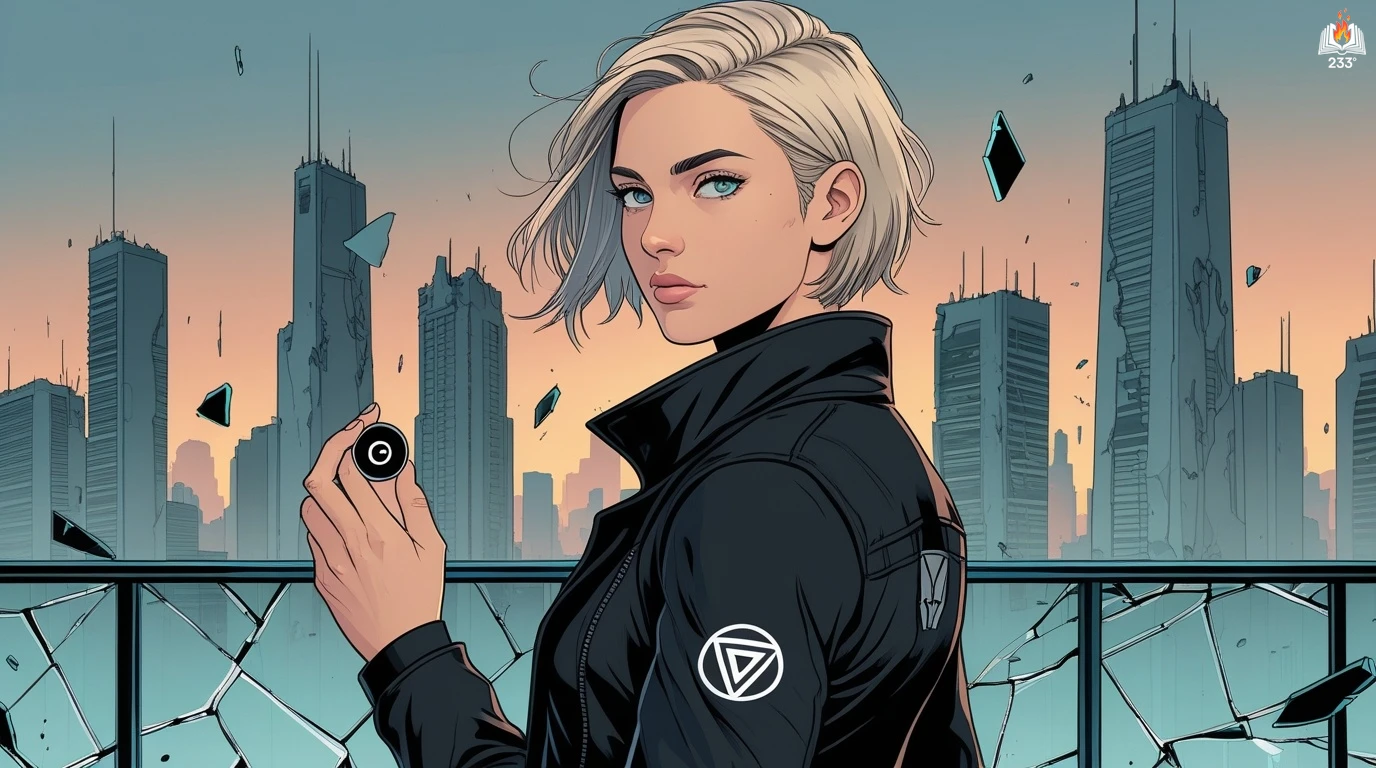


Arch-Conspirator by Veronica Roth, published in 2023, is a gripping dystopian reimagining of Sophocles’ Antigone, set in a crumbling city where genetic preservation, political oppression, and the hunger for freedom collide. Roth, known for the Divergent series, weaves classical tragedy with futuristic desperation, exploring timeless themes of defiance, loyalty, and the cost of rebellion.
Plot Summary
In a world withered by environmental collapse and ruled by the cold mechanics of genetic preservation, the city stands as a flickering ember of civilization. Its people live under the shadow of the Archive, where ichor – the distilled essence of the dead – is stored to ensure that humanity might endure, if not in body, then in essence. But to be born naturally, without the benefit of gene editing, is to be marked as cursed. Antigone and her siblings, children of the legendary Oedipus and Jocasta, are such aberrations – alive and doomed, loved and feared.
After the brutal assassination of Oedipus, power falls into the iron grasp of Kreon, the High Commander. Kreon, once Oedipus’ brother and now Antigone’s uncle, sweeps into their lives not as savior, but as ruler. He offers the orphans a place under his roof, a gilded cage where they are family in name but prisoners in truth. Antigone, fierce and unyielding, carries her grief like a banner. Ismene, delicate and cautious, navigates the currents of survival. Polyneikes and Eteocles, twin sons divided by ideology, drift toward a conflict written in their blood.
The city strains under scarcity, unrest simmering in alleys and whispered in dark corners. Polyneikes, restless and defiant, finds purpose among rebels who seek to unseat Kreon. Antigone watches him from the margins, torn between protecting her brother and fearing the noose tightening around them all. Eteocles, in contrast, moves ever closer to Kreon, seduced by power, perhaps believing that loyalty might buy protection.
The rebellion comes not as thunder but as a jagged crack through the night. Swords clash in the courtyard, bodies crumple on blood-soaked stones, and when the dust settles, two brothers lie dead, their hands still gripping the weapons that slew them. Antigone’s heart splinters. Her twin is gone. Yet Kreon’s decree twists the knife deeper: Polyneikes is to be left unburied, his ichor denied the Archive, his name scrubbed from the eternal tapestry. A traitor, he is condemned to oblivion.
Antigone’s grief hardens into resolve. She will defy Kreon’s law. She will extract her brother’s ichor and give him the immortality his bloodline was denied in life. But the walls of the city are thick with ears, and her every step is shadowed. Ismene, trembling but loyal, pleads with her sister to abandon the mad scheme. Haemon, Kreon’s son and Antigone’s betrothed by political design, wavers between obedience and love, his heart pulled in two.
The world beyond Antigone’s window marches on. In the market, children chant rhymes of the seven districts falling to ruin. In the Archive, couples come to select souls for rebirth, crafting futures out of the past. But for Antigone, the present is a blade at her throat. Armed with her mother’s old Extractor, she slips through alleys and across quiet courtyards, drawn to the place where her brother’s body lies beneath the eyes of the guards and the weight of Kreon’s law.
Ismene, ever the cautious sister, tries to pull Antigone back from the edge, her fear a desperate shield against the inevitable. Yet Antigone’s gaze is fixed, her will set. She moves with the certainty of the condemned, knowing there is no road back, only forward. Parth, the rebel ally, circles in the shadows, the revolution’s heartbeat still pulsing faintly in the city’s veins. Haemon, caught between his father’s command and his fiancée’s defiance, stands at the crossroads of loyalty and rebellion.
In the quiet hours before dawn, Antigone reaches the guarded body. Her hands are sure, her movements swift. But the city does not sleep. Kreon’s men seize her, and the courtyard becomes a theater of grief. Kreon, towering and implacable, declares the penalty – death. His voice carries over the stones, over the ivy-clad walls, over the people who gather to watch the sacrifice of a girl who dared defy the order of things.
Haemon pleads. Eurydice, Kreon’s wife, weaves through the corridors of power, a pale and trembling figure who sees too clearly the unraveling of her family. But Kreon is deaf to all appeals, wedded to his vision of law above mercy, of control above compassion.
As the execution approaches, the city holds its breath. Antigone, unbowed, walks to her fate with the same fierce determination that marked her every choice. Ismene weeps. Haemon stands broken, the man his father molded now fractured by the woman he loved. Kreon, at the pinnacle of power, finds his triumph curdled with loss. And in the hush that follows, as the dust settles and the blood dries on the stones, the cost of control, of defiance, of love is counted – and it is a reckoning that spares no one.
The city endures, scarred and trembling. The Archive hums with the quiet preservation of the past, even as the future frays at the edges. Kreon’s house, once a monument to order, stands haunted by absence. Eurydice, ethereal and watchful, lingers in the spaces where love and grief entwine. Ismene, fragile and fierce in her own way, carries forward the brittle thread of survival. And Haemon, his heart cracked wide, stands on the precipice of his father’s undoing.
Above them all, the Trireme waits, pointed to the stars, a monument to hope and desperation, ready to send its signal into the void – a beacon from a world crumbling under the weight of its own making.
Main Characters
Antigone: Fierce, defiant, and unwavering, Antigone is driven by a profound sense of duty to honor her deceased brother by preserving his ichor, defying Kreon’s brutal edict. Her arc is a tragic struggle between personal conviction and the crushing force of state power.
Kreon: The iron-fisted High Commander and Antigone’s uncle, Kreon is a man obsessed with order and survival. His need to control and his belief in the primacy of law over compassion mark him as both a protector and a tyrant, making his downfall both inevitable and tragic.
Haemon: Kreon’s son and Antigone’s fiancé, Haemon is torn between loyalty to his father and love for Antigone. His evolution from obedient son to conflicted rebel adds emotional depth and ultimately tragic consequences to the narrative.
Ismene: Antigone’s sister, cautious and fearful, Ismene struggles with the pull of family loyalty and her instinct for survival. Her hesitancy contrasts sharply with Antigone’s boldness, underscoring the complexity of moral choice.
Parth: A rebel leader and strategist, Parth embodies pragmatic resistance. His interactions with Haemon reveal the brewing tensions beneath the city’s surface and the moral ambiguities of rebellion.
Theme
Rebellion vs. Authority: The clash between Antigone’s moral defiance and Kreon’s authoritarian rule is the novel’s core, examining how individuals confront oppressive systems and the price they pay for resistance.
Family and Loyalty: Roth explores the bonds of family, both biological and chosen, as characters navigate love, betrayal, and sacrifice. These ties propel them into actions that shape the fate of the city.
Mortality and Legacy: The novel is haunted by the characters’ awareness of death and their desperate attempts to leave something lasting behind, whether through rebellion, genetic preservation, or legacy.
Freedom and Control: Roth’s dystopian setting foregrounds themes of surveillance, genetic control, and restricted agency, raising urgent questions about what it means to be free and who decides the boundaries of freedom.
Writing Style and Tone
Roth’s writing in Arch-Conspirator is taut and poetic, blending the elegance of classical tragedy with the raw immediacy of dystopian fiction. Her prose is vivid, often lyrical, and layered with symbolism, echoing the ancient roots of Antigone while breathing life into a stark future world. She balances intimate character moments with sweeping philosophical reflections, making the reader feel both the personal stakes and the broader societal collapse.
The tone is dark, tense, and tragic, charged with emotional intensity. Roth sustains a relentless sense of foreboding as characters grapple with impossible choices, yet she also allows space for moments of tenderness and quiet rebellion. The atmosphere she builds is heavy with doom yet shot through with flickers of hope, making the final unfolding both heart-wrenching and cathartic.
Quotes
Arch-Conspirator – Veronica Roth (2023) Quotes
“She said that protecting a thing was just an excuse to control it. She dedicated herself to freeing people from that control.”
“I didn't long to be a man. What I longed for, instead, was the freedom to follow my inclinations.”
“No one asked us if we wanted to. No one had asked us if we could bear it. As it happened, I couldn’t bear it, but I did it anyway.”
“There was always danger in him, boiling just beneath the surface... It made my steps careful and my words guarded... His shadow was long, and filled every corner of our house.”
“Technology can be used for liberty as well as domination,”
We hope this summary has sparked your interest and would appreciate you following Celsius 233 on social media:
There’s a treasure trove of other fascinating book summaries waiting for you. Check out our collection of stories that inspire, thrill, and provoke thought, just like this one by checking out the Book Shelf or the Library
Remember, while our summaries capture the essence, they can never replace the full experience of reading the book. If this summary intrigued you, consider diving into the complete story – buy the book and immerse yourself in the author’s original work.
If you want to request a book summary, click here.
When Saurabh is not working/watching football/reading books/traveling, you can reach him via Twitter/X, LinkedIn, or Threads
Restart reading!