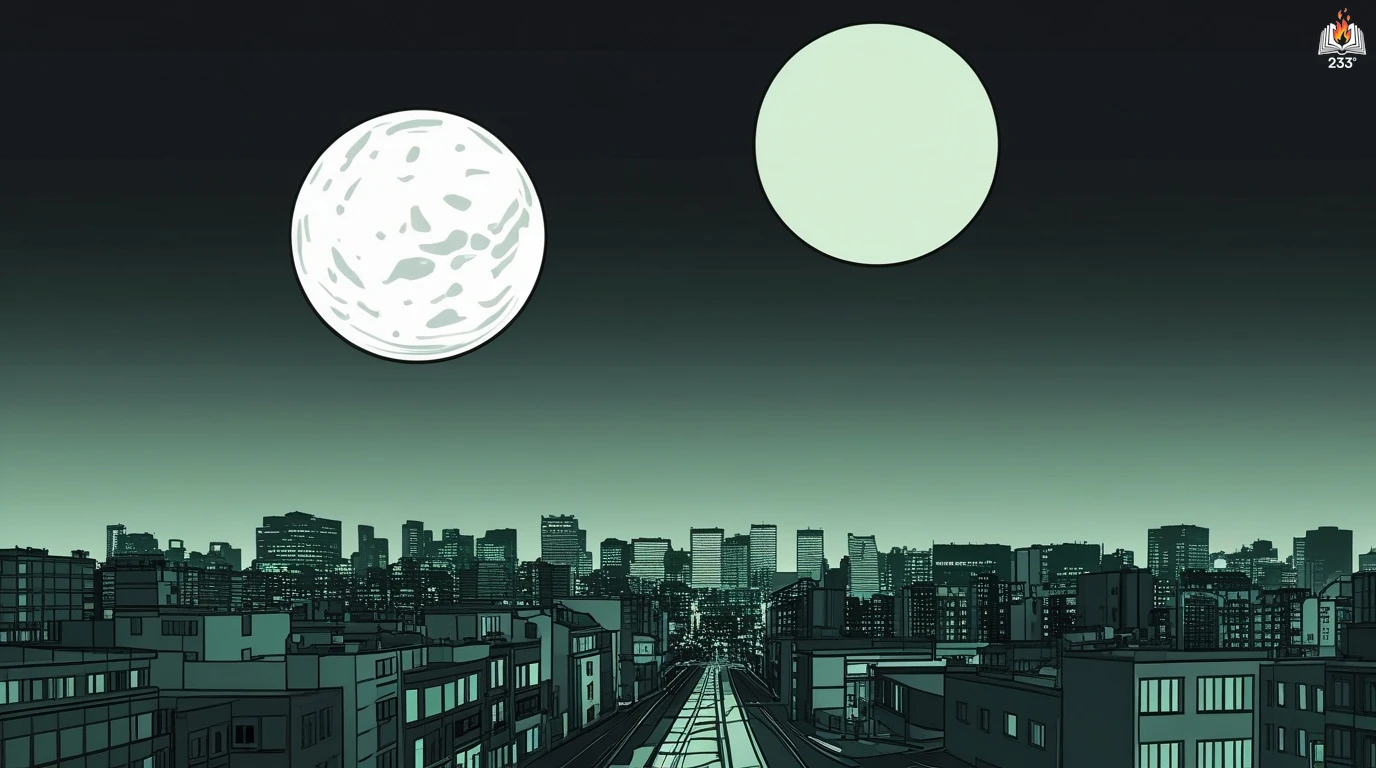
Killing Commendatore, written by Haruki Murakami and first published in 2017, is a metaphysical and surreal novel that unfolds as a meditation on art, memory, and identity. Divided into two parts – The Idea Made Visible and The Shifting Metaphor – the book follows an unnamed portrait painter whose life is upended after a separation from his wife, leading him to a remote house once owned by a renowned Japanese artist. Within the quietude of the mountains, strange phenomena emerge: a mysterious bell from underground, a faceless man seeking a portrait, and the discovery of a hidden painting that blurs the line between imagination and reality. Murakami’s tale delves deep into the eerie and the existential, using artistic creation as a gateway to spiritual and personal revelation.
Plot Summary
In the quiet retreat of the mountains near Odawara, a nameless portrait painter arrives at a house once belonging to a famed Japanese artist, Tomohiko Amada. His wife, Yuzu, has left him suddenly, offering only a cryptic explanation rooted in a dream, and he has abandoned his life in Tokyo in search of solitude, clarity, and perhaps a new purpose. The house stands like a forgotten shrine on the edge of mist and pine, its walls holding the silence of Amada’s long, solitary years and the quiet intensity of his vanished work. Here, the painter hopes to resume life at a gentler pace, surrounded by tall trees, shifting light, and the disjointed memories of a marriage already dissolved.
The days pass slowly. The house breathes with the sound of wind and the meow of stray cats. The painter teaches an art class in town, but most of his hours are spent wandering through the house and sketching in the sunlit studio Amada left behind. Then one day, in the attic, hidden under a tarp, he discovers a painting – strange and luminous, bathed in the glow of myth and violence. It is titled Killing Commendatore, a scene rendered in Japanese traditional style, yet bursting with surreal energy. A helmeted figure drives a blade into a man dressed in white – the Commendatore – whose eyes gleam with acceptance rather than fear. The painter cannot explain why this discovery unsettles him, only that it seems to wake something dormant in him.
Not long after, a bell begins ringing in the middle of the night. The sound rises from beneath the woods near the house, muffled and steady. Curious and unnerved, the painter joins his enigmatic neighbor Menshiki in uncovering the source. They dig deep into the earth and find a buried pit lined with stone, like an ancient shrine or tomb. Inside, they find nothing but darkness and silence. The bell’s sound ceases after the opening, but its echo lingers – as though something invisible has been released.
Menshiki, silver-haired and immaculate, lives across the valley in a white mansion that gleams like a cube of ice. He is refined and persuasive, with a taste for beauty and a hunger for secrets. He hires the painter to do his portrait, though insists on being seen not just in body, but in essence. As the sessions unfold, the painter notices subtle shifts in the world around him. Dreams take on weight. Ideas wear bodies. One night, a tiny man no taller than a child appears in the studio – the Commendatore himself, stepping from the painting into the real world. He speaks in riddles, acts like a guide, and insists he is no more than an Idea – nothing more, nothing less.
Reality begins to tilt. A strange man with no face appears in dreams, asking to have his portrait painted. The painter finds himself haunted by these visitations, his boundaries between waking and dreaming blurred. As he follows the threads of these surreal encounters, he discovers that Tomohiko Amada had once painted political allegories under threat of censorship, and Killing Commendatore may have been more than an abstract vision – it may have been a metaphorical scream against war and repression.
Menshiki’s portrait reveals more than just a face. In its lines and shades, the painter senses the man’s secrets – especially his obsession with a thirteen-year-old girl named Mariye, who lives nearby and may be his biological daughter. Menshiki watches her from afar, never approaching directly, constructing a life of appearances around a truth he cannot admit aloud. The painter becomes involved in this strange triangle, taking Mariye as a student and trying to understand her sharp silences and the hidden loneliness she carries.
When Mariye suddenly disappears, the painter is forced to venture further into the realm of the unreal. He returns to the pit beneath the woods, finding a passage through metaphor itself – a place where consciousness folds and grief becomes landscape. He enters a black space populated by shifting memories and symbolic forms, where time holds no shape and the only way forward is surrender. Guided by the faceless man and the Commendatore, he walks through the absence, searching for Mariye, or some version of her essence.
Emerging from this ordeal weakened but changed, he returns to the surface. Mariye is safe, her disappearance more emotional than literal, but something in her has altered, just as something in him has softened and matured. The world outside resumes its steady pace, but for the painter, nothing is quite as it was before. He has touched something primal, something beyond art and beyond comprehension. His portraits now hold more weight, more breath, more silence.
Eventually, his wife Yuzu returns. She carries the signs of her own long journey – a pregnancy, a quiet sadness, and a wish to begin again. They speak not as broken halves but as people who have traveled separately through difficult terrain and now meet on common ground. She is expecting a child, the painter does not ask whether it is his, and somehow it does not matter. What matters is that they are here, now, speaking honestly. The past rests like ash behind them, the future unwritten.
In the final moments, the painter begins a new portrait – not for a client, not as a product, but for himself. He has learned to look deeper, to sketch not just the surface but the soul beneath it. The Commendatore no longer appears. The bell remains silent. But in the stillness of the mountain house, in the space between art and life, something unseen continues to breathe.
Main Characters
The Narrator (Unnamed Portrait Painter): A quiet, introspective artist who specializes in painting portraits, the narrator undergoes an internal and external journey after his wife suddenly asks for a divorce. Moving into the mountain home of artist Tomohiko Amada, he becomes entangled in a surreal sequence of events that challenge his perception of reality. He is haunted by memories, driven by a need to rediscover authentic art, and gradually pulled into metaphysical realms through his encounter with the mysterious painting Killing Commendatore.
Menshiki: A wealthy, enigmatic neighbor who commissions the narrator to paint his portrait. Menshiki is refined and intelligent but harbors secrets and obsessions, particularly concerning a young girl he believes may be his daughter. His carefully curated life and eerie charisma mirror the artifice and ambiguity that permeate the story.
Mariye Akikawa: A 13-year-old girl whom Menshiki suspects is his daughter. She is curious, emotionally restrained, and artistically gifted. Mariye becomes an important emotional and narrative pivot, connecting the narrator and Menshiki through themes of longing and paternity.
Tomohiko Amada: The famed painter whose mountain home the narrator occupies. Though now in a nursing facility due to dementia, his presence is felt through his works, especially the chilling Killing Commendatore, which serves as a symbolic and metaphysical gateway in the novel. Amada’s life, including his involvement in a political art movement, becomes a lens through which artistic truth and memory are explored.
The Commendatore (Idea personified): A personification of an “Idea” that takes the form of a small, humanoid figure resembling a character from Amada’s painting. He speaks in riddles and appears and disappears mysteriously, acting as a guide to the narrative’s deeper metaphysical mysteries.
The Faceless Man: An eerie figure that appears to the narrator in dreams and visions, representing the unknowable void and perhaps the cost of losing identity or creative purpose. His presence blurs the distinction between symbolic dreams and lived experiences.
Theme
Art as a Gateway to the Subconscious: The novel explores how art captures more than the physical – it reflects memory, emotion, and hidden truths. Through the narrator’s shift from commercial portraiture to deeper, more expressive work, Murakami interrogates the artist’s role as a medium between seen and unseen worlds.
Identity and Transformation: The protagonist’s disconnection from his past self and search for meaning reflects a broader existential theme: Who are we when we remove external roles and relationships? His interactions with metaphysical entities reveal the fluidity of self and the layers of constructed identity.
Loss and Longing: From the narrator’s separation to Menshiki’s paternal uncertainty, the novel is threaded with a profound sense of absence. These voids – whether emotional, physical, or spiritual – act as haunting forces that compel characters toward action and introspection.
The Metaphysical and the Real: Murakami blurs the boundary between dream and reality, suggesting that the metaphysical – personified Ideas, the Double Metaphor, the Faceless Man – is as real as the mundane. These intrusions challenge both the protagonist and reader to reconsider what constitutes truth.
Isolation and Observation: Living in the mountains becomes a mirror for the narrator’s isolation, both emotional and existential. Yet, isolation sharpens observation, leading to deeper insights into self, others, and the universe – a motif reinforced through the art of portraiture and surveillance.
Writing Style and Tone
Murakami’s signature surrealism permeates the narrative, yet in Killing Commendatore, it is more meditative and painterly. The prose unfolds with calm, hypnotic pacing that mimics the stillness of the mountain setting and the introspective solitude of the protagonist. Murakami’s language is deceptively simple but layered with philosophical undertones, inviting readers to linger on each sentence the way one might stare into a painting to search for hidden meaning.
He uses repetition and dreamlike sequencing to mirror the fluidity of memory and time, while the dialogue remains taut and deliberate, often with elliptical phrasing that suggests more than it reveals. The tone balances melancholy with mystery, and detachment with bursts of emotional resonance. The result is an atmosphere that feels like stepping into an echo chamber of thought – quiet, strange, and filled with reverberations of something just out of reach.
Quotes
Killing Commendatore – Haruki Murakami (2017) Quotes
“From a distance, most things look beautiful.”
“Instead of a stable truth, I choose unstable possibilities.”
“Look deep enough into any person and you will find something shining within.”
“As I gazed at my reflection I wondered, Where am I headed? Before that, though, the question was Where have I come to? Where is this place? No, before that even I needed to ask, Who the hell am I?”
“We all live our lives carrying secrets we cannot disclose.”
“None of us are ever finished. Everyone is always a work in progress.”
“You can have all the desire and ache inside you want, but what you really need is a concrete starting point.”
“No need to worry. Time is the remedy for your concerns. It is the key for all things that possess form. True, time does not last forever, but as long as you have it, it is remarkably efficacious. So look forward to the future, my friends.”
“A face is like reading a palm. More than the features you’re born with, a face is gradually formed over the passage of time, through all the experiences a person goes through, and no two faces are alike.”
“I couldn’t be sure if I had moved forward or fallen behind, or if I was just circling over the same spot.”
“what hurt me was actually me, myself. In the midst of that continuing, unsettled silence my feelings, like a heavy pendulum, a razor-sharp blade,”
“If this was a dream, then the world I’m living in itself must all be a dream.”
“It seems as if, year after year, the world becomes a more difficult place to live.”
“The silence lent a faint weight to the air. As though I were sitting alone, at the bottom of the sea.”
“No matter how vivid a memory, the power of time was stronger. I knew this instinctively.”
“I was desperately clinging to a scrap of wood that had been swept away. In pitch-black darkness, not a single star, or the moon, visible in the sky. As long as I clung to that piece of wood I wouldn’t drown, but I had no clue where I was, where I was heading.”
“Tomorrow is tomorrow. Today is all we have right now.”
“You’re still young, so that’s why you say that. When you get to be my age, you’ll understand how I feel. How much loneliness the truth can cause sometimes.”
“Memory can give warmth to time.”
“Everything has a bright side,” he said. “The top of even the blackest, thickest cloud shines like silver.”
“Nature grants its beauty to us all, drawing no line between rich and poor.”
“I am endowed with the capacity to believe. I believe in all honesty that something will appear to guide me through the darkest and narrowest tunnel, or across the most desolate plain.”
“I believe that it’s not necessary to believe in the soul’s existence. But turn that around and you come to the belief that there’s no need to not believe in its existence.”
“to me my face in the mirror looked like a virtual fragment of my self that had been split in two. The self there was the one I hadn’t chosen. It wasn’t even a physical reflection.”
We hope this summary has sparked your interest and would appreciate you following Celsius 233 on social media:
There’s a treasure trove of other fascinating book summaries waiting for you. Check out our collection of stories that inspire, thrill, and provoke thought, just like this one by checking out the Book Shelf or the Library
Remember, while our summaries capture the essence, they can never replace the full experience of reading the book. If this summary intrigued you, consider diving into the complete story – buy the book and immerse yourself in the author’s original work.
If you want to request a book summary, click here.
When Saurabh is not working/watching football/reading books/traveling, you can reach him via Twitter/X, LinkedIn, or Threads
Restart reading!