The Virgin Suicides, written by Jeffrey Eugenides and published in 1993, is a haunting literary novel set in a quiet suburban neighborhood in 1970s Michigan. The story unfolds through the collective voice of a group of anonymous neighborhood boys who obsessively recount the tragic lives and deaths of the five Lisbon sisters. Through their fragmented recollections, interviews, and memorabilia, they attempt to understand the ungraspable reasons behind the girls’ suicides. This atmospheric and introspective novel established Eugenides as a significant literary voice with its blend of nostalgia, myth, and psychological exploration.
Plot Summary
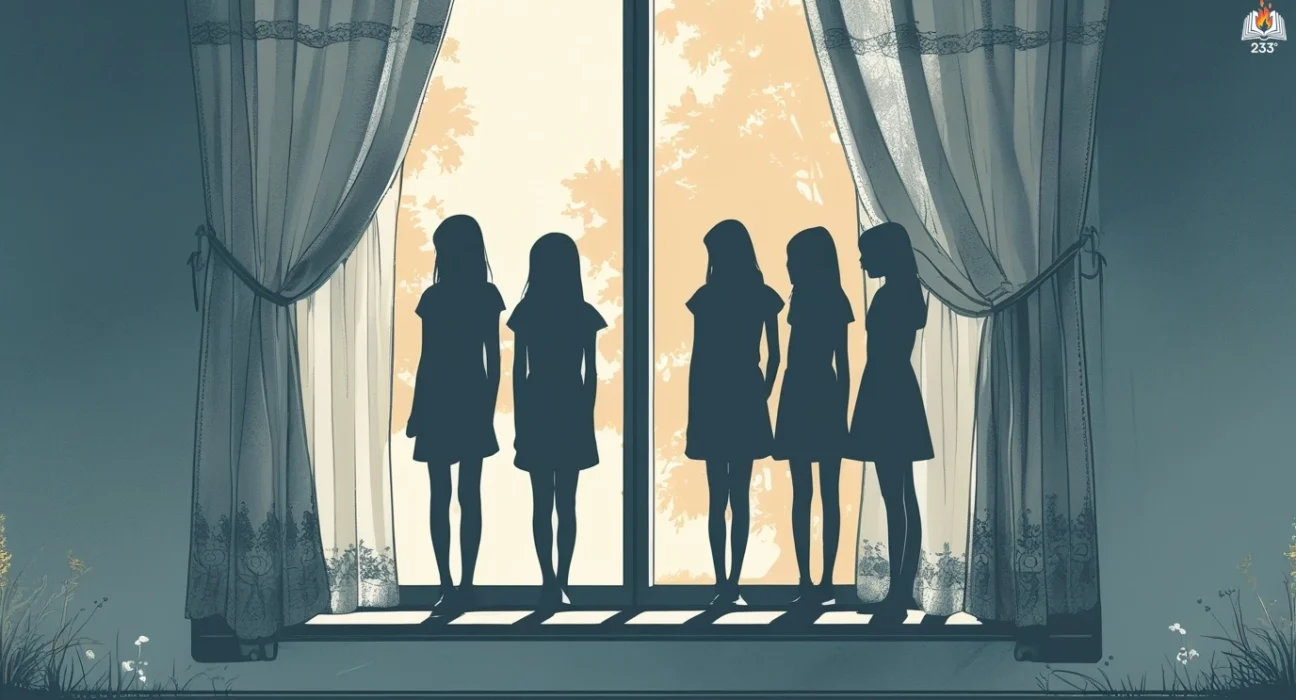
The Lisbon girls lived in a house that decayed as quietly and mysteriously as they did, on a tree-lined street in a nondescript suburb where lives were expected to be neat and manageable. There were five of them – Cecilia, Lux, Bonnie, Mary, and Therese – each separated by a year in age, moving like a constellation behind drawn curtains, guarded by parents who clung to strict Catholic traditions and feared the noise of modern youth. They were beautiful and unreachable, and to those who watched from the houses across the street, they seemed less like individuals than a collective spell that shimmered briefly before extinguishing itself.
It began when Cecilia, the youngest at thirteen, slit her wrists in the bathtub. When the paramedics found her, she held a picture of the Virgin Mary to her chest. Her body, barely clinging to life, was quiet and strange. She was saved, stitched up, sent home. A doctor asked her what could be so wrong with her life at such a young age. Cecilia, already ancient in her sadness, answered with the knowledge of a girl who had glimpsed something beyond the world her parents had made for her.
The house changed after that. The girls were given slightly more freedom. There was even a party – an awkward affair with punch and dominoes, chaperoned by their pale mother and withdrawn father. The girls tried, briefly, to step into the light of adolescence. Lux flirted with the boys, teasing them with a single finger pressed into a palm. But Cecilia never left her barstool. Dressed in her wedding gown, wrists hidden beneath taped-on bracelets, she seemed barely tethered to the room. She asked to be excused, climbed the stairs with her face to the floor, and jumped from her window onto the spiked fence below. Her body, caught midair by the hem of her dress, seemed to hover for a moment before the spike entered her heart.
After Cecilia died, the house darkened. The curtains closed, the windows sealed with masking tape. The remaining sisters disappeared behind the walls, and the family turned inward. But the girls lingered in the minds of the neighborhood boys, who scavenged for meaning in old snapshots and faint memories. They watched, obsessed, as the Lisbon house grew feral, as if absorbing the grief it contained. Lux lay out in the yard sunbathing while her sisters hovered nearby, silent sentries.
Lux became the most visible after Cecilia’s death. Her beauty grew feral, urgent. She smoked cigarettes on the roof, kissed boys in the dark, and gave herself to them beneath the stars. But always, she returned home before curfew, slipping through the door into the ever-narrowing space her parents allowed. After one such night, she was caught. The punishment came swiftly – the sisters were pulled out of school, shut inside the house entirely. The telephone was disconnected. Shades were drawn. The girls no longer existed beyond the bricks of their home.
Inside, their world dimmed into ritual. They aged together in confinement, whispering through walls, their voices heard only by one another. Their rooms filled with the scent of menstruation, baby powder, mildew, incense. Mr. Lisbon, once a math teacher, retreated into carving wooden animals, whittling away at frogs and birds in his darkened apartment after leaving the home. Mrs. Lisbon became a figure of quiet control, silent in her rule, holding the reins with invisible hands.
Lux found freedom where she could. She began sneaking onto the roof each night, and one night, Trip Fontaine – the golden boy with nothing but desire behind his lazy smile – called and asked to take Lux to Homecoming. Against all odds, the Lisbons agreed, on one condition: the other girls had to come too, escorted by Trip’s friends.
They went. For a few hours, the sisters were like other girls. They danced under the school lights, wore wrist corsages, rode in convertibles. Trip and Lux vanished together on the football field. He awoke alone hours later, the scent of her still on the grass, and walked home barefoot. Lux, returned home late, was locked in the house. It was the last time anyone outside saw any of the Lisbon girls.
Then came silence. The house became an island. Time passed. Neighbors whispered, speculated, stared. Inside, the sisters thinned. Lux took to the rooftop again. Bonnie prayed in the living room, rocking in rhythm to invisible hymns. Mary tried to take her own life with sleeping pills but survived, barely. And then, one warm June night, the Lisbon girls made their final move.
They lured the boys to the house, whispering through the telephone lines that buzzed once more. Come over. Bring your sleeping bags. Help us escape. The boys arrived, breathless and stunned, and found the front door unlocked. Inside, shadows loomed, and Lux led them through dim hallways like a queen in exile. She kissed one of the boys, led him to the roof, and disappeared again.
Downstairs, the boys waited, then wandered. In the garage, they found Bonnie hanging. Panic rippled through them, but they were silent. They fled. None stayed to call for help. By dawn, all four remaining girls were gone – one by hanging, one by gas, one by pills, one by slipping away quietly. Only Mary lingered a few days in the hospital before joining her sisters in death.
Afterward, the Lisbon house was sold. The furniture cleared, the wallpaper stripped, the rot scraped from the floorboards. No trace of the girls remained. The neighborhood moved on, but the boys did not. They gathered fragments – photographs, diary pages, lipstick tubes, stories passed from neighbor to neighbor – and tried to make sense of what had happened. But time passed, and no answer emerged. Only the memory of five girls, slipping one by one from the world, lingered – ephemeral and indecipherable.
They left behind no reasons, only the ache of having been alive in a world that didn’t know how to hold them.
Main Characters
Cecilia Lisbon – The youngest of the sisters at thirteen, Cecilia is ethereal, introverted, and deeply enigmatic. She is the first to attempt suicide and eventually succeeds, becoming a haunting presence that lingers over the rest of the novel. Her detachment from the world and obsession with death foreshadow the tragedies that follow, and her brief yet pivotal role anchors the story’s tone of melancholy and mystery.
Lux Lisbon – Fourteen and the most vibrant and rebellious of the sisters, Lux captivates both the neighborhood boys and the narrative. She embodies sexual freedom and defiance, engaging in secret rendezvous while struggling against the constraints of her home life. Lux’s inner torment is masked by her beauty and sensuality, making her descent into despair especially harrowing.
Mary Lisbon – Sixteen and the most conventionally hopeful of the sisters, Mary is characterized by a desire to conform and recover. She attempts suicide but initially survives, only to later succeed quietly with sleeping pills. Her fate epitomizes the futility of rescue in a world indifferent to suffering.
Therese Lisbon – The eldest sister at seventeen, Therese is intellectual, studious, and devout. She is portrayed as remote and serious, often absorbed in academic pursuits. Her internal life remains largely inaccessible, adding to the novel’s pervasive mystery.
Bonnie Lisbon – Fifteen and deeply religious, Bonnie is marked by her spiritual devotion and physical awkwardness. She often retreats into prayer and ritual, and her eventual suicide is the most somberly ritualistic. Bonnie’s fate seems like a martyrdom, steeped in a misunderstood faith.
Mr. and Mrs. Lisbon – The parents of the girls, strict and emotionally repressed, represent the suffocating control and moral rigidity of conservative suburbia. Their inability to adapt or connect with their daughters indirectly facilitates the tragic events. Mr. Lisbon is a passive, ineffectual father, while Mrs. Lisbon enforces a punishing moral code that deepens the girls’ isolation.
The Narrators (the neighborhood boys) – Speaking in a collective first-person plural, they act as retrospective observers haunted by the Lisbon girls. Their obsessive documentation reveals as much about their longing and guilt as it does about the Lisbon family. They symbolize the yearning of youth to make sense of inexplicable loss.
Theme
Adolescence and Sexual Awakening – The Lisbon sisters’ lives are steeped in the mysteries of puberty, desire, and emotional volatility. Their budding sexuality, especially Lux’s, is both alluring and threatening to the adult world. The narrators’ fascination with this awakening is tangled with confusion, desire, and helplessness.
Suburban Decay and Confinement – The setting, a seemingly peaceful suburb, becomes a suffocating enclosure. The Lisbon house deteriorates as the story progresses, mirroring the psychological breakdown of its inhabitants. The novel critiques the façade of suburban life and its inability to nurture emotional truth.
Memory and Obsession – The narrators reconstruct the past obsessively, collecting artifacts and testimonies to piece together the Lisbon sisters’ story. Their fixation underscores the human desire to find meaning in tragedy, even when answers remain elusive.
Death and the Incomprehensibility of Suicide – Suicide is central, not just as an event, but as an unfathomable act that destabilizes everyone left behind. The girls’ suicides are not glorified but rendered as deeply mysterious, painful choices that resist explanation, challenging the narrators’ and readers’ understanding.
Religious Imagery and Martyrdom – The Lisbon girls are often cast in saintly or sacrificial imagery, particularly in how they are remembered. Cecilia clutching the Virgin Mary card, Bonnie’s saintlike demeanor, and Lux’s name all contribute to a motif of spiritual suffering and doomed purity.
Writing Style and Tone
Jeffrey Eugenides employs a lush, lyrical prose style that blends the elegiac with the eerie. His sentences often unfold in long, sweeping cadences filled with sensory detail and poetic melancholy. The narrative voice – the collective “we” of the neighborhood boys – lends the novel a choral quality, blurring individual perspective in favor of shared memory and myth-making. This stylistic choice emphasizes the communal obsession and the emotional distance that time creates between the narrators and the events.
The tone of The Virgin Suicides is wistful, elegiac, and saturated with a haunting nostalgia. Eugenides balances lyrical beauty with stark horror, drawing the reader into a dreamlike atmosphere that feels suspended in time. The contrast between the mundane suburb and the sublime, tragic beauty of the Lisbon girls creates a sense of otherworldliness. The tone never moralizes or seeks closure, instead embracing ambiguity and loss, making the story resonate with the profound ache of unanswered questions and the irretrievability of youth.
Quotes
The Virgin Suicides – Jeffrey Eugenides (1993) Quotes
“She held herself very straight, like Audrey Hepburn, whom all women idolize and men never think about.”
“Basically what we have here is a dreamer. Somebody out of touch with reality. When she jumped, she probably thought she'd fly”
“In the end, it wasn't death that surprised her but the stubbornness of life.”
“We couldn't imagine the emptiness of a creature who put a razor to her wrists and opened her veins, the emptiness and the calm.”
“In the end we had the pieces of the puzzle, but no matter how we put them together, gaps remained, oddly shaped emptinesses mapped by what surrounded them, like countries we couldn't name.”
“I don’t know what you’re feeling. I won’t even pretend.”
“In the end, the tortures tearing the Lisbon girls pointed to a simple reasoned refusal to accept the world as it was handed down to them, so full of flaws.”
“All wisdom ends in paradox.”
“The girls took into their own hands decisions better left to God. They became too powerful to live among us, too self-concerned, too visionary, too blind.”
“We knew, finally, that the girls were really women in disguise, that they understood love and even death, and that our job was merely to create the noise that seemed to fascinate them.”
“You never get over it, but you get to where it doesn't bother you so much.”
“We knew that Cecilia had killed herself because she was a misfit, because the beyond called to her, and we knew that her sisters, once abandoned, felt her calling from that place, too. ”
“We realized that the version of the world they rendered for us was not the world they really believed in...”
“During a warm winter rain ... the basins of her collarbones collected water.”
“Winter is the season of alcoholism and despair.”
“What lingered after them was not life, which always overcomes natural death, but the most trivial list of mundane facts: a clock ticking on a wall, a room dim at noon, and the outrageousness of a human being thinking only of herself.”
“Capitalism has resulted in material well-being but spiritual bankruptcy.”
“They're just memories now. Time to write them off.”
“and she had succeeded, on the second try, in hurling herself out of the world.”
“The time has to be right and the heart willing.”
“The zipper opened all the way down our spines.”
“The seeds of death get lost in the mess that God made us.”
“The world, a tired performer, offers us another half-assed season.”
“We had loved them, and that they hadn't heard us calling, still do not hear us... calling them out of those rooms where they went to be alone for all time, alone in suicide, which is deeper than death, and where we will never find the pieces to put them back together.”
We hope this summary has sparked your interest and would appreciate you following Celsius 233 on social media:
There’s a treasure trove of other fascinating book summaries waiting for you. Check out our collection of stories that inspire, thrill, and provoke thought, just like this one by checking out the Book Shelf or the Library
Remember, while our summaries capture the essence, they can never replace the full experience of reading the book. If this summary intrigued you, consider diving into the complete story – buy the book and immerse yourself in the author’s original work.
If you want to request a book summary, click here.
When Saurabh is not working/watching football/reading books/traveling, you can reach him via Twitter/X, LinkedIn, or Threads
Restart reading!