Lord of the Flies, written by William Golding and published in 1954, is a profound allegorical novel that explores the descent into savagery of a group of boys stranded on an uninhabited island. Isolated from the structures of civilization, they grapple with primal instincts, power struggles, and the thin veneer of societal order, culminating in a harrowing examination of human nature.
Plot Summary
The sun blazed upon the wreckage of a downed plane, its scar slicing through the lush jungle of a deserted island. From this ruin emerged Ralph, a fair-haired boy of twelve, his thoughts alight with the thrill of adventure. Nearby, a rotund boy with thick spectacles stumbled from the foliage, introducing himself hesitantly. He preferred not to be called “Piggy,” but Ralph found the name too amusing to resist. Together, they discovered a gleaming conch shell, its spirals delicate and pale. Piggy suggested its use as a call to summon others who might have survived.
The conch’s deep note echoed through the island, and soon boys of all ages appeared, their clothes torn and dirt streaking their faces. Among them stood Jack Merridew, red-haired and commanding, leading his choirboys like soldiers. A vote was held to decide who would lead, and Ralph, with his calm demeanor and the conch in hand, was chosen as chief. Seeking to maintain peace, Ralph assigned Jack and his choir the role of hunters. Together, they vowed to work for rescue, lighting a signal fire atop the island’s highest point using the lenses of Piggy’s glasses.
At first, the island seemed idyllic. The boys reveled in their freedom, swimming in the warm lagoon and feasting on tropical fruit. Ralph organized the building of shelters, though only a few, including the introspective Simon, assisted. The littlest boys, or “littluns,” whispered of a beast lurking in the jungle. Ralph dismissed their fears, but the seeds of unease were sown. Jack, meanwhile, became increasingly obsessed with hunting. His pursuit of wild pigs consumed him, his face smeared with clay and his demeanor growing feral.
One day, while most boys played, Jack and his hunters abandoned their post at the fire to chase a pig. Their triumph in killing the animal was short-lived; a ship passed by on the horizon, but the fire had gone out. Ralph’s fury clashed with Jack’s exhilaration, creating a rift between them. The island’s unity began to crumble as the boys’ fear of the beast intensified. A dead parachutist, his body tangled in the trees on the mountain, became the embodiment of their terror, though they did not recognize it as human.
Simon, drawn by an innate understanding of the island’s mysteries, ventured into the heart of the jungle, where he discovered a pig’s head mounted on a stick. Flies swarmed its decaying flesh, and its hollow grin seemed alive with malice. Simon gazed at it, sensing the darkness it represented—the savagery lurking within the boys themselves. Overcome, he fainted.
When Simon awoke, he climbed the mountain and found the truth: the “beast” was nothing more than the lifeless parachutist swaying in the breeze. He stumbled to the beach to share this revelation, but the boys were in the throes of a frenzied ritual. Painted and chanting, they mistook Simon for the beast and set upon him with wild abandon. By the time their bloodlust subsided, Simon lay motionless, the tide pulling his broken body into the sea.
The boys divided further. Jack, now the self-proclaimed chief, established a rival tribe at Castle Rock, a fortress of stone. Here, he ruled with brutality, demanding allegiance through fear and violence. Ralph, Piggy, and a few loyal boys clung to the remnants of order, but their numbers dwindled. One night, Jack’s tribe raided their camp, stealing Piggy’s glasses to reignite their fire. Without them, Ralph’s group was left defenseless and blind to the dangers ahead.
Desperate to reclaim the glasses, Ralph and Piggy approached Castle Rock, pleading for reason. Jack met them with contempt. Tensions erupted into violence, and Roger, a silent shadow of cruelty, unleashed a boulder from the heights. It struck Piggy with devastating force, shattering the conch and silencing him forever. His body tumbled to the rocks below, swallowed by the sea.
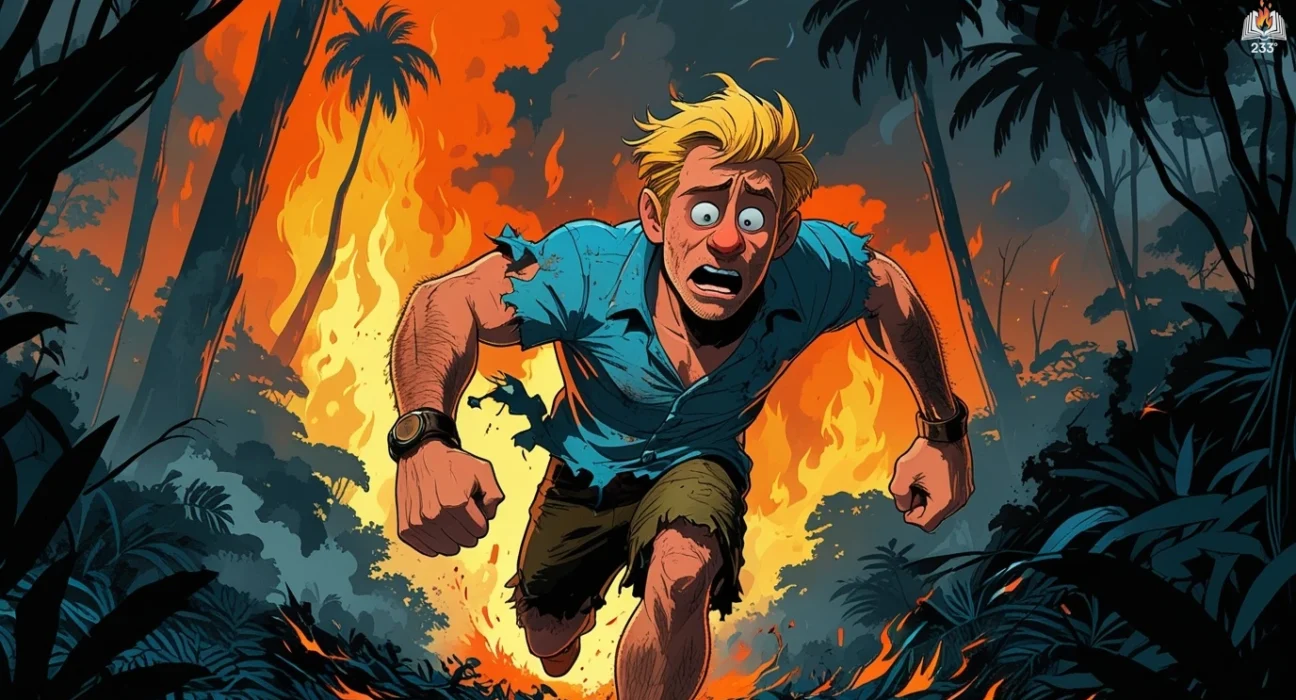
Ralph fled, his heart pounding with the realization that Jack’s tribe had crossed the final threshold into savagery. Alone and hunted, he navigated the jungle as the boys, now bloodthirsty predators, pursued him with sharpened spears and painted faces. The forest burned around him, flames consuming the island in a chaotic inferno. Trapped and desperate, Ralph stumbled onto the beach, expecting death.
Instead, he found salvation. A naval officer stood before him, his crisp uniform a stark contrast to the soot-streaked, wild-eyed boys who emerged from the jungle. The officer expressed surprise at the boys’ descent into barbarity, remarking on the civilized behavior expected of children. Overcome with relief and shame, Ralph wept for the loss of innocence, for Piggy, for Simon, and for the darkness revealed in their hearts.
The officer, gazing at the smoke-filled sky, prepared to bring the boys back to the world they had left behind. The island smoldered, a haunting reminder of the fragile line between order and chaos, and the savagery that lurks within us all.
Main Characters
Ralph: A fair-haired boy who is elected the group’s leader. Rational and idealistic, Ralph represents civilization and order, striving to establish rules and maintain a signal fire to ensure rescue. His arc reflects the fragility of societal structures under pressure.
Jack Merridew: Charismatic and domineering, Jack leads the choirboys and becomes Ralph’s rival. He embodies savagery and the lust for power, descending into violent tyranny as the story progresses.
Piggy: Intellectual but physically weak, Piggy is Ralph’s confidant. His glasses symbolize knowledge and rationality, which are often dismissed by the other boys. He represents the voice of reason and is tragically ignored.
Simon: A shy and introspective boy with a mystical connection to nature. Simon represents innate human goodness and spirituality, acting as a Christ-like figure whose insights are tragically misunderstood.
Roger: Quiet and sinister, Roger gradually reveals a sadistic nature. He represents unrestrained cruelty and the dark side of humanity, unchecked by societal constraints.
Sam and Eric (“Samneric”): Twins who are loyal to Ralph but are eventually coerced into Jack’s tribe. They symbolize the struggle of individuals torn between morality and survival.
The “Lord of the Flies”: A pig’s head on a stick, worshiped by the boys as a symbol of fear and savagery. It represents the inherent darkness within human beings.
Theme
Civilization vs. Savagery: The novel explores the conflict between the impulse to maintain order and the pull toward chaos and primal instincts. This struggle defines the boys’ descent into barbarism.
Loss of Innocence: Golding examines how isolation and survival reveal humanity’s darker instincts, stripping the boys of their childhood innocence and exposing their capacity for evil.
Power and Leadership: Through Ralph and Jack’s conflicting leadership styles, the novel critiques the dynamics of power, authority, and the susceptibility of groups to authoritarianism.
Fear and the Unknown: The boys’ fear of the “beast” symbolizes how humans often project inner fears onto external forces, creating monsters out of uncertainty.
The Duality of Human Nature: Golding illustrates the coexistence of civilization and savagery within individuals, revealing how thin the boundary between the two truly is.
Writing Style and Tone
Golding’s writing is rich in symbolism and allegory, with descriptive prose that vividly portrays the natural beauty and underlying menace of the island. His use of detailed imagery—whether describing the lush tropical landscape or the ominous descent into savagery—immerses readers in the boys’ experiences.
The tone shifts throughout the novel, beginning with an adventurous optimism before darkening into one of foreboding and despair. Golding employs omniscient narration to explore the psychological depth of his characters, using stark contrasts between innocence and brutality to emphasize the story’s moral weight. His language is deliberate and layered, inviting readers to reflect on the themes of human nature and societal fragility.
Quotes
Lord of the Flies – William Golding (1954) Quotes
“Maybe there is a beast... maybe it's only us.”
“Ralph wept for the end of innocence, the darkness of man's heart, and the fall through the air of the true, wise friend called Piggy.”
“The thing is - fear can't hurt you any more than a dream.”
“We did everything adults would do. What went wrong?”
“I think women are foolish to pretend they are equal to men, they are far superior [to men] and always have been.”
“The greatest ideas are the simplest.”
“Fancy thinking the Beast was something you could hunt and kill! You knew, didn’t you? I’m part of you? Close, close, close! I’m the reason why it’s no go? Why things are what they are?”
“What are we? Humans? Or animals? Or savages?”
“Sucks to your ass-mar!”
“If faces were different when lit from above or below -- what was a face? What was anything?”
“The world, that understandable and lawful world, was slipping away.”
“He found himself understanding the wearisomeness of this life, where every path was an improvisation and a considerable part of one's waking life was spent watching one's feet.”
“We've got to have rules and obey them. After all, we're not savages. We're English, and the English are best at everything.”
“They looked at each other, baffled, in love and hate.”
“The mask was a thing on it's own, behind which Jack hid, liberated from shame and self-conciousness.”
“Maybe," he said hesitantly, "maybe there is a beast." [...] "What I mean is, maybe it's only us.”
“They walked along, two continents of experience and feeling unable to communicate.”
“Which is better--to have laws and agree, or to hunt and kill?”
“I know there isn't no beast—not with claws and all that, I mean—but I know there isn't no fear, either." Piggy paused. "Unless—" Ralph moved restlessly. "Unless what?" "Unless we get frightened of people.”
“The rules!" shouted Ralph, "you're breaking the rules!" "Who cares?”
“He lost himself in a maze of thoughts that were rendered vague by his lack of words to express them. Frowning, he tried again.”
“People don't help much.”
“I believe man suffers from an appalling ignorance of his own nature. I produce my own view in the belief that it may be something like the truth.”
“the conch exploded into a thousand white fragments and ceased to exist.”
“I'm scared of him," said Piggy, "and that's why I know him. If you're scared of someone you hate him but you can't stop thinking about him. You kid yourself he's all right really, an' then when you see him again; it's like asthma an' you can't breathe...”
“Kill the pig. Cut her throat. Spill her blood.”
“His mind was crowded with memories; memories of the knowledge that had come to them when they closed in on the struggling pig, knowledge that they had outwitted a living thing, imposed their will upon it, taken away its life like a long satisfying drink.”
We hope this summary has sparked your interest and would appreciate you following Celsius 233 on social media:
There’s a treasure trove of other fascinating book summaries waiting for you. Check out our collection of stories that inspire, thrill, and provoke thought, just like this one by checking out the Book Shelf or the Library
Remember, while our summaries capture the essence, they can never replace the full experience of reading the book. If this summary intrigued you, consider diving into the complete story – buy the book and immerse yourself in the author’s original work.
If you want to request a book summary, click here.
When Saurabh is not working/watching football/reading books/traveling, you can reach him via Twitter/X, LinkedIn, or Threads
Restart reading!