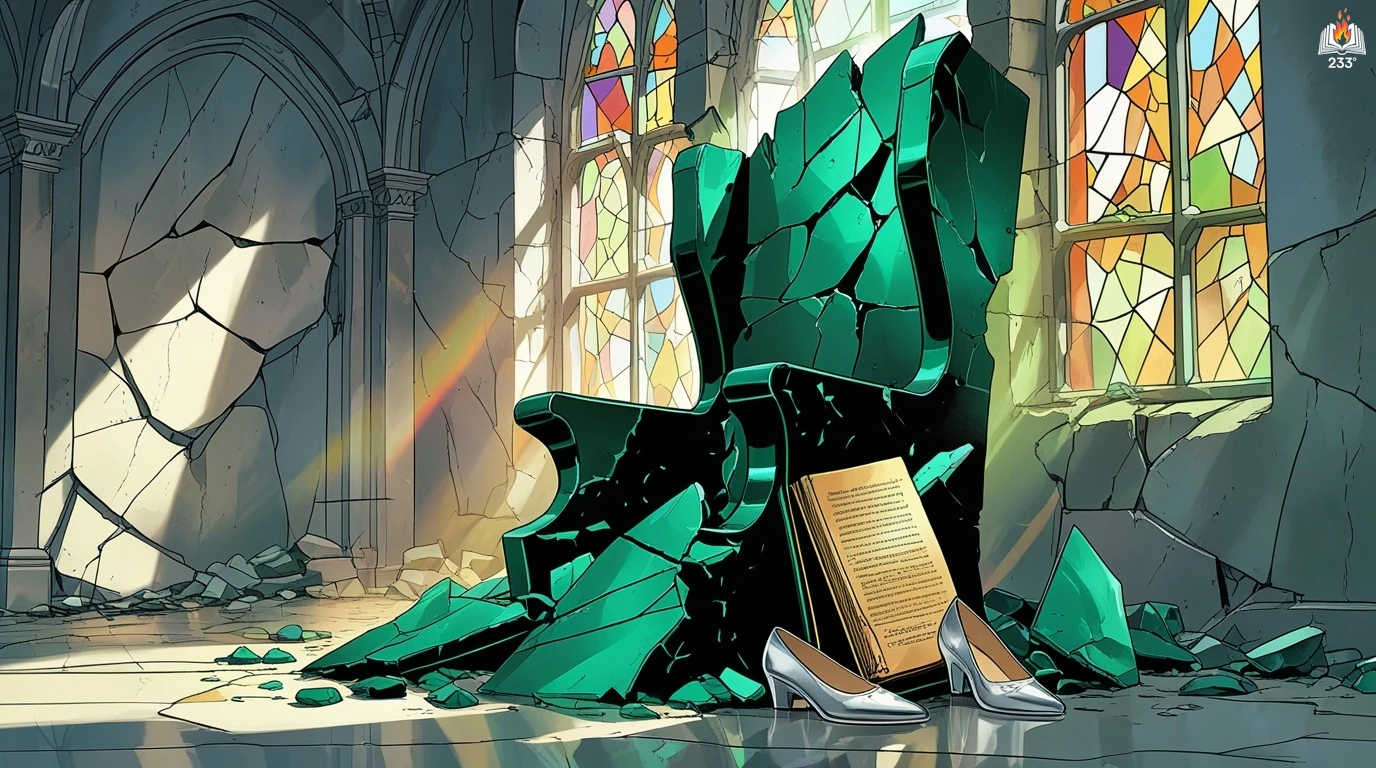
Poster Girl by Veronica Roth, published in 2022, is a chilling dystopian novel that examines surveillance, guilt, and redemption in a post-totalitarian society. Best known for her Divergent series, Roth delivers here a mature, introspective narrative centered on Sonya Kantor, once the poster child of a regime that has since crumbled, now imprisoned in the Aperture, a walled-off city for the remnants of that failed government.
Plot Summary
In a world shattered by the fall of the Delegation, Sonya Kantor, once the darling of government propaganda, lives behind the steel gates of the Aperture, a prison for the remnants of the old regime. Once, her face had adorned posters across the city, eyes shining with the promise of order and loyalty. Now, she tends rooftop gardens cobbled from salvaged wood and trades tomatoes in a crumbling market, her youth eroded by confinement and loss.
Inside the Aperture, life is a slow erosion. Buildings slump under the weight of memory and neglect. Neighbors like Nikhil, a kind-hearted fixer, and Mrs. Pritchard, ever clinging to old decorum, fill Sonya’s days with the small exchanges of survival. But the weight of the past, the image of her younger self smiling out from propaganda posters, lingers in every whispered taunt and every sideways glance. Sonya, once the Poster Girl, moves through the Aperture haunted by her own complicity, her guilt sharpened by loss – the deaths of her family, her fiancé, and the collapse of everything she once knew.
Hope flickers only faintly, mostly in the form of the Children of the Delegation Act, a government decree that releases those imprisoned as minors during the fall. Sonya, at seventeen when the gates closed, narrowly missed that cut. She watches as younger residents like Nicole step through the dilating gates into a world unknown, her own chance for freedom locked away by a technicality and a past she cannot shake.
But change arrives in the figure of Alexander Price, once a betrayer of her family, now a representative of the new order. He enters Sonya’s crumbling apartment, casual in his intrusion, holding an offer of conditional freedom. The government has lost something – someone – and they want Sonya to find it. In exchange, they promise her release. To Sonya, the offer is a blade pressed between old wounds. She has no reason to trust Alexander, no reason to help the government that still holds her captive, and yet the possibility of freedom hums beneath her skin.
As the weight of the proposal settles, Sonya moves through her familiar world with new unease. The rooftops, the market, the garden beds where dead plants are cleared for winter – everything feels thinner, more fragile. The government’s annual visit to the Aperture arrives with its parade of well-dressed officials and polished smiles. Sonya stands beneath dimming lights, changing bulbs at Mrs. Pritchard’s anxious request, when one official recognizes her. The girl from the propaganda posters. Laughter, sharp and cold, slices through the air, and Sonya clenches her jaw, the words of her past twisting back to choke her.
Against Nikhil’s gentle encouragement, Sonya wrestles with her choice. Once, she had been a symbol of compliance, of youthful loyalty to a system that thrived on fear. Could she now become a seeker of truth, a figure of change? Her days are filled with the rhythm of small tasks – fixing stoves, tending gardens, helping elderly neighbors – yet the pulse of the outside world beats louder. Newspapers smuggled into the Aperture whisper of the Analog Army, a rebel faction attacking technology itself. The past is no longer something Sonya can avoid; it is clawing its way through the cracks.
At last, she yields, not to the promises of freedom, but to the quiet hunger inside her for redemption. The government’s task is revealed: to find Grace Luther, the missing daughter of a Delegation leader. Grace had vanished into the Aperture’s labyrinth, a ghost among the forgotten. Sonya moves through the underbelly of her world – abandoned apartments marked by grief, residents clinging to broken heirlooms, and the weight of names carved into walls. Her search becomes more than a mission; it becomes an excavation of memory and guilt.
The trail leads Sonya through encounters thick with unspoken history. Graham Carter, a hoarder of relics, offers clues with his distracted murmurs. The younger men of Building 2, restless and reckless, circle her path with suspicion and bitter humor. Old friends like Renee and Douglas float on the edges, their lives shaped by acceptance, denial, or rebellion. And through it all, Sonya carries the bitter taste of her own past – the dead fiancé, the betrayed parents, the childhood that was never fully her own.
As she draws closer to Grace’s hiding place, Sonya uncovers more than a fugitive; she uncovers a mirror. Grace, a girl shaped by the same machine that shaped Sonya, has slipped into the shadows not out of malice but out of fear, out of the desperate need to carve a life outside the ruins of a corrupt system. The confrontation between them is quiet, marked not by grand speeches but by the shared understanding of what it means to be devoured by history.
Sonya makes her choice. She delivers Grace to the government, but it is not a triumph. The taste of victory is ash on her tongue, the weight of betrayal pressing fresh onto her shoulders. The promise of freedom comes with a hollow ring. As the gates open and sunlight spills in, Sonya steps forward not as the girl from the posters, but as the woman she has scraped together from the rubble of her past.
Outside, the world waits – unfamiliar, unfinished. Sonya carries no illusions. Freedom is no clean slate, and the past lingers like dust in her lungs. But as she walks forward, the ache of survival gives way to the sharp breath of possibility. The world beyond the Aperture hums with its own kind of decay and renewal, and Sonya, no longer anyone’s poster girl, steps into it with eyes open, a woman stitched together by guilt, memory, and the quiet determination to endure.
Main Characters
Sonya Kantor: Once the beautiful face of the Delegation’s propaganda, Sonya is now a haunted, pragmatic survivor in the Aperture. She grapples with guilt over her past privilege and complicity, wrestling with her own moral awakening and search for redemption. Over the course of the novel, Sonya evolves from passive prisoner to someone determined to reclaim her agency.
Alexander Price: A former resistance member with complicated ties to Sonya’s past, Alexander offers her a chance at freedom, but his motives are layered with past betrayals and current manipulations. His interactions with Sonya are marked by tension, regret, and political calculation.
Nikhil Price: An aging, wise figure and mentor in the Aperture, Nikhil helps Sonya find purpose amidst their constrained world. His quiet resilience and steady presence offer Sonya both practical guidance and emotional grounding.
Nicole: A younger resident soon to be freed under the Children of the Delegation Act, Nicole’s departure acts as a catalyst for Sonya, forcing her to reflect on her own captivity and lost chances.
Mrs. Pritchard: A widowed neighbor, embodying the lingering traces of the old order, Mrs. Pritchard clings to etiquette and control, often mirroring the kind of societal performance Sonya is learning to shed.
Theme
Surveillance and Control: The omnipresent “Insight” implants symbolize the invasive surveillance of the Delegation. Even after the regime’s collapse, its legacy lingers, with the Aperture itself functioning as a living monument to control and observation.
Guilt and Redemption: Sonya’s journey is shaped by her deep guilt over her past complicity. Roth explores whether redemption is possible for those entangled in oppressive systems and whether good intentions can erase complicity.
Freedom and Confinement: Physical imprisonment in the Aperture mirrors the characters’ internal prisons of regret, grief, and fear. Roth probes what it means to be free – whether it’s physical release or liberation from guilt and societal roles.
Memory and Identity: Sonya’s recollections of life before the fall – her family, her former fiancé Aaron, and her public image – highlight the tension between personal memory and public identity, questioning whether one can escape the past.
Decay and Survival: The crumbling world of the Aperture is both literal and symbolic. Roth uses the setting’s decay to underscore human resilience and the stubborn will to survive even in the most hopeless conditions.
Writing Style and Tone
Veronica Roth’s prose in Poster Girl is sharp, restrained, and atmospheric, often balancing introspection with tension. The writing leans heavily on interiority, immersing readers in Sonya’s conflicted mind, while maintaining a crisp, cinematic depiction of the dystopian world. Roth’s choice of first-person narration pulls readers into Sonya’s immediate experience, making every moment feel taut and personal.
The tone is reflective and elegiac, with a pervasive undercurrent of sorrow. Roth carefully balances bleakness with quiet moments of beauty and connection, never allowing the novel to drown in despair. Even in the cold austerity of the Aperture, small details – the sweetness of a tomato, the warmth of community, the ache of memory – shimmer with life. This creates a mood that is at once somber and hopeful, forcing readers to grapple with the complexities of justice, punishment, and forgiveness.
Quotes
Poster Girl – Veronica Roth (2022) Quotes
“It is the symptom of a disease that still infects our population--the desire to make everything easy, to sacrifice autonomy and privacy for convenience. That's what technology is, Ms. Kantor. A concession to laziness and the devaluing of human effort”
“If your every choice is in defiance of a system, you are as much a servant of that system as someone who obeys it.”
“The thing about zealots is how much hypocrisy they can justify.”
“Trades rely on trust, the belief that if you give what you agree to give, you will receive what is promised.”
“Just because you’re not committing a crime now, by going where you go, by seeing who you see, doesn’t mean that another government, another set of people with another set of priorities, won’t come along and call you a criminal one day.”
“Never a scribe to carelessness that which can be adequately explained by shame.”
“It seems to me, that if your every choice is in defiance of a system, you are as much a servant of that system as someone who obeys it.”
“You're like... a piece of paper, looks blank and pale and boring, but if you handle it wrong, it'll cut the shit out of you.”
“I hope you keep living for a long time. I hope you think of him every minute. I hope you inhale the pain of missing him and exhale the guilt of betraying him.”
We hope this summary has sparked your interest and would appreciate you following Celsius 233 on social media:
There’s a treasure trove of other fascinating book summaries waiting for you. Check out our collection of stories that inspire, thrill, and provoke thought, just like this one by checking out the Book Shelf or the Library
Remember, while our summaries capture the essence, they can never replace the full experience of reading the book. If this summary intrigued you, consider diving into the complete story – buy the book and immerse yourself in the author’s original work.
If you want to request a book summary, click here.
When Saurabh is not working/watching football/reading books/traveling, you can reach him via Twitter/X, LinkedIn, or Threads
Restart reading!