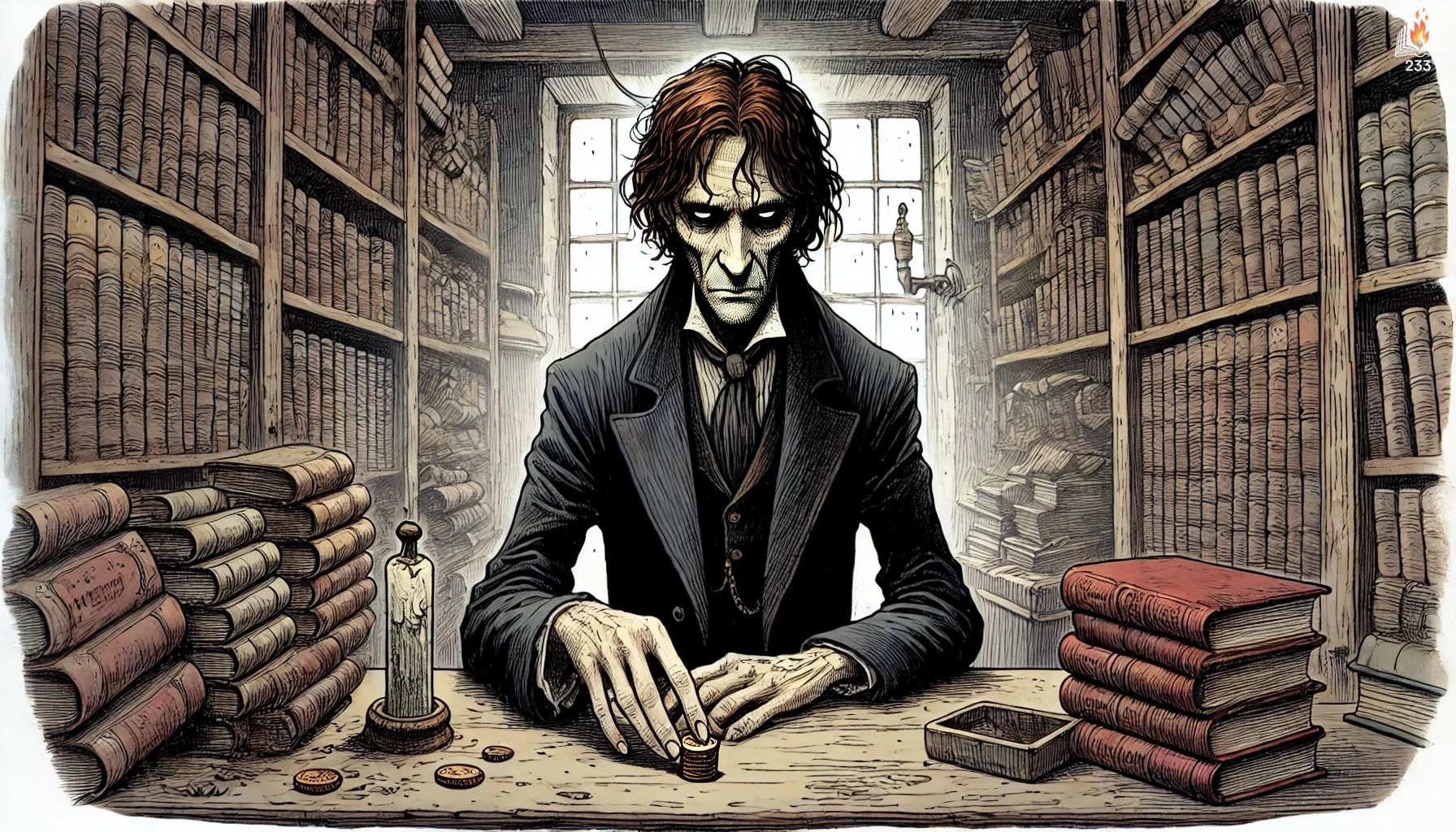
Making Money, published in 2007 by Terry Pratchett, is the 36th book in the acclaimed Discworld series, a satirical fantasy saga blending sharp wit, social commentary, and whimsical storytelling. This installment follows the exploits of conman-turned-civil servant Moist von Lipwig as he is coaxed into revitalizing the crumbling Royal Bank of Ankh-Morpork, following his earlier success in reforming the city’s postal service.
Plot Summary
Moist von Lipwig was doing very well, considering he’d once been hanged. Only mostly hanged, true, and by the sort of benevolent tyranny that believes in second chances as long as one doesn’t mind the occasional dangling threat. After turning Ankh-Morpork’s decrepit postal service into a sleek, humming machine of communication and postage stamps, he had settled into the tedium of honest work. Which, as it turned out, was its own kind of prison.
The Post Office ran on time. It employed staff who were largely vertical and breathing. Letters traveled, parcels arrived, and Moist was slowly suffocating under layers of committee reports and civic responsibility. That was when Lord Vetinari, the city’s Patrician and professional chessmaster of people, presented Moist with a gift: a new opportunity to teeter on the edge of doom. The Royal Bank and the Royal Mint, two venerable institutions burdened by tradition, class, and a quantity of gold that had long since stopped being useful, were now his to save. Or ruin. The city would accept either, as long as it was entertaining.
The bank had been ruled by the Lavish family for generations, culminating in the very sudden death of Sir Joshua Lavish – not unpleasant, considering it involved oysters and someone named Honey. His widow, Topsy Lavish, now owned the controlling shares of the bank. More accurately, her small dog Mr. Fusspot did, since she had left everything to the dog out of sheer spite and revolutionary flair. Moist, without ever signing anything, became both the master of the Mint and the guardian of a canine chairman.
His entry into the bank was not met with applause. Mr. Bent, the chief cashier, greeted Moist with a smile so rigid it could have doubled as a blade. Bent worshipped gold, numbers, and propriety in that order, and had about as much flexibility as a steel rod in a snowdrift. The bank itself was a temple to staleness – rows of sage-green desks, whispers echoing under a dome of velvet reverence, and clerks who treated misfiled ledgers as moral failures.
Moist discovered quickly that the bank was more than simply outdated. It was teetering. The gold standard had become a golden ball and chain, limiting circulation, stifling commerce, and causing people to hoard coins in old socks. Even the Royal Mint, the grand machine that produced currency, barely broke even. There were mites, tuppenny pieces, and elusive elims – coins so small and costly they bordered on conceptual art. Golems ran the treadmill that powered the Mint, widow women engraved details under candlelight, and most of the real work was farmed out to families who had minted coins for generations without questioning why their work didn’t seem to pay much.
Moist, of course, was not a man to be chained by tradition. His criminal mind saw what the bankers could not – that money was belief, not metal. He proposed an idea so radical it was practically illegal: issuing banknotes, pieces of paper backed not by gold but by trust and common sense. Naturally, this caused outrage. Bent nearly had an aneurysm. The board of directors murmured and scowled. But then Moist did what he did best – he sold the dream.
Behind the scenes, things were less tidy. Mr. Bent was unraveling, haunted by a past he had buried under layers of accounting. A chance encounter revealed that Bent was once a music hall performer, shamed and ridiculed, who had reinvented himself through numbers and the authority of gold. When he finally collapsed under the pressure of a financial scandal, Moist took the reins fully. But instead of firing Bent, he restructured the entire institution around transparency and efficiency, turning shame into strength and mistakes into a lesson for the whole city.
Meanwhile, Adora Belle Dearheart, Moist’s acerbic and chain-smoking fiancée, was off in Überwald digging up secrets of her own. Golems were being found in ancient mines, silent watchers from forgotten civilizations. She was orchestrating a new future for these clay workers, one that challenged guild monopolies and legal definitions of personhood. Her war was of purpose, not profit, and though she remained at the edges of Moist’s banking drama, her influence was always felt – a grounding voice amid the gold dust.
To bring the bank into the present, Moist staged a spectacular demonstration. He had the golem-powered Mint print the first batch of banknotes under heavy security, launched with a public spectacle worthy of a royal wedding. The people of Ankh-Morpork, drawn by Moist’s flair and charisma, embraced the notes. They were lighter than coins, prettier than stamps, and promised not only value but hope.
But no good deed goes unpunished. Cosmo Lavish, the megalomaniacal cousin of the late Sir Joshua, believed himself the true heir to the bank. Obsessed with Vetinari and driven mad by envy, Cosmo plotted Moist’s downfall. He forged documents, employed thugs, and even attempted to impersonate the Patrician himself. His downfall, poetic in its absurdity, involved a self-inflicted collapse brought on by trying to wear Vetinari’s shoes – quite literally – and losing touch with reality entirely.
In the end, the bank was reborn. Moist had turned the stodgiest institution in the city into a place where paper spoke louder than metal, and trust meant more than weight. Mr. Bent returned to his post, no longer hiding from his past. Topsy Lavish, relieved of power, retired to a life of gleeful irrelevance. And Mr. Fusspot remained a most content and powerful dog.
Moist von Lipwig, once a hanged man, now walked through the halls of finance as the master of invisible money. The city whispered his name with awe, fear, and a tinge of envy. He had made money – not just coins and notes, but a living system that pulsed with belief. And in Ankh-Morpork, belief was the most valuable currency of all.
Main Characters
Moist von Lipwig – A charming former swindler who has been coerced into respectability by Lord Vetinari. Moist thrives on risk and illusion, bringing a performer’s flair to every bureaucratic post he holds. Now managing the Royal Bank, he grapples with both financial reform and his criminal instincts.
Lord Havelock Vetinari – The Patrician of Ankh-Morpork, a calculating and supremely intelligent ruler. With subtle manipulations and an understanding of psychological leverage, he ensures that Moist remains a useful tool for civic reform.
Adora Belle Dearheart – Moist’s sharp-tongued, chain-smoking fiancée and a passionate advocate for golems’ rights. She maintains a complicated relationship with Moist, marked by mutual respect and stark honesty.
Mr. Bent – The fastidious and secretive chief cashier of the Royal Bank, obsessed with gold and propriety. His backstory and personal eccentricities add unexpected depth and mystery to the financial institution.
Topsy Lavish – The newly minted (pun intended) chairwoman of the bank and guardian of a dog who technically owns the bank. A parody of banking inheritance and legal absurdities.
Gladys – A golem undergoing a peculiar transformation into femininity, providing comic relief and social commentary on gender and labor.
Theme
Value vs. Perception – A core theme questions what makes something valuable – is it intrinsic like gold, or perceived, like faith in currency? Moist challenges society’s fixation on gold by introducing the idea that belief in money is more powerful than its physical form.
Identity and Reinvention – Moist constantly grapples with his dual identity as a reformed criminal and a respected official. The book explores how society views redemption and whether people can truly change.
Power of Bureaucracy and Systems – Pratchett satirizes institutions, especially banking and government, revealing how rules, traditions, and paperwork can mask absurdities and enable exploitation.
Freedom and Manipulation – Vetinari’s control over Moist illustrates a subtle form of tyranny, posing philosophical questions about freedom when choices are manipulated so deftly.
Gender Roles and Social Expectations – Through characters like Gladys and Adora Belle, the novel critiques gender norms and the expectations society imposes, even on magical clay beings.
Writing Style and Tone
Terry Pratchett’s style in Making Money is unmistakably his own – witty, erudite, and densely packed with irony. He masterfully weaves humor into serious commentary, using puns, wordplay, and clever dialogue to expose the follies of modern institutions. Pratchett often relies on footnotes and asides to break the fourth wall, adding an informal, conversational touch that engages the reader in both the story and its satirical implications.
The tone of the novel is both comedic and critical. Pratchett never shies away from skewering societal structures, but he does so with warmth and a sense of fun. His narratives are layered: while the surface is a rollicking fantasy adventure, beneath lies a razor-sharp dissection of real-world economics, politics, and morality. In Making Money, this duality is especially potent, as the trappings of fantasy cloak an astute examination of modern banking.
Quotes
Making Money – Terry Pratchett (2007) Quotes
“Insanity is catching.”
“It was sad, like those businessmen who came to work in serious clothes but wore colorful ties in a mad, desperate attempt to show there was a free spirit in there somewhere.”
“A weapon you held and didn't know how to use belonged to your enemy.”
“Watching a dog try to chew a large piece of toffee is a pastime fit for gods. Mr. Fusspot's mixed ancestry had given him a dexterity of jaw that was truly awesome. He somersaulted happily around the floor, making faces like a rubber gargoyle in a washing machine.”
“Students, eh? Love 'em or hate 'em, you can't hit them with a shovel!”
“You get a wonderful view from the point of no return.”
“People don't like change. But make the change fast enough and you go from one type of normal to another.”
“I wouldn't trust you with a bucket of water if my knickers were on fire!”
“And what had he wanted? He'd never sat down to think about it. But mostly, he wanted yesterday to be different from today.”
“But what's worth more than gold?" "Practically everything. You, for example. Gold is heavy. Your weight in gold is not very much gold at all. Aren't you worth more than that?”
“Building a temple didn't mean you believed in gods, it just meant you believed in architecture.”
“Whole new theories of money were growing here like mushrooms: in the dark and based on bullshit.”
“He sighed. It had come to this. He was a responsible authority, and people could use terms like "core values" at him with impunity. ”
“The only really sane person in there is Igor, and possibly the turnip. And I'm not sure about the turnip.”
“Mr Lipwig, there's a lady in the hall to see you and we've thanked her for not smoking three times and she's still doing it!”
“This looks like a job for inadvisably applied magic if ever I saw one.”
“A banker ? Me ?" "Yes, Mr. Lipwig." "But I don't know anything about running a bank!" "Good. No preconceived ideas." "I've robbed banks!" "Capital! Just reverse your thinking," said Lord Vetinari, beaming. "The money should be on the inside .”
“You're not going to tell me they built fifty-foot-high killer golems, are you?" "Only a man would think of that. It's our job," said Moist. "If you don't think of fifty-foot-high killer golems first, someone else will.”
“He’d forgotten the ancient wisdom: take care, when you are closely observing, that you are not closely observed.”
“I think it is just a matter of getting into the mind of the writer,” Vetinari went on, looking at a letter covered with grubby fingerprints and what looked like the remains of someone’s breakfast. He added: “In some cases, I imagine, there is a lot of room.”
“Plans can break down. You cannot plan the future. Only presumptuous fools plan. The wise man steers.”
“The gods help those who help themselves, and my word, didn't I help myself.”
“Why are you always in such a hurry, Mr. Lipwig?” “Because people don’t like change. But make the change happen fast enough and you go from one type of normal to another.”
“There was no himself in himself.”
“I'm an Igor, thur. We don't athk quethtionth." "Really? Why not?" "I don't know, thur. I didn't athk.”
“The Igor position on prayer is that it is nothing more than hope with a beat to it.”
We hope this summary has sparked your interest and would appreciate you following Celsius 233 on social media:
There’s a treasure trove of other fascinating book summaries waiting for you. Check out our collection of stories that inspire, thrill, and provoke thought, just like this one by checking out the Book Shelf or the Library
Remember, while our summaries capture the essence, they can never replace the full experience of reading the book. If this summary intrigued you, consider diving into the complete story – buy the book and immerse yourself in the author’s original work.
If you want to request a book summary, click here.
When Saurabh is not working/watching football/reading books/traveling, you can reach him via Twitter/X, LinkedIn, or Threads
Restart reading!