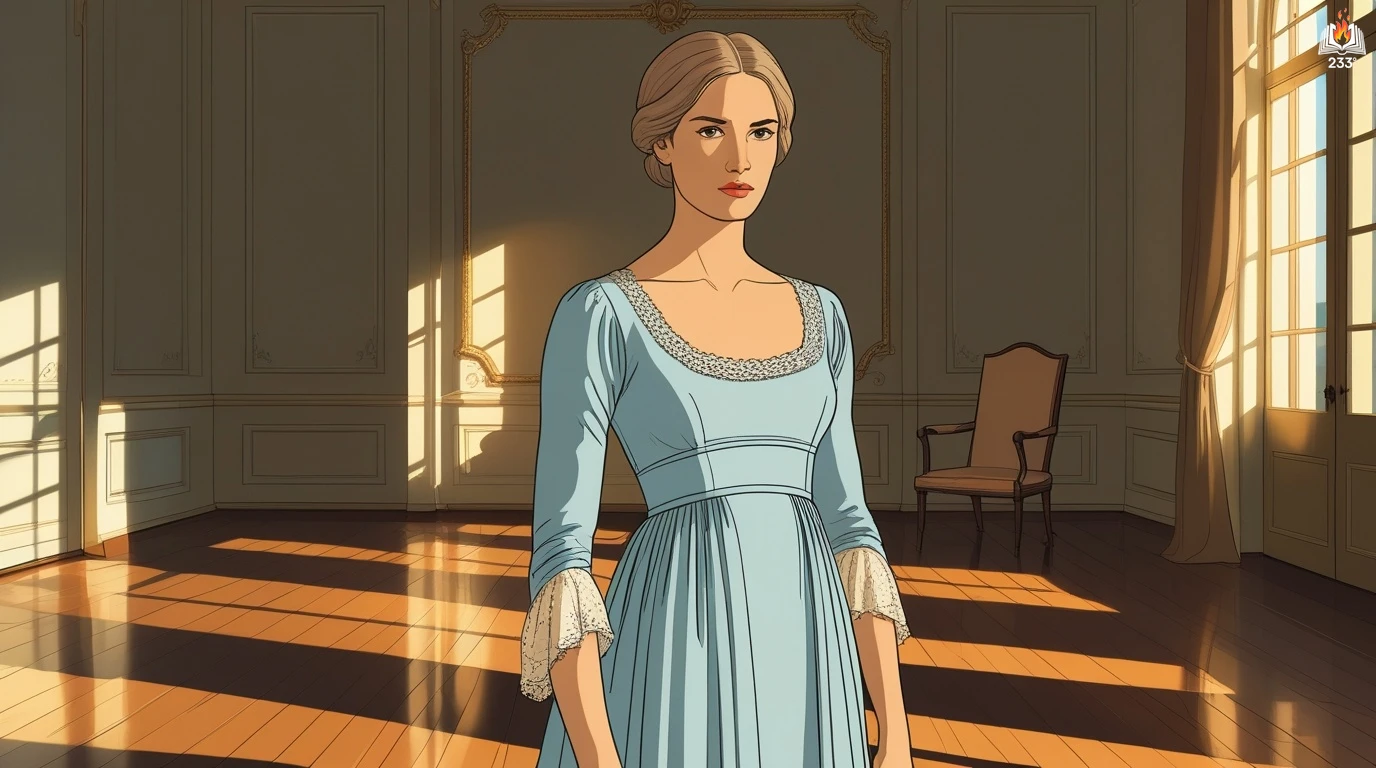
The Girl with the Make-Believe Husband by Julia Quinn, published in 2017, is the second installment in the beloved Rokesbys series – a prequel to the famous Bridgerton saga. Set against the turbulent backdrop of the American Revolutionary War, this historical romance tells the story of Cecilia Harcourt, a determined Englishwoman who crosses the Atlantic in search of her injured brother and instead finds herself pretending to be the wife of his closest friend. Rich in emotion, secrets, and slow-burning passion, the novel blends historical drama with Quinn’s trademark wit and heart.
Plot Summary
On the war-ravaged shores of Manhattan Island in 1779, Captain Edward Rokesby lay unconscious in a makeshift hospital, battered by an injury and haunted by shadows of memories he could no longer recall. His waking was a storm of confusion – aching head, a forgotten past, and a green-eyed woman claiming to be his wife. She sat beside him with quiet strength, tending him with gentle hands and lemon-scented warmth, the kind that whispered of home. Her name was Cecilia, and according to the commanding officer, Colonel Stubbs, she was Mrs. Rokesby. But in Edward’s fractured mind, nothing about her – not her face, not her touch – stirred recognition. Only her name rang familiar, like the signature on a letter he had once treasured.
Cecilia Harcourt, a determined young woman from Derbyshire, had crossed an ocean under false pretenses. Her brother Thomas, Edward’s closest friend, had gone missing in the colonies. With her father dead and her inheritance under threat by a predatory cousin, Cecilia had made the only reckless decision of her life – she followed her brother into a war zone. Denied access to Edward in the hospital and desperate to uncover Thomas’s fate, she claimed to be Edward’s wife. It was a lie that opened doors and shackled her heart with guilt, a deception she intended to shed the moment Edward awoke. But when he did, disoriented and vulnerable, he accepted her presence, grasping for anything solid amidst the wreckage of his memory.
What began as a ruse quickly became an uneasy alliance. Edward, despite his doubts and missing months, felt a pull toward Cecilia – an echo of the connection they had forged through their long correspondence. The quiet wit she had once woven into letters now shone in her everyday gestures. She was warm, pragmatic, and fiercely devoted, not only to her brother but, it seemed, to him as well. Their days were laced with unspoken tension, each touch a careful negotiation of truth and affection. Edward’s instincts warred with his uncertainty. He wanted to protect her, to comfort her, even as he struggled to place her in the fog of his mind.
The army, pressed for space, released Edward into Cecilia’s care, and the two were housed at the Devil’s Head Inn – an unremarkable place, except for the soft hush of intimacy that settled between them. Sharing a room, their proximity grew charged. Edward, still unaware of the lie, found himself studying the curve of her smile, the defiance in her gaze, the sadness she tried so hard to hide. Cecilia, torn between the necessity of her deceit and the affection blooming in Edward’s presence, continued to play the part of wife, even as her conscience withered under its weight.
Edward’s memory remained elusive, but his instincts remained sharp. Her touch was familiar, her voice soothing, and the pain in his skull seemed lessened in her presence. And yet, doubts crept in. Small details – a mismatched memory here, a misstep in a tale there – began to stir questions. But Edward, gentleman to the bone, chose to trust the woman who sat by his bed each night, who wiped his brow when fever struck, who looked at him not with fear, but with fierce belief.
While the war churned outside their window and soldiers marched beneath the inn’s flickering lanterns, inside their shared quarters, something tender unfolded. They spoke of family, of Thomas, of quiet things that made two strangers feel like something more. In the late hours, their conversations veered toward dreams they had never voiced aloud. There were no grand declarations, just the rustle of shifting emotions and the crackle of desire laced with restraint. Edward kissed her, hesitantly, reverently – a kiss that neither confirmed the past nor predicted the future, but belonged entirely to the aching present.
Still, the truth loomed like a blade above them. Cecilia’s deception weighed heavier with each passing day. The search for Thomas remained fruitless, and Edward’s fragmented memory refused to yield answers. Major Wilkins, a smug and meddlesome officer, poked holes in her story, forcing Cecilia to navigate a maze of careful lies. And all the while, Edward began to suspect that the woman he might be falling in love with was not telling him everything.
Then came the moment when Edward’s memory stirred – not a flood, but a drop, a flicker. He remembered leaving for Connecticut on a secret mission. He remembered the tension in his orders, the urgency of his task. But still, the weeks between then and now remained a chasm. And Cecilia – her presence, her claim – didn’t fit within it. The pieces didn’t align, and his instincts, honed on battlefields and diplomacy, could no longer ignore the inconsistencies.
Cecilia confessed. There, in the room that had held both her deepest guilt and greatest solace, she unraveled the truth. She had never been his wife. The marriage had been a fiction spun from desperation, a lie meant to get her into the hospital, a means to an end. She had meant to tell him from the start, but then he’d looked at her with trust, with tenderness, and she’d been too afraid to break the spell.
Edward listened in silence. Hurt flickered behind his eyes, but it was quickly eclipsed by something else – understanding. He saw her then, not as a liar, but as a sister grieving her brother, a woman abandoned by the world and clinging to the only hope she had. His pride stung, but his heart – the one that had grown inexplicably, steadily tethered to her – could not turn cold.
Together, they continued the search for Thomas, their bond tempered by honesty at last. Their shared days were no longer built on pretense but on the raw, uncertain tenderness of two souls who had come together in the ruins of war. The memory of their supposed marriage faded beneath the real affection that blossomed in its place. Edward found himself watching her not as a patient in need of comfort, but as a man choosing the woman who had once lied to him – and who, despite it all, had become his truth.
And when word finally came – of Thomas, of safety, of the war turning its tide – there was no need for pretense anymore. What began as a lie born of desperation had bloomed into a love neither had planned. They had found each other through ink and paper, through injury and healing, through lies and forgiveness. And in the end, there was no doubt.
They had chosen each other.
Main Characters
Cecilia Harcourt – A fiercely loyal and clever young woman from Derbyshire, Cecilia is driven by duty and desperation. When her brother goes missing in the American colonies, she bravely sets sail to find him. Faced with indifference and closed doors, she claims to be the wife of his injured friend Edward Rokesby to gain access and care for him. Cecilia is witty, resourceful, and guided by a strong moral compass, even as she finds herself caught in a web of deception and growing affection.
Captain Edward Rokesby – A noble and principled British officer, Edward is the second son of an earl. After sustaining a serious head injury in the war, he wakes with no memory of the past few months and is stunned to learn he’s supposedly married to Cecilia Harcourt. His confusion turns into curiosity, and gradually into something deeper. Edward is charming, honorable, and emotionally intelligent, with a deep sense of loyalty and a quietly commanding presence.
Thomas Harcourt – Cecilia’s beloved brother and Edward’s best friend, Thomas is the missing link between the two protagonists. Though absent for most of the novel, his character looms large, shaping Cecilia’s motivations and Edward’s loyalties. Through letters and memories, his warmth, humor, and love for his sister are vividly conveyed.
Colonel Stubbs – Edward’s stern commanding officer, a pragmatic man of authority. Stubbs plays a key role in validating Cecilia’s claims and enabling her presence in the hospital, though he often prioritizes military protocol over individual needs.
Major Wilkins – A self-important and dismissive officer, he initially hinders Cecilia’s search for her brother. Later, he reappears as a foil to highlight Cecilia’s growing confidence and social maneuvering.
Theme
Identity and Deception – Central to the narrative is the lie Cecilia tells – that she is Edward’s wife – and the moral and emotional complexities that arise from this deception. The novel explores how identity can be reshaped by desperation, love, and circumstance, and how truth eventually demands confrontation.
Memory and Loss – Edward’s amnesia serves as both plot device and theme. His lost memories mirror Cecilia’s emotional dislocation and her grief over her father and brother. Together, they must piece together what’s real and what’s imagined in their budding relationship.
Duty and Sacrifice – Both protagonists act out of duty: Cecilia to her brother and moral integrity, Edward to his country and sense of honor. Their sacrifices reveal character and deepen their bond. The setting during wartime intensifies the stakes and underscores the personal costs of larger conflicts.
Love Born from Letters – Their emotional connection, built over months of shared correspondence, emphasizes how intimacy can bloom without physical presence. The epistolary foundation of their relationship lends poignancy and depth to their eventual romance.
Writing Style and Tone
Julia Quinn’s writing in The Girl with the Make-Believe Husband maintains her hallmark blend of historical authenticity and romantic charm. Her prose is elegant yet accessible, laced with wit, inner monologues, and vibrant dialogue that feels both period-appropriate and emotionally resonant. She excels at pacing – unfolding the narrative in a way that balances slow-burn romantic tension with moments of levity and urgency. The story is as much about emotional revelation as it is about external conflict.
The tone of the novel is warm and intimate, occasionally tinged with melancholy but always hopeful. Quinn’s use of humor, even in moments of darkness or uncertainty, prevents the story from becoming too heavy. She crafts a lush, immersive atmosphere, drawing readers into the late 18th-century world with rich details, from the colonial setting of war-torn New York to the rigid social structures Cecilia defies. Through both Cecilia and Edward’s perspectives, Quinn conveys vulnerability, confusion, longing, and eventually, deep love – all with a tone that feels honest and tender.
Quotes
The Girl with the Make-Believe Husband – Julia Quinn (2017) Quotes
“Change what you can and accept what you can't.”
“...So when the weather wasn't too overbearingly hot he tucked her arm in the crook of his elbow, and they walked about town, running errands and asking questions. And falling in love”
“This letter is for both of you. I am so glad you have each other. The world is a kinder place when one's burdens can be shared.”
“It occurred to him that perhaps he ought not to have married a woman with such extraordinary eyes.”
“It's bacon. How can anything in the world seem bleak when one is eating bacon?”
“Change what you can, he’d once told her, and accept what you can’t.”
“The loss of hope versus the certainty of truth. It’s not an easy judgment to make.”
“She took pride in her newfound calluses. They seemed to say that she was capable, that she could take control of her own destiny. She saw strength in her hands, strength she had not known she possessed.”
“was somehow even more heartbreaking. “I wonder if it would be easier,” she said, “knowing for sure.” “I don’t know. The loss of hope versus the certainty of truth. It’s not an easy judgment to make.”
“Anything I could get my hands on. Thomas liked to call me a bookworm.” “More of a book dragon, I should think.” She laughed. “Why would you say that?” “You are far too fierce to be a lowly worm.”
“When he kissed her, he tasted the promise of redemption.”
“How can anything in the world seem bleak when one is eating bacon?”
“The loss of hope versus the certainty of truth.”
“In other words, they were all plumb crazy.”
“The summer air in the colonies had an unpleasant solid quality to it. Rather like fog, if one heated it to the temperature of one’s body.”
“But you hate each other,” Edward protested. “Not nearly so much as we love each other,” Billie said.”
“Thomas liked to call me a bookworm.” “More of a book dragon, I should think.” She laughed. “Why would you say that?” “You are far too fierce to be a lowly worm.”
“Shall you tell him or shall I?” Billie said. George took a breath. “Well, now that is quite a story . . .”
We hope this summary has sparked your interest and would appreciate you following Celsius 233 on social media:
There’s a treasure trove of other fascinating book summaries waiting for you. Check out our collection of stories that inspire, thrill, and provoke thought, just like this one by checking out the Book Shelf or the Library
Remember, while our summaries capture the essence, they can never replace the full experience of reading the book. If this summary intrigued you, consider diving into the complete story – buy the book and immerse yourself in the author’s original work.
If you want to request a book summary, click here.
When Saurabh is not working/watching football/reading books/traveling, you can reach him via Twitter/X, LinkedIn, or Threads
Restart reading!