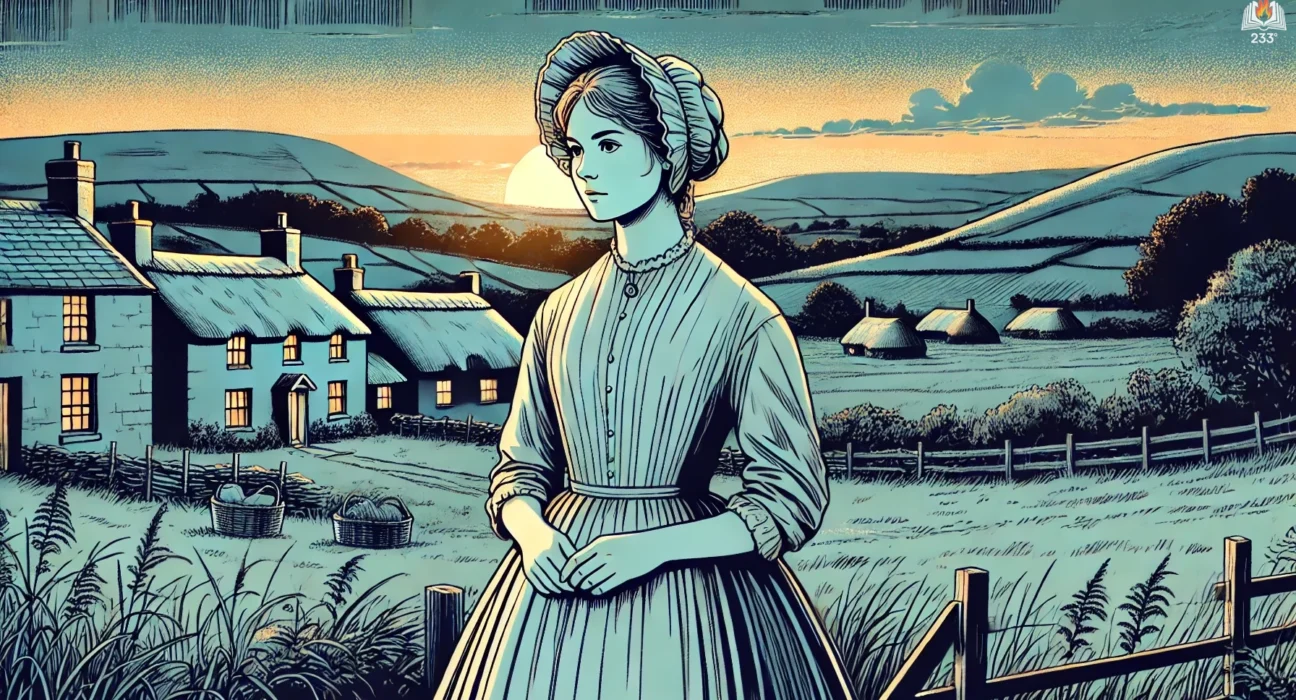
“Tess of the d’Urbervilles” by Thomas Hardy is a classic of English literature that examines the life of Tess Durbeyfield, a young woman from a rural English village whose beauty, heritage, and moral strength lead her through hardships of love, betrayal, and societal judgment. Written in 1891, this novel, set in Hardy’s fictional Wessex, reflects the themes of naturalism and Victorian society’s challenges, particularly for women, and remains a timeless exploration of character and fate.
Plot Summary
In the lush Vale of Blackmoor, young Tess Durbeyfield learns of her noble lineage, a descent from the ancient d’Urbervilles, when Parson Tringham informs her father, John Durbeyfield, of this lineage. John, a proud yet indolent man, revels in this newfound pride, though he has neither the means nor the social standing to elevate his family. However, the news stirs a yearning in Tess’s mother, Joan, who dreams of using their heritage to improve their fortunes, especially by marrying Tess into a more prosperous life. Tess, the eldest daughter, bears the weight of these hopes and expectations even as she remains untouched by the vanity of noble blood.
Trouble strikes when Tess agrees to take her father’s load to market with her younger brother Abraham. Her father’s drinking leaves him unfit for the task, so Tess takes charge, but their journey ends in tragedy. Their beloved horse, Prince, is killed in an accident, leaving the family without the means to earn a living. In despair, Joan presses Tess to seek out Mrs. d’Urberville, a wealthy woman rumored to be a distant relative, in the hope that her family might be able to secure some assistance or, more ambitiously, a match for Tess.
Reluctantly, Tess sets off to the d’Urberville estate in Trantridge, where she encounters Alec d’Urberville, the young and well-to-do heir who takes an immediate interest in her. Unbeknownst to Tess, Alec’s family has no genuine connection to her ancestors; their name was purchased for its nobility, a fact Alec knows but hides from her. With practiced charm and feigned affection, Alec entices Tess into working at the estate, showering her with attention. Tess, however, is wary of Alec’s intentions and constantly resists his advances. But her vulnerability and the precariousness of her family’s situation leave her without options.
Over time, Alec’s persistence breaks down Tess’s defenses, leading to a moment in the woods where he ultimately overpowers her. Tess returns to Marlott, now tainted by shame in the eyes of her community, though her suffering is far from over. She gives birth to a child, whom she names Sorrow, and in quiet dignity, baptizes him herself when it becomes clear he will not survive. With her baby’s death, Tess hopes to leave behind the misery of Trantridge, and in an effort to move forward, she seeks work elsewhere.
Tess finds employment on a distant farm where she labors under grueling conditions alongside other workers. Amidst the daily grind, she meets Angel Clare, a freethinking young man and the son of a reverend, whose idealistic nature and unconventional views draw Tess to him. Angel is captivated by her beauty and purity, envisioning Tess as the perfect embodiment of the rural innocence he cherishes. Despite her attempts to distance herself, Tess falls deeply in love with Angel, a feeling that brings both hope and fear, as she harbors the dark secret of her past with Alec.
Over time, Angel’s affections overcome Tess’s hesitations, and he proposes marriage, promising a life of devotion. On the night before their wedding, Tess finally confesses her past in a heartfelt letter, hoping to trust her beloved with the truth. But fate intervenes when the letter slips unnoticed under Angel’s door, leaving him ignorant of her confession. They are married, and on their wedding night, Angel confesses to a past indiscretion, prompting Tess to reveal her own. To her horror, Angel cannot reconcile his image of Tess with the reality she reveals. His love turns cold, and despite her pleas, he leaves her, traveling abroad to forget her, and Tess is left to navigate the world alone.
Desolate and desperate, Tess returns to Marlott, where she takes up work as a farmhand. Her hopes for a reunion with Angel linger even as she toils in misery, contending with poverty and the stigma of her past. Eventually, Alec reappears, having rediscovered a twisted sense of affection for Tess. He implores her to be with him, using her impoverished family’s plight to manipulate her into submission. Alec’s persistence grates on Tess, but her family’s relentless poverty ultimately forces her to make a grim choice.
Angel, meanwhile, has spent time in Brazil, where his idealism is tempered by hardship and disease. He realizes the cruelty of his rejection and finally resolves to find Tess, hoping she might forgive him. He returns to England and travels to Marlott, but Tess is no longer there. After a long search, he tracks her to Sandbourne, where he finds her living as Alec’s mistress. In a moment of torment and resolution, Tess kills Alec, freeing herself from his grasp and fleeing with Angel.
Their reunion is brief and bittersweet. Tess, overcome by the weight of her deeds and the relentless shadow of her past, knows their escape is futile. They find fleeting happiness while hiding in an abandoned mansion, but reality soon intrudes. Authorities close in, and Tess, accepting her fate, surrenders peacefully. She asks Angel to marry her younger sister, ‘Liza-Lu, to secure her family’s future. Tess is led away, and at sunrise, the solemn toll of a bell signals her execution.
Thus, Tess’s life, shaped by love, betrayal, and society’s unforgiving judgments, closes in tragedy, her brief joys eclipsed by fate’s indifferent cruelty.
Main Characters
- Tess Durbeyfield: The protagonist, Tess is a resilient and beautiful young woman from a poor family. Though gentle and moral, she faces repeated tragedy due to her family’s legacy and her encounters with two men, Alec and Angel, each of whom profoundly impact her life.
- Alec d’Urberville: A wealthy, arrogant young man, Alec is Tess’s seducer and the catalyst for much of her suffering. His manipulation and desire for Tess lead to a complex relationship, marked by power imbalances and tragedy.
- Angel Clare: Idealistic and educated, Angel is Tess’s love interest who admires her purity but ultimately rejects her due to her past. His love is tainted by his own flawed morality and idealism, making him both Tess’s hope and heartbreak.
- John Durbeyfield: Tess’s father, a haggler by trade who learns of his supposed noble lineage. His pride in this discovery sets Tess on a path that intertwines her fate with the d’Urbervilles.
Theme
- Fate and Destiny: Tess’s life appears shaped by forces beyond her control, from the d’Urberville name to the societal expectations and moral judgments she faces. Hardy explores whether Tess is doomed by fate or by human failing, casting light on the hardships of determinism.
- Purity and Morality: Tess’s purity is central, though Hardy uses it to critique Victorian values, questioning society’s rigid notions of moral purity and the stigmatization of women who stray from these ideals. This theme also questions Angel’s love, which is conditional and idealized.
- Nature and Industrialization: Hardy contrasts the pastoral beauty of Tess’s surroundings with the looming modern world, often personifying nature to mirror Tess’s emotional state. The encroachment of industrialization represents a threat to rural life and values, echoing the changes Tess herself faces.
- Religion and Hypocrisy: Through characters like Alec and Angel, Hardy examines the complexities of religion and morality. The novel questions the church’s—and society’s—harsh judgments on Tess, exposing hypocrisy in attitudes toward sin, forgiveness, and redemption.
Writing Style and Tone
Hardy’s prose in Tess of the d’Urbervilles is deeply lyrical, laden with vivid natural imagery that captures the rustic beauty of the English countryside while also reflecting Tess’s inner life. He uses descriptive language and regional dialects to create authenticity, immersing readers in a world both idyllic and unyielding. Hardy’s writing style employs poeticism, especially in his depiction of nature, which often acts as a sympathetic backdrop to Tess’s struggles, giving readers an intimate connection to her emotions.
The tone of the novel is elegiac and melancholic, embodying a sense of impending tragedy and inevitability. Hardy’s naturalist leanings infuse the story with realism, depicting the harshness of life for women like Tess in a society that offers little mercy. Despite Tess’s resilience, the narrative tone forewarns her suffering, capturing the tension between beauty and sorrow, idealism and cruelty, which frames her journey from innocence to despair.
Quotes
Tess of the d’Urbervilles – Thomas Hardy (1891) Quotes
“A strong woman who recklessly throws away her strength, she is worse than a weak woman who has never had any strength to throw away.”
“Beauty lay not in the thing, but in what the thing symbolized.”
“Why didn’t you tell me there was danger? Why didn’t you warn me? Ladies know what to guard against, because they read novels that tell them of these tricks; but I never had the chance of discovering in that way; and you did not help me!”
“Did it never strike your mind that what every woman says, some women may feel?”
“The beauty or ugliness of a character lay not only in its achievements, but in its aims and impulses; its true history lay, not among things done, but among things willed.”
“Ladies know what to guard against, because they read novels that tell them of these tricks...”
“If an offense come out of the truth, better is it that the offense come than that the truth be concealed.”
“...our impulses are too strong for our judgement sometimes”
“This hobble of being alive is rather serious, don’t you think so?”
“My eyes were dazed by you for a little, and that was all.”
“So each had a private little sun for her soul to bask in; some dream, some affection, some hobby, or at least some remote and distant hope....”
“Don't think of what's past!" said she. "I am not going to think outside of now. Why should we! Who knows what tomorrow has in store? ”
“I agree to the conditions, Angel; because you know best what my punishment ought to be; only - only - don't make it more than I can bear!”
“She was not an existence, an experience, a passion, a structure of sensations, to anybody but herself. To all humankind besides Tess was only a passing thought. Even to friends she was no more than a frequently passing thought.”
“Let not your heart be troubled, neither let it be afraid.”
“You, and those like you, take your fill of pleasure on earth by making the life of such as me bitter and black with sorrow; and then it is a fine thing, when you have had enough of that, to think of securing your pleasure in heaven by becoming converted!”
“Never in her life – she could swear it from the bottom of her soul – had she ever intended to do wrong; yet these hard judgments had come. Whatever her sins, they were not sins of intention, but of inadvertence, and why should she have been punished so persistently?”
“Do you know that I have undergone three quarters of this labour entirely for the sake of the fourth quarter?”
“...she moved about in a mental cloud of many-coloured idealities, which eclipsed all sinister contingencies by its brightness.”
“Tis because we be on a blighted star, and not a sound one, isn't it Tess?”
“That it would always be summer and autumn, and you always courting me, and always thinking as much of me as you have done through the past summertime!”
“It was the touch of the imperfect upon the would-be perfect that gave the sweetness, because it was that which gave the humanity”
We hope this summary has sparked your interest and would appreciate you following Celsius 233 on social media:
There’s a treasure trove of other fascinating book summaries waiting for you. Check out our collection of stories that inspire, thrill, and provoke thought, just like this one by checking out the Book Shelf or the Library
Remember, while our summaries capture the essence, they can never replace the full experience of reading the book. If this summary intrigued you, consider diving into the complete story – buy the book and immerse yourself in the author’s original work.
If you want to request a book summary, click here.
When Saurabh is not working/watching football/reading books/traveling, you can reach him via Twitter/X, LinkedIn, or Threads
Restart reading!