Confessions of an Ugly Stepsister by Gregory Maguire, published in 1999, reimagines the classic Cinderella tale through a radically different lens – one grounded in realism, ambiguity, and the shifting shadows of 17th-century Holland. Unlike traditional fairy tales that favor magic and clear-cut morality, Maguire’s novel explores art, perception, and survival during the Dutch Golden Age. With a tone that is both thoughtful and unsettling, this novel dissects beauty, power, and the stories we tell to protect ourselves.
Plot Summary
In the waning light of a crumbling Dutch economy, a widow named Margarethe Fisher arrives in Haarlem with her two daughters, Iris and Ruth, seeking refuge and a second chance. Her husband, once a scholar, had died during their flight from England, leaving Margarethe to scavenge opportunity from the scraps of strangers’ mercy. They are poor, displaced, and exhausted – strangers in a city obsessed with beauty and commerce, a place where appearances matter more than truths.
Margarethe’s daughters are reflections of contrast. Iris, bright but plain, watches the world with wary intelligence. Ruth, mute and large, is slow in body but deep in presence, often fading into the background like furniture no one bothers to polish. Margarethe, driven by ambition and bitterness, forces them forward. They find shelter and work in the home of an aging painter named Schoonmaker, a recluse who sees the ugliness of the world with the same clarity he brings to canvas.
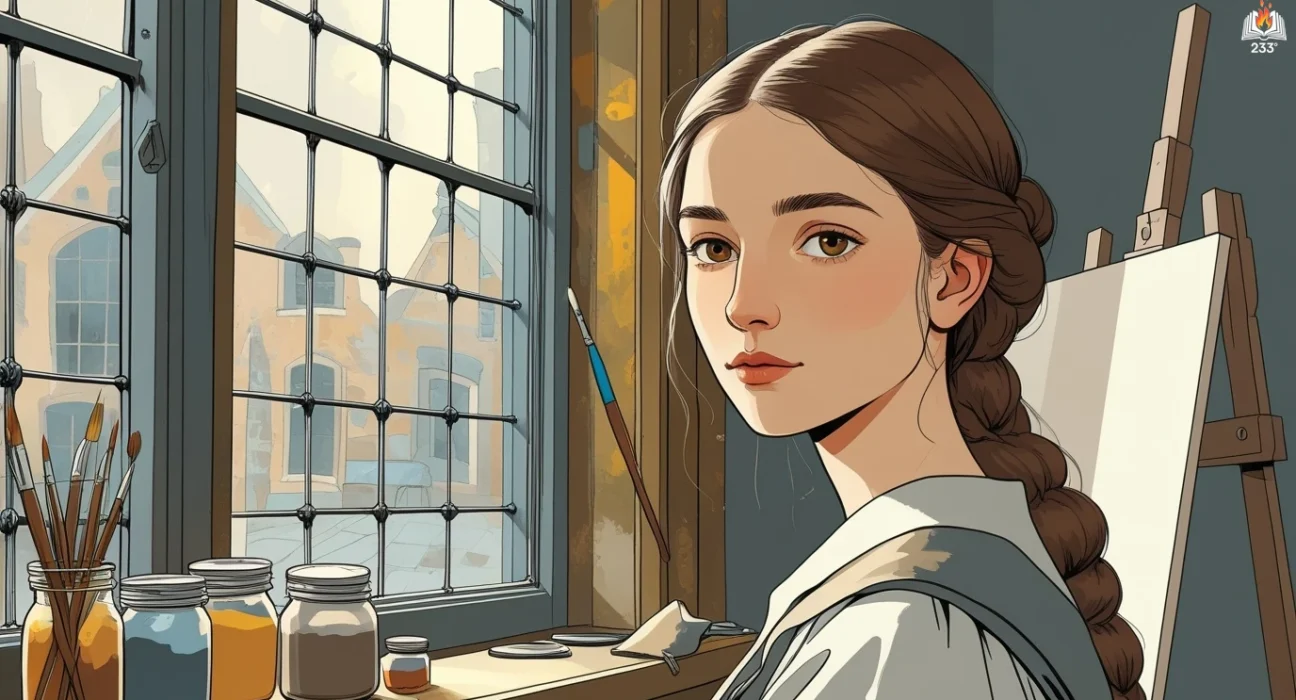
Schoonmaker paints truth rather than illusion. He instructs Iris in his studio, letting her clean brushes, mix paints, and observe. There is no glamour here, only the solemn light of honest labor. Through him, Iris begins to see that beauty, so prized in Haarlem, is not a virtue but a veneer – fragile, hollow, and often unkind. The painter introduces Iris to his apprentice, Caspar, a gentle soul who treats her with a warmth that unsettles her more than it comforts.
Their lives shift when Margarethe latches onto a new opportunity – the van den Meers, a wealthy family grieving the death of the mother and clinging to the fragile health of their only daughter, Clara. Clara is a ghost of a girl, more myth than child. She is beautiful in the way angels are imagined, too delicate for the world’s grime. After her mother’s death, she retreats to the shadows of her own home, barely speaking, barely seen. Her father, Cornelius van den Meer, consumed by guilt and superstition, allows Margarethe to infiltrate their household as a companion, a caretaker, then as something more.
With calculated grace, Margarethe marries Cornelius. The Fisher women are no longer beggars but residents of a gilded prison, inhabitants of a house haunted by grief and obsessed with appearances. Clara, unwilling to accept her stepmother’s authority, hides in the kitchen among the servants, refusing to be seen in public. She calls herself Ashgirl, preferring the soot and quiet over the expectations forced upon her.
Margarethe sees Clara’s beauty as both threat and currency. She envisions a future where Clara’s marriage secures the family’s wealth, and her own daughters rise beside her. But Clara will not obey. She recoils from the world and its hunger, guarding her silence like a jewel. Margarethe grows harsher, tighter, wielding cruelty like a chisel against her stepdaughter’s resistance.
Schoonmaker, sensing the currents swirling in the van den Meer household, proposes a portrait – one of Clara, luminous and pale, the very embodiment of the era’s ideal. It is a commission meant for art and posterity, but it serves other purposes too. Clara agrees reluctantly, lured by the idea of being captured and understood, even if only in pigment and canvas. Iris, now Schoonmaker’s assistant in truth as well as in name, watches Clara closely. In her ethereal stillness, Clara seems not divine but trapped – a child sacrificed on the altar of beauty.
As the portrait takes shape, so does Iris’s understanding. She sees Clara’s fragility not as privilege but as armor. She begins to see herself not as the ugly stepsister of myth but as a girl forming into a woman, one who notices too much, who feels the sting of being overlooked and the grace of being truly seen. Caspar sees her too. His affection is quiet, steady, unshaken by her lack of ornament.
The household prepares for a ball – an extravagant event thrown by the dowager queen of France, visiting Holland on royal matters. Every merchant, noble, and family of ambition will attend, including Clara, whose presence Margarethe insists upon. Clara resists, but her rebellion cannot endure against her stepmother’s resolve and the threat of forced marriage. On the night of the ball, Clara vanishes.
Panic erupts. Margarethe blames everyone – Iris, the servants, even the ghost of Clara’s mother. But Iris knows better. Clara has not been stolen; she has escaped. Whether she is hiding or has fled the city, Iris cannot tell. The absence leaves a hollow in the house, a silence sharper than Ruth’s muteness.
Schoonmaker dies not long after, his final painting – Clara’s portrait – unfinished. It remains a spectral image, hovering between presence and absence, like the girl it tried to capture. The house declines. Cornelius retreats into mourning, and Margarethe falls ill, her ambition finally outpacing her strength.
Clara returns with the spring, not in rags nor splendor, but with calm and confidence. She reclaims her space in the house, not as a captive beauty but as its master. She cares for her father, forgives her tormentors in silence, and resumes a life that is hers to shape. She has become her own tale, no longer Ashgirl nor icon, but woman.
Iris, too, makes her choice. She leaves Haarlem with Caspar, not to chase fortune, but to create something of their own – a life shaped not by beauty or myth, but by the quieter truths of kindness, intelligence, and love freely given. Ruth remains, steady as ever, the secret soul of the family, her silence still speaking volumes to those willing to listen.
The painting of Clara, unfinished and haunting, remains in the studio, a reminder of what was lost, what was never whole, and what beauty fails to explain.
Main Characters
Iris Fisher: Sharp, observant, and plain, Iris is one of the titular stepsisters. She serves as the novel’s primary lens, growing from a cautious child into a perceptive young woman. Unlike her fairy-tale counterpart, Iris is empathetic and intelligent, grappling with self-worth, beauty, and the power of art and identity. Her quiet courage and evolving sense of morality make her a compelling heroine.
Margarethe Fisher: Iris’s mother, Margarethe is a proud, desperate widow driven by ambition and survival. Fierce and pragmatic, she is willing to manipulate and sacrifice to elevate her family’s status. Her complex motivations make her a dark matriarchal figure, often harsh but undeniably human in her struggle against poverty and loss.
Ruth Fisher: Iris’s mute and intellectually disabled sister, Ruth is largely underestimated by those around her. Her silence masks a keen perception, and her role as the story’s subtle observer adds depth to the narrative. Her presence challenges assumptions about communication, intelligence, and power.
Clara van den Meer: The archetypal Cinderella, Clara is reimagined as an ethereal, cloistered beauty haunted by grief and fear. She resists the outside world and lives in voluntary confinement. Her beauty isolates her, and her fragility conceals both trauma and unexpected agency.
Schoonmaker: A master painter who mentors Iris and commissions Clara’s portrait, Schoonmaker represents the artistic spirit of the age. His insights on beauty, perception, and truth influence Iris’s development. His detached nature conceals a conflicted soul shaped by loss and artistic integrity.
Caspar: Schoonmaker’s apprentice and Iris’s romantic interest, Caspar is kind, loyal, and emotionally intuitive. His affections toward Iris are sincere, reflecting her inner worth rather than her appearance. His presence offers hope and tenderness amid the novel’s darker tensions.
Theme
Beauty and Perception: The novel interrogates conventional ideas of beauty, contrasting Clara’s angelic looks with Iris’s plainness and exploring how beauty confers power but also imposes isolation. Through art and personal experience, characters learn that beauty is subjective and can be both weapon and prison.
Survival and Ambition: Margarethe’s relentless drive to survive and elevate her family illustrates the grim realities of a society where women’s fates hinge on marriage and appearance. The theme reflects how desperation can erode ethics and shape destinies.
Art and Truth: The Dutch Golden Age setting allows Maguire to explore the role of art as a means of capturing and manipulating truth. Through Schoonmaker’s paintings and Iris’s reflections, the story delves into how art reveals inner life and challenges surface realities.
Voice and Silence: Ruth’s muteness and Clara’s self-imposed seclusion underscore the theme of voice – who is allowed to speak, who is heard, and how silence can be both a shield and a form of resistance. The novel reclaims narrative space for those traditionally voiceless.
Reinterpretation of Fairy Tales: By dismantling the Cinderella myth, the book highlights the fluidity of stories and how perspectives shape meaning. Maguire suggests that fairy tales obscure the messy truths of human lives, encouraging readers to question inherited narratives.
Writing Style and Tone
Gregory Maguire’s writing style in Confessions of an Ugly Stepsister is lyrical yet grounded, blending historical realism with subtle philosophical inquiry. He avoids the whimsical cadence typical of fairy tales, opting instead for a mature, reflective tone that suits the novel’s themes. His prose is richly textured, steeped in sensory detail and psychological insight, mirroring the painterly world he evokes. The story unfolds in deliberate, atmospheric layers, revealing its secrets slowly through implication and character development rather than overt plot mechanics.
Maguire employs third-person narration that aligns closely with Iris’s perspective, allowing readers to witness her internal growth and moral questioning. Dialogue is precise and measured, often carrying double meanings. The tone shifts from melancholic to contemplative, and at times to hopeful, but always remains tinged with the unease of a world where survival often requires compromise. The book’s overall atmosphere evokes a chiaroscuro painting – full of darkness and light, ambiguity and revelation.
Quotes
Confessions of an Ugly Stepsister – Gregory Maguire (1999) Quotes
“In the lives of children, pumpkins turn into coaches, mice and rats turn into men. When we grow up, we realize it is far more common for men to turn into rats.”
“If magic was present, it moved under the skin of the world, beneath the ability of human eyes to catch sight of it.”
“It's the endlessly thinking about yourself that causes such heart shame.”
“Approval is overrated. Approval and disapproval alike satisfy those who deliver it more than those who receive it.”
“The thing about a mirror is this: The one who stares into it is condemned to consider the world from her own perspective.”
“I take responsibility only for the future, not the past. The past can't hurt you the way the future can.”
“And a puzzle is for the piecing together, especially for the young, who still believe it can be done.”
“Immortality is a chancy thing; it cannot be promised or earned. Perhaps it cannot even be identified for what it is.”
“To consider what other people might say is hardly a good reason to take action or defer it.”
“How shallow the words are, really - She is a witch . One might as well say, She is a mother , thinks Iris; that about covers the same terrain, doesn't it?”
“...perhaps charity is the kind of beauty that we comprehend the best because we miss it the most.”
“Small steps to the madhouse still get us there at last”
“To consider what other people might say is hardly a good reason to take action or to defer it. You have your own life to live, Iris, and at its end, the only opinion that amounts to anything is that which God bestows”
“It’s the place of the story, beginning here, in the meadow of late summer flowers, thriving before the Atlantic storms drive wet and winter upon them all.”
“SELF-MOCKERY IS AN UGLIER THING THAN ANY HUMAN FACE, IRIS... YOU ARE SMART AND YOU ARE KIND. DON'T BETRAY THOSE IMPULSES IN YOURSELF. DON'T BELABOR THE LACK OF PHYSICAL BEAUTY, WHICH IN ANY CASE EVENTUALLY FLEES THOSE WHO HAVE IT AND MAKES THEM SAD.”
“...looking at him makes her feel like laughing all over - as if she could laugh not just with her mouth but with her eyes, her heart, her very limbs.”
“Is this the main thing that painters of portraits care about? The person on the verge of becoming someone else?”
“What is strange is that we may remember what we have done, but not always why we did it.”
“The beauty of the day is the only thing that doesn't fade in time. Day after day, such beauty revives itself.”
“You can endure any sort of prison if you can apprehend a window in the dark.”
“So let my hands and my face make their way in this world, let my hungry eyes see, my tongue taste.”
“Ah, the inner eye blinks, and the spirit trembles, at the dangerous cost of seeing one's self as one is.”
“And it's a cold place the world, especially when warmed by arsen.”
“What no one tells the young is to be careful of their childhoods. The memories from those days are the most compelling paintings in the mind--to which, with nostalgia or dread, you must ever return.”
“Forgive us our trespasses,” says Margarethe, “and get out of our way.”
We hope this summary has sparked your interest and would appreciate you following Celsius 233 on social media:
There’s a treasure trove of other fascinating book summaries waiting for you. Check out our collection of stories that inspire, thrill, and provoke thought, just like this one by checking out the Book Shelf or the Library
Remember, while our summaries capture the essence, they can never replace the full experience of reading the book. If this summary intrigued you, consider diving into the complete story – buy the book and immerse yourself in the author’s original work.
If you want to request a book summary, click here.
When Saurabh is not working/watching football/reading books/traveling, you can reach him via Twitter/X, LinkedIn, or Threads
Restart reading!